




How a Century of Change Shaped the School Bus Industry We Know Today
 MENU
MENU SEARCH
Every day, millions of students climb aboard. But few realize the yellow school bus has helped transform education, connect communities, and come to symbolize civic responsibility.
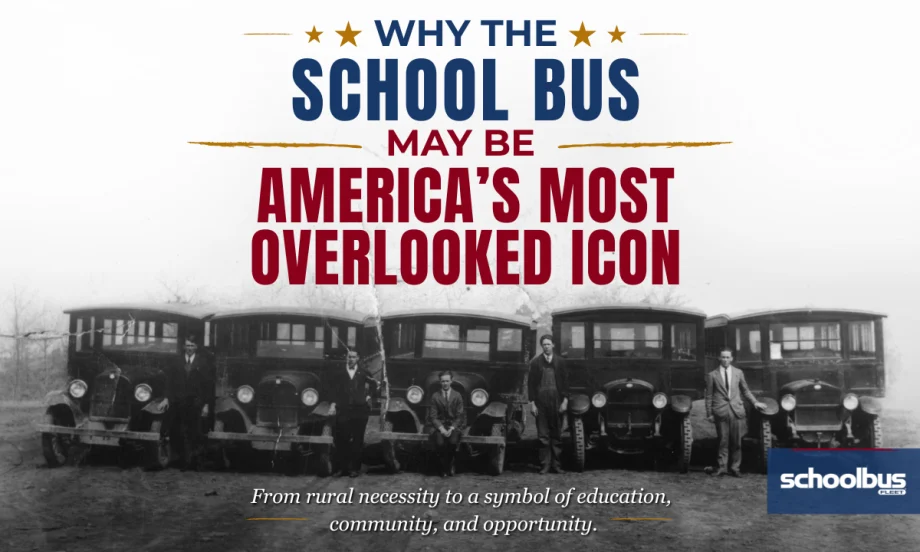
The American school bus has evolved dramatically over the past century, but its mission has remained the same: safely connecting students to educational opportunity.
North Carolina Department of Public Instruction Archives/School Bus Fleet
*Summarized by AI
If we want to simplify it, school buses connect homes to schools. It’s a core function of the school transportation industry. Big yellow buses bring children to an educational setting where they must act as students. Along the way, these buses teach lessons of their own: responsibility, routine, community, and the understanding that each child is part of something larger than themselves.
We all know how these buses operate, so as the country celebrates the United States’ 250th birthday in 2026, let’s explore the reason why the school transportation system was established and its unique ties to Americana.
As Curt Macysyn, executive director of the National School Transportation Association (NSTA), puts it: "When you think about the school bus, it really is a piece of Americana. It's something that is very much attached to the United States of America."
Unlike in most other countries, where student transportation is often handled through a combination of public transit, private operators, or local arrangements, the United States developed a uniquely standardized and highly regulated school bus system. The familiar yellow school bus and the nationwide infrastructure behind it are a distinctly American approach to getting children safely to school.
Naturally, for many Americans, the school bus is one of the most memorable symbols of childhood. It appears in movies, television shows, books, and family photo albums. Its distinctive yellow color is instantly recognizable. Yet the school bus is more than a vehicle. It’s an American institution born out of a desire to provide educational access, shaped by community values, and continually reinvented.
The roots of school transportation stretch further back than many realize and, in multiple ways, tell the story of America itself.
As the United States expanded westward throughout the 19th century, families became dispersed across rural communities. Roads were often little more than muddy tracks, public transportation was scarce, and children frequently walked miles to school. For many farm families, the realities of distance, weather, and seasonal work made consistent school attendance difficult.
At the same time, states began embracing the idea that education should be available to all children. According to Smithsonian Magazine, Massachusetts passed the nation's first compulsory education law in 1852, and by 1900, 31 other states had followed suit. Suddenly, communities faced a practical question: If children were required to attend school, how would they get there?
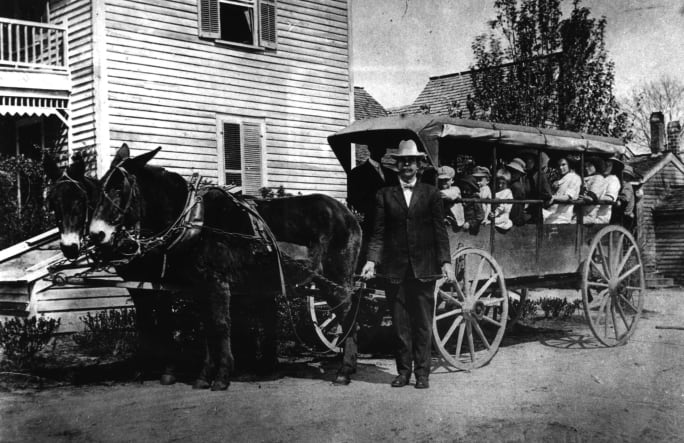
Before automobiles, horse-drawn wagons were customized to transport children to school in rural farm communities.
North Carolina Department of Public Instruction Archives
In the 2023 book “All through the Town: The School Bus as Educational Technology,” Antero Garcia and Stephanie Robillard recall the first documented student transportation vehicle in the United States, appearing in 1886, just about the same time as the first automobile. These horse-drawn wagons, known as "kid hacks," transported children to school in rural communities. These rough rides represented the beginning of organized school transportation and an early commitment to educational access.
The solutions varied from community to community. In Indiana, Wayne Works developed one of the nation's earliest purpose-built school conveyances in 1892. By 1914, the company was producing motorized school vehicles, helping transform student transportation from a local necessity into a growing industry.
As automobiles emerged in the early 20th century, these vehicles evolved into motorized buses. At a time when school transportation standards varied widely, buses came in different designs and even different colors, including “patriotic” shades of red, white, and blue.
The growth of public education and the consolidation of rural schools created a practical need for reliable transportation. School buses allowed communities to move beyond one-room schoolhouses and provide students access to larger, centralized schools. In many ways, the school bus helped make modern public education possible.
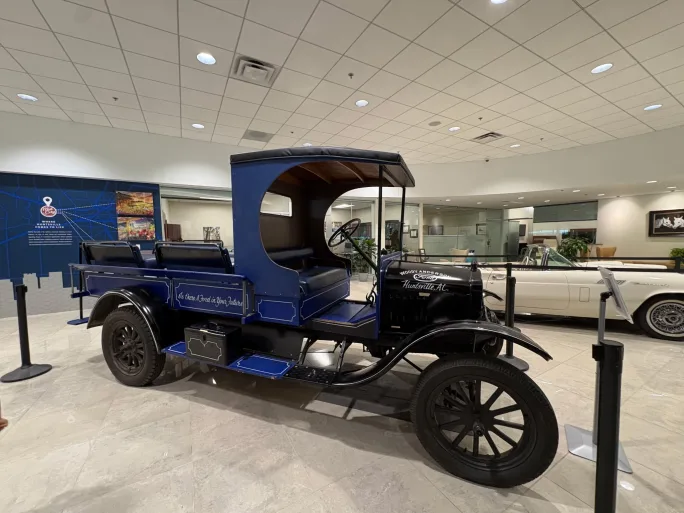
This 1917 Model T Ford is on display at Woody Anderson Ford and once served as a school bus for Huntsville City Schools in Alabama. Similar to a kid hack, the automobile's bed featured benches facing each other to accommodate more passengers.
Christy Grimes
So, by the 1930s, school buses were common, but consistency was not. Along with varying colors, that also meant differences in design and safety features. Even back then, the development of the school bus reflected the American tendency toward standardization and innovation.
In 1939, with support from the Rockefeller Foundation, educator and transportation advocate Frank W. Cyr organized a national conference that brought together representatives from every state, manufacturers, and industry experts to establish common standards for school buses. The resulting 44 recommendations, titled “Minimum Standards for School Buses,” covered everything from fire extinguishers and first-aid kits to speedometers and vehicle design.
The conference also produced one of the most recognizable symbols in American transportation history: National School Bus Chrome, later known as National School Bus Glossy Yellow.
The bright yellow color was chosen because it made black lettering easier to read in the early morning light, improving visibility and safety. More than 85 years later, the basic appearance of the American school bus remains pretty much unchanged.
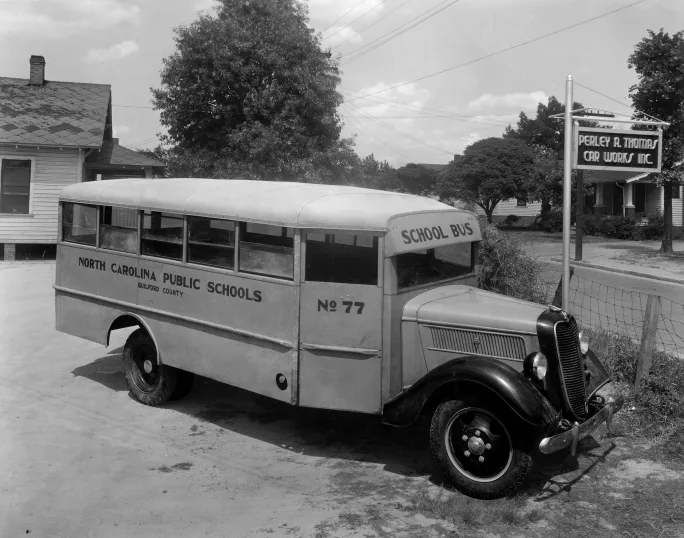
Pictured here is a 1936 Guilford County school bus from North Carolina Public Schools.
Thomas Built Buses
The school bus exists because communities collectively decided that getting children to school mattered.
Long before transportation departments, routing software, and GPS systems, local residents recognized that access to education required access to transportation. Farmers, entrepreneurs, and community members stepped in to help transport students who otherwise might not have been able to attend school regularly.
That community-centered spirit remains at the heart of student transportation today. "If you think of the concept of the school bus itself, it's a civically driven initiative because people have to want to band together and say, 'Hey, for the good of the cause, let's get all our children on this bus. It's going to be safer for them,'" Macysyn said.
The arrangement still requires compromise. Some students board first and arrive home last. Families trust transportation professionals to safely transport what matters most to them.
As Macysyn noted: "That's also community spirit — that life is a little bit about give and take."
Few pieces of infrastructure better illustrate the balance between individual needs and collective benefit than the school bus.
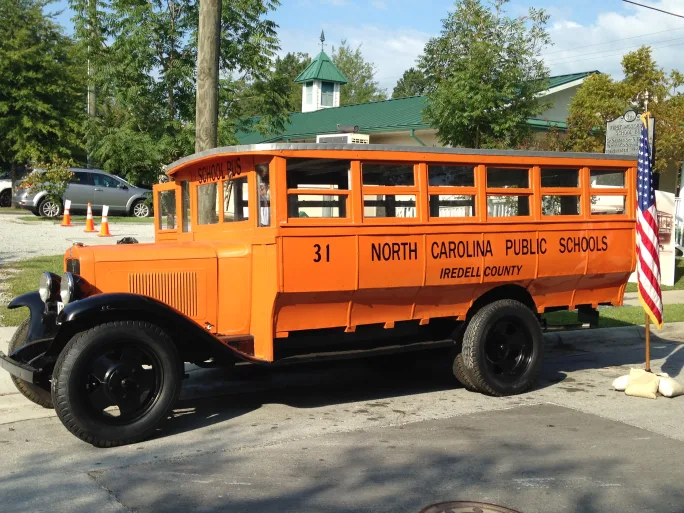
This Iredell County, North Carolina, school bus made its rounds beginning in 1931, when the "Omaha Orange" color was popularized by Orange County's first bus purchase. Neighboring counties followed suit. Once National School Bus Chrome was formalized in the 1939 standards, this unique color was phased out.
Derek Graham
As towns expanded, suburbs emerged, and rural populations spread across vast distances, transporting students became more complex. The school bus helped bridge those distances, connecting homes to schools regardless of geography.
Today, according to the National Highway Traffic Safety Administration and the New York School Bus Contractors Association, approximately 480,000 public school buses travel more than 4.3 billion miles annually, transporting over 25 million students to and from school and school-related activities.
The scale is staggering because school transportation remains the largest mass transit system in the United States, serving communities in every region of the country. Unlike many forms of transportation infrastructure, it reaches nearly every American family at some point.
The school bus is also unique in its legal status. Motorists are required to stop for loading and unloading school buses, giving the vehicle a level of protection and recognition unmatched by most other vehicles on the road. The flashing red lights and stop arm have become symbols of a national commitment to student safety.
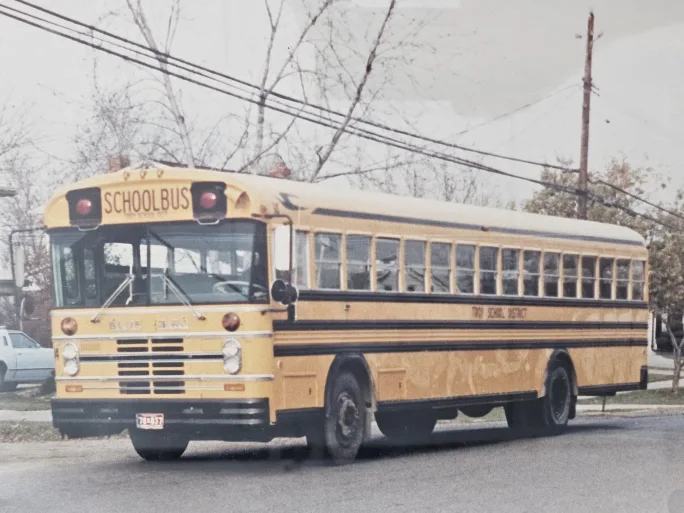
Pictured here is a Troy School District Blue Bird school bus ridden by Brad Beauchamp in 1980.
Brad Beauchamp
The history of school transportation is not solely a story of access and innovation. Garcia and Robillard wrote about how it’s also intertwined with some of the nation's most significant social and political challenges.
For example, before the landmark Brown v. Board of Education decision in 1954, students attended segregated schools and rode segregated buses in many parts of the country. Following the Supreme Court's ruling, school transportation became a tool in efforts to integrate schools. The term "busing" took on new political and cultural meaning as districts used transportation to support desegregation efforts.
Communities across the country, including Charlotte-Mecklenburg Schools in North Carolina, Boston Public Schools, and Berkeley Unified School District in California, became focal points in national debates over educational equity and access in the late 20th century. Court decisions, community activism, political campaigns, and public protests frequently centered around school transportation routes and assignment plans.
The experiences of students during this era also reveal the complexities of using transportation as a tool for social change. For many Black students, integrated schools offered access to expanded academic opportunities, newer facilities, and broader resources. At the same time, these students encountered hostility, discrimination, and difficult transitions as communities struggled with the realities of desegregation.
The story of school busing demonstrates both the possibilities and limitations of transportation as a solution to larger societal challenges. Another example showed the school bus playing an unexpected role in federal work-relief during the Great Depression, where, on top of transporting students, buses also carried workers to Civilian Conservation Corps and Works Progress Administration sites.
During World War II, school bus manufacturers contributed directly to the war effort by building troop carriers and other military vehicles, helping support national needs while maintaining essential transportation services at home.
These chapters in the history of school transportation illustrate that buses have never simply been about moving students from one location to another. They have also reflected broader questions about opportunity and the role of public education in American society.
Through economic hardship and wartime mobilization to suburban growth and technological innovation, the school bus has traveled alongside the nation through some of its most defining eras.
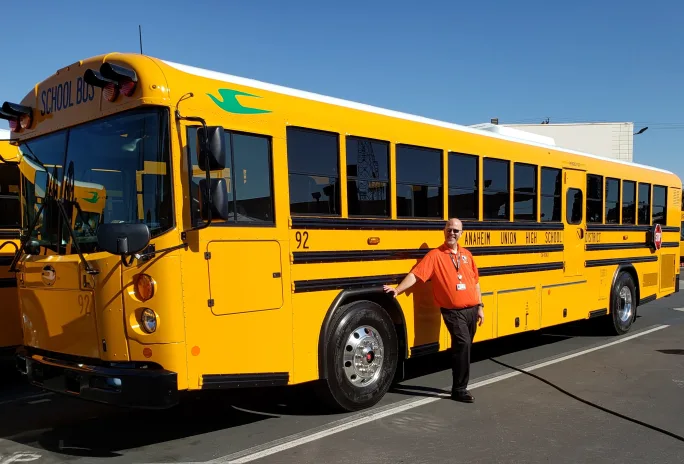
Matthew Thomas stands beside an Anaheim Union High School District Blue Bird school bus in 2021 when he served as director of transportation. In his early years, he drove school buses for the Orange Unified School District. Thomas also went on to lead the transportation department for Orange USD, where he serves as director and school board member.
Pam McDonald
While the yellow school bus remains an enduring symbol, the technology inside and around it continues to evolve. From telematics and GPS tracking to artificial intelligence-powered cameras, alternative fuels, and electrification, the interiors of today’s school buses bear little resemblance to those of their predecessors.
School districts are already beginning to see the next wave of innovation. Craig Beaver, just-retired transportation administrator for Oregon’s Beaverton School District, said artificial intelligence is poised to transform everything from route planning to operational efficiency.
“I'm really excited for what's coming with AI,” Beaver said. “We just started to scratch the surface here at Beaverton." He pointed to tasks that once took months of manual work and believes emerging technologies will dramatically reduce that burden in the years ahead.
Macysyn sees this constant innovation as one of the industry's defining characteristics. "Every time I think, well, have we hit the limit with respect to technology? There's always somebody much smarter than I am who's inventing or coming up with a concept that makes things even better," he said.
For nearly 140 years, student transportation professionals have worked to safely connect children with educational opportunities. The vehicles have changed. The technology has changed. The communities they serve have changed. The purpose has not.
As the United States marks its 250th birthday, there are countless symbols that represent the nation's history and character. The school bus deserves a place among them.
It represents innovation and standardization. It reflects the growth of public education and embodies civic responsibility and community cooperation. It has played a role in some of the nation's most important conversations about access, equity, and opportunity. Most importantly, it continues to serve millions of students every day.
For transportation leaders, the school bus is a tool, a workplace, and a responsibility. For much of the public, it is also a shared memory. That combination alone may be what makes it uniquely American.
The school bus has made education more accessible by providing reliable transportation for students, ensuring that children from various communities can attend school regularly and receive an education.
*Summarized by AI
Loading data...

Management
When should you sell an aging school bus? Learn how maintenance, mileage, corrosion, specifications, and timing can affect resale value long before the auction.

Management
What makes emotions run high, and how should you handle an angry colleague or parent? Follow these steps for staying calm, listening, showing empathy, and resolving conflict.

Management
Learn the five key elements that bus drivers and transportation directors can use to stay calm in any situation.
Management
Every day, millions of students climb aboard. But few realize the yellow school bus has helped transform education, connect communities, and come to symbolize civic responsibility.

Management
Discover five strategies for building an effective mentorship program to strengthen leadership development and support staff retention.

Special Needs Transportation
Small missteps in wheelchair securement can have serious consequences. Here are 32 tips from experts to reduce risk and increase student safety on the bus.

Management
Take the burden out of bidding. Cooperative contracts can save district transportation teams time, money, and hassle. Here’s how.

Management
Learn from school transportation leaders on how to develop bus drivers, monitors, and mechanics into future leaders through coaching and culture.
Safety
With student safety on the line, here’s a look at what’s working, what’s changing driver behavior, and what districts need to know when it comes to stop-arm programs.
Management
As we celebrate seven decades of industry coverage, let’s revisit historic milestones, timeless content, and examine the industry's progression from those who lived it.