The Most Common Wheelchair Securement Mistakes on School Buses (and How to Fix Them)
Small missteps in wheelchair securement can have serious consequences. Here are 32 tips from experts to reduce risk and increase student safety on the bus.
Hands-on driver training and attention to detail are critical for safety every time a student rides the bus.
Credit:
School Bus Fleet
8 min to read
Seven-year-old Charlotte McCollum boarded her school bus in 2016 just like any other day. Charlotte is a wheelchair user, but that day, not all four tie-downs were applied.
As the bus turned a corner, Charlotte’s wheelchair tipped over, slamming to the ground. The whole thing was caught on video, FOX 13 Seattle reported.
Ad Loading...
Thankfully, Charlotte was OK, but it could have been much worse. With her wheelchair weighing about 90 pounds, she was at risk of severe injury had it unfolded in any other number of ways.
“In the past 12 months alone, I have been asked to consult and retrain as a result of wheelchairs tipping or sliding during transport,” Alexandra Robinson, owner of A. Robinson Consulting, shared with us. “While there was no physical injury in some cases, there was always emotional trauma, and these incidents could've been a lot worse. In each instance, the attendant and driver were sitting close to the front of the bus instead of near the child, the wheelchair was behind them, out of their line of sight, the chairs were not secured properly, and the students involved were non-verbal.”
Stories like these illustrate the importance of properly securing wheelchairs in the school bus every single time.
The unfortunate reality is that when drivers are rushed, improperly trained, or not focused, even a single misstep can have disastrous consequences.
Teena Mitchell, special-needs coordinator at Greenville County Schools, adds that she sees many people assume that if an occupant restraint is used, it is automatically safe.
“That is far from the truth,” she told us. “Before the occupant restraint can be correctly secured, the wheelchair must also be properly secured with all four retractors. But, before either of these steps can take place, the wheelchair itself must first be inspected to determine whether it is appropriate and safe for transport on a school bus.”
So, how can you increase safety while reducing risk to your students with disabilities? We asked several experts to find out.
Here’s what they shared.
Common Mistakes Drivers and Aides Make When Transporting Students in Wheelchairs
Not being connected to the mission, which should always place student safety above anything else.
Rushing to stay on time and skipping steps to stay on schedule (it’s always worth an extra few seconds to get it right).
Not training or refreshing often enough. Using lifts, tie-downs, and safety vests should come with muscle memory from doing it (the right) way time after time.
Letting the stress of a long day affect your performance. Each student should be secured with the same care and attention from the first on the bus in the morning to the last one in the afternoon.
Relying on video or classroom training without getting hands-on to prove competence.
Not going through equipment or vendor-specific training (not all similar products are designed to be used the same way!).
Assuming that just one system is safe enough. Remember that both wheelchair tie-downs and occupant restraint systems (or seat belts) must be used together to comply with crash-test standards.
Using the wheelchair’s brakes as an extra safety measure. Securement systems and tie-downs should do all the work to keep the chair in place.
Not attaching the securement system’s retractor hooks to a stable part of the wheelchair frame. All four securement points must be used every time.
Improperly positioning the lap-shoulder belt, such as placing the buckle too high over the abdomen or allowing the shoulder strap to sit incorrectly off the student’s collarbone. It should be positioned just as it would be in a passenger vehicle, over your chest and collarbone; and the lower edge of the lap belt should be touching their thigh (remember this phrase: "If it's not on the thigh, it's too high.").
Using a piece of equipment for convenience or behavior management instead of its intended purpose. Never improvise and hope something will work if it hasn't been designed for such.
Using postural harnesses in place of or without occupant restraints. The former are not strong enough to protect the occupant from the forces generated in a vehicle. Also note that postural harnesses should be worn under the lap-shoulder belt.
Not making student securement a team effort. Drivers and attendants should work together to check tie-downs, ensure no movement, and communicate with the passenger.
Hoping the end-user will correct something used improperly (the driver and aide should be the expert, not the child).
Not knowing what could happen if a piece of equipment is not applied correctly (understanding the consequences helps see the bigger picture).
Not using the lap-shoulder portion of the securement system (remember, these devices are crash tested this way).
Not removing the lap tray prior to transport (this is a recommended best practice in the NSTSP).
Believing that a one-size-fits-all approach is good enough. Every wheelchair, and every student, is different.
Neglecting equipment condition. Make sure to report when something is no longer working as it should.
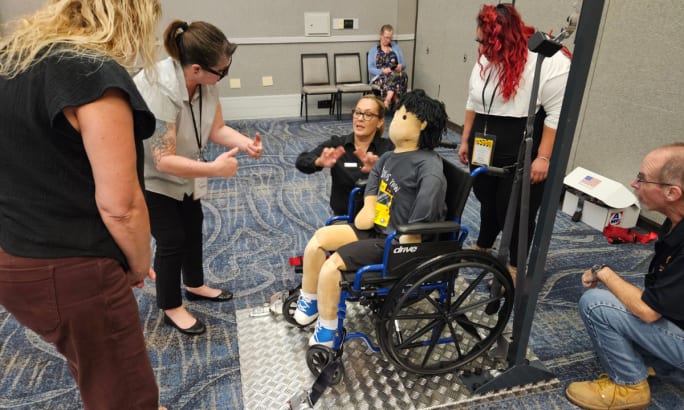
Maritza Valentin walks CASTO attendees through a two-part wheelchair securement training.
Credit:
Amanda Huggett/School Bus Fleet
Common Mistakes Directors & Admins Make in Supporting Drivers and Students
Setting unclear expectations around how to support students in wheelchairs. Make sure drivers know that student safety always comes first.
Not providing hands-on training or refreshers often enough. If it’s not a priority for you, it won’t be for your drivers, either.
Not leaning on technology to enhance learning. There are plenty of free online-based training courses as well as conferences to keep you (and your drivers) in the know. One great training tool are the crash videos from University of Michigan.
Not layering in training and support on student behavior on top of special-needs equipment training. Drivers should be just as comfortable knowing how to address unsafe behavior like students removing their seat belts as they are buckling a seat belt.
Only focusing on daily route drivers. Don’t neglect aides, subs, or any other staff who may take on a route if needed.
Not inspecting the equipment on your buses. Student safety support devices should be regularly maintained, inspected, and replaced when needed.
Not replacing old or malfunctioning equipment enough. Driver knowledge only goes so far if the products no longer perform.
Not working with PTs, OTs, IEP and SPED teams, and behavioral specialists for individualized transportation plans. Don’t assume every student in a wheelchair has the same needs. If you’re not involved in those conversations, insert yourself.
Not making time to occasionally ride along on routes to observe how students are being secured, offering coaching and support to offer gentle corrections. Your drivers should trust they can come to you with questions without fear of punishment or judgment.
Not documenting or communicating processes and expectations during evacuation and emergencies, and not offering drills and practice.
Not knowing federal, state, and local laws and regulations.
Real-World Scenarios That Illustrate Potential Harm in Improper Securement
In School Bus Fleet’s February 2026 episode of The Route, Brianna Pauwee of Wheel With Me Foundation shared a story of a driver who once prioritized time and speed over her own safety. “I know what it's like to try to roll into a vehicle and have the driver get so flustered with securements and be like, ‘we don't need them, we're just going to go,” she recounted to us.
In that moment, Pauwee remembers feeling like her life wasn’t a priority. “We have to slow down and take the time to make sure everything's safe and to make sure that the people are safe,” she said.
Sue Shutrump, an industry consultant and former OT/PT, reminded attendees at the 2025 NASDPTS conference that wheelchair riders don’t benefit from traditional compartmentalization; therefore, they need both wheelchair tie-downs and a properly positioned lap-shoulder belt. One alone does not provide enough protection in the event of an accident.
Robinson also reminded that the “least restrictive environment” under IDEA is for equipment decisions, too. “You can't go immediately to the most restrictive environment; you have to start implementing strategies in a progression,” she said.
Finally, make sure you’re fluent in national guidance and best practices. Reference the updated NSTSP sections on special needs and have an understanding of the requirements under IDEA.
Quick Tips for Wheelchair Securement Success
Teena Mitchell outlines these easy practices you can implement right away to improve wheelchair securement safety.
Inspect the chair for safe transport before routing.
Have the attendant outside the bus and the driver inside the bus while loading the student.
Never let the student drive on or off the lift.
Be sure the chair brakes are engaged when on the lift.
Keep a grip on the chair while the chair is on the lift.
Do a verbal hand-off with the driver before the brakes are released.
Have the driver install the equipment on the bus while the attendant is receiving the student and doing a daily inspection of the wheelchair.
The driver should center the chair in the slot and secure the brakes.
Attach the four retractors to the chair either in the transport eyes if equipped or to a welded metal junction and tighten.
Attendants will close the lift door and assist in the securement of the wheelchair.
Release the brake and test the securement and reset the brake.
Secure the occupant securement as instructed by the manufacturer (typically over the shoulder and across the thighs). Be sure the straps are touching the student at the shoulder and both hips.
Have the driver and the attendant switch positions and check behind each other for proper securement.
What else can you do?
Lean on experts when you’re not confident in something. Ask your safety trainer, SPED or IEP team, tap into your peer network, or contact a consultant. Remember that most, if not all, special-needs equipment providers, offer free training and can even come to your site to do audits, training, or in-services; use them!
What makes emotions run high, and how should you handle an angry colleague or parent? Follow these steps for staying calm, listening, showing empathy, and resolving conflict.
Every day, millions of students climb aboard. But few realize the yellow school bus has helped transform education, connect communities, and come to symbolize civic responsibility.
Small missteps in wheelchair securement can have serious consequences. Here are 32 tips from experts to reduce risk and increase student safety on the bus.
With student safety on the line, here’s a look at what’s working, what’s changing driver behavior, and what districts need to know when it comes to stop-arm programs.
As we celebrate seven decades of industry coverage, let’s revisit historic milestones, timeless content, and examine the industry's progression from those who lived it.