





No one claims that a child riding in a passenger vehicle has the same level of safety they would in a school bus. But in some cases, a school bus cannot provide the same accommodations other modes can. And transporting students another way can be the difference between them getting to school or missing out. Alternative transportation is a supplement, not a replacement, to the school bus.
Rethinking the Route: A Deep Dive into Alternative Transportation for School Districts
As district and student needs evolve, schools are increasingly looking beyond the yellow bus and turning to alternative transportation options. Learn why this niche is growing, tips on choosing a safe, reliable provider, and an overview of the companies ready to help.
June 4, 2025
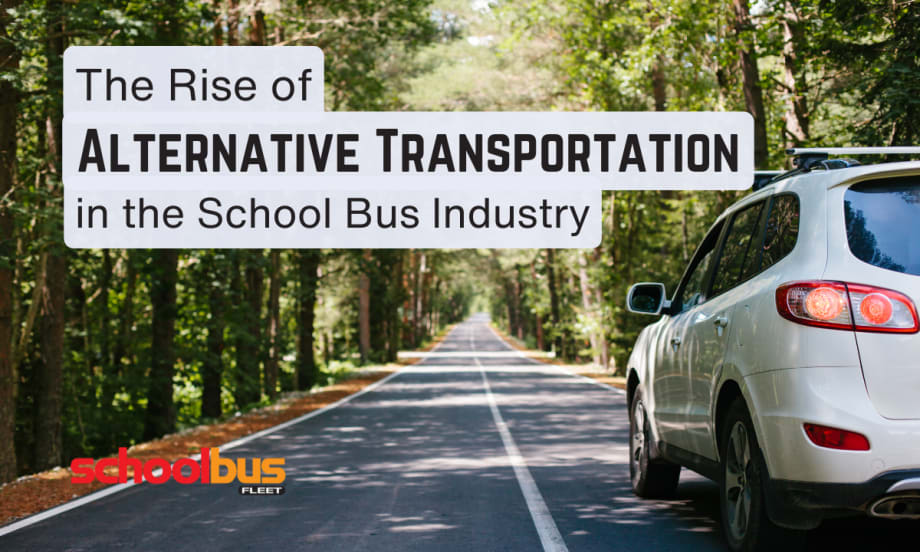
It can be a controversial topic for some, but the fact is, alternative transportation is catching on.
Photo: SBF/Canva
18 min to read
Unique needs call for unique solutions. Just as school bus fleets are changing, so too are the needs of the students the industry serves. With the past half decade especially bringing monumental change, schools are seeing an increasing demand for specialized services.
This is where contractors and alternative transportation providers can step in to alleviate the burden of a district managing varied needs for its riders.
What is Alternative Transportation?
The easiest way to describe alternative transportation is to say it’s any modern method a school uses to get kids to class other than a yellow bus. It’s a new(ish) trend, with numerous companies now specializing in it. And it is growing. Fast.
This can be panic-inducing for some. Alternative transportation holdouts cite safety as a primary concern — but it’s coupled with the fear that drivers and vehicles are not put through the same paces that yellow buses and its drivers are subject to.
We all know the NHSTA stat that children are 70 times more likely to get to school safely in a school bus. But the fact remains: If a school bus doesn’t make sense due to a student’s location, needs, or the district’s operations, transporting them another way can be the difference between them getting to school or not.
Derek Graham, pupil transportation consultant, raises this point: “One safety issue is that we still have student pedestrian fatalities, not just by passing motorists, but also by the school bus itself,” he said. “When a smaller vehicle arrives at the student’s residence (which is the typical pickup/drop-off point) and often pulls into the driveway, it seems to me there is much less likelihood the child will be struck by the vehicle.”
Gregg Prettyman, VP of First Alt, added: “As one of the founders of the alternative transportation model and with 16 years of experience, I have seen it gain wider acceptance and become a standard part of districts’ transportation offerings to parents. One thing that we need to be aware of, though, is any effort to reduce the requirement and vetting of alternative drivers. Regardless of vehicle type, all drivers should be vetted and held to the same high standards.”
Other providers agree. “HopSkipDrive believes deeply in high standards for safety — both for drivers and every other aspect of a ride experience,” said Joanna McFarland, CEO and co-founder. “We know firsthand the challenges that schools are facing, and regulations and recommendations must be shaped to solve those problems. One of the reasons HopSkipDrive and others in alternative student transportation have grown is because schools and districts realize that a school bus alone cannot solve all of the unique and varied student situations. As we continue to engage with policymakers, industry stakeholders, districts, and others, we feel strongly that we must all stand united in our primary and shared goal: getting kids to school so they can access learning and opportunity.”
Alternative Transportation Usage
How many kids actually use alternative transportation? While no officially tracked stats are currently available, we can use anecdotal numbers to make an educated guess. Of the 49,261,141 students enrolled in public K-12 schools, we know that half ride a school bus. Tallying rider approximates from alternative transportation companies, we very roughly estimate it accounts for about 45,000 students, or just under 1%.
Two districts share their transportation breakdown to illustrate:
At Prosper ISD in Texas, about 8,000 students (27%) ride the bus, just over 22,000 either walk or are driven by a family member (73%), and 40 use an alternative transportation provider (less than 1%).
In Denver, of the 28,000 students eligible for transportation, about 11,500 are manifested for the bus, and 5,500 ride the yellow bus daily (20%). Many gen-ed high school students use free public transit. An additional 1,000 use alternative transportation (4%).
So, let’s dig into why a school may want to turn to alternative transportation — and what to consider for those interested.
Why Alternative Modes?
Alternative transportation providers step in when a student can’t ride a yellow bus for various reasons, ranging from a student’s unique medical or behavioral needs to living outside district boundaries, being in foster care, or experiencing housing instability and qualifying for McKinney-Vento.
“Here’s why this matters,” said Dr. Stephanie Burrage of Collaborative Student Transportation. “Many students we transport may live in unstable households, are experiencing homelessness, or are considered ‘highly mobile,’ meaning their residence could change daily or weekly. This … requires transportation teams to update the student’s information sometimes daily, includes changing pick-up and drop-off locations, or documenting attendance. As district staff are managing the yellow bus service or working with multiple vendors, having a relationship with a company like CST allows them to focus on multiple areas, without distraction, and know that we will provide the best service that students and their families deserve.”
In other cases, a student may use alternative transportation if a district is short on drivers, buses, or budget, and cannot be transported by a friend or family member, by foot, or by public transit.
Mitch Bowling, EverDriven’s CEO, said specializations, scalability, and cost-savings are among the biggest benefits: “Rather than hiring additional staff or purchasing more vehicles, districts can rely on EverDriven’s trusted nationwide network and infrastructure to adjust quickly and cost-effectively as needs arise throughout the school year.”
For students with disabilities, IDEA mandates that all students with an IEP have access to school transportation. So, when a bus cannot accommodate all situations, alternative transportation shines.
As Greg Jackson, a former transportation director and current director of business development at School Bus Logistics says, “What’s the alternative? Cancelling routes?”
Jackson recalls a district student with brittle bone disease who was at extreme risk on a bus: Any abrupt stop or turn could mean disastrous consequences that other children do not face. That child was safer in a passenger vehicle than a bus, and putting them in one provided greater protection against a potential lawsuit.
“Be cautious of thinking you can do everything in yellow,” Jackson said. “Your highest-risk students may not thrive in that environment, even if it gets them from point A to B. [Alternative transportation] may be the only pathway to school for some kids.”
Even many contractors are coming around — with the same caveats around safety and standards that others share.
“We see the rise of alternative transportation providers as a response to the growing demand for flexibility and individualized service,” said Gaurav Sharda, Beacon Mobility’s chief technology officer. “At Beacon, we’ve embraced that shift by expanding our own capabilities: offering non-traditional vehicles and routing models that meet the needs of students outside the traditional bell curve.”
Jackson also advocates that using alternative transportation does not have to be a permanent solution. If you have an issue that facilitates the need to get creative, you can use it short-term to gain time to hire more drivers, buy more buses, or rework your budget or routes.
Shannon Weber, director of transportation at Florence Unified School District #1, agrees and employs alternative transportation as a partner only when the district doesn’t have enough internal resources. When they do use it, it is a small percentage and intermittent.
Greenville County Schools doesn’t use alternative transportation for special needs students; instead, its medically fragile students are paired with an onboard nurse. They do, however, temporarily use alternative transportation for McKinney Vento students while they work out school bus routing.
Association Takes & New Standards
As alternative transportation continues to catch on, it’s drawn the attention of industry associations.
Last January, the National Association of State Directors of Pupil Transportation Services (NASDPTS) released a position paper on the topic to help states work toward ensuring safe transportation and meeting vehicle requirements while striving to protect student safety.
“Student safety is our top priority, and there is no doubt that children are safest in the yellow school bus,” stated NASDPTS President Mike Stier. “States are, however, increasingly turning to other modes of transportation, and we want to ensure that everyone has a resource available to help them navigate the options.”
The National Association for Pupil Transportation (NAPT) released a position statement last December to offer additional guidance. Its message: “While it is always preferable that children ride on yellow school buses, there are some areas and instances where this may not be possible. In such situations, it is crucial that children are transported in the safest possible vehicles and driven by qualified, trained, and well-regulated drivers.”
Good news is here for those concerned about the previous lack of standards and accountability for alternative transportation.
For the first time, the 17th annual National Congress on School Transportation (NCST) in 2025 added a committee on alternative transportation to define and adopt standards. The committee identified four key areas to address safety using alternative transportation:
Driver credentials.
Driver training.
Vehicle design/equipment.
Special education policy considerations.
Standards in each area were approved at the Congress in early May and will be added to the NSTSP manual that many states adopt. Check out this NCST recap article for more details!
Tyler Bryan, education associate, school transportation for the Delaware Department of Education, NASDPTS president-elect, and chair of the NCST writing committee, said all of this demonstrates the industry’s commitment. “The NCST perspective is to give a set of standards that ensures students who need alternative transportation have safety standards placed on their vehicles and drivers to ensure students' overall safe transportation. … States will use the NCST recommendation for alternative transportation to shape state and local regulation to ensure training and vehicle standards are being implemented, if used, to ensure safety expectations.”
“We have now arrived at a critical point where we need to ensure an industry-wide standard for alternative transportation,” Prettyman said. “The pendulum started to swing too far where companies were encouraging districts and states to lower their standards, and now we see these governing bodies realizing that the bus driver standards must also be in place for those who drive alternative vehicles.”
“The fact that this committee is being accepted is exciting because it demonstrates a commitment to progress and the willingness to embrace change for the betterment of our schools and communities,” Teri Mapengo, director of transportation at Prosper ISD in Texas, added.
“Alternative transportation isn’t just a backup solution; it’s an essential part of the educational ecosystem.” — Amen Pawar-LaRosa, Pawar Transportation
How to Pick Your Provider
For districts looking to partner with a new provider, Alex Spann, state transportation director for Tennessee, advises asking yourself the key question: Is it best for the children? “Safety, security, and stability should never be compromised in favor of convenience,” he said.
If you’ve determined that outsourcing is best, you’ll want to ask the right questions of your potential provider. This starts with being clear on your own needs and expectations. A few considerations include:
Contract and usage terms. If you need a flexible model that you can turn on and off as needed, that should be clear from the get-go.
Pricing structure. You should be clear on if charges are fixed, by mile, by time, per student, day, or by vehicle, and can meet your budget goals.
Who will use the service. What types of riders will be served by these providers? Make sure to gauge interest in advance and loop in other departments like the IEP team.
Driver policies and procedures. If you want your contracted provider to follow the same checklist and be held to the same standards your own drivers would, put in writing what those are, and ensure checks and balances are in place for non-CDL driver accountability. If having driver consistency is important, ask that up front, too.
Training and testing. Ask what training, physical exams, and background checks their drivers receive and how often they’re updated.
Safety. Find out what safety policies their drivers follow and what technology their vehicles employ. Ask if they do pre-and post-trip vehicle inspections, and request their safety record.
Insurance. Know what coverage the company carries to protect against liabilities.
Data privacy. Find out how the company protects student and district data and learn if they comply with regulations and SOC Type 2 attestation.
Special-needs considerations. Ensure drivers are up-to-date on wheelchair securement standards and other assistive technologies, are trained in both physical and cognitive disabilities, and learn how they accommodate students on the spectrum.
Regulations. Make sure your providers are familiar with state and local requirements and can ensure compliance. Find out if they work with other agencies for inspections or testing.
Emergency protocol. Learn their evacuation and accident procedures and training.
Accountability and communication. Find out how often and in what manner check-ins and reviews will occur. Know how and who to go to with concerns or updates (and what instructions parents will need). Take note of their customer service and technological capabilities.
With any big decision, look for other users of a service or contractor and listen to their experiences. Testimonials from peers you trust are powerful. Don’t be afraid to ask a potential provider for a list of references!
“We find the greatest success in those partnerships that work with us to communicate both clearly and often to families and our team,” Weber said. “Lack of communication and poor on-time performance or reliability have been the biggest discouragement with particular partners.”
The state of Tennessee recommends that any alternative vehicle be equipped with the same safety features as yellow buses: cameras, two-way radios, first aid kits, emergency triangles, and other essential safety equipment.
Prosper ISD currently partners with HopSkipDrive and EverDriven. “We have carefully vetted these companies to ensure that they meet the same high standards that we hold for our own vehicles and drivers,” Mapengo said. “This includes thorough background checks, regular vehicle maintenance, and strict adherence to traffic laws and safety regulations. We have learned to manage this relationship by maintaining open communication, setting clear expectations, and regularly reviewing and updating our safety protocols. If we have an issue, we get all the key people in on the conversation so that we can resolve the issue quickly.”
Denver Public Schools, which also uses HopSkipDrive and EverDriven, echoes the sentiment. “We work closely with both to make sure that our students experience the same policies and practices with alternative transportation providers as they would with a yellow bus,” said Tyler Maybee, DPS’ director of operations, transportation department. “We know our alternative transportation providers are not perfect, and we maintain a close relationship with a person devoted to our account to make sure they are aware of any issues that are reported to us. We work with them to inform policies and practices that would be beneficial to maintain trust with our team and meet district policies. We focus on communication and reward policy adherence with an increased workflow when it naturally arises.”
Once you’ve chosen your new partner, check in frequently to ensure all is running smoothly and give and get feedback.
Alternative Transportation Provider Options
If you’re ready to begin interviewing or pick a new partner to serve your district’s students, here’s a guide to the alternative transportation providers to help get you going.
Adroit
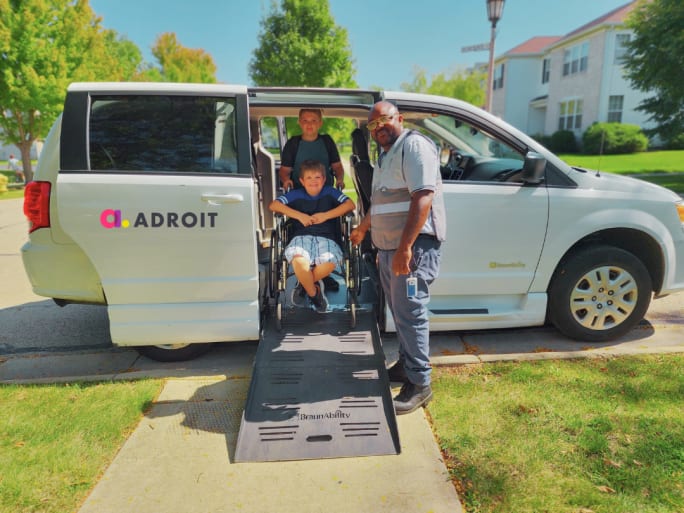
An Adroit driver stands with one of the fleet’s wheelchair-accessible vans.
Photo: Adroit
Owned by contractor Beacon Mobility, Adroit describes itself as a supplemental and flexible transportation solution specializing in services beyond traditional bus routes, including students with special needs and IEPs, McKinney-Vento and foster students, hard-to-service and out-of-district students, charter schools & non-public schools.
It operates in 10 states, has conducted 1,000+ rides, and transports almost 2,000 students each day. It uses minivans, sedans, wheelchair-accessible vehicles. Drivers are rigorously background checked, drug tested, and complete any local training requirements prior to getting on the road, according to Ryan King, VP of operations.
Assisted Student Transportation
Under the American Student Transportation Partners (ASTP) umbrella since fall 2023, Assisted Student Transportation is the contractor’s alternative transportation arm. Founded in 1992, it provides transportation solutions for students and families with alternative transportation needs, including early childhood, special needs, out-of-district, and hard-to-serve trips.
The company operates a fleet of 250 minivans, full-sized vans, and ADA-accessible wheelchair vans and serves nine school districts in Kansas and Missouri. Between its two locations, it transports more than 2,000 students daily, with more than 750 of those being students with special needs.
Assisted drivers and aides are all employees and trained to work with students with special needs, including those in wheelchairs and with visual or hearing impairments. Its drivers receive over 40 hours of classroom and field training before transporting students.
All vans are owned by the company and are equipped with safety cameras, GPS tracking, and two-way radios.
Collaborative Student Transportation
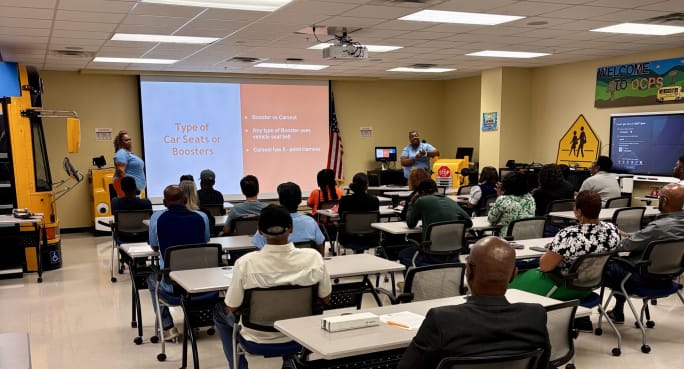
The partner engagement team at Collaborative Student Transportation (CST) spent time with its partners at Orange County Public Schools last February leading training and engaging with drivers.
Photo: Collaborative Student Transportation
Headquartered in Minnesota, Collaborative Student Transportation (CST) serves students in 15 states and transports more than 5,000 students each year using vans and automobiles for 90 districts and charter schools.
CST aims to offer consistency so students transitioning from home to school have the same driver each day, at the same time, so families know they can count on them for a safe and reliable ride. CST’s on-time record is 98.9%.
Its pricing model is flexible to complement what works best for the district. “Our adaptability sets us apart from other contractors,” said Dr. Stephanie Burrage, CEO. “If a district wants CST to bill them per mile, per day, or per trip, we are well-equipped to offer what they need.”
CST also conducts daily pre- and post-trip inspections to make sure all vehicles meet or exceed safety requirements, and are equipped with GPS tracking. Drivers are trained in emergency procedures, student care, safety, parent communication, and support for students with special needs. This includes up-to-date instruction on wheelchair securement, assistive technologies, and behavior management techniques.
Burrage adds that CST is well-versed in all state and local regulations and ensures operations meet or exceed those standards. “Our team collaborates regularly with district staff to address concerns, adapt to changing requirements, and ensure students are transported safely, reliably, and in full compliance,” she said.
EverDriven

EverDriven reached full compliance with California’s SB 88 legislation six months early. The bill called for enhanced safety protocols, driver training requirements, and vehicle maintenance regulations in the state.
Photo: EverDriven
The largest provider, EverDriven started in 2005 in Orange County, California, as ALC Schools. Its founders saw a gap in traditional transportation models and stepped in to support children who needed more personalized solutions.
Today, it serves students in 34 states with more than 700 district contracts and has driven more than 108,000 students in the past 10 years. About 37% of its riders are SPED students and 48% are McKinney-Vento.
EverDriven provides customized safety accommodations for students who need extra support — from child safety seats and booster seats to wheelchair-accessible vehicles and one-on-one student monitors. Ride data, including trip status and driver information, is readily available for transparency and peace of mind. EverDriven vehicles are also equipped with AI-powered, in-ride cameras. And, its VIP app gives parents and school staff real-time tracking.
EverDriven offers a pay-per-trip model that aligns cost with actual usage. Trips can often be canceled with short notice — typically up to two hours in advance — without penalty, offering flexibility if a student is absent or no longer requires service.
“Safety is at the heart of everything we do,” Bowling said. “In response to evolving expectations, we’ve introduced onboard monitors, outfitted drivers with safety vests, and developed a specialized driver education program focused on supporting students with unique needs.”
According to the company’s first safety and operations report, out of more than 2 million trips, 99.6% were completed without complaint, 99.99% were accident-free, 90% on time, the same driver serviced 70.81% of trips for students with disabilities, and 100% of its vehicles passed a third-party annual safety inspection.
All EverDriven drivers undergo drug testing, motor vehicle record checks, and background screenings that meet Department of Education and state requirements, and every vehicle used in service is subject to inspection. Drivers also complete an education course, which covers everything from defensive driving and wheelchair securement to sensitivity training.
First Alt
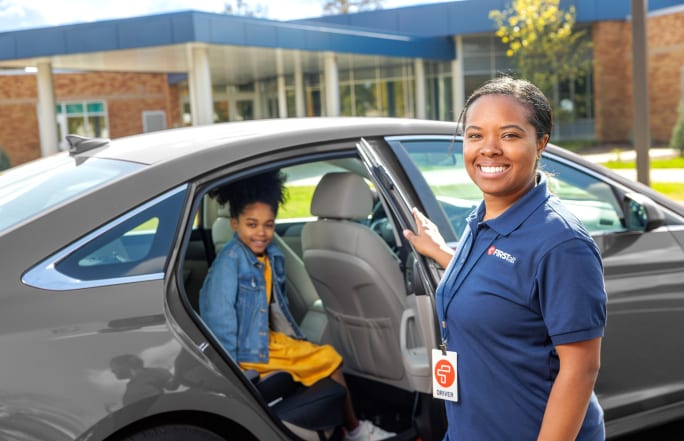
First Alt’s software was launched in 2022 under the lead of one of SBF’s 2025 Trailblazers, allowing driver document uploads, real-time tracking for both districts and parents.
Photo: First Student
First Student’s alternative transportation arm, First Alt, works with hundreds of districts across 20 states. Launched in 2022, First Alt is designed to meet the demands of districts across the country needing solutions for students traveling out of district, attending specialty schools, or who are not equipped to be on a bus with others. To ensure consistency and safety for its students, First Alt provides the same driver every day and holds all drivers to the same rigorous standards as First Student’s traditional bus drivers.
First Alt’s compliance department ensures that drivers understand all state and district requirements, and its software solution does not allow trips to be assigned to non-compliant drivers. This includes training on how to work with students with special needs, understanding the rage cycle, and de-escalation tools.
Its fleet uses small-capacity vehicles — a mix of sedans, SUVs, minivans, and wheelchair vans. All vehicles meet a 32-point inspection process, and each trip is monitored and tracked.
Pricing models typically include a base trip minimum, a set number of included miles, and a per-mile charge beyond that. Additional services such as car seats or wheelchair-accessible vehicles, etc., are available and priced on an as-needed basis.
A 2024 customer survey showed that 100% of First Alt customers would recommend the service to their colleagues.
HopSkipDrive
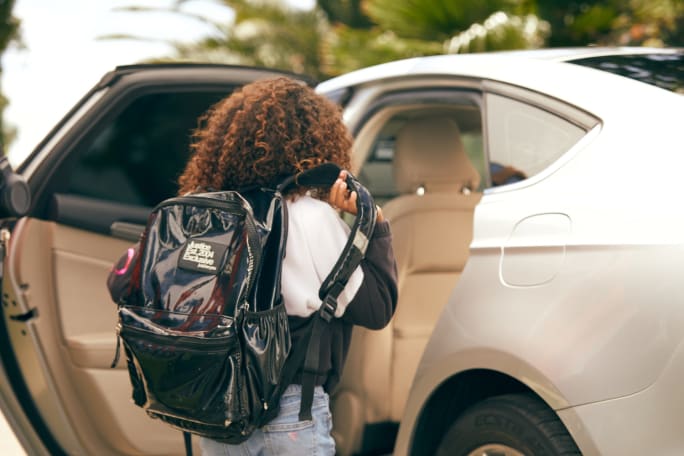
Specializing in offering multi-modal solutions to districts, HopSkipDrive also recently announced that it is now offering wheelchair-accessible rides in 10 select cities, with more on the way next year.
Photo: HopSkipDrive
By working alongside traditional bus fleets, HopSkipDrive enables more than 10,000 schools to create more efficient transportation systems that adapt to the unique requirements of their student populations.
HopSkipDrive can arrange safe rides with as little as six hours’ notice. This flexibility eliminates inefficiencies that can occur when last-minute challenges arise, often leaving administrators and educators as the fallback solution.
Since 2020, HopSkipDrive has reported a 4,859% increase in rides for students eligible under McKinney-Vento and a 2,624% increase in rides for students on an IEP.
HopSkipDrive’s unique model supplements traditional buses with a diverse network of vetted CareDrivers: caregivers who use their own personal vehicles that meet stringent safety standards, including criminal background and driving record checks, fingerprinting, child abuse and neglect screening (CANS), and strict vehicle requirements.
HopSkipDrive touts that it was the first company in the industry to publish a comprehensive annual Safety Report, demonstrating a commitment to transparency and continuous improvement. It had over 99.7% of rides completed without a safety concern last school year and more than 50 safety products and features.
Pawar Transportation
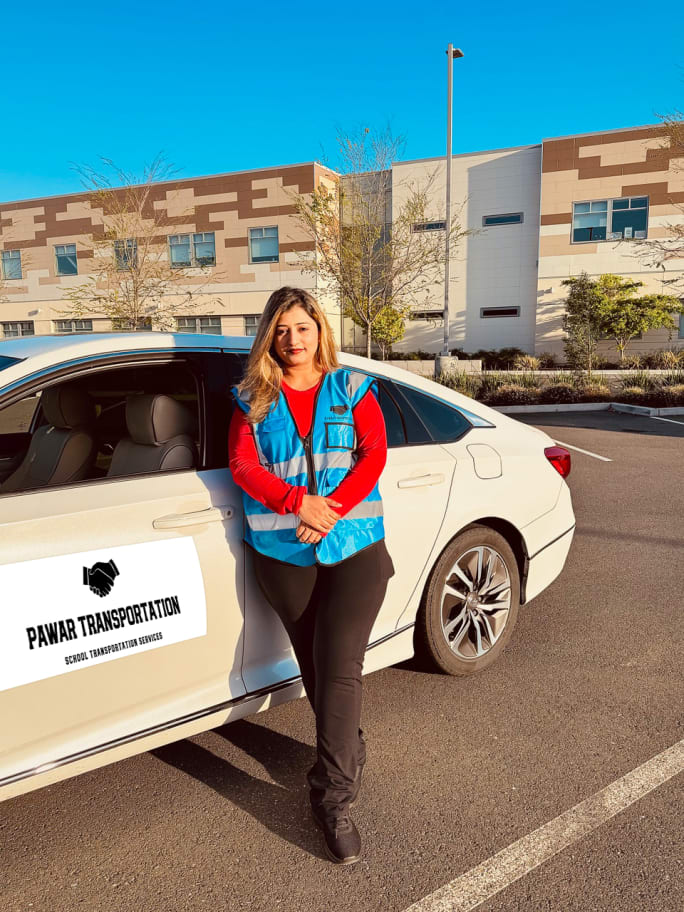
A Pawar driver stands with a company vehicle in California, where the transportation provider is based.
Photo: Pawar
Pawar Transportation was founded with a mission to provide flexible, personalized transportation for students who don’t fit the traditional yellow bus model. The service started in 1992 and has experienced gradual, organic growth through word of mouth and strong relationships since.
Its fleet consists of smaller passenger vehicles with a 90% on-time performance rate. Each vehicle undergoes pre-trip inspections, and post-trip inspections are done randomly. It is in the process of becoming SB88 compliant to further enhance safety and operational standards.
Approximately 80% of Pawar’s work serves students with special needs, behavioral challenges, or those covered under the McKinney-Vento Act. Driver training covers student safety, emergency procedures, disability awareness, and behavioral management.
With flexible pricing models, districts can choose from per-route pricing, per-mile pricing, or a flat daily rate per vehicle.
As a minority-owned, family-operated business, Pawar brings a personal touch and hands-on approach, transporting hundreds of students every day. While its primary operations are in California, the company is actively exploring opportunities to expand into other states.
The team engages in one-on-one conversations with parents before transportation services begin to gain insight into how to best serve each student. They offer real-time tracking and communication tools to districts, too.
Amen Pawar-LaRosa, VP of marketing, said their goal is to be part of the solution by maintaining open communication and acting as a reliable, supportive partner. “We take pride in being team players and in helping to create a positive, safe, and consistent transportation experience for every student we serve,” she said.
Do you use alternative transportation in your operations? Let us know your thoughts in the comments!
Subscribe to Our Newsletter
More Management
How to Build a Better Driver Training Program
Ready to boost up your school bus instructor training? Here’s how to pick the right talent and improve recruitment, retention, and safety.
Read More →
CALSTART and Forth Combine to Form Catalyst Mobility
The new name represents a renewed vision for the nonprofit focused on advancing clean, equitable, and affordable transportation solutions that move people and goods.
Read More →
What Makes a Great School Bus Driver Trainer?
Choosing the right school bus driver trainer takes more than experience. Learn six keys to selecting and developing trainers and evaluating program effectiveness.
Read More →

School Bus Contractors Expand Through New Deals, Acquisitions & Partnerships
STA's Canadian division acquires Ontario-based G&L Stevenson Transport while Durham School Services adds a new district contract in California, First Student adds a New Jersey contract, and Minnesota Coaches acquires Halo Transportation.
Read More →
Logan Bus Company Rolls Out AI Phone System for NYC School Bus Families
A summer pilot found that AI agents could handle most routine calls, freeing up time for customer service staff to focus on emergencies and complex family concerns.
Read More →
From Intent to Impact: What I Learned About Leadership from TAPT
A Texas transportation supervisor shares lessons on self-awareness, accountability, managing stress and building trust — and why investing in leadership development matters at every stage of your career.
Read More →
NAPT Names 2026 Award Recipients, Hall of Fame Inductee
Who earned national recognition for their work in student transportation? This year, NAPT named five recipients of its 2026 awards for service, safety, and leadership, plus its newest Hall of Famer.
Read More →
Sponsored•September 2, 2026
2026 State of Student Transportation Report
Driver shortages. Rising costs. Growing safety expectations. More data, but not enough time to act on it. The 2026 State of Student Transportation Report reveals what transportation leaders say is putting the most pressure on their operations—and where they’re investing next. See how your priorities compare.
Read More →
How to De-Escalate an Angry Person: 5 Steps for Handling Workplace Conflict
What makes emotions run high, and how should you handle an angry colleague or parent? Follow these steps for staying calm, listening, showing empathy, and resolving conflict.
Read More →
Sponsored•September 1, 2026
What Readiness Looks Like This School Year
Learn about the challenges shaping the 2026–2027 school year, from persistent driver shortages and budget pressure to technology and readiness gaps. See how school districts are responding and adapting in Zonar’s 2026 Back-to-School Readiness Report.
Read More →