




2026 Hot Takes: Innovation Was the Answer: Five Lessons Learned in School Transportation from 2025–26
Are Vans and Cars Safe for Student Transportation?
As alternative student transportation grows, a look back at the longstanding debate around safety and driver standards when using vans, cars, and other small vehicles to transport students.

Thomas McMahon・Executive Editor
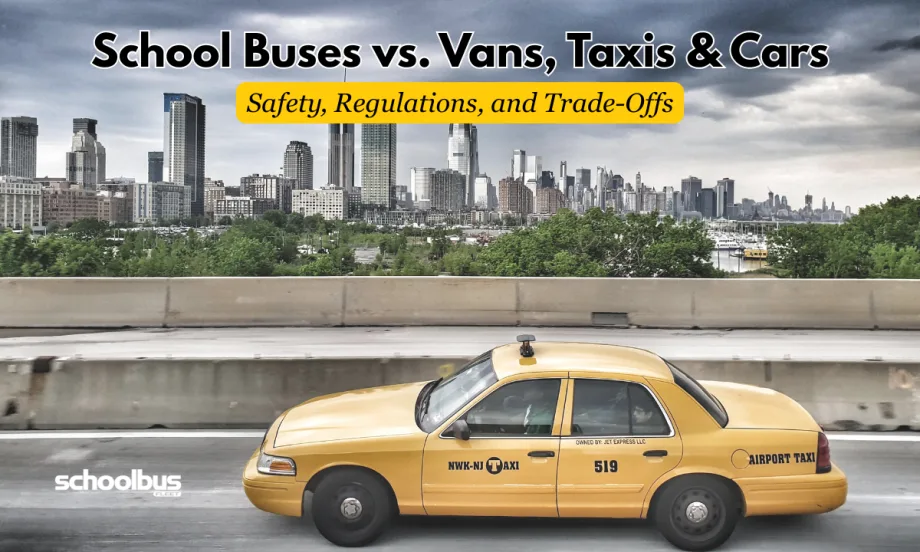
Taxis are commonly used to transport students in metros areas like Chicago.
Credit:
School Bus Fleet
18 min to read
- School districts and contractors are using various vehicles beyond traditional yellow buses to enhance transportation services.
- The alternatives being used, like taxis and vans, often help in reducing transportation costs and decreasing ride times for students.
- Concerns have been raised regarding the safety of using non-school bus vehicles for student transportation.
*Summarized by AI
Editor's Note: This article was originally published in October 2013 and was reviewed in September 2026 to verify that the information remains current, with minor updates to reflect industry relevancy. For a newer article on the state of alternative transportation, please see our June 2025 feature,Rethinking the Route: A Deep Dive into Alternative Transportation for School Districts.
When school started in Dallas this year, many students and parents expecting to see a yellow school bus roll up the street were surprised by what arrived: taxi cabs, vans, and SUVs.
News reports quoted bewildered parents. Some shared concerns about their children being placed in unconventional transportation arrangements. Other parents seemed to be more upset that they weren't informed of this significant change. And some just wanted the school bus back.
“Old yellow school bus,” parent Chris Williams told CBS DFW. “You can’t take that out of school. It’s like taking those No. 2 pencils out of there."
Across the country, many school districts and contractors are employing a variety of vehicles to supplement traditional school bus service. Taxis, minivans, and other small vehicles are often used to cut costs and shorten ride times for homeless or students with special needs who travel long distances to school.
Few would contend that a school bus is more efficient than a car in certain situations — shuttling one child 30 miles to a special school, for example — but the safety implications of transporting students in these alternative vehicles have become a contentious issue in the pupil transportation industry.
Dallas ISD Turns to Alternative Student Transportation
In Dallas Independent School District (ISD), the bulk of the concerns apparently stemmed from parents not being informed of their children's new transportation arrangements before the school year began.
"Although the district and ALC [American Logistics Co.] attempted to reach out to parents, unfortunately many parents were not made aware of the change to student transportation services," Gregg Prettyman, vice president of corporate communications for ALC, tells SBF.
(Editor's note as of September 2026: In 2020, American Logistics Company sold its student transportation division and became known ALC Schools, which rebranded to EverDriven in 2022.)
At the time of original reporting, transportation for Dallas ISD was provided by intermediate agency Dallas County Schools.
"If you show up at the bus stop on the first day and there’s a stranger in a minivan or a sedan, even if they have a placard [with school info], no one's going to feel comfortable with that — myself included," Prettyman says, adding that the key to success is “educating parents about these types of changes and the measures taken to ensure that the drivers and vehicles are safe and qualified for this type of service."
Dallas ISD officials did not return phone calls and e-mails requesting an interview for this article, but the district posted on its website a detailed message to parents about the alternative transportation program.
How Smaller Vehicles Can Cut Costs and Student Ride Times
At the time or original reporting, transportation for Dallas ISD is provided by intermediate agency Dallas County Schools. Earlier this year, the agency sought an independent service that could provide cost-effective transportation on routes having fewer than 10 students, for which a school bus is not required by state or federal law.
According to the Dallas ISD message to parents, the goals of this effort were:
- To reduce transportation costs and reallocate dollars to schools.
- To reduce the drive time that students were enduring on school buses.
ALC was chosen as the contractor to provide this alternative transportation service. Dallas County Schools and Dallas ISD had used a car/van service in the past for about 100 routes, but this year the program was greatly expanded, to more than 400 routes. Many of the passengers attend special-needs schools, academies or magnet schools.
ALC reportedly took numerous steps to prepare for its increased load of students this year. Among them:
- Credentialing and training of more than 400 drivers.
- Vehicle placards with route number and destination school.
- Vehicle inspections.
- Route tags for children to help ensure that they get on the right vehicle.
- Outreach pamphlets for parents and schools.
In its message to parents, Dallas ISD said that at the beginning of the school year, some vehicles did not have clear identification, which caused "understandable concern and confusion among parents and students."
The district said that by the end of the first week of school, all of the alternative vehicles would be clearly identifiable as being "official Dallas County transportation vehicles."
"We will continue to work with Dallas County to make adjustments so that all students and parents feel comfortable with their transportation," the district message said. "We sincerely apologize for any confusion and reiterate our commitment to the safety of all students."
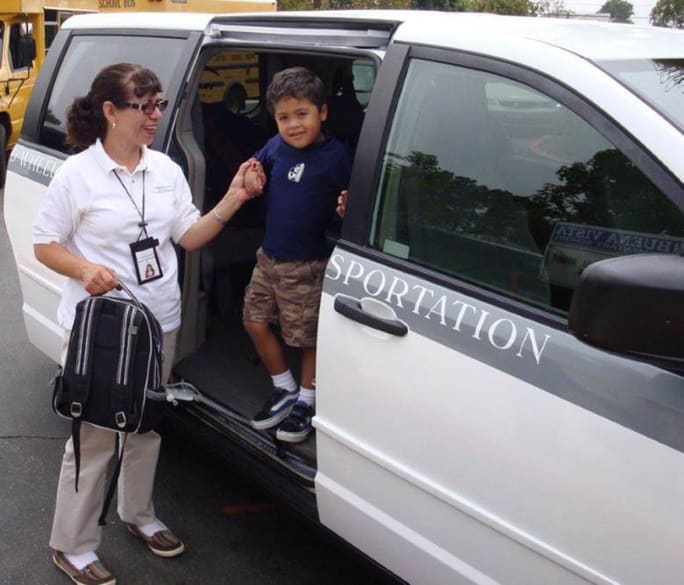
American Logistics Co. arranges alternative transportation services for school districts. Here, a driver helps a student out of a van.
Credit:
American Logistics Co.
Some news outlets reported that Dallas ISD decided to phase back in school buses in place of the alternative transportation, but ALC's Prettyman told SBF about two weeks after the school year started that the district was continuing with the program. However, all taxi vehicles were removed at the district’s request.
Prettyman says that as parents adjusted to the new service and got to know their children's drivers, they became more comfortable with it and even began to see the benefits. He cites an example of a mother who wrote to Dallas ISD officials asking them to stick with the alternative transportation.
The mother wrote that her son's ride to school took one-and-a-half to two hours one way in previous years. Now, on an ALC shuttle, the ride is less than 30 minutes. The mother also noted that the driver is professional, timely and, by her son's account, a safe driver.
Driver Screening for Alternative Student Transportation
Along with the safety of the vehicle, the safety of the driver is a key concern raised by critics of the use of taxis, vans, and other such vehicles to transport students.
In its service for school districts, ALC contracted with existing transportation providers, so their people already were in the driving profession.
"We'll find a small business; they may have a shuttle service or a limo service," Prettyman explains. "They're already in the community, already licensed. We find those resources and talk to them about this opportunity."
ALC confirms that the drivers undergo driving record reviews, criminal background checks, and random drug and alcohol testing. The company also works to ensure that the drivers meet the district’s own specifications, such as CPR certification or certain special-needs training. In Dallas, for example, more than 50 alternative transportation drivers attended a deaf education training seminar.
Cab Drivers Can Come with Checkered Pasts
Elsewhere, problems have surfaced with drivers employed by other companies.
Earlier this year, NBC Chicago investigated cab drivers who were transporting students for area school districts and discovered many with checkered pasts.
The news outlet found 66 school cab drivers who had been arrested for or convicted of such crimes as aggravated battery, possession of a controlled substance, firearms violations and assault.
For instance, NBC Chicago reported that school cab driver Jean Juste was convicted in 1994 of sexually assaulting a teenager. He was also convicted of smuggling and selling cocaine a few years later.
In response to the news, the Illinois secretary of state office launched an investigation of the hiring practices of the cab company that employed Juste.

Students disembark a Micro Bird school bus constructed vehicle operated by Gibsonia, Pa.-based Monark Student Transportation Corp. These types of vehicles have a capacity of nine passengers or fewer but are built to federal motor vehicle safety standards for school bus construction.
Credit:
Monark Student Transportation Corp.
Illinois Requirements for Student Transportation Drivers
Although some dubious drivers slipped through the cracks, the state of Illinois has strict requirements for taxi drivers who transport students to and from school.
State pupil transportation director Cinda Meneghetti tells SBF that these school cab drivers have to earn a restricted school bus driver's permit, which means undergoing "everything that a school bus driver has to have, but no CDL." That includes a medical exam, drug and alcohol testing, a tuberculosis test, background checks, fingerprinting and an eight-hour class.
Cabs that transport students have to be inspected at an Illinois official testing station every six months or 10,000 miles, whichever comes first. Also, vehicles in salvage or junk status cannot be used as school cabs.
Meneghetti, who works for the Illinois State Board of Education in Springfield, notes the safety risks that could have been posed with the Chicago-area taxi drivers whose backgrounds weren't properly checked.
"You put two nonverbal special-ed kids in the back seat, that's not a good situation," Meneghetti says. But she adds that the "secretary of state has been cracking down" on the cab driver background issue.
Why One District Stopped Using Taxis
Worries about the cab drivers who were transporting its students led Gurnee (Ill.) School District 56 to discontinue the use of taxis a few years ago.
"We were all concerned about the type of people that were driving the taxis," Gurnee Superintendent Dr. John Hutton says. "We knew little or nothing about most of them."
The cost of the taxi service was also a concern, "but a secondary concern," Hutton adds. "Those two things made us say, 'The only way we can control the drivers is to do it ourselves.'"
In an intergovernmental agreement, Gurnee and two neighboring school districts bought six minivans and launched their own alternative transportation program.
"The people driving the vans are school employees," Hutton says. "They've had background checks; we know them. ... All three school districts would say we're very pleased with what's going on."
The districts have found that the vans, which undergo regular inspections and maintenance, are advantageous for transporting small numbers of special-needs and homeless students and for constantly adapting to their schedules and locations.
Gurnee also runs school buses. It shares about 80 yellow buses with one of the neighboring school districts. Although the districts are considering buying more vans, Hutton notes that the vans are not taking over the role of school buses.
"It is a supplement," he says. "Between special-needs kids and homeless families, [the transportation costs] put a lot of pressure on our budget, and we need to supplement with the vans."
Pennsylvania Rules for Vans Used in Student Transportation
Vans are commonly used to transport students in Pennsylvania. These "school vehicles," as they are classified, must have a capacity of 10 passengers or fewer, including the driver.
At the time, there were 5,228 of these school vehicles in the state and about 31,024 school buses. Craig Yetter, a spokesperson for the Pennsylvania Department of Transportation, says that school vehicle crash statistics are not broken out from other crash statistics.
For school buses, there were 393 crashes in 2012, which was 0.3% of the total crashes. In the crashes that involved school buses, three people were killed — none of whom was a school bus occupant.
Pennsylvania school bus drivers are required to have a CDL with passenger and school bus endorsements. For school vehicles, drivers only need a regular, non-commercial license.
While the state doesn't require school vehicle drivers to meet all of the qualifications that are required of school bus drivers — such as an annual physical — Yetter says that "many employers hold their school vehicle drivers to the same standards as the school bus drivers."
Pennsylvania does require school vehicles to undergo semi-annual state inspections. They are also subject to random vehicle and driver spot checks by state police.
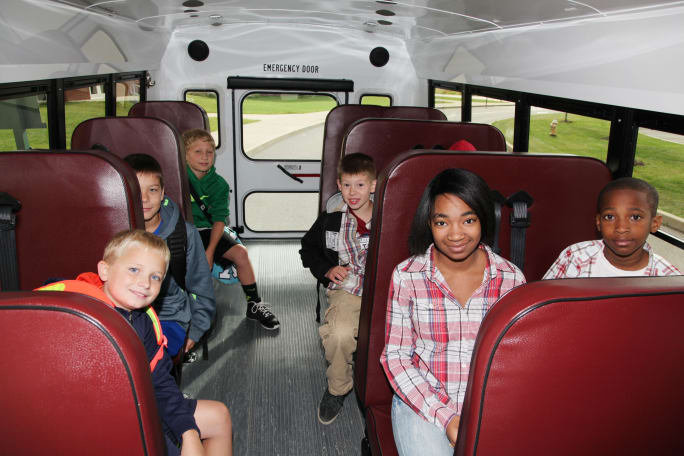
Monark Student Transportation Corp.’s fleet includes about 90 school bus constructed vehicles (pictured), which President Mark D. Schmitt calls “a safer way [than vans] to transport children in those smaller capacities.”
Are Vans Safe for Student Transportation?
School transportation officials in Pennsylvania are divided on whether vans should be used to carry students.
Mark D. Schmitt, president and owner of Gibsonia, Pa.-based Monark Student Transportation Corp., is one of the more vocal critics of van use.
"Ultimately, our job is to make sure children are being transported as safely as they can possibly be," Schmitt says. "The school bus is the safest form of ground transportation in the world. ... [Yet] thousands of schoolchildren are being transported in vans. It just makes no sense."
Under federal law, new vans with a capacity of more than 10 passengers (including the driver) cannot be sold or leased to transport students if they do not meet federal motor vehicle safety standards (FMVSS) for school buses.
As recently as 2010, the heads of the National Highway Traffic Safety Administration (NHTSA) and the Federal Motor Carrier Safety Administration sent a letter about van safety issues to all 50 states’ motor vehicle administrators. Included in the letter was a reminder that 12- and 15-passenger vans should not be used to transport students "because they do not provide the same level of safety as school buses meeting NHTSA’s safety standards."
However, according to Schmitt, many of these same large vans have been converted to a shorter, smaller, legal passenger capacity to be sold for transporting students.
"It’s constructed the exact same way as the bigger van that’s been outlawed," he says, "so what did [the federal restrictions] accomplish?"
School Bus-Constructed Vehicles as an Alternative to Vans
For student transportation situations that call for a smaller vehicle, Schmitt and some others in the industry advocate what they say is a safer alternative to vans: school bus constructed vehicles, as they are called in Pennsylvania.
These nine-passenger vehicles aren't technically school buses, and they don't have the flashing red and amber lights and stop arm — and therefore can't stop traffic. But they are built to the same FMVSS for construction as full-size school buses. That includes the same windows and mirrors, joint and rollover strength, seat padding and compartmentalization, rear emergency exit and heavy-gauge steel side-impact barriers.
"We have a vehicle that is built exactly the same as a school bus," Schmitt says. "It's a safer way [than vans] to transport children in those smaller capacities."
Schmitt's contracting company, Monark Student Transportation Corp., operates about 310 large and small school buses and about 90 school bus constructed vehicles. The latter are often used for transporting students with disabilities, but they're suited for other applications as well, such as picking up the overflow on a route that exceeds the capacity of a regular school bus. A small team trip is another fit.
As with the school vehicle vans in Pennsylvania, a CDL is not required to drive a school bus constructed vehicle. Schmitt says that this helps in dealing with driver shortages.
"One of the beautiful things about having a small vehicle like this available is that you don't have to have a CDL," he says. "This vehicle gives us the opportunity to hire and employ more drivers while they train for their CDL."
Schmitt is also the president and owner of Blue Bird Bus Sales of Pittsburgh Inc., which offers school bus constructed vehicles, but he insists that his advocacy for the vehicles is about safety, not sales.
"I'm obligated to let people know there's something safer [than vans] out there," he says. "My competitors are selling them as well."
As a price comparison, a new school bus constructed vehicle typically costs around $9,000 more than a new school vehicle van, according to Schmitt. "But what price do you put on safety?" he adds.
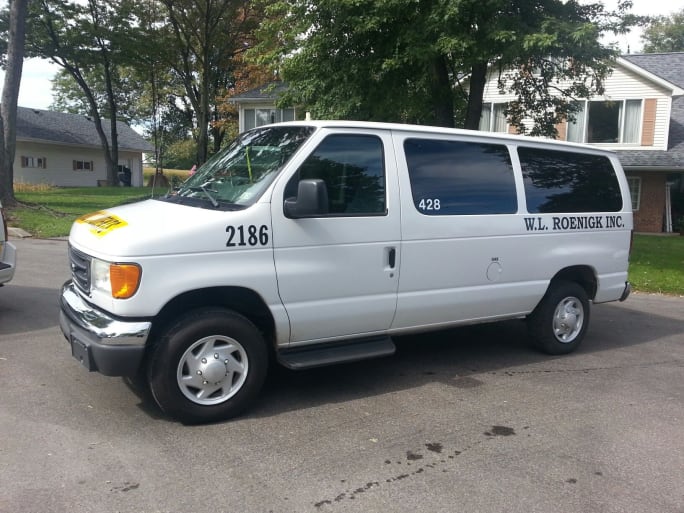
W.L. Roenigk Inc., a Sarver, Pa.-based contractor, runs a fleet of about 463 vans and about 500 school buses. The vans range in capacity up to 10 passengers. The yellow sign on the front says “SCHOOL STUDENTS.”
Contract Change
About eight years ago, Butler (Pa.) Area School District stopped the use of vans to transport its students. The district put in its transportation contract that only school buses or school bus constructed vehicles could be used.
The change was partly to ensure that students would be riding in vehicles that meet federal school bus standards, and partly because the district's vans weren't holding up well.
"We had some kids that were destroying our [Dodge] Caravans," says Brenda Collins, transportation supervisor for Butler Area School District. "They were tearing them apart inside."
While the drivers of school bus constructed vehicles aren't required to have CDLs, Collins says that the district's contractor "puts them through all of the training as if they were getting a CDL."
In assessing the safety of school bus constructed vehicles versus vans, Collins cites rollover strength as particularly important. She points to a September accident in Lee County, Fla., in which a church van with 16 people on board flipped after a tire tread separated. The van's roof was crushed, several passengers were ejected and three people were killed.
While a new van that carries as many passengers as that in the Florida crash couldn't legally be sold for student transportation without meeting school bus FMVSS, similar vans with a capacity of 10 or fewer are permissible.
"Those are the types of vans people are transporting children in. ... I see them driving around all the time," Collins says. "I really think school districts need to be careful using those vehicles."
Where Smaller Vans Can Have an Advantage
Sue Roenigk has a different take on vans. Her family's contracting company, Sarver, Pa.-based W.L. Roenigk Inc., runs nearly as many vans as school buses.
The company's fleet had about 500 school buses and about 463 vans. The van contingent includes many seven-passenger Dodge Caravans and the larger GMC Savanas and Ford E-Series vans, ranging in capacity up to 10 passengers.
Sue Roenigk, who is president of the company, says that the vans are especially adept at maneuvering in and out of driveways to pick up students with disabilities away from traffic.
"There's a longer time frame for loading special-needs students," Roenigk says. "A smaller van gets us in the driveway, and there's a lot less difficulty backing out. Something bigger couldn't do that."
In fact, the maneuverability is the key reason that the contractor uses vans.
"It's not so much the fuel economy; it's more about getting into the area," Roenigk says.
Those areas include urban neighborhoods in Pittsburgh as well as rural environs far outside of the city. On the more rugged rural roads, W.L. Roenigk relies on its vans that have all-wheel drive and can turn around at tight dead ends.
Training and Screening Van Drivers
W.L. Roenigk's van drivers undergo training on the type of vehicle they will be driving as well as on other safety and student-related topics that school bus drivers are trained on.
Also, all of the company's drivers and other employees, including mechanics, have to pass the same background checks and drug testing.
W.L. Roenigk does not run school bus constructed vehicles. According to Sue Roenigk, they have some disadvantages compared to vans — for example, the maneuverability is not as good, she says. Beyond that, W.L. Roenigk's school district customers haven't requested that the contractor use school bus constructed vehicles.
Roenigk maintains that the vans her family's company — and many other school transportation providers — use to transport students are safe.
"We feel that 10-passenger and smaller vans are built to specifications for people to haul their own children in," Roenigk says. "The manufacturers of these vans are doing a great job of making safe vehicles — they're making them to government standards."
What Does NHTSA Say About Vans for Student Transportation?
The National Highway Traffic Safety Administration (NHTSA) and other federal agencies have issued numerous warnings about the risks associated with 12- and 15-passenger vans, but as of 2013, have largely been silent on the use of smaller vehicles — minivans, cabs, etc. — to transport students.
A NHTSA spokesperson did not fulfill a request for an interview for this article. Here are key points from a statement and another NHTSA message on vans.
- Federal requirements regulate new vehicles that carry 11 or more persons that are sold for transporting students to or from school or school-related events. Those vehicles are required to meet all federal motor vehicle safety standards for school buses.
- Federal regulations apply only to the manufacture and sale or lease of new vehicles.
- Each state prescribes its own regulations that apply to the use of any vehicle that is used to transport students.
- In a December 2010 letter to state motor vehicle administrators, the heads of NHTSA and the Federal Motor Carrier Safety Administration said that their agencies’ data indicate that nine-, 12- and 15-passenger vans “are often inadequately maintained, and the tires are especially vulnerable to deterioration as they age. Because these vehicles have unique handling characteristics, they display particular sensitivity to rollovers, particularly when they are fully loaded.”
- In the same letter, the agency officials included a reminder that “pre-primary, elementary and secondary schools should not use 12- or 15-passenger vans for transporting students because they do not provide the same level of safety as school buses meeting NHTSA’s safety standards.”
Vehicle | Passengers | Uses | Driver requirements |
|---|---|---|---|
School bus | Manufacture capacity | Curriculum-related and non-curriculum trips | School bus driver permit (CDL) |
Car (taxi cabs, district-owned cars) | Manufacture capacity | Curriculum-related trips | Restricted school bus driver permit (non-CDL) |
Car (taxi cabs, district-owned cars) | Manufacture capacity | Non-curriculum trips | Valid driver’s license |
Van | 10 or less, including driver | Curriculum-related trips | Restricted school bus driver permit (non-CDL) |
Van | 10 or less, including driver | Non-curriculum trips | Valid driver’s license |
Passenger cargo vans | 11 to 15 | Not allowed | Not allowed |
This abridged table shows driver requirements for student transportation-related uses of different types of vehicles.
What OEMs Said About Safety Advantages of School Bus Construction in 2013
Manufacturers of small and large school buses are consistent in their stance against the use of vans to transport students.
The OEMs point to the superior safety record and strict construction standards of school buses. For low-capacity applications, these companies offer alternatives to vans: school bus constructed vehicles or, as they are often called, multi-purpose passenger vehicles (MPVs).
Steve Girardin, president of Micro Bird, says that his company has had success in a few states in promoting its MPV certified to school bus standards.
“We’ve gotten good traction in trying to get people to understand the safety benefit,” Girardin says.
Bob West, product manager of Type A at Thomas Built Buses, highlights the fact that vans do not meet school bus safety standards. On the other hand, the company’s Minotour MPV is built to those standards, including rollover protection, joint strength and seat protection.
“With these standards in place, our MPV is safer than passenger vans, minivans or other personal vehicles that may be used to transport children,” West says.
According to Tony Augsburger, senior director of sales at Collins Bus Corp., when vans or other non-school bus vehicles transport students, “there are risks associated with them. We strongly encourage the use of a certified Type A school bus, MFSAB [multi-function school activity bus] or nine-passenger MPV versus a non-school bus vehicle.”
Brian Barrington, national sales manager for Trans Tech Bus, says that he has seen an increase in the use of nine-passenger vans, particularly for transporting small sports teams.
“We understand that there is a need [for smaller vehicles],” Barrington says. “However, the price difference to put children into a vehicle that is school bus constructed is minimal and should be the way to go.”
Officials from Blue Bird Corp., IC Bus and Thomas Built Buses — which are members of the American School Bus Council — pointed to statistics showing that students are nearly eight times safer riding in a school bus than in a passenger car or other non-school bus vehicle.
“IC Bus believes the safest way to transport our children is in a school bus vehicle,” IC Bus President John McKinney added.
Subscribe to Our Newsletter
More Safety

How to Build a Better School Bus Driver Training Program
Is it time to strengthen your driver training? Here’s how to pick the right talent and improve recruitment, retention, and safety. This video is brought to you by IC Bus.
Read More →
Recent School Bus Accidents Leave 2 Dead, 2 Injured
Four school bus crashes in Florida, Illinois, and Georgia highlight risks in transportation lots, at bus stops, and during student loading and unloading.
Read More →
Sponsored•September 8, 2026
When Every Second Matters, Clarity Keeps Routes Moving
From routine delays to urgent incidents, strong communication practices help drivers, dispatchers, schools, and families respond with confidence.
Read More →

What Happens When a School Bus Catches Fire — and What Can Help
School bus fires are rare but can be devastating. Learn how advances in fire suppression and asset protection help fleets detect fires earlier, reduce damage, and improve safety.
Read More →
Geotab Launches Tool to Help Fleets Investigate Road Incidents
Geotab Investigations combines telematics data, video, documents, and other evidence to help fleets reconstruct incidents, resolve claims, and determine what happened.
Read More →
Texas Sixth Grader Wins 2026 National School Bus Safety Poster Contest
Sai Darshana Yekolu of Moseley Middle School in Prosper, Texas, was named the newest winner for her artwork, bringing the theme of “Safe Rides, Everyday Heroes” to life.
Read More →
Sponsored•August 27, 2026
Doing More With Less: How Transportation Directors Can Prioritize Safety Amid Budget Uncertainty
With diesel prices soaring and nearly one-third of transportation directors expecting budget cuts, maintaining student safety has never been more challenging. Download this guide to learn how leading districts are prioritizing risk, funding critical safety technology, and building stronger budget cases with data.
Read More →
Walton County Schools Adds Gatekeeper Stop-Arm Enforcement System
The Florida district will deploy Gatekeeper’s updated Student Protector technology, which now incorporates AI to improve video evidence.
Read More →
How To Build a More Secure School Bus Yard During and After Hours
As thefts and overnight security threats continue, school transportation leaders are combining stronger operational practices with AI-enabled surveillance to better protect buses, facilities, and staff.
Read More →
FMCSA Names New Chief Safety Officer: What School Bus Operators Should Know
Steve Dowling is set to lead the federal agency's efforts to advance commercial motor vehicle safety and reduce crashes, fatalities, and injuries on the nation's roadways.
Read More →