





Check Out: Traffic Control & School Bus Stops: 9 Keys to Keeping Students Safe
Survey: Most Parents Want Automated Enforcement on School Buses
A recent Verra Mobility survey reports that 82% of parents support safety cameras to penalize stop-arm violators and 70% favor automated enforcement in school zones.
January 28, 2026
Even parents and guardians have witnessed close calls around the school bus, leading many to advocate for increased safety measures.
Photo: School Bus Fleet
2 min to read
A new 2025-2026 school year survey from Verra Mobility, issued via Pollfish, reveals that parents and caregivers of school-aged students overwhelmingly support the use of automated enforcement to improve student safety, according to a company press release.
The survey included 2,000 parents or caretakers of children who walk, drive, are driven, or take transportation to school, and revealed that many respondents have witnessed near-miss incidents where a student was almost hit in a school zone or near a school bus.
The data illustrates parents' desire for action, with the survey showing that:
82% support safety cameras to monitor and penalize drivers who illegally pass stopped school buses.
70% of respondents favor automated enforcement in school zones.
43% have observed a "near miss" in a school zone.
33% have seen a "near miss" surrounding a stopped school bus.
Automated enforcement programs have long been proven effective. Verra Mobility program data shows that school bus stop-arm programs have experienced as much as a 50% reduction in violations within just two months of launching. As programs continue, 98% of drivers who receive one stop-arm violation don't receive a second.
Similar success has been experienced with school zone speed safety programs, where programs have experienced a 94% reduction in speeding at speed camera locations.
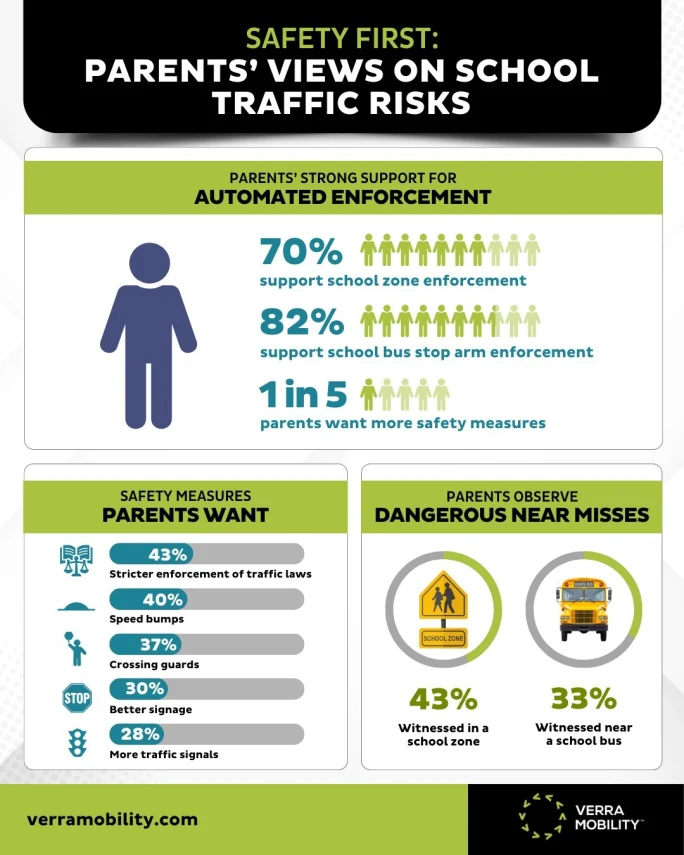
A survey by Verra Mobility revealed parents’ perceptions of traffic risks and safety measures around schools.
Source: Verra Mobility
"Parents, educators, and communities share the same priority – keeping students safe," said David Dorfman, senior vice president, Verra Mobility. "With a large majority of parents supporting automated enforcement in school zones and for school bus stop-arm enforcement, technology offers a proven way to change dangerous driving behaviors and prevent tragedies."
This data comes as cities and counties across the U.S. are utilizing technology to make a difference. During the 2024-2025 school year, Verra Mobility launched 13 new school zone speed programs, from Memphis to Poulsbo, Washington, to deter dangerous driving and protect students.
This trend also reflects concerns from educators and school administrators, with 38% of public-school officials moderately or strongly agreeing that traffic patterns around their schools pose a threat to students' physical safety during their commute. To combat this, parents are advocating for a holistic safety approach with physical and policy-based improvements such as speed bumps, more crossing guards, better signage, and traffic signals.
More Safety
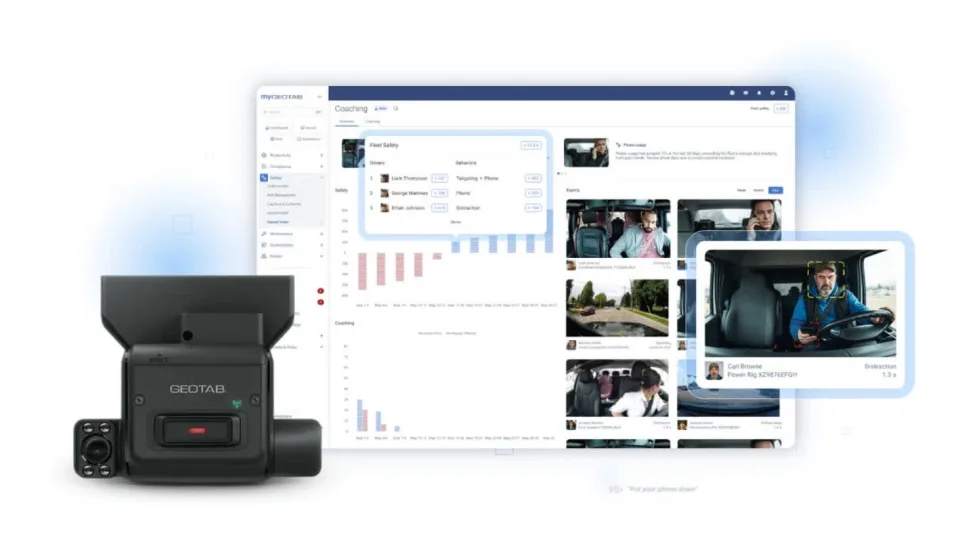
Geotab Expands Fleet Safety Tools With Video Coaching, Risk Insights
New safety and video capabilities aim to help fleet managers assess risk, support drivers, and take targeted action through video coaching, red-light violation detection, and more.
Read More →
How to Build a Better School Bus Driver Training Program
Is it time to strengthen your driver training? Here’s how to pick the right talent and improve recruitment, retention, and safety. This video is brought to you by IC Bus.
Read More →
Recent School Bus Accidents Leave 2 Dead, 2 Injured
Four school bus crashes in Florida, Illinois, and Georgia highlight risks in transportation lots, at bus stops, and during student loading and unloading.
Read More →

Sponsored•September 8, 2026
When Every Second Matters, Clarity Keeps Routes Moving
From routine delays to urgent incidents, strong communication practices help drivers, dispatchers, schools, and families respond with confidence.
Read More →
What Happens When a School Bus Catches Fire — and What Can Help
School bus fires are rare but can be devastating. Learn how advances in fire suppression and asset protection help fleets detect fires earlier, reduce damage, and improve safety.
Read More →
Geotab Launches Tool to Help Fleets Investigate Road Incidents
Geotab Investigations combines telematics data, video, documents, and other evidence to help fleets reconstruct incidents, resolve claims, and determine what happened.
Read More →
Texas Sixth Grader Wins 2026 National School Bus Safety Poster Contest
Sai Darshana Yekolu of Moseley Middle School in Prosper, Texas, was named the newest winner for her artwork, bringing the theme of “Safe Rides, Everyday Heroes” to life.
Read More →
Sponsored•August 27, 2026
Doing More With Less: How Transportation Directors Can Prioritize Safety Amid Budget Uncertainty
With diesel prices soaring and nearly one-third of transportation directors expecting budget cuts, maintaining student safety has never been more challenging. Download this guide to learn how leading districts are prioritizing risk, funding critical safety technology, and building stronger budget cases with data.
Read More →
Walton County Schools Adds Gatekeeper Stop-Arm Enforcement System
The Florida district will deploy Gatekeeper’s updated Student Protector technology, which now incorporates AI to improve video evidence.
Read More →
How To Build a More Secure School Bus Yard During and After Hours
As thefts and overnight security threats continue, school transportation leaders are combining stronger operational practices with AI-enabled surveillance to better protect buses, facilities, and staff.
Read More →