





Last Year's Take: 2025 Trend to Watch: Tech & Telematics in Focus
Where Is All This Tech Taking Us in 2026?
AI and industry technology shifts from reports to real-time coordination in 2026, unifying platforms, boosting safety tech, and making parent transparency the norm.
December 30, 2025
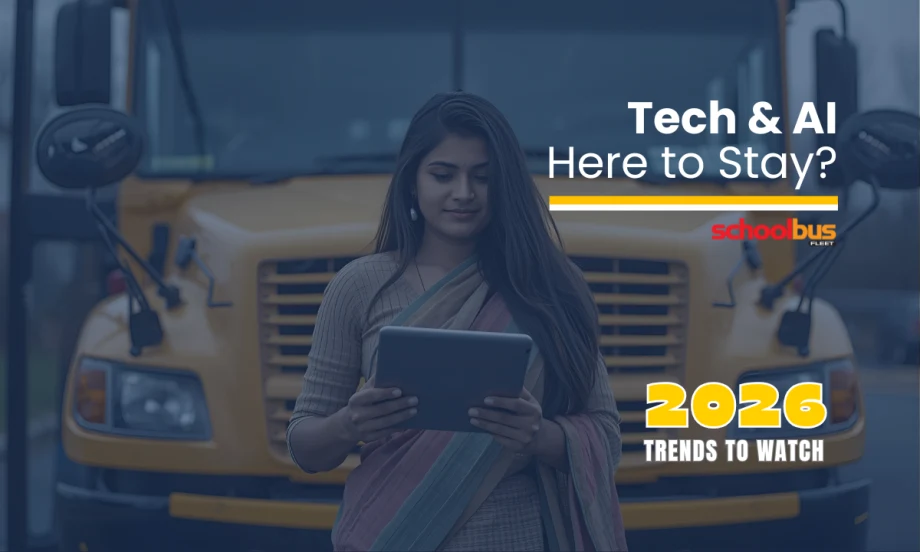
In 2026, school transportation technology moves from reactive to proactive, with advanced tools playing a key role in how we plan, activate resources and personnel, and evaluate results.
Photo: School Bus Fleet. This is an AI-generated image. Refer to our Terms of Use.
7 min to read
If 2024 was the year emerging technologies like AI proved what they could do, and 2025 was when they started showing up in real applications, 2026 looks like the year they become embedded in school transportation infrastructure.
Across various industries, the conversation has shifted from “Should we use AI?” to “How do we implement it effectively without breaking trust?” For pupil transportation, that matters even more because school bus operations sit right at the intersection of safety, real-time logistics, parent expectations, budget pressure, and workforce strain.
In other words, the industry operates in the exact kind of environment where technology or AI can be either a helpful partner or a complicated burden.
So, what happens in the year ahead? We asked industry experts to find out (it’s worth noting these observations aren’t meant to represent every corner of the industry; in reality, they reflect themes raised by those interviewed for this piece).
Technology Shifts From Reporting to Coordinating
Right now, a lot of school transportation tech is still built around an “after the fact” mentality. Something happens, a report is generated, and a human reacts. In 2026, that flips. We’ll see more systems that actively coordinate resources in real time.
Beacon Mobility Chief Technology Officer Gaurav Sharda describes the transition as AI moving from “passive reporting to active orchestration,” meaning systems that continuously evaluate constraints such as staffing, ridership, weather, traffic, and vehicle availability to surface optimized, real-time options for directors.
Using AI could reduce back-office burdens, turning dispatch into something closer to continuous optimization. It doesn’t replace the dispatcher; it just reduces manual reconciliation, per Sharda.
That direction also shows up in the routing space, where vendors are increasingly trying to close the gap between a perfect plan and messy reality. Antonio Civitella, CEO of Transfinder, notes that adoption can be challenging, especially for tech that lives on the bus. “Rates of adoption have always been very low,” he said, adding that routes can “look great on paper,” but the real test is putting them into action.
In practice, when tablets and navigation roll out, they sometimes expose hidden flaws districts never saw before, like stops sequenced differently in real life than in routing sheets. That mismatch can shake driver confidence unless systems are flexible enough to meet them where they are.
At the district level, Jenny Robinson, transportation general manager at Bethlehem Area School District in Pennsylvania, is already building the foundation for orchestration. Every vehicle has a tablet, and “the drivers have a shortcut to their own routes, but can also pull up routes or individual tiers for any route to assist with coverage,” she explained. Tablets with live routing access don’t yet equal AI coordination, but the technology enables it.
By 2026, expect more districts to trial semi-automated routing that updates daily based on ridership, staffing, and traffic. As Civitella puts it, the next evolution is systems that “look at the plan, look at the actual information, and immediately come up with something that's in between that makes sense.”
Don’t fret, AI won’t replace transportation directors. It will continuously surface better options so directors can make decisions faster and with more confidence.
Unified Platforms Start Beating Fragmented Stacks
Another theme across interviewees is fragmentation fatigue. Districts often juggle routing from one vendor, cameras from another, parent comms from a third, maintenance in a separate system, and spreadsheets holding it all together.
Verra Mobility’s Head of Growth and Strategic Partnerships, School Bus Division, Matt Reich, said the burden is becoming harder to ignore.
“With the volume of technology available to school districts, the details of implementation, such as vetting vendors, technology installation, and training, can be overwhelming,” he said. Fragmented systems, he added, create “inefficiencies and gaps in oversight.”
Civitella underscores why this matters: districts are swimming in data streams, most don’t have the bandwidth to interpret them manually. “Some say, ‘I don't want the staff to analyze this amount of data day in and day out,’” he explained. “This is where we come in. We do the analysis live, and we make recommendations.”
The 2026 prediction here is that consolidation accelerates. Districts and contractors may choose fewer partners with broader capability because, in certain situations, the operational burden is lower. Vendors with interoperable suites, or even tightly integrated alliances, may win out.
Safety Tech Becomes More Proactive
Safety remains a huge consideration for technology adoption, and in 2026, that definition takes us inside and outside the school bus.
Inside the Bus
Live video and interior cameras are already becoming standard practice, but they still depend on someone noticing or reporting an issue. Sharda says Beacon Mobility is moving toward AI-powered incident detection paired with conversational co-pilots that can summarize, timestamp, and route safety-relevant information to the right responder within seconds, turning what is often a manual, delayed workflow into immediate action.
This shift is also true for Transportant, where CEO Martin Staples points to AI that flags risky patterns such as “vaping, harassment, or students being out of their seat,” helping staff intervene sooner and more consistently.
Expect the new year to bring more AI-assisted alerting, with an emphasis on assistive tech rather than surveillance. Clear privacy safeguards and vendors who can show ethical, bias-checked models and controlled access will push trust in this more.
“Don't let [AI] do everything for you,” Civitella advocates. “Have some place in your day where there is a confirmation on your part.”
Staples agrees that AI should recommend and accelerate, but we humans should still set the workflows.
Outside the Bus
Robinson doesn’t mince words about the standout innovation of the last year. “Stop-arm cameras! A school bus driver's attention is already divided into too many directions.” In 2026, stop-arm enforcement programs are poised to expand in regions with existing legal frameworks and to spread through new pilots elsewhere.
Reich says AI is making these programs more practical by filtering out noise from the process. Verra Mobility’s cameras use AI to “analyze traffic behavior in real time, determine whether vehicles are in violation, eliminate non-violations, and prioritize actionable violations for review.”
Plus, passenger vehicle safety features are now migrating into school buses more quickly. Robinson looks for the basics, specifically backup cameras, lane drift alerts, blind spot alerts, and crash detection notifications. Expect more of these to be bundled into standard bus configurations.
In the far future, Safe Fleet President Mike Hagan looks forward to vehicle-to-vehicle communication and stoplight technology catching on for school bus use. "If the driving public all has cars, they’re all communicating with one another, and the school bus is communicating ‘Here I am and I’m stopped, and you’re not to pass,’ in an automated way, it could eliminate the human error and the potential to illegally pass.”
Parent Trust Becomes a Baseline Expectation
Parents increasingly expect transparency that matches rideshare or package delivery, and districts are responding. Robinson describes a major shift in family-facing visibility, while Staples calls this demand non-negotiable.
“We have recently rolled out a parent-facing app so that parents can anticipate arrival time to a stop,” she said, with more features like attendance tracking expected next for the district.
Transportant's established parent app will soon be adding two-way communication between parents and schools. “Parents, especially working parents, expect confirmation that their child has boarded, arrived, and returned home safely,” Staples said. “That expectation is becoming the norm, not the exception.”
“Real-time parent transparency also reduces call-center volume, missed connections, and confusion on days when routes shift due to staffing or traffic constraints,” Sharda added.
Civitella goes one step further into what might be controversial today but normal tomorrow: parent participation in daily routing. If a student isn’t riding, he argued, parents should be able to signal that so routes can adjust dynamically.
It’s a glimpse of where 2026 could head with AI-assisted routing that adapts in the morning based on real attendance rather than historical averages.
From Breakthroughs to Better Systems
Put it all together, and 2026 looks less like a year of breakthroughs and more like a year of transformation. AI becomes an operational teammate. Platforms unify. Safety shifts from reactive documentation to proactive prevention. Parent transparency becomes a baseline expectation.
Overall, technology and AI adoption depend on usability that adapts with drivers, administrators, mechanics, and directors, not the other way around. A common goal should be to preserve institutional knowledge while offering flexibility to the process. If training and workflow fit are afterthoughts, tech adoption fails.
“Treating AI as an operational partner, powered by reliable data, is what will separate the leaders from the laggards in an increasingly complex environment,” said Neil Cawse, founder and CEO of Geotab.
The big question next year won’t be whether technology belongs in student transportation. It will be whether we implement it in a way that protects privacy, supports staff, and keeps district missions at the forefront.
Editor's Note: This article is part of our 2026 trends analysis exploring key issues to watch this year.
Check out the other articles in this series:
Subscribe to Our Newsletter
More Technology

Summit School Services to Complete Fleetwide Samsara Technology Rollout
The company said outfitting its entire fleet with AI-powered safety and fleet management technology will strengthen student safety and operational efficiency across its local brands.
Read More →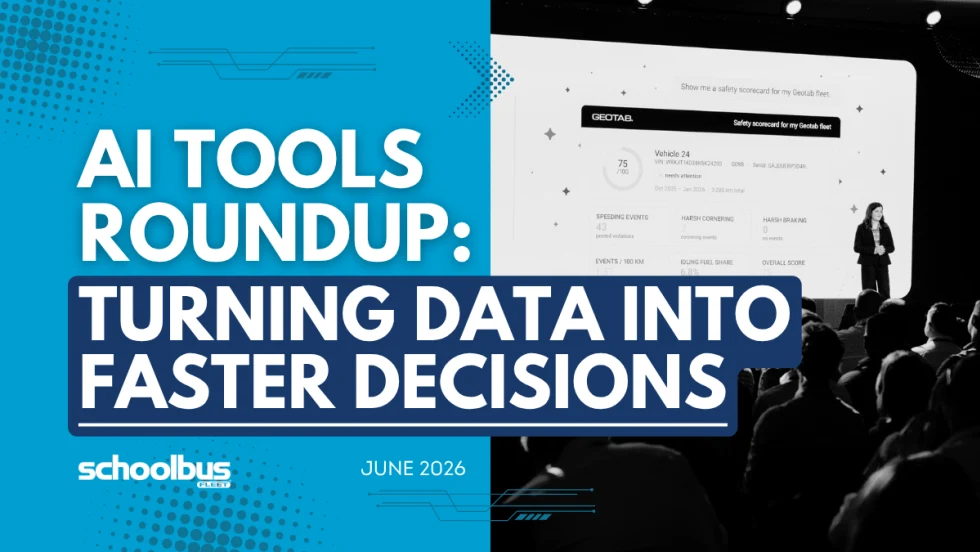
AI Tools Roundup: New Fleet Tools Aim to Turn Data Into Faster Decisions
The latest AI-powered platforms could help student transportation teams analyze fleet performance, manage maintenance, and uncover operational insights using natural-language queries.
Read More →
From Overwhelmed to Optimized: How AI Is Transforming School Transportation Leadership
Artificial intelligence is quickly becoming one of the most practical tools in today’s transportation office. Here’s how it is improving parent communication, board reporting, training development, and overall efficiency — without replacing professional judgment.
Read More →
How GPS Tracking Helps School Bus Fleets Improve On-Time Performance Without Adding Routes
Struggling with late buses? GPS data can help fleets cut delays, fix route bottlenecks, and improve on-time performance without adding routes.
Read More →
Planning Before Purchasing: A 10-Step Framework for Vetting Tech
New tech tools can drive real impact or real frustration. Here’s how pupil transportation leaders can make smarter, safer, and budget-friendly tech decisions using a vetting process.
Read More →
Driving Made Safer: AI Cameras as a Bus Driver’s Co-Pilot
See how AI-powered driver assistance technology works as a partner on the road, offering timely alerts and coaching to keep students and drivers safe.
Read More →
Inside Parent Routing Apps: How Digital Tools Are Transforming School Transportation
From real-time tracking to instant alerts, technology is reshaping how districts communicate bus routes and changes with parents. Yet, as districts and vendors reveal, successful transportation hinges not just on apps, but also on the people and partnerships behind the screens.
Read More →
How Creative Routing Can Keep You Prepared for the Unexpected
Flexible routing, using routing tools, and easily communicable routes can help you keep ahead of any potential roadblocks when transporting students. Here are some tips for keeping the bus rolling and getting students to school on time, regardless of what the day brings.
Read More →
2025 Trend to Watch: Tech & Telematics in Focus
Discover how telematics is revolutionizing school bus operations in 2025, from GPS tracking and video monitoring to preventive maintenance and AI-enabled insights. Learn about telematics’ evolution, challenges to adoption, and what’s next.
Read More →