No, robots won’t be replacing school bus drivers, but artificial intelligence (AI) tools can be used in a number of surprising ways in pupil transportation, from turn-by-turn routing to reinforcing safe driving practices.
AI has boarded the bus! The emerging tech is now transforming school transportation by optimizing routes, improving safety, assisting with driver training, and more.
Credit:
This image was created in whole or part using GenAI. Photo: SBF
6 min to read
AI is a hot topic currently, as recent advances have opened up a variety of applications for the technology. School transportation is one area where AI is starting to find its footing in several applications…so far.
Keeping on Route
The obvious use of the technology is in the GPS systems that can be used to guide drivers along their routes. When drivers have to deviate from their standard routes, AI can quickly analyze alternatives and find the best path forward for a bus.
Ad Loading...
“The turn-by-turn instructions have been a wonderful help for our drivers,” said Teri Mapengo, director of transportation at the Prosper (Texas) Independent School District. “There have been situations where our drivers have had to take a different turn and the AI would take them down a road they didn’t know was there in order to get back on route.”
The turn-by-turn instructions from Samsara utilized by Prosper Independent School District are a big step up from the paper route instructions they used to use.
Efficient Transportation Routes
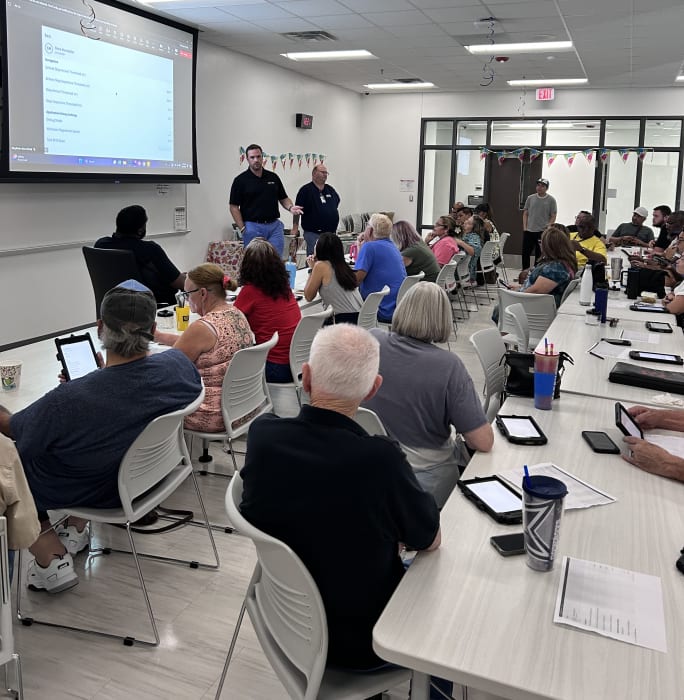
Drivers at Prosper Independent School District utilized a combination of classroom and hands-on training in order to familiarize themselves with the AI technology that is now on their buses.
Photo: Teri Mapengo/Prosper Independent School District
On-the-fly routing is not the only way AI can be used when determining how to move students from one location to another. By putting all of the route information into an AI system, schools may find some surprising optimizations that can be made.
“For route optimization, the AI has helped us notice things that we may have otherwise missed as well as combine routes,” Mapengo said. “We are one of the fastest-growing districts in the state of Texas, and we need to use every avenue to help us avoid missing things.”
Finding routes that can be combined allows districts to make sure their buses are full, eliminating time spent moving while empty. This also enables them to more easily handle the ongoing bus driver shortage.
Ad Loading...
Keeping Parents in the Loop
Prosper Independent School District also utilizes the Stopfinder app, which allows parents to see estimated arrival times. With the AI-powered app keeping parents up to date on when their children will arrive, the school district has seen a decrease in the number of calls received.
Keeping Track of Trends
With all these AI tools, Prosper Independent School District has been able to identify several trends.
Driver performance is quickly recorded and sent to the school by AI, showing them things like the percentage of drivers that are making use of their on-board tablets. With this data, the district can know which drivers may need additional help or training with the technology.
“The AI tech has helped us identify a lot of driver performance trends, we can see the percentage of tablet use and know which drivers need more help with the technology,” Mapengo said. “It also helps us find things more quickly, we’re only two months in and already finding things that we wouldn’t have otherwise. With this, we can get the additional help for drivers quickly when they need it.”
Learning the Ropes of AI
How else can K-12 transportation directors use AI?
Training for the new technology was a big focus when it was adopted. Drivers would be presented a topic and then were given a chance to implement it before moving on to the next piece, giving them time to familiarize themselves with the technology as they learned.
Ad Loading...
For some drivers, the district’s video tech assistant can ride along on routes in order to help teach them how to manage the technology while on the road.
The other area that needed a lot of training was for the district’s routers.
“We needed to make sure that the AI played well with our tablets, as well as make sure they knew how to put all of the information into the system,” Mapengo said. “We also brought in some on-site training for our drivers and bought in an IT specialist to help out.”
For parents, the district put together training videos to help go over the new apps that the AI technology enabled.
AI-Powered Safety
AI can also be used to improve safety while on route. While the AI routing can help plan safer and more efficient routes, AI dash cameras can be installed to monitor both the interior and exterior of the bus.
Ad Loading...
These cameras can record and analyze driver behavior, as well as issue real-time alerts to help drivers remember to drive safely. Some common behaviors that the dash cams can identify are distracted driving, speeding, or failing to obey traffic signals.
Implementing cameras like these can raise concerns about them being used as surveillance measures instead of safety measures. However, schools can prioritize them as essential safety tools and introduce driver rewards programs to incentivize safe driving. By recognizing safe driving, programs can reinforce positive behaviors to create an environment where drivers feel safe and valued.
When recording what is going on outside of the bus, the AI cameras can be used to help districts in legal cases involving school bus accidents. Illegal school bus passing has become a major focus recently, and these cameras can be used to hold other drivers accountable.
School bus camera systems can also be integrated into the cloud, allowing districts to quickly retrieve videos on demand. Administrators can use these videos to look at student behavior trends and take action as situations arise.
More Ways to Implement AI
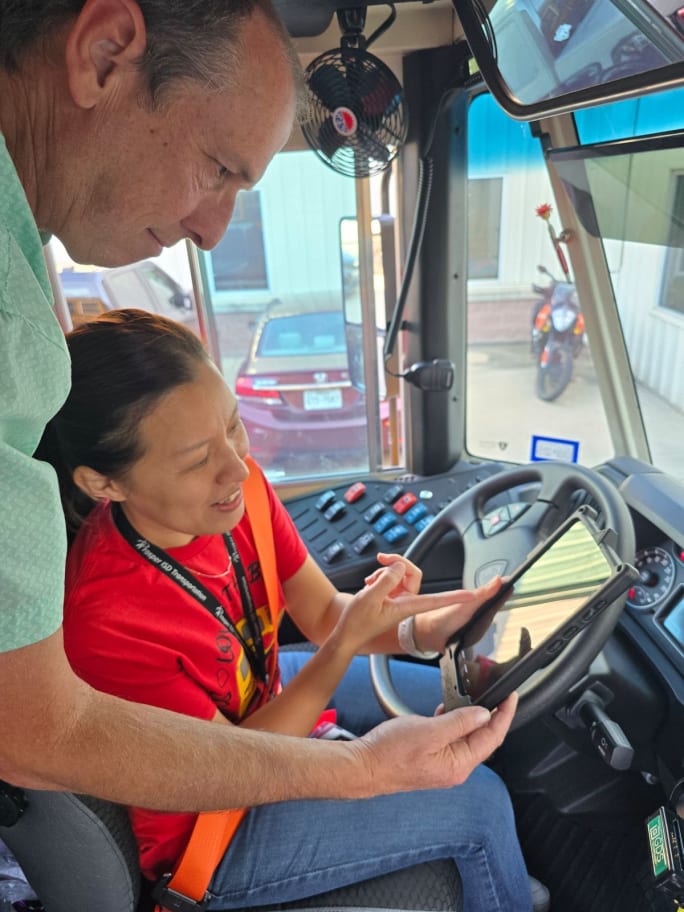
Prosper Independent School District utilizes AI powered tablets to help keep drivers on route. The AI utilized in the tablets allows for easy on-the-fly rerouting when circumstances prevent the driver from traveling on the original route.
Photo: Teri Mapengo/Prosper Independent School District
AI can do a lot more for districts as well. One feature that Prosper Independent School District has not implemented yet is a reporting feature for stop-arm violations.
Ad Loading...
“One of the biggest things I would like to see implemented is a stop sign violation button,” Mapengo said. “Just having a button we can push to send information directly to law enforcement would be a massive help when dealing with data related to stop sign violations we are encountering. I know there are some camera systems that have it, however we still need to look into the details.”
To this point, just last June, Safe Fleet released a new stop-arm violation system called SAVES.
The coaching features through Samsara are another aspect that Prosper Independent School District is interested in. This feature would allow the Samsara GPS to communicate directly with drivers to help them through various situations they may come across on the road.
AI can assist with predictive maintenance, too, reducing workflow disruptions, reducing downtime and expenses, and empowering techs to take a more active role in the health of their fleet.
Understanding What You Are Getting
When implementing unfamiliar technologies like these, it is important to understand what you are getting. AI is being rapidly developed, so when looking at what it can do for your fleet, make sure to research and arrange technical demonstrations before making decisions.
Ad Loading...
Drivers and parents also should be aware of the technology and how it works. Setting up pilot programs can help identify how technology can be implemented in a fleet as well as find and address any safety concerns.
Districts like Prosper Independent School District need to rapidly adapt to keep up with the population growth in their area. Finding the creative routes necessary to keep student transportation flowing smoothly is much easier with the help of AI.
“AI can help with efficiency and data collection. I think schools need to keep the door open for any technology that can help with safety,” Mapengo said. “AI looks at all aspects of an operation and can help keep things safe for everyone. I think that as long as we use AI to help find problems and possible solutions under human observation, it can be a great benefit. We definitely still need that human touch, however.”
Human instinct goes a long way and will always be necessary to keep a transit system running safely and efficiently. During the NAPT ACTS 24: Futurecasting, the Impact of AI workshop, Mapengo emphasized the need for human interaction when implementing AI. Utilizing AI tools to quickly collect and analyze data is a good starting point for finding optimal routes and strategies, though there are numerous factors that a purely logical computer may overlook.
The new name represents a renewed vision for the nonprofit focused on advancing clean, equitable, and affordable transportation solutions that move people and goods.
Choosing the right school bus driver trainer takes more than experience. Learn six keys to selecting and developing trainers and evaluating program effectiveness.
STA's Canadian division acquires Ontario-based G&L Stevenson Transport while Durham School Services adds a new district contract in California, First Student adds a New Jersey contract, and Minnesota Coaches acquires Halo Transportation.
A summer pilot found that AI agents could handle most routine calls, freeing up time for customer service staff to focus on emergencies and complex family concerns.
A Texas transportation supervisor shares lessons on self-awareness, accountability, managing stress and building trust — and why investing in leadership development matters at every stage of your career.
Who earned national recognition for their work in student transportation? This year, NAPT named five recipients of its 2026 awards for service, safety, and leadership, plus its newest Hall of Famer.
Driver shortages. Rising costs. Growing safety expectations. More data, but not enough time to act on it. The 2026 State of Student Transportation Report reveals what transportation leaders say is putting the most pressure on their operations—and where they’re investing next. See how your priorities compare.
What makes emotions run high, and how should you handle an angry colleague or parent? Follow these steps for staying calm, listening, showing empathy, and resolving conflict.
Learn about the challenges shaping the 2026–2027 school year, from persistent driver shortages and budget pressure to technology and readiness gaps. See how school districts are responding and adapting in Zonar’s 2026 Back-to-School Readiness Report.