




More on Technology in Buses: EverDriven Enhances Safety, Visibility with New Camera Solution
How Routing Data Improves Transportation Efficiency
How school bus route data can help schools make transportation more efficient and handle problems as they come up.
by Staff
November 4, 2024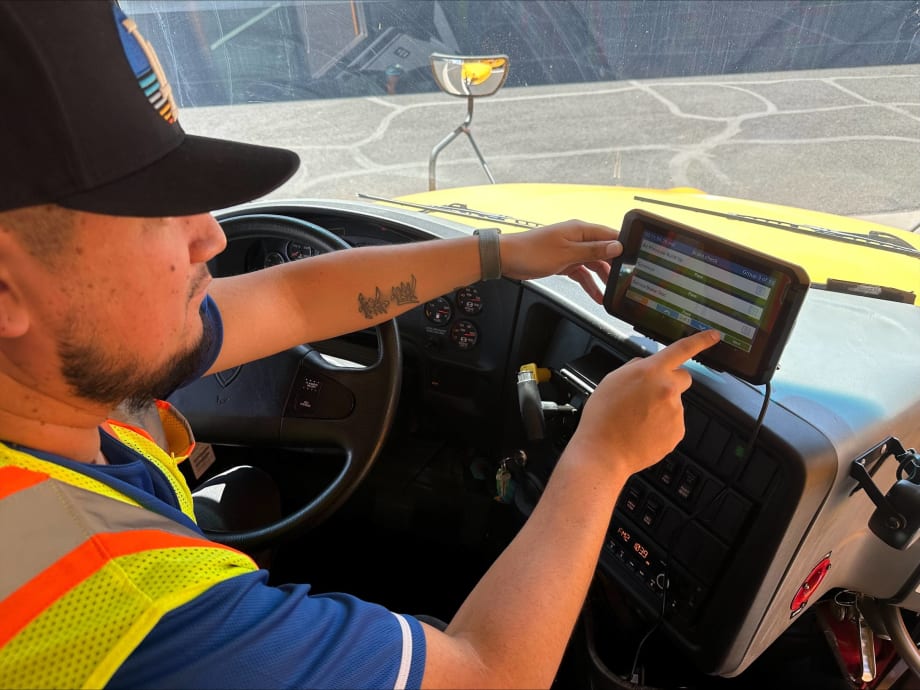
Drivers at Florence Unified School District #1 are equipped with tablets that help them stay on route, scan students onto the bus, and send student conduct reports to administrators.
Photo: Florence Unified School District #1
6 min to read
As technology advances, it has become easier to collect data in every aspect of our lives. Schools across the country have started implementing various technologies into their buses in order to gather and analyze route data.
With easy access to information like how long it takes a bus to reach its destination and how many students are taking advantage of certain routes, schools can find new ways to optimize their transportation systems.
Using tools such as Synovia, CalAmp, Edulog, Infinite Campus, or Here Comes the Bus app among others, schools can gather route data, analyze it, and easily notify parents about any changes or delays to the bus schedule.
“Synovia/CalAmp houses our team's time and attendance as well as vehicle history and reports associated with both,” said Michael Henley, Douglas County (Ga.) School System coordinator of transportation. “We enjoy having real-time vehicle locations and vehicle history at our fingertips when it is time to assist our community and schools. Infinite Campus is our district's student information system. Information from IC is transferred to Edulog, our route management system, and then transferred to Synovia/CalAmp. The ease of use of each system has made my team's job easier.”
Data-Driven Routing
Using the data gathered while the buses are on their routes, districts can identify and adjust routes to ensure buses are running as efficiently as possible. Douglas County School System was able to utilize the data they gathered and minimize dead head time, or driving from one location to the next empty.
“Our district recently moved to a three-tier system,” Henley said. “Now, all of our high school runs are within a short distance to the route's elementary school. The same exists for our middle school runs. This has helped us with running double loads and arriving prior to the school bell ringing. We have done the same work for our routes that serve students with disabilities. Instead of utilizing schools to make decisions, we created routes based on student placement.”
On top of minimizing the amount of time buses are running around, consolidating routes to increase efficiency can also help offset the ongoing bus driver shortage.
Identifying Training Needs
Another use for the data is making training decisions. Shannon Weber, director of transportation at Florence (Ariz.) Unified School District #1, looks at daily ridership data to help identify areas where additional training may be needed.
“We want to make sure kids that are on the bus are getting off the bus,” Weber said. “It helps us to reassure their safety, but also attendance and on time performance. It allows us to see who’s getting there early, who’s maybe getting there late, and that drives some training decisions in our department.”
Real-time ridership data can also be transmitted through apps like the Here Comes the Bus that Florence Unified School District #1 uses in order to help parents know where their child is and when they will get to and from school.
Optimizing Safety
Safety is another area where data collection technologies can lend a hand. Using Bus Conduct, a real-time student conduct app, allows drivers to send student conduct referrals to administrators as events happen. School administrators use this data to find trends in student conduct as they are developing and take actions as needed.
“The Bus Conduct technology allows us to manage student conduct differently,” Weber said. “Principals and parents are hearing about things very quickly and instead of it creating a level of frustration for drivers, it has reduced the amount of time they have to wait to hear what’s happening.”
When it comes to safety, looking at route data can also help districts plan safer routes. For instance, by minimizing the amounts of left turns on a route, transporting students becomes safer.
Taking Advantage of Support
Another aspect that schools can take advantage of is the support teams for the technologies they are implementing. Services like Edulog offer professional development along with technical support.
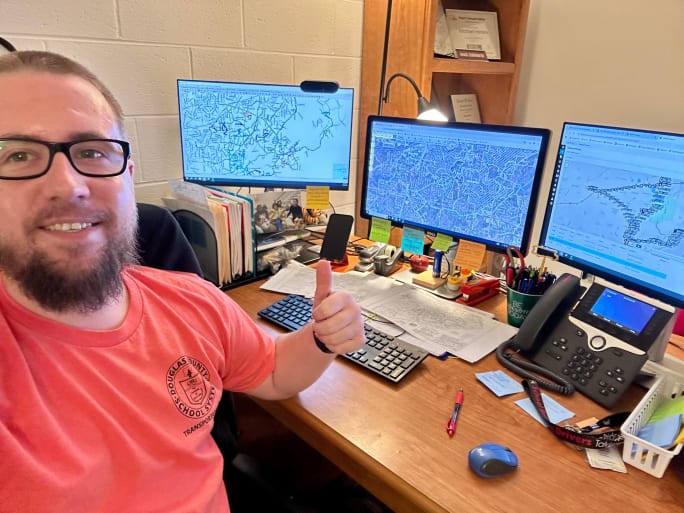
Michael Henley shows off his routing software, which allows for route optimization and real-time tracking of each bus's location.
Photo: Michael Henley/Douglas County School System
“Prior to my current role, I used Edulog as a user. Now, I use Edulog as an administrator,” Henley said. “I was able to utilize Edulog University for the basics of my new role in addition to utilizing the Technology Support Team for in-depth assistance. Their team is always friendly, quick to respond, and they assist in a way that allows me to write notes so I can do the same work if an issue arises in the future.”
Getting Started with the Technology
Implementing these technologies can be a little tricky at times, however. In districts where bus drivers are primarily made up of retired individuals, getting drivers to accept using the technology can be challenging.
“Depending on how well they like or don’t like technology, things can get a little tricky,” Weber said. “They had to be trained to use the tablets and what to look for with student scanning. It throws another ball in the juggling act, so teaching it carefully and making sure that they get it and don’t get flustered is important.”
By starting in a classroom setting and then putting the ideas into practice on buses in controlled breakout settings, Weber was able to find a training method that worked for her district.
“As with any new technology, there are hiccups,” said Henley. “We respond to challenges equitably; what one group of drivers needs to be successful with technology might be completely different from another group.”
Letting drivers and the community get a good understanding of the technology helps implementation go smoothly. Successfully implementing technologies like these requires people to understand how it can work for them. Getting everyone who will be using the technology to buy into using it is often the first step.
“I would recommend anybody who’s rolling out with things like the student scanning technology to have a pilot school first,” Weber said. “Before I did all 13 of my schools, we were able to put out some of the fires and take out some of the kinks with one group. Sometimes rolling out a little bit slow and a little bit conservatively helps with the big picture.”
Finding the Funds
Introducing new technologies into a school district needs to support the community around the school. Funding for schools is often influenced by the community, so being able to show them the benefits of a new program or technology can help make it happen.
“If you are going to introduce a technology, I think it has to support your drivers and it has to support your community,” Weber said. “We don’t get the funds to do these things without the support of our voters. It’s important to know what they want to see from the transportation perspective, and I know a lot of times we just get them to and from school and we don’t really ask our community these questions.”
Finding more efficient routes and operation methods is more easily done when looking at the data that these technologies can provide.
“Making data-driven decisions has helped us with running an efficient operation,” Henley said. “While there are hiccups at times, we have made significant progress. We are grateful to have the technology needed to support our decision-making process in support of our community and schools.”
By integrating advanced technologies into transportation systems, school districts can harness more efficient, safe, and responsive bus services. While routing is just one avenue of data collection, multiple other tools exist that can help create measurable efficiencies, whether telematics, smart maintenance solutions, video cameras, student badges, or whatever else might ne next on the horizon.
Subscribe to Our Newsletter
More Management

How to Build a Better Driver Training Program
Ready to boost up your school bus instructor training? Here’s how to pick the right talent and improve recruitment, retention, and safety.
Read More →
CALSTART and Forth Combine to Form Catalyst Mobility
The new name represents a renewed vision for the nonprofit focused on advancing clean, equitable, and affordable transportation solutions that move people and goods.
Read More →
What Makes a Great School Bus Driver Trainer?
Choosing the right school bus driver trainer takes more than experience. Learn six keys to selecting and developing trainers and evaluating program effectiveness.
Read More →


School Bus Contractors Expand Through New Deals, Acquisitions & Partnerships
STA's Canadian division acquires Ontario-based G&L Stevenson Transport while Durham School Services adds a new district contract in California, First Student adds a New Jersey contract, and Minnesota Coaches acquires Halo Transportation.
Read More →
Logan Bus Company Rolls Out AI Phone System for NYC School Bus Families
A summer pilot found that AI agents could handle most routine calls, freeing up time for customer service staff to focus on emergencies and complex family concerns.
Read More →
From Intent to Impact: What I Learned About Leadership from TAPT
A Texas transportation supervisor shares lessons on self-awareness, accountability, managing stress and building trust — and why investing in leadership development matters at every stage of your career.
Read More →
NAPT Names 2026 Award Recipients, Hall of Fame Inductee
Who earned national recognition for their work in student transportation? This year, NAPT named five recipients of its 2026 awards for service, safety, and leadership, plus its newest Hall of Famer.
Read More →
Sponsored•September 2, 2026
2026 State of Student Transportation Report
Driver shortages. Rising costs. Growing safety expectations. More data, but not enough time to act on it. The 2026 State of Student Transportation Report reveals what transportation leaders say is putting the most pressure on their operations—and where they’re investing next. See how your priorities compare.
Read More →
How to De-Escalate an Angry Person: 5 Steps for Handling Workplace Conflict
What makes emotions run high, and how should you handle an angry colleague or parent? Follow these steps for staying calm, listening, showing empathy, and resolving conflict.
Read More →
Sponsored•September 1, 2026
What Readiness Looks Like This School Year
Learn about the challenges shaping the 2026–2027 school year, from persistent driver shortages and budget pressure to technology and readiness gaps. See how school districts are responding and adapting in Zonar’s 2026 Back-to-School Readiness Report.
Read More →