




10 Years, Same Debate: Why We Need to Implement Seat Belts on School Buses
From NHTSA in 2015 to NTSB in 2025, the message on school bus seat belts hasn’t changed. In this op/ed, Derek Graham explores what a decade of data reveals about safety, student behavior, and driver satisfaction.

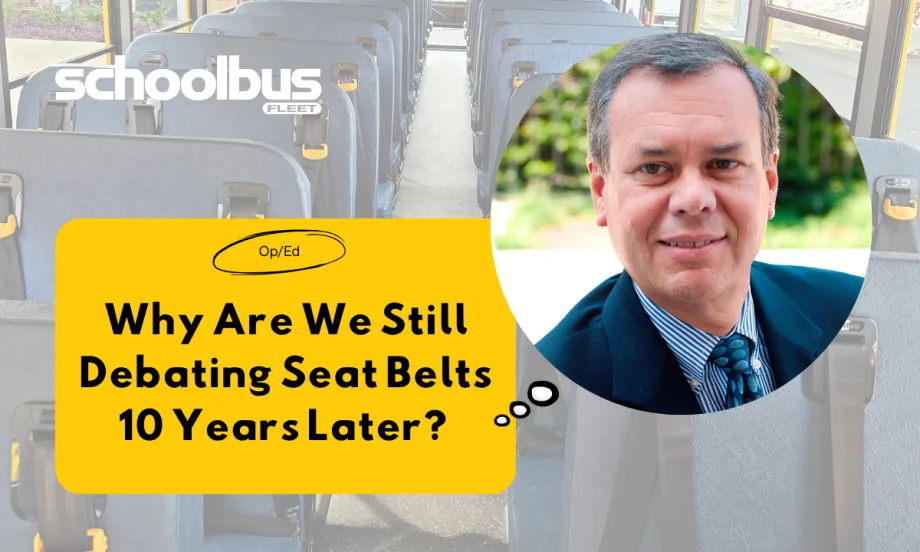
“We all know that advances in school buses usually involve a phased-in approach, so the only way to progress is to start phasing,” Graham says.
Photo: School Bus Fleet
What a difference a decade makes! Or does it?
I have to wonder how far we have come, despite continued input and recommendations espousing the safety benefits of seat belts on school buses, ranging from crash protection to driver performance and job satisfaction.
In two notable instances, separated by 10 years and six days’ time, federal transportation safety officials addressed industry leaders about seat belts on school buses. I was there for both.
NHTSA 2015
On November 8, 2015, the administrator of the National Highway Traffic Safety Administration, Dr. Mark Rosekind, was addressing attendees at the National Association for Pupil Transportation (NAPT) conference in Richmond, Virginia. Rosekind rocked the industry with a very direct statement: “School buses should have seat belts. Period.” Making it more personal, Rosekind added that “every child on every school bus should have a three-point seat belt.”
Without a doubt, this prompted many to action. There have been local and state initiatives to include lap/shoulder (three-point) belts as standard equipment on new school buses. Even school bus manufacturer Blue Bird now includes three-point belts on its buses as standard protection for student passengers.
NTSB 2025
Fast-forward 10 years to the 2025 NASDPTS conference in Washington, D.C., on November 13. National Transportation Safety Board Member Michael Graham addressed the topic, reviewing the circumstances of the recent school bus crash in Leander, Texas.
Graham told the crowd: “It is hard to believe we are still having a discussion about the safety benefits of seat belts — and their proper usage — on any roadway vehicle, let alone a school bus. The safety data could not be clearer: school buses equipped with lap and shoulder belts, combined with proper usage of the belts, provide maximum protection for all occupants.”
And yet, there was plenty of pushback from the audience. Some of the same arguments that were made a decade earlier:
“The problem is the cost,” some attendees said. Maybe for some, but I can point you to many places that choose not to implement, even though there is no additional cost to the district. Contrast that to regulations where emissions requirements increase the cost of engines and buses, the additional cost is seen as “unavoidable” and is simply built into the cost of the bus.
“How can I justify to one parent that we are protecting some kids with belts, but not their child?” Has this argument prevented districts from phasing in illuminated stop signs and school bus signs to improve the safety of student pedestrians? We all know that advances in school buses usually involve a phased-in approach, so the only way to make progress is to start phasing. (Exceptions can be found. For example, in 2012 in Helena, Montana, where bus service is contracted, the school board required every bus provided on the contract to be equipped with lap-shoulder belts.)
I’ve often thought that I would hate to be a school district facing questions about student injury or death if I had the opportunity to implement lap-shoulder belts but did not, or if I implemented belts but they weren’t being used. Well, that happened in Leander. Although belts were available in every seating position, only six of 42 passengers visible on the video were belted at the time of the rollover crash, resulting in injuries for many of the unbelted passengers. The NTSB issued urgent recommendations to Leander, NAPT, the National School Transportation Association (NSTA), and NASDPTS to ensure that passengers on buses equipped with seat belts are, in fact, belted when the bus is in operation.
After receiving the NTSB recommendations, the district explained changes to its safety practices, including training, oversight, and monitoring related to seat belt use, on its website.
Many tragedies have resulted in improved practices. Indiana state law was changed to require right-side pickups outside of city limits following the Rochester illegal passing tragedy. But it doesn’t always work that way. Despite a student-on-board fatality, the Ohio School Bus Safety Working Group did not recommend or encourage further implementation of seat belts on school buses in that state.
Not Just Crash Protection
Implementation of lap-shoulder belts is about safety, but not just crash protection.
Rutherford County Schools in North Carolina orders replacement school buses with lap-shoulder belts at no extra charge to the district. The first nine buses were put in service in 2017, and the phase-in continues, with over half of the fleet now equipped. In August 2024, I had chatted one-on-one with some of their school bus drivers. I was pleasantly surprised by how it is second-nature to them. At elementary schools, when teachers or assistant principals help load buses in the afternoon, they might step on the bus and reinforce the message from the driver: “Go ahead and find your seat and buckle up.”
Drivers had nothing negative to say. In fact, quite the opposite. They cited improved student discipline. Better behavior, better driver satisfaction.
This comes as no surprise. In a 2021 NHTSA report, the punch line is that, in addition to crash protection (fortunately, bad crashes do not happen every day), there are other safety benefits because “seat belts on school buses contributed to calmer and less distracted environments for school bus drivers.” This can happen every day.
However, there is no easy button. A successful implementation of lap-shoulder belts requires effort to make it a priority. According to the NHTSA report,
In general, the most important factors in successful policy planning seem to be:
Training and education procedures, and
Enforcement of passenger use requirements.
It can be done. I’ve seen it in California, North Carolina, and Montana.
The NTSB and NHTSA do not study, recommend, and perform research to complicate our day-to-day. They do it in the interest of safety. So maybe, just maybe, the statements, data, and reports coming from our federal partners have merit — not just to prevent a tragedy, but to improve operations, retain drivers, and bolster public confidence in what we do.
This article was authored and edited according to School Bus Fleet editorial standards and style. Opinions expressed do not necessarily reflect that of SBF or Bobit Business Media.
More Safety

How to Build a Better School Bus Driver Training Program
Is it time to strengthen your driver training? Here’s how to pick the right talent and improve recruitment, retention, and safety. This video is brought to you by IC Bus.
Read More →
Recent School Bus Accidents Leave 2 Dead, 2 Injured
Four school bus crashes in Florida, Illinois, and Georgia highlight risks in transportation lots, at bus stops, and during student loading and unloading.
Read More →
When Every Second Matters, Clarity Keeps Routes Moving
From routine delays to urgent incidents, strong communication practices help drivers, dispatchers, schools, and families respond with confidence.
Read More →

What Happens When a School Bus Catches Fire — and What Can Help
School bus fires are rare but can be devastating. Learn how advances in fire suppression and asset protection help fleets detect fires earlier, reduce damage, and improve safety.
Read More →
Geotab Launches Tool to Help Fleets Investigate Road Incidents
Geotab Investigations combines telematics data, video, documents, and other evidence to help fleets reconstruct incidents, resolve claims, and determine what happened.
Read More →
Texas Sixth Grader Wins 2026 National School Bus Safety Poster Contest
Sai Darshana Yekolu of Moseley Middle School in Prosper, Texas, was named the newest winner for her artwork, bringing the theme of “Safe Rides, Everyday Heroes” to life.
Read More →
Doing More With Less: How Transportation Directors Can Prioritize Safety Amid Budget Uncertainty
With diesel prices soaring and nearly one-third of transportation directors expecting budget cuts, maintaining student safety has never been more challenging. Download this guide to learn how leading districts are prioritizing risk, funding critical safety technology, and building stronger budget cases with data.
Read More →
Walton County Schools Adds Gatekeeper Stop-Arm Enforcement System
The Florida district will deploy Gatekeeper’s updated Student Protector technology, which now incorporates AI to improve video evidence.
Read More →
How To Build a More Secure School Bus Yard During and After Hours
As thefts and overnight security threats continue, school transportation leaders are combining stronger operational practices with AI-enabled surveillance to better protect buses, facilities, and staff.
Read More →
FMCSA Names New Chief Safety Officer: What School Bus Operators Should Know
Steve Dowling is set to lead the federal agency's efforts to advance commercial motor vehicle safety and reduce crashes, fatalities, and injuries on the nation's roadways.
Read More →