





NTSB investigations October 2023 to September 2024: 17, including 3 school bus-related crashes (Millstone, W.V.; Rushville, Ill; and Dale, Texas)
NTSB investigations October 2024 to July 2025: 10, no school bus crashes
5 Questions: NTSB’s Meg Sweeney on School Bus Safety
Check in with the NTSB in this Q&A that breaks down how the federal agency investigates school bus accidents, its push for key safety measures, and what lessons we’ve learned as an industry.
August 19, 2025
Meg Sweeney, PhD, is a project manager and accident investigator at the NTSB’s Office of Highway Safety. She’s been with the agency since 2019.
Photo: NTSB/School Bus Fleet
7 min to read
When a school bus crash makes headlines, one federal agency is quietly working behind the scenes to find out what went wrong — and more importantly, how to prevent it from happening again.
Catch up with Meg Sweeney, project manager and accident investigator at the National Transportation Safety Board (NTSB), for an inside look at what we’ve learned from school bus accidents.
Q: How exactly is the NTSB involved in school bus safety and what role do you play in crash investigations?
Sweeney: NTSB is a non-regulatory, independent federal agency. Our mission is to investigate crashes, to determine a probable cause, and then write safety recommendations aimed at preventing future crashes.
We investigate all modes of transportation — aviation, marine, rail, pipeline, and highway. Our Office of Highway Safety is responsible for investigating school bus crashes.
We are a relatively small agency with a team of about 425 people; our highway office has about 35 people. Unlike the Office of Aviation, which is charged with investigating every civil aviation accident, the much smaller Office of Highway Safety must be selective in the crashes that we launch. The decision to launch is based on several different reasons, for example, high public interest or a safety issue we’ve been following.
We investigate about 10-12 crashes a year. It takes up to two years for our investigation process from the launch to the final report.
Q: How often does the NTSB investigate school bus incidents and what is the process?
Sweeney: We have a response operations center that monitors multiple news outlets and looks for crashes. We're often notified by law enforcement or somebody we worked with in the past.
In a major investigation, we launch a multidisciplinary team with specialists in different areas like human performance, motor carrier, vehicle, highway, and survival factors. Human performance will investigate driver aspects of the crash, such as fatigue, distraction, or experience. In a school bus crash, the motor carrier will focus on the school district and the state's operations and policies. Survival factors look at occupant protection and emergency response issues.
The vehicle investigator inspects the vehicle, looks for potential defects, and investigates how that vehicle design could be improved, if something was wrong, or if there was technology that could have been applied. The highway investigator will examine the design of the roadway and look at if the highway signage was correct, if the speed limit is appropriate, if there was a work zone.
In a vehicle crash, we interview drivers and witnesses. We use data recorder information and cameras to tell us if the brakes were activated or if the seat belt was used. We look at driver records, licensing records, and crash records, including scheduling, since we don’t want people to be fatigued while they’re driving. We check phone records to make sure somebody wasn’t using a cell phone at the time of the crash.
In the investigation, we work in a system called the party system. We work closely with police agencies, local law enforcement, and departments of transportation and emergency responders since we can’t get to the scene right away. Along with vehicle manufacturers, these organizations are a resource for the technical information we need.
We take a multidisciplinary approach when we write reports. We examine various aspects that could have prevented the crash and then develop and write our recommendations. Those are sent to our fellow agencies and organizations. In the school bus industry, that is NHTSA, NASDPTS, NSTA, and NAPT. We issue recommendations to manufacturers who will sometimes target ways to prevent those crashes from happening again.
We have a good overall acceptance rate of our recommendations. Our strength is really where people or agencies try to take action on the recommendations.
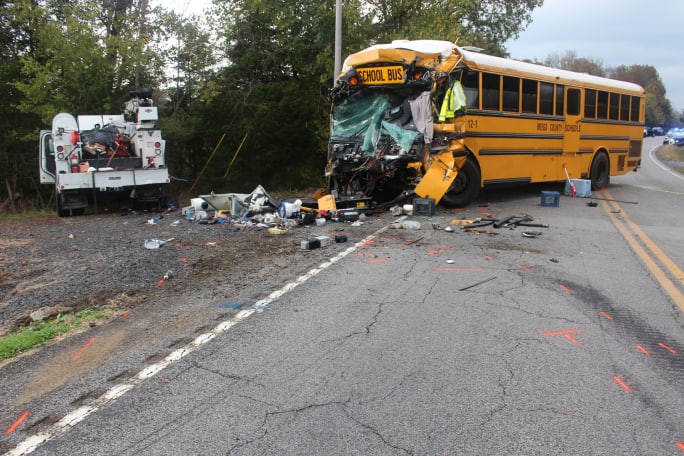
Two vehicles post-crash in Decatur, Tennessee, October 2020.
Source: Tennessee Highway Patrol
In terms of trying to identify what happened, we often know the “what,” but we want to find out the “why.” We can say a truck hit the bus or the bus hit a pole, but we want to know the real details of why that happened.
Q: What industry changes have resulted from school bus crashes?
Sweeney: You may have heard of the Safe System approach where we have safe users, safe roads, safe vehicles, safe speeds, and post-crash care. If you apply that general guideline, you will see some of our recommendations falling into those categories.
With safe vehicles, we've made recommendations for avoidance collision technologies on school buses. In terms of occupant protection, we've made several recommendations on lap-shoulder belts. For safe roads, we could include safe routing, where we try to minimize the number of times that students cross the road.
In broad terms, we've made recommendations for improving vehicle safety, occupant safety, and driver safety, and making sure that the post-crash response is adequate.
Q: What are some recent accidents you've investigated, and what did we learn from them?
Sweeney: One crash that was different from some of our typical ones was in Rochester, Indiana, in 2018. Students were being picked up in the morning, and they were crossing a high-speed roadway when a driver approaching from the other direction failed to stop. [The other driver] struck the four students, killing three of them and seriously injuring the fourth. That was a “school bus-related crash” because they were boarding the school bus, but the issue was another vehicle.
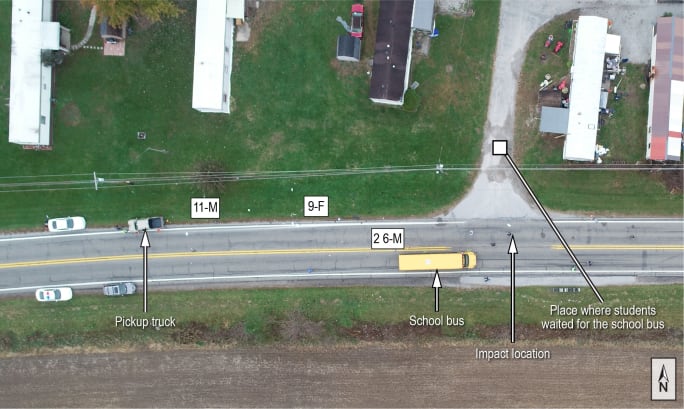
The Rochester, Indiana, crash in 2018 was the result of an illegal stop-arm passing that killed three siblings waiting for the bus. NTSB recommended that schools plan routes that avoid students crossing the road, especially on high-speed roads. This shows the post-collision site and positions of the school bus, pickup truck, and struck pedestrians.
Source: Indiana State Police, modified by the NTSB
When we investigated that crash, we made recommendations from several perspectives. We looked at education and enforcement, making sure people know the law and that they have to stop for a school bus even if it's in the other travel lane. One of the recommendations that came out of that was something much simpler: Try to minimize routes that require students to cross a road.
Decatur (Tennessee) was an interesting crash in terms of the occupant protection issue because it was a frontal impact. The school bus hit a truck that came into its lane. What we were able to observe through the onboard cameras was that several of the students were out of position. They weren’t sitting properly in their seats, and that contributed to their injuries since they didn’t benefit from compartmentalization. There, we reiterated recommendations for lap-shoulder belts on school buses to the states.
Each crash is different and unique. Issues like occupant protection come up a lot, but we’ve issued recommendations for improved vehicle technology and driver safety, so there’s a spectrum.
Q: What influenced NTSB's pro-seat belt stance, and why do you stand behind it?
Sweeney: We know that school buses are safe, big vehicles. They’re heavy, yellow, lit up, and people know them. In the late ‘70s, compartmentalization was introduced, the concept with of high-back, energy-absorbing seats that are close together, so in a crash the student will have a limited forward motion.
Compartmentalization provides a level of safety in front- and rear-end crashes, but not so much in a side impact or rollover crash, where students may be forced out of the compartment. So, in 1999, NTSB issued recommendations to NHTSA asking for performance standards for occupant protection systems that would account for frontal, side, rear, or rollover collisions.
We've investigated crashes in which lap belts were used, and we found that lap belts will offer students protection from being ejected, but we still saw upper body flailing. When their upper body isn’t restrained, they’ll move from side to side, but it keeps them within the bus and from being ejected in a rollover crash.
We’ve also investigated crashes with the lap-shoulder belt where the belt mitigated injuries to those students. Finally, we made the recommendation in 2018 to the states that don’t have lap shoulder belts on school buses to install them. That was the result of a school bus crash that rolled over and hit a utility pole in Chattanooga.
BONUS: What changes do you anticipate in school bus safety over the next five to 10 years?
Sweeney: The school bus industry takes safety very seriously. That's reflected in the crash and fatality records often in the single digits now. I would like to see us continue that trend and reach that big zero in a year. I think it's an achievable goal.
Subscribe to Our Newsletter
More Safety

How to Build a Better School Bus Driver Training Program
Is it time to strengthen your driver training? Here’s how to pick the right talent and improve recruitment, retention, and safety. This video is brought to you by IC Bus.
Read More →
Recent School Bus Accidents Leave 2 Dead, 2 Injured
Four school bus crashes in Florida, Illinois, and Georgia highlight risks in transportation lots, at bus stops, and during student loading and unloading.
Read More →
Sponsored•September 8, 2026
When Every Second Matters, Clarity Keeps Routes Moving
From routine delays to urgent incidents, strong communication practices help drivers, dispatchers, schools, and families respond with confidence.
Read More →

What Happens When a School Bus Catches Fire — and What Can Help
School bus fires are rare but can be devastating. Learn how advances in fire suppression and asset protection help fleets detect fires earlier, reduce damage, and improve safety.
Read More →
Geotab Launches Tool to Help Fleets Investigate Road Incidents
Geotab Investigations combines telematics data, video, documents, and other evidence to help fleets reconstruct incidents, resolve claims, and determine what happened.
Read More →
Texas Sixth Grader Wins 2026 National School Bus Safety Poster Contest
Sai Darshana Yekolu of Moseley Middle School in Prosper, Texas, was named the newest winner for her artwork, bringing the theme of “Safe Rides, Everyday Heroes” to life.
Read More →
Sponsored•August 27, 2026
Doing More With Less: How Transportation Directors Can Prioritize Safety Amid Budget Uncertainty
With diesel prices soaring and nearly one-third of transportation directors expecting budget cuts, maintaining student safety has never been more challenging. Download this guide to learn how leading districts are prioritizing risk, funding critical safety technology, and building stronger budget cases with data.
Read More →
Walton County Schools Adds Gatekeeper Stop-Arm Enforcement System
The Florida district will deploy Gatekeeper’s updated Student Protector technology, which now incorporates AI to improve video evidence.
Read More →
How To Build a More Secure School Bus Yard During and After Hours
As thefts and overnight security threats continue, school transportation leaders are combining stronger operational practices with AI-enabled surveillance to better protect buses, facilities, and staff.
Read More →
FMCSA Names New Chief Safety Officer: What School Bus Operators Should Know
Steve Dowling is set to lead the federal agency's efforts to advance commercial motor vehicle safety and reduce crashes, fatalities, and injuries on the nation's roadways.
Read More →