


When did your staff have a problem-free day? A recent survey of U.S. student transportation professionals confirms that the constant pressure you feel is shared by many.
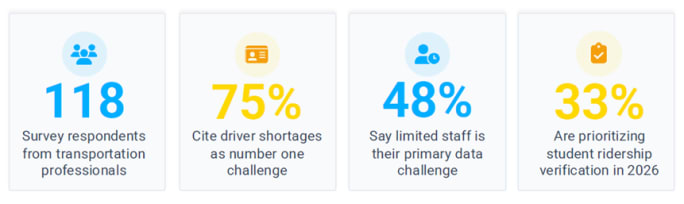
Conducted by School Transportation News and Zonar, answers from 118 respondents show that our industry is stretched thin by:
- Workforce and driver shortages
- Ongoing budget constraints
- Higher expectations for student rider safety
Yet, student transportation fleets are adapting by focusing on accountability, visibility, and tools that help overworked teams manage their complex operations more easily, with more actionable data.
Data shows a maturation of fleet technology in 2026, with investment in student ridership verification and driver coaching. The first generation of tools got buses on the road, on time. The next is about what's happening on board.
Zonar Systems
Driver Shortages Reshape Reliability
For 75% of the survey’s respondents, hiring and retaining drivers is their top challenge. Moreover, 70% expect the driver shortage to stick around long-term.
Fewer drivers mean inconsistent service and budget pressure that compounds. With fewer people to put behind the wheel, transportation teams spend more time managing expectations than running daily operations as smoothly as they’d like.
Looking at the data, the fleets managing today’s pressures most effectively are reducing manual work with:
- Streamlined workflows for dispatch, drivers and staff
(48% cite limited staff as a top challenge) - Clearer visibility into daily fleet operations
(33% plan to adopt student ridership tracking) - Tools that help teams operate reliably in disruption
(ranked first as operation KPI priority)
Safety Challenges Extend Beyond Bus Routes
Student safety remains highest priority. Today’s transportation leaders also include communication and compliance as persistent challenges. And the numbers confirm the reality.
Of the 118 survey respondents, 45% cite parent communication gaps as their most difficult safety issue, and an equal share point to driver behavior and compliance. Student ridership tracking came in a close third.
In an age where people can track their approaching rideshare, families expect timely, accurate updates for their child’s school bus.
Safety is now a system-wide effort that includes how seamlessly information moves between drivers, dispatchers, school administrators, and families. Communication hiccups increase the number of parent calls to strained transportation staff. No one wins; everyone feels the frustration.
In 2026, student transportation fleets also look to standardize inspections and monitor driver behavior more closely. By reducing friction across multiple aspects of fleet safety, they look to head off disruptions rather than react when those disruptions escalate.
Technology Adoption Shifts Toward Accountability
Most school bus fleets already have core tools. Survey results, however, bring to light a shift in where transportation leaders plan to add in 2026, especially regarding student ridership tracking—the largest gap between those with the technology versus those considering it.
· Only 41% of respondents currently use student rider tracking.
· But 33% plan to evaluate student ridership tracking technologies in 2026.
Why? Accountability and on-the-bus visibility.
Transportation fleet leaders need to know who’s on board, and when and where each student is picked up and dropped off. Plus, knowing actual route performance compared to planned will help teams more effectively plan and optimize resources.
Data Competes With Daily Operations
Transportation departments generate more data than ever, but 48% of this survey’s respondents say limited staff keep them from acting on it. Too few people, and too many disconnected systems and data silos render that data almost meaningless, especially when managing that information competes with managing daily operations.
Survey responses point toward a growing need for integration and automation over more solutions. Technologies and systems that automatically surface data and consolidate fleet insights into an easier view are the key to supporting limited staff.
What This Means for Transportation Leaders
This survey underscores a simple truth: Successful, reliable student transportation is measurable. Yes, on-time reliability is a critical key performance indicator, but success is also visible. School administrators and families first notice safety, consistency, and reliability; all of which takes hard work.
In 2026, transportation leaders are focusing their technology investments on tools that support the people doing that work.
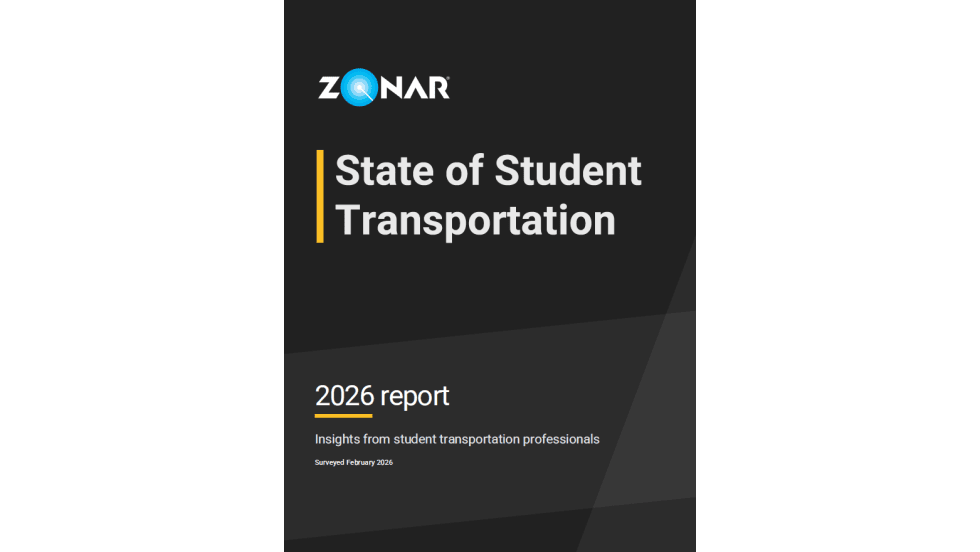
The full 2026 State of Student Transportation Report explores these findings in greater depth, including investment priorities by fleet size and role, long-term strategic focus areas, and detailed benchmarks.
Download the complete industry report to explore the full survey findings and data insights.
This article reflects the views of Zonar Systems and does not necessarily represent the views of School Bus Fleet or Bobit Business Media.