




Check out what companies and services are included in the Sourcewell marketplace for student bus and transportation services online.
 MENU
MENU SEARCH
Take the burden out of bidding. Cooperative contracts can save district transportation teams time, money, and hassle. Here’s how.
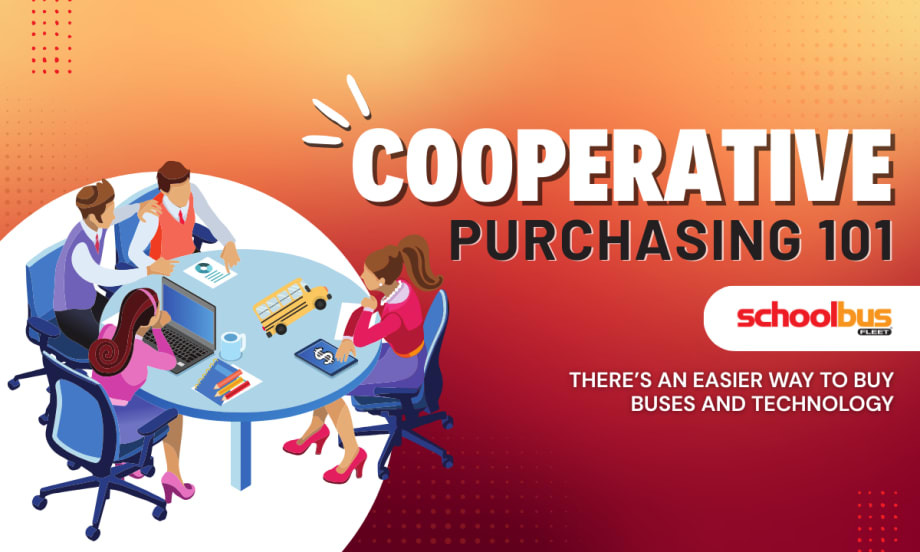
Using a co-op for transportation purchases can save admins valuable time and money while offering greater choice.
School Bus Fleet
*Summarized by AI
Have you ever shopped for groceries at one of those local co-ops? They’re usually run by community leaders who vet the items in their stores carefully and negotiate discounted pricing for their members so you can trust everything inside their doors.
A similar option exists for school transportation. In fact, it’s likely that your school district already participates in cooperative purchasing. If transportation has been left out of that process, or you want to explore if it’s right for you, this guide will help break down what it is, how it works, and what else you need to know to make bidding and buying way easier.
You probably buy your buses and certain technologies through a competitive bidding process. And it’s rarely not time-consuming to prepare documentation, send it out, evaluate proposals (if you even get any back), and make your decision (or start over). That process alone is one way cooperative purchasing can make your job easier. (State contracts work similarly.)
The biggest difference between using a cooperative like Sourcewell and a state contract is that a state does its own bidding on behalf of itself and all districts in its area, whereas Sourcewell does it on behalf of the entire country. And that higher volume often brings substantially higher benefits. “Now, that doesn't guarantee that our pricing is going to be better than a state,” warned Andy Campbell, director of cooperative contracts at Sourcewell, “but it does give school districts more choice.”
Translation: State contracts can be narrow in scope to follow local specs, but you may want to add additional features to your buses. However, you can rest assured that all Sourcewell contracts will automatically match your state’s specifications at minimum. And, they ask all vendors to make their entire product catalog available throughout the process.
Not all industry vendors make the cut, though. Sourcewell uses a competitive solicitation process, asking each supplier it contracts with pointed questions about their company history, product offering, and customer support. “It really filters out the contenders from the pretenders,” Campbell said.
Campbell notes that using Sourcewell’s cooperative purchasing contracts also makes purchasing much less risky. “With a bid, it's at best 50/50 that a supplier will win your bid,” he explained. “Oftentimes, the ‘low bidder’ wins, and we all know why that company is low bid.”
You’re probably familiar with a district administrator who sees the price of something and pushes for the lowest-cost solution to save money. You’re probably also familiar with situations in which that low line-item upfront actually ends up costing more in the long run.
Remember, you are the expert in your department, and you must advocate for yourself to administrators. District superintendents or purchasing departments don’t know what they don’t know, and it’s up to you to educate them on how buses and transportation actually works.
Fueling, maintenance, downtime, accidents, corrosion, specialty parts, technology integrations, certifications for specific systems, are all considerations that must be accounted for when thinking about total cost of ownership. When in doubt, pull real-world data to illustrate pain points that may not be felt outside of the bus barn.
Oh, and the fact that time is money.
“I think as public servants, we naturally don't give ourselves enough credit for what our time is worth,” Campbell said. “That is, hands down, a massive load of stress off to buy the same way that the private sector does, and the Sourcewell contract is the great equalizer.”
Eric L. Watkins, transportation & school safety director for Stewart County Schools in Tennessee, agrees. "Sourcewell saves us a great deal of time," he said. "We don't have to worry about advertising or seeking out bids. In a small department like ours, we have to work smarter, not harder."
Watkins also appreciates that by using cooperative purchasing, he doesn't have to deal with auditors as Sourcewell's documentation takes care of any issues
“Using a cooperative contract is a massive leveling of the playing field, because once that district has realized and done their due diligence to say, ‘yes, we're legally allowed to use cooperative purchasing as a compliant way to purchase,’ it's a game changer.”
Need help starting the conversation with your administration? Stephanie Eckes, director of government accounts for K-12 at Sourcewell, encourages transportation directors feeling stuck to reach out for help. “Let us take a look at what your district has bought from other cooperative contracts,” she said. “Let's work together. Maybe it's a joint meeting with the purchasing office. Maybe we have to get our government relations team involved to evaluate if they can use us or not. Engage us in the conversation, and we'll do everything we can to support you.”
If one of your hesitations to use co-ops was limited selection, it’s time to take another look at what’s available. Sourcewell says they’re always listening to what real fleets need and want and adding more categories and offerings to the marketplace.
“We're constantly innovating and coming up with more and more contract categories to hit some of these niche areas of need for school districts,” Campbell said. “Now we have an alternative student transportation category. Maybe a school district had to lay off mechanics, and now maintaining buses is becoming a challenge. We have garage services that can work with districts to help maintain their fleet assets. I mean, these are like niche things that you don't often see with other cooperatives.”
Dig deeper into this conversation in this video episode of The Route!
What is cooperative purchasing, anyway? Cooperative purchasing is defined as “Procurement conducted by, or on behalf of, one or more public procurement units.” This essentially boils down to collective purchasing power. The more people in an industry buy something through a group contract, the more each saves in the long run (kind of like the power of collective bargaining through a labor union).
Who is eligible to participate? Products and services available through Sourcewell are available to government and education entities. Businesses, private consumers, and for-profit organizations are not eligible.
How does it work? Sourcewell does all the heavy lifting for you, including developing and collecting RFPs for solutions and products. You just need to pick what products or services you need and select the vendor that best fits what you’re looking for. If you need guidance, Sourcewell also offers consulting to help you understand your options.
How do I know if cooperative purchasing is legally compliant in my state? To make it easy to find out if your state allows cooperative purchasing, and what laws and regulations govern its use, check out Sourcewell’s website; simply select your U.S. state from the dropdown menu to find legal statutes where you work.
What types of solutions are available? Nearly any product or service you might need to run your vehicle fleet can be found as a contract option, from buses to tires, to cameras and fleet software, electrification, or alternative transportation.
What is the process like? For Sourcewell, the process looks like this: Their team develops and opens the RFP, advertises it, evaluates all proposals along a scoring criteria, and decides which companies to award contracts to.
How are the vendors vetted? Each company that works with Sourcewell is hand-selected by a team that thoroughly reviews all applicants (not all will be chosen) and ensures that the provider can meet what its end-users need and expect. They look for things like longevity, expertise, responsiveness, responsible business practices, current client satisfaction, and reliability.
What happens if the market price of something drops mid-contract? All Sourcewell contracts allow for price changes to be requested throughout the term of the contract. All vendors must detail the changes they’d like made, why, and provide supporting documentation for the change. After a multi-step approval process, the price change is approved. This process allows for awarded suppliers to add new products to their contracts or remove obsolete products.
What if I’m not happy with a vendor I chose? It’s important to note each vendor’s legal terms & conditions with the purchase order. Sourcewell contracts allow additional terms between the purchasing entity and the awarded supplier. These should detail any specific performance expectations you have. If you don’t feel the supplier is living up to those, reach out to your Sourcewell rep! “We don’t leave schools out on an island,” Campbell said. “Oftentimes, we are able to leverage our relationships with our awarded suppliers to resolve most conflicts.”
Is Sourcewell the only cooperative purchasing option? No, there are many co-ops available for student transporters like BuyQ, BuyBoard, Choice Partners, Cooperative Purchasing Connection, or OMNIA, as well as some state-wide and niche groups! (We chose to focus on Sourcewell in this article because of the depth and breadth of their industry experience and offering.)
When should I not use cooperative purchasing and bid on my own? The two main reasons Campbell suggests using a co-op is for everyday items you use regularly (buses, fuel, telematics, parts, etc.), or if you’ve found a supplier that meets all your needs and they’re already in the Sourcewell marketplace. If you’re in search of a niche, one-off purchase or your preferred vendor doesn’t work with Sourcewell, you’re probably better off going directly through that company.
How can I participate? If you’re interested in using a Sourcewell contract, register on their website. There is no cost to sign up and no obligation to purchase. Once you find the contract you’re interested in, contact the supplier to get a quote and seal the deal (if you choose).
Cooperative purchasing involves multiple school districts joining together to leverage their combined buying power for transportation services, which helps to reduce costs and streamline the procurement process.
*Summarized by AI
Loading data...

Management
Learn the five key elements that bus drivers and transportation directors can use to stay calm in any situation.

Management
Every day, millions of students climb aboard. But few realize the yellow school bus has helped transform education, connect communities, and come to symbolize civic responsibility.

Management
Discover five strategies for building an effective mentorship program to strengthen leadership development and support staff retention.

Special Needs Transportation
Small missteps in wheelchair securement can have serious consequences. Here are 32 tips from experts to reduce risk and increase student safety on the bus.
Management
Take the burden out of bidding. Cooperative contracts can save district transportation teams time, money, and hassle. Here’s how.

Management
Learn from school transportation leaders on how to develop bus drivers, monitors, and mechanics into future leaders through coaching and culture.
Safety
With student safety on the line, here’s a look at what’s working, what’s changing driver behavior, and what districts need to know when it comes to stop-arm programs.

Management
As we celebrate seven decades of industry coverage, let’s revisit historic milestones, timeless content, and examine the industry's progression from those who lived it.