How a Century of Change Shaped the School Bus Industry We Know Today
As we celebrate seven decades of industry coverage, let’s revisit historic milestones, timeless content, and examine the industry's progression from those who lived it.
As we celebrate 70 years of School Bus Fleet, let's take a look back at the industry moments and milestones that shaped pupil transportation.
Photo: School Bus Fleet
7 min to read
The article reflects on seven decades of School Bus Fleet's coverage, highlighting significant milestones in the school transportation industry.
It delves into the historical progression and transformation of the industry through accounts from expert veterans who experienced it firsthand.
The content revisits timeless information, offering insights into how past changes have shaped the current state of the school bus industry.
*Summarized by AI
For seven decades, School Bus Fleet (SBF) has chronicled an industry that is both remarkably stable in its mission and constantly evolving in its methods.
The story of pupil transportation is a story of safety breakthroughs, engineering leaps, cultural shifts, and the relentless dedication of people determined to protect children whom, in some roles, they may never meet. As we mark our 70th anniversary, we asked industry veterans to reflect on the moments that shaped the yellow bus into the safest vehicle on the road, and what work we still have left to do.
Ad Loading...
What emerges is a portrait of an industry defined by an array of innovations and regulations pushing waves of change, including:
The 1939 national standards that unified the school bus’s basic identity.
The 1977 Federal Motor Vehicle Safety Standards that reshaped its engineering.
The adoption of diesel, alternative fuels, and now electrification.
The rise of technologies, from two-way radios to GPS and telematics, that fundamentally altered daily operations.
However, these decades are defined by people like directors, drivers, and engineers whose decisions have shaped millions of student journeys. It’s a rare thing when an entire industry is in it for the right reasons, and that’s the reality for all of us in pupil transportation.
As we celebrate 70 years of School Bus Fleet, let's take a look back at the industry moments and milestones that shaped pupil transportation.
Photo: School Bus Fleet
A Century-Long Arc of Engineering Progress
The foundation for the modern school bus was laid long before School Bus Fleet’s first issue, but the magazine’s history overlaps with a period of unprecedented standardization and design evolution.
As Blue Bird’s EV Product Segment Leader, Brad Beauchamp, said, “The era when School Bus Fleet started was at the beginning of the years when the school bus started shifting toward its current form.”
In the post-war decades, consolidation of school districts created demand for larger-capacity buses, prompting the rise of Type D designs and gradual unification of lighting, signage, and structural features.
The 1960s marked a huge visual shift when buses transitioned from rounded bodies to the flatter, more angular forms that dominate today. This new geometry, Beauchamp explained, “provided a better space for identification, warning, and loading lights.”
But the most transformative changes came through regulation. Nearly every expert tapped for this article pointed to the creation of national standards as a defining moment.
Ken Hedgecock, former Thomas Built Buses sales exec and retired sales manager at United Safety & Survivability Corp., highlighted two: the national minimum standards proposed for school buses in 1939, which, along with dozens of other standards, introduced the iconic yellow color, and the 1977 federal safety standards. These initiatives, he said, brought “safety features like fuel tank cages, 60% joint strength, rollover protection, and seat construction into federal law and were implemented by all OEMs on school buses, leading to the school bus becoming the safest form of ground transportation in the nation.”
Max Christensen, state director in Iowa, SBF editorial advisory board member, and senior safety advocate at First Light Safety Products, reflected on his early career that began in 1987. At the time, his district still operated some pre-1977 buses, and he noted the differences right away. “They definitely were not as safe as the newer buses, and that was looking at them with a greenhorn's eyes.”
The 1988 Carrollton, Kentucky, crash further illuminated gaps in the post-1977 standards, particularly around fuel tank protection. “I still remember having to take all of my buses to the local school bus dealership (50 miles away) and having cages installed,” Christensen said, illustrating how tragedies continued to shape engineering priorities.
Radios, Routing, and the Tech Layer
If federal standards redefined the structure of the bus, everyday technologies reshaped its operations. Beauchamp places the two-way radio and the automatic transmission at the top of his list.
Two-way radios transformed communication, coordination, and safety. “It was a valuable tool used every day,” Beauchamp said. Radios allowed drivers to alert dispatchers to absent students, congestion, or hazards, and they also helped build camaraderie. Even simple sanity checks could be quickly accomplished, he said, sharing a memory of hearing “17, your left turn signal is on.”
Automatic transmissions, meanwhile, changed the job of driving entirely. Beauchamp painted the “old world” vividly. “The drivers were dancers in those days. [...] It was an art in action to watch!” Only by the mid-1980s did automatics become the norm outside rural and agricultural regions, reducing fatigue and improving safety.
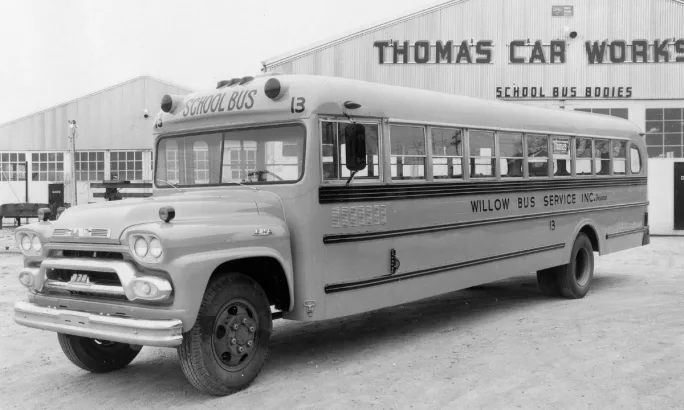
Long before this 1958 photograph, the earliest “school buses” were horse-drawn carriages known as “kid hacks.”
Photo: Thomas Built Buses
Similarly, the rise of computerized routing and GPS marked a turning point. Derek Graham, former NC state director and current industry consultant with Edulog, noted that when he began, “computer routing was just being made to be operable on PCs.” Today, apps, student-tracking systems, and onboard navigation have become “essential.”
Terry Tippin, executive director of the School Transportation Association of Indiana, recalled the leap from “pins and string” to software, describing how the current profession is built on data, telematics, and integrated platforms. “Routing software and GPS have replaced manual mapping. [...] Data analytics now drive decisions on cost, efficiency, and compliance,” he said.
The role of the transportation director evolved accordingly, moving from hands-on mechanic-drivers to strategic leaders guiding multimillion-dollar operations.
“We are no longer just logistics managers — we are leaders shaping the future of student transportation,” Tippin said.
Safety Innovations: Seat Belts, Compartmentalization, and More
Seat belts have long been one of the industry’s most contentious topics. While compartmentalization — codified in 1977 — created a passive safety environment, leaders across the industry still view modern lap/shoulder belts as a next-generation enhancement.
Graham pointed to multiple milestones, including piloting fixed seating in 2003, introducing flex seating in 2007, and the NASDPTS position paper in 2014 supporting lap/shoulder belts, which was the first national endorsement of its kind.
“Here we are in 2026, and there is still pushback, often citing the same arguments given for lap belts in the ‘70s and ‘80s,” he said, even as federal agencies recommend belts.
John Barrington, executive director of school bus sales at IMMI, added that lap/shoulder belts are “practical” now because manufacturers have found ways to maintain seating capacity. The incremental nature of safety improvements, he argued, reflects an industry “slow to adopt tech” but deeply committed to risk reduction.
On the other hand, California’s seat belt mandates illustrate how legislation drives adoption. Pam McDonald, former director of transportation at Orange Unified School District in California, highlighted how “three-point seat belts were required on school buses manufactured after July 1, 2005, for those carrying more than 16 passengers.” Plus, students are legally required to wear them and must also receive instruction in proper belt use.
Alexandra Robinson also points to California’s early adoption here as a milestone firm in her recollection of industry history.
Yet, some innovations arrived quietly before their time. Barrington recalls that Superior Coach introduced a crossing control arm in the 1960s, only to remove it due to poor sales. Today, “it’s required equipment in many states,” proof that good ideas sometimes need decades to take root.
From High School Drivers to Professionalized Leadership
Many of these industry veterans emphasized just how much culture has changed.
“Until CDLs came along (implemented in the early 1990s), it was common in many states in the south for school buses to be driven by high school students. It was a highly sought-after job,” Graham said. Before CDLs, requirements to drive a school bus varied from state to state and often required only a driver’s license (occasionally with a special endorsement).
McDonald recalled an era when drivers were part-time, and the profession was gender-segregated. “Most drivers were women, and the men were retired from a different profession. At the time, most transportation directors were men,” she said. Today, she’s happy to see many more women leading transportation teams.
Tippin highlights the professionalization of leadership in the 1990s, crediting figures such as Mike Martin and organizations like the National Association for Pupil Transportation for elevating directors through professional development programs.
Across these decades, the driver shortage endures. Graham puts it bluntly: “I’ve never known a time when we had too many school bus drivers.”
It’s true that people shape the industry's mission. “The most critical component of the pupil transportation industry’s impeccable safety record is people, the dedicated professionals who have one simple goal. [...] The safety of their students is their No. 1 priority,” Hedgecock said.
Christensen offered a quote capturing this ethos: “Virtue lies in caring about the safety and well-being of children you don't know.”
A callback to mentorship threads through every interview, including Charlie Hood, Chris Darling, Linda Bluth, Ron Kinney, Peggy Burns, Nick Meyerrose, and dozens more who shaped careers and standards alike.
Earlier in Tippin’s career, Meyerrose told him, “Regardless of the size of the school, we all face the same challenges.”
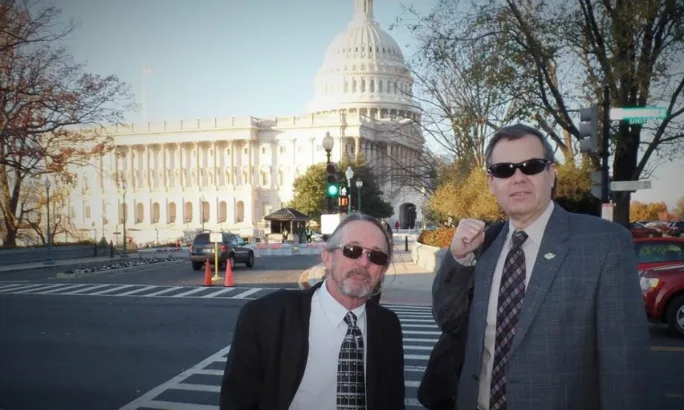
The U.S. Capitol looms behind Derek Graham (right) and Charlie Hood (left) during a trip attending a NASDPTS meeting.
Photo: Derek Graham
Unfinished Business and the Road Ahead
Despite all the progress, every industry veteran identifies gaps such as funding constraints, illegal passing, driver recruitment, equity, and technology adoption that remain to be closed.
As School Bus Fleet turns 70, the story of the school bus continues to unfold. Every advancement in pupil transportation is, at its core, an act of collective care.
The industry’s past is rich, its challenges real, and its future bright, because its people continue to lead with a strong integrity unique to what the industry is known for: an unwavering commitment to safeguarding every child on the school bus with a profound sense of responsibility.
School Bus Industry Milestones at a Glance
1880s: The earliest “school buses” were horse-drawn carriages known as “kid hacks.”
1939: The first National Congress on School Transportation (NCST) is held (then called a conference) and formulates 44 recommended standards, including the color now called “National School Bus Glossy Yellow.”
1977: Federal Motor Vehicle Safety Standards are introduced, a new set of federal standards calling for certain safety features across school buses (including compartmentalization, emergency exits, roof strength, fuel system integrity, and brake systems).
1992: Stop arms become federally required on all new school buses and a new requirement for all school bus drivers to have a CDL begins.
2021: The Bipartisan Infrastructure Law created the EPA’s first round of Clean School Bus Program funding for electric vehicles and infrastructure.
Key milestones include the introduction of standardized safety measures and bus body improvements, the development of specialized vehicle designs, and advancements in fuel technology and emissions standards.
Industry coverage has provided a platform for sharing innovations, safety protocols, and regulatory changes, thereby guiding the sector’s development and standard practices.
Revisiting historic milestones allows us to understand the challenges and innovations that have shaped current practices and ensure ongoing improvements in safety and efficiency.
Notable figures include manufacturing engineers, safety advocates, state directors, association leads, and policy makers who have pioneered and advocated for changes in safety standards and vehicle design.
Recent trends include the adoption of electric buses, enhanced safety technologies, and a focus on sustainability and environmental impact.
What makes emotions run high, and how should you handle an angry colleague or parent? Follow these steps for staying calm, listening, showing empathy, and resolving conflict.
Every day, millions of students climb aboard. But few realize the yellow school bus has helped transform education, connect communities, and come to symbolize civic responsibility.
Small missteps in wheelchair securement can have serious consequences. Here are 32 tips from experts to reduce risk and increase student safety on the bus.
With student safety on the line, here’s a look at what’s working, what’s changing driver behavior, and what districts need to know when it comes to stop-arm programs.
As we celebrate seven decades of industry coverage, let’s revisit historic milestones, timeless content, and examine the industry's progression from those who lived it.