




The Illegal Passing Problem: Reducing School Bus Stop-Arm Violations
 MENU
MENU SEARCH
With student safety on the line, here’s a look at what’s working, what’s changing driver behavior, and what districts need to know when it comes to stop-arm programs.
Stop-arm violations remain widespread and dangerous. Here’s what’s working.
School Bus Fleet
*Summarized by AI
The school bus slows to a stop, activates its amber lights, then its red lights, and the stop arm extends. Cars stop. Students cross safely.
Right?
Well, that may be the law, but that doesn’t represent reality.
As many of us in the school bus business know, drivers not stopping when they should has become an epidemic.
“Despite more public awareness and tougher laws, many drivers continue to ignore stop arms, often because they’re distracted or impatient,” said AngelTrax President and CEO Richie Howard.
Public awareness efforts alone aren’t enough to turn the tide. Enter stop-arm enforcement programs.
We now have a better idea of why drivers aren't stopping. In a recent NHTSA public attitudes on student safety survey, 30% of respondents said they don't stop for the bus because they don't care. A quarter justified it because they were in a hurry, and another quarter didn’t understand the law.
Distracted driving and hustle culture contribute to the problem. While technology has exacerbated the problem on the one hand, it can also help alleviate it.
“Buses are now equipped with better lights, cameras, and stop arms to catch offenders, and penalties have increased in many states,” Howard added. “But ultimately, real change only happens when drivers face actual consequences — like citations and the fines that accompany them.”
Across the U.S., school bus operators are increasingly turning to enforcement programs backed by video, data, and partnerships with law enforcement.
Stop-arm enforcement programs typically combine exterior cameras mounted on the school bus, automated violation detection, human review, and law enforcement approval to identify and penalize illegal school bus passing.
The goal: sustained behavior change.
Across the U.S., students face the threat of drivers missing or ignoring the stop arm on the school bus, leading to injuries and even deaths.
Maryland is no stranger to this trend. In 2018, Baltimore ranked second in a statewide survey on drivers who ignored the buses’ flashing lights and stop signs.
To combat this dangerous trend, in 2024, Baltimore County began the school year with new cameras installed on its buses. The district partnered with local police and AngelTrax on the technology, while upgrading existing cameras and increasing video footage availability.
During the warning period in Baltimore County, drivers who illegally passed a stopped school bus received a written warning by mail. After the warning period, each violation was subject to a $250 fine. That’s not to say it happened automatically; each infraction was reviewed by both AngelTrax and a Baltimore County police officer before the citation was issued.
Most of the revenue from the fines went toward the cost of the cameras; the rest to the county government, which distributed it to safety assistants to create safe environments through student relationships.
“During a one-day study, we had over 387 cars pass our school buses in Baltimore County just in one day,” Chief of Police Robert McCullough told WYPR. “It's a much-needed program so that we can protect our students.”
In the 2025 National Association of State Directors of Pupil Transportation Services (NASDPTS) survey, the state of Maryland reported 1,686 illegal passes from 5,056 participating school bus drivers. That’s an average of 0.33 passes per bus per day.
For comparison, in 2024, it reported 1,922 illegal passes from 4,588 drivers. That’s an average of 0.41 passes per bus per day.
Year over year, it's an improvement of about 20% across the state.
Another district that launched a stop-arm enforcement program is Santa Rosa County District Schools in Florida.
In 2023, a new state statute permitted schools to contract with third-party providers for stop-arm camera violation enforcement. The district teamed up with its local sheriff’s office and AngelTrax in 2024 to introduce citations and $225 fines to violators. Violators who don’t follow through on payment, transfer, or contestation within 60 days of the issuance of the citation will receive a uniform traffic citation (UTC). AngelTrax has been approved by the state of Florida to issue UTCs on behalf of law enforcement, eliminating the burden that would normally be on law enforcement.
The program was well-received by its community. On social media, comments expressed happiness about the camera addition, with many noting they have personally witnessed numerous infractions. Some wished the fines were larger and penalties were stricter.
In states where funding is allocated to assist with implementing stop-arm enforcement programs, added success usually follows.
Minnesota’s Department of Public Safety has hosted eight rounds of stop-arm camera grants, reimbursing districts and contractors who purchase and install camera systems. Since the program began in 2022, the state has awarded more than $15 million, equipping about 8,000 school buses statewide with cameras.
“The safety of our students is our top priority, and these cameras will help ensure drivers stop when students are boarding and unloading,” said Tom Jerome, superintendent of the Roseau school district, whose 13 buses are receiving cameras.
Christine Tucci-Osorio, superintendent of ISD 622 added, “The cameras provide an extra layer of security and reinforce the importance of stopping for school buses.”
The district’s use of cameras led to 2,105 citations for violations in 2024.
One industry association has been tracking illegal passings since 2011. NASDPTS reports show that illegal passes were at their worst pre-pandemic. The national average of illegal passings per day has fluctuated from 0.69 per day in 2011 to 0.65 per day after 2019. The 13th annual survey in 2025 found 0.59 per day, finally reversing the 4% year-over-year increase from the previous two years.
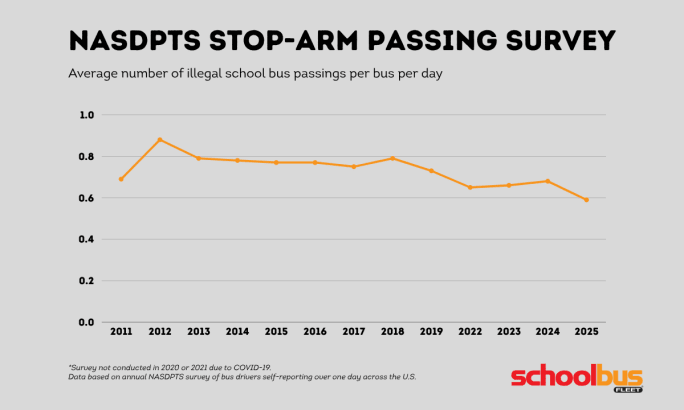
The most recent national survey shows that stop-arm passing is finally trending downward. But that doesn’t mean we can rest on our laurels.
NASDPTS
It's an improvement, but it still records 39.3 million violations per year nationwide, and each violation represents a moment when a child was exposed to unnecessary risk.
“We recognize for the first time we have seen a reduction in illegal passings, but we also note the problem is far from resolved,” NASDPTS added in response to the 2025 results.
To continue combating the problem, multiple efforts are underway, from legislation to education and advocacy to increased awareness of the dangers of ignoring the school bus stop sign.
What makes school bus cameras effective is not just documentation. It’s visibility, certainty, and follow-through.
The good news is that camera technology is advancing so fast that what once produced unreliable imagery now boasts clear, irrefutable proof of violations. (Plus, costs have come down, a win for tight district budgets.)
Cameras capture evidence, deter drivers by being visible on the side of the bus, and now feature high-resolution video, AI detection of vehicles entering the stop arm violation zone, and dual license plate cameras that capture 5MP images from multiple directions across several lanes.
AngelTrax’s Child Safety Program combines automated detection with human review and law enforcement oversight, ensuring citations are accurate, legally sound, and focused on behavior change rather than volume. When its cameras are in use, a Child Safety Program supervisor manually reviews video evidence to verify the vehicle’s owner registration data using DMV and Nlets databases before elevating the evidence to law enforcement. Then, authorized law enforcement officers access a secure web portal to review the evidence package, determine whether a violation occurred under state law, and approve or reject the citation request.
In Harford County Public Schools, then-transportation director Cathy Bendis fully integrated cameras on its fleet for the 2023-24 school year.
The installation included:
“We believe there is an awareness level that has been increased with the public and we hope to see a continued pattern of improvement,” Bendis said. “This technology also allows for reports on specific days, times, and locations of repeat offenders. This reporting allows for local law enforcement to deploy officers efficiently to support the work of the cameras.”
To increase effectiveness, Harford County ensured drivers stopped correctly, reviewing proper procedures with over 700 staff members.
Fortunately, after the program’s been in effect for over a year now, the district is seeing a reduction in stop-arm citations: An approximate 19.79% decrease from the 2023-2024 to the 2024-2025 school year.
Danielle Bedsaul, director of transportation, said that they work very closely with the Harford County Sheriff's Office and Sherriff Jeffrey Gahler to provide public awareness. Check out this video collaboration for National School Bus Safety Week:
“What I like about civil fines being levied through automated stop arm camera enforcement programs is that the number of violations means more citations and more members of the public are touched,” said Derek Graham, industry consultant. “If (someone is) angry that they received a citation, they will likely complain about it to friends. More chatter means more awareness and maybe, just maybe, improved motorist behavior.”
The bottom line: Industry data shows that up to 98% of drivers cited for a stop-arm violation do not reoffend, a powerful indicator that enforcement changes behavior.
The best approach to tackling stop-arm passing will have multiple levels, said Lieutenant Brian Reu, Minnesota State Patrol. It starts with education and ensuring motorists understand the law.
“The installation of the stop-arm cameras has assisted law enforcement greatly in identifying violations and in the follow-up investigation,” Reu said.
Denis Gallagher, Jr., senior VP of operations, Student Transportation of America, called illegal passings one of the most dangerous problems in school transportation, but also one of the most solvable. “We need a combination of technology and shared ownership to fix it,” he said. “Every time someone illegally passes a school bus, a child’s life is at risk. Let’s make it clear that this isn’t just illegal, it’s unacceptable.”
Stop-arm enforcement programs are crucial because they enhance student safety by deterring drivers from illegally passing stopped school buses, thereby preventing potential accidents and ensuring students can board and leave buses safely.
*Summarized by AI
Loading data...

Management
What makes emotions run high, and how should you handle an angry colleague or parent? Follow these steps for staying calm, listening, showing empathy, and resolving conflict.

Management
Learn the five key elements that bus drivers and transportation directors can use to stay calm in any situation.

Management
Every day, millions of students climb aboard. But few realize the yellow school bus has helped transform education, connect communities, and come to symbolize civic responsibility.

Management
Discover five strategies for building an effective mentorship program to strengthen leadership development and support staff retention.
Special Needs Transportation
Small missteps in wheelchair securement can have serious consequences. Here are 32 tips from experts to reduce risk and increase student safety on the bus.

Management
Take the burden out of bidding. Cooperative contracts can save district transportation teams time, money, and hassle. Here’s how.

Management
Learn from school transportation leaders on how to develop bus drivers, monitors, and mechanics into future leaders through coaching and culture.
Safety
With student safety on the line, here’s a look at what’s working, what’s changing driver behavior, and what districts need to know when it comes to stop-arm programs.
Management
As we celebrate seven decades of industry coverage, let’s revisit historic milestones, timeless content, and examine the industry's progression from those who lived it.