




Owatonna Bus Co. Shares TCO Secrets
Greg Lammers, Owatonna Bus Co.’s fleet manager, attributes his success to a dependable software management system and efficient procedures, which keep his total cost of ownership at a minimum.

Owatonna Bus Co. has six locations, serving 48 states and all Canadian provinces. Though the company’s bread and butter is school buses, its various locations also offer services such as a full paint booth for outside work, charter coaches and special-needs transportation.
A minimal total cost of ownership (TCO) is the goal for any fleet manager. With some precise company procedures, Greg Lammers, the fleet manager for Owatonna Bus Co. in Owatonna, Minnesota, has managed to calculate and measure his exact TCO for each vehicle in his 275-vehicle fleet. What has helped Lammers perfect his system is management software called ManagerPlus.
With this software, some strategic forward-thinking, and an effort to streamline his labor, maintenance and inventory costs, Lammers has created a system that minimizes human error and safety checks that ensure no vehicle maintenance falls through the cracks.
Getting started
Owatonna Bus Co. began in 1967 with owner William E. Regan’s purchase of Mason Bus Co., which consisted of two charter coaches, 16 school buses and a few hearses. Over the next 46 years, the fleet expanded into various locations throughout Minnesota, Iowa and Nevada. Now, Owatonna Bus Co. has six locations, serving 48 states and all Canadian provinces. Though the company’s bread and butter is school buses, its various locations offer other services as well, such as a full paint booth for outside work, charter coaches and special-needs transportation with Type A wheelchair vans.
Lammers explains that when he started with the company in 1977 as a service technician, technicians had to record everything in a notebook. They wrote down the mileages of buses at least once a week or when they were being refueled. The technicians recorded how much fuel was used, the date and the mileage of the bus. These notebooks, of course, were not surefire, and if a technician overlooked a bus or recorded the mileage wrong, it could cause maintenance and cost issues.
“All of a sudden if someone realizes a bus didn’t get the oil changed for 10,000 miles when it should have been done at 4,000 miles, that’s a problem,” he says. “The chances of something like that happening now, slipping through the cracks, is pretty rare, just because there are so many systems put into place to double check itself.”
For example, if the driver enters a nonsensical mileage into the fueling software, the system understands that and prompts the driver to reenter the mileage. After three tries, the driver can manually enter it, but the software logs it as incorrect and Lammers will get an alert. That’s one of the processes that makes an oversight almost impossible.
The evolution
The company purchased ManagerPlus in 1997 in an effort to cut down on paper waste, cost and maintenance oversight. The system was originally run on DOS and then switched over to a Windows application, which Owatonna Bus Co. has been on for nearly 20 years. In that time, the software has enabled Lammers and his team to streamline their processes, allowing them to focus their energies on the bottom line.
The first thing ManagerPlus allows for is each technician to log his own maintenance at every facility Owatonna has. Lammers once had to enter all the data into a single terminal by hand, from work orders that were printed. Now, with three terminals in the Owatonna location for four technicians, each technician is able to create his own preventive maintenance work orders in the system, cutting down on paper usage. “Every bus that’s brought in is logged right away, and the system tells us which service it’s ready for. All I do is make sure the info and the data is correct,” Lammers explains.
The other main feature Owatonna uses ManagerPlus for is fuel tracking. The company uses an independent fuel software that is tied to its fueling sites. Each major location has onsite fueling. When a bus is fueled, the company knows who fueled it, what time, the mileage and the amount of fuel the driver took. That information is then exported and uploaded into ManagerPlus every two to three days. Lammers has the pumps checked every six months to ensure preciseness, which is, in turn, how ManagerPlus knows when to schedule preventive maintenance for the vehicles. Plus, this is another area in which the company has cut down on paper flow.
On top of fuel and labor, Owatonna Bus Co. uses ManagerPlus for tracking inventory. Lammers says that mechanics can create a purchase order for a part. With the system, he can see which bus these parts went to. “We can track our usage,” he explains. “If I want to know how many oil filters we use in a month or six months because a vendor is having a sale, I can order those parts accordingly with just a couple keystrokes.”
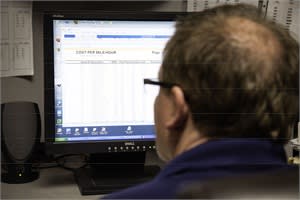
With the transparency of information provided by ManagerPlus software, Greg Lammers, the fleet manager for Owatonna Bus Co., can quickly determine the TCO for each of the fleet’s buses, and whether the shop’s procedures are saving money.
Numbers don’t lie
With all of these system measurements in place, Lammers is able to be exact in measuring his TCO, which is the best system usage of all. “I can look at a group of buses that are the same year, make and model, and I can tell you exactly what our TCO for each one is,” he says. With this transparency of information, he is able to see if their processes are saving even a minimal amount. “When you’re operating 500,000 to 600,000 [miles] on a contract, saving 10 cents per mile is huge. … That’s a chunk of change,” he says.
An area of his fleet in which Lammers noticed a significant cost savings was with the type of bus he was operating. The Owatonna fleet includes a mix of different makes of large school buses. However, Lammers noticed as he did fuel testing that the Thomas Built was the most cost effective. He explains that after extensive testing in the spring of 2013, with the same driver, route and conditions, the Thomas buses had an advantage of three-quarters of a mile per gallon, which he said makes them the better choice for replacing older vehicles. With 20,000 miles run per bus per year, the difference is substantial.
Plus, Lammers says, Owatonna Bus Co. has excellent Thomas Built support within Minnesota. He has several Thomas/Freightliner-trained mechanics who were familiar with the multiplex wiring when it was launched, so the transition was simple. Lammers says, “Though I hate to have all my eggs in one basket, I think once we started seeing the numbers and fuel mileage and the ease of maintenance, [Thomas Built] was the way to go.”
Owatonna’s future
The company is currently working toward a comprehensive Enterprise system for ManagerPlus. While Lammers is an advocate of the software, each location terminal operates independently of the others, making it impossible to access all bus records simultaneously. As it is, Lammers has to travel to each location to verify the information is being entered correctly. With the new system, employees will be able to access the server remotely, and Lammers can see exactly what is going on at each location in terms of service, parts and fuel management.
Additionally, technicians will have their own laptop at their workstation so that they don’t need to walk into a kiosk to enter the service or work order. Plus, technicians will have access to the Thomas/Freightliner tech site, the IC Bus tech site and Blue Bird’s site in case they need to reference anything during the service.
There are also some nuanced benefits of this new central server. The company will be able to mark up labor for any outside work technicians do rather than having to change the base cost. And, technicians will now be able to include a digital scan on the title of the vehicle, and any warranty or recall information, so everything is one place. This, along with a physical document recorded in each unit’s file, creates a paper trail in case of a Department of Transportation audit, according to Lammers.
Lammers is also looking forward to examining the TCO variance between drivers and locations. By comparing several buses running on the same route, he will be able to see how the driver alone makes a difference on fuel mileage and maintenance. “We can really look at those and see where we can save some money,” he says. “We’re a private contractor, so we want to be able to maximize our dollar for what we’re doing.”
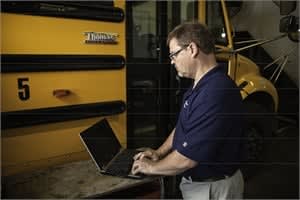
Owatonna Bus Co. has been able to cut down on paper flow with ManagerPlus, which tracks fuel, mileage and inventory, and can schedule preventive maintenance.
Advice for fleet managers
Having streamlined his TCO measurements, Lammers gives some advice to fleet managers who are looking to do the same. He says that one cannot do a good job without data. Without data, one won’t be able to calculate a TCO. With data, fleet managers are able to see what is and isn’t working.
Trial and error is another recommendation, if the company can afford it. Because Owatonna Bus Co. is now a big company, it is able to experiment and test different products. For example, a few years ago, the fleet made the switch to synthetic oils. While they are more expensive, the company increased the fleet’s drain intervals, making it a bonus. “We’ve found some things that have worked and we’ve found some things that really haven’t. If you have good data input, it’s pretty easy to see,” Lammers says.
Finally, he says he can’t encourage networking enough. While it may sound like a silly endeavor, he says, there are nationwide fleets with fleet managers who have been working for a very long time. There are resources out there to help people and answer questions. Lammers says, “We can talk to a guy who works for Coach USA that probably has 100 of the same model we’re operating one of. We can talk to him when we’re having problems or ask who he talks to. They see a lot more than we do.”
Quick Answers
Greg Lammers is the fleet manager at Owatonna Bus Co.
*Summarized by AI
More Management

EverDriven Launches Route Consolidation Calculator to Estimate Diesel Savings
As diesel prices hit record highs, the largest alternative transportation provider says a 10% route consolidation could save a 120-route district more than $78,000 a year in fuel alone.
Read More →
Zum Secures Continued Financing Support for School Bus Expansion
Generate Private Credit has financed approximately $75 million in school bus deployments across three states, supporting more than 500 buses as Zum expands across the county.
Read More →
Beyond Discipline: A Different Approach to Student Behavior on the Bus
After implementing a dean of students program in Oregon, North Clackamas is seeing positive improvements. Here’s how it worked. The Route is brought to you by IC Bus.
Read More →
A Dean of Transportation's Different Approach to Student Behavior on the School Bus
After implementing a dean of students program in Oregon, North Clackamas is seeing positive improvements on the bus. Here’s how it worked.
Read More →
Inside NAPT ACTS 2026: Highlights from Louisville
From federal updates and student behavior strategies to new school bus technology and industry awards, see highlights from NAPT ACTS 2026 in Louisville.
Read More →
Meet the 2025 School Bus Driver Hero Winner: Annette Brown
We caught up with Wa-Nee Community Schools' Annette Brown on site at SBFX, where she was named the 2026 School Bus Driver Hero Award winner. Hear about her reaction, what she loves most about being a school bus driver, and more!
Read More →
Predictability Is Like Ketchup (According to 6-Year-Olds)
To students, a different school bus can feel like a full-blown crisis. One driver reflects on why familiar routines, showing up on time, and being reliably boring matter more than we think.
Read More →
Samsara Launches Free Driver Rewards Program
The new Driver Perks program gives eligible professional drivers access to discounts and offers without adding a cost for participating fleets.
Read More →
How Tax-Exempt Municipal Leases Can Help Finance School Buses
Let’s explore school bus financing options, including municipal leases, vendor payable accounts, and balloon payments, and how they can help stretch fleet budgets.
Read More →
Nominate Rising School Transportation Pros Under 40!
We’re searching for the next generation of leaders making an impact across the K-12 student transportation industry to recognize as SBF’s 2027 Trailblazers. Nominations are open now!
Read More →