




Management
Why Emotional Intelligence Matters in Student Transportation
Learn the five key elements that bus drivers and transportation directors can use to stay calm in any situation.
 MENU
MENU SEARCH
Learn the five key elements that bus drivers and transportation directors can use to stay calm in any situation.
You check the health of your bus before every run. Do you also take time to check yourself before a trip? Just a few seconds of mindfulness can have big impacts.
School Bus Fleet
*Summarized by AI
Have you ever reacted to a situation that, at the time felt like an appropriate response, but in retrospect was all sorts of wrong? I think most of us have at some point.
After all, it’s human nature. When we overreact, underreact, or don’t know how to react at all in a high-stress, high-emotion scenario, our brains simply aren’t thinking straight.
It’s science!
So, how can you train yourself to calm down, think clearly, and react appropriately in a way that is sensitive to both you and others? Let’s get into it.
Dr. Dan Siegel is credited with the hand model of the brain, which illustrates that when we feel calm and regulated, all parts of our brain are working together in harmony. However, when we feel dysregulated due to a stressful situation, the part of the brain that controls our thoughts becomes disconnected, leading to poor decisions.
This very concept became an area of expertise for Kellie Doyle Bailey, an author, speech-language pathologist, and emotional intelligence coach who taught this to students in schools while working for the Maine Department of Education. One day, she was asked to present to a group of bus drivers, and after reflecting on her own relationship with her childhood driver, she took the leap.
Now, Doyle Bailey teaches emotional intelligence (EI) to student transportation professionals almost exclusively. She understands the shared challenges that drivers have, including:
"When it comes to emotional intelligence and social-emotional learning, we think that that's child-based, that's outward-facing for kids, right?” she said. “So I started exploring the concept of emotional intelligence in the basis of being a human."
When she began teaching school bus drivers about EI, she started by sharing the mind, brain, and relational sciences because that foundation helps us better understand why we behave the way we do and why others behave the way they do, especially during times of uncertainty or fear associated with big emotions brought on by stress.
So, what is emotional intelligence, anyway? Doyle Bailey says it’s our capacity to be self-aware, to understand that we all have thoughts, feelings, and emotions. And those thoughts, feelings, and emotions can inform and drive our attention and our behavior.
Five basic concepts drive your emotional intelligence in any given moment.
What all of this boils down to, Doyle Bailey says, is giving yourself permission to slow down, be still, and be intentional. “They’re tools to help us build our humanity and our capacity to be well and to interact with ourselves and others.”
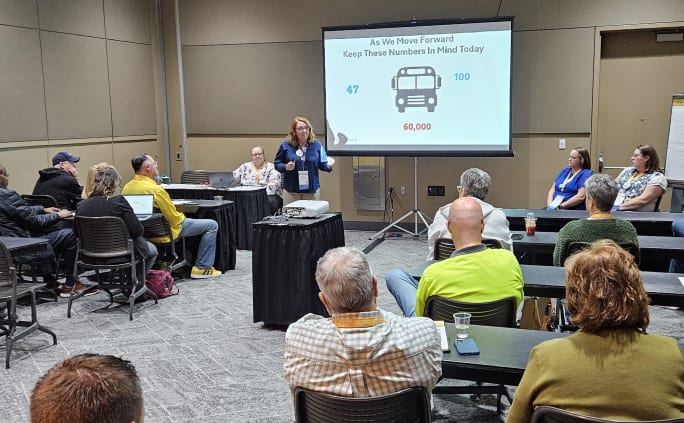
Kellie Doyle Bailey presents on "Driven to Connect: Keep Calm and Bus On" at the 2025 NAPT ACTS.
Amanda Huggett
Talking about mental health and emotional intelligence can sound woo-woo, too touchy-feely, or simply like something you don’t have time for when your to-do list is already too long. But it’s important to note, you don’t need a full meditation before a busy route or a dreaded meeting to feel grounded.
The key is that how you show up affects how your students and colleagues perceive you and can set the tone for their day, too. When you’re carrying an invisible burden, you probably let it affect you more than you realize.
“I mean, how we say ‘good morning,’ even just that can inform a vulnerable nervous system that's coming on the bus as to whether or not it's safe to be here,” Doyle Bailey said. “I keep bringing it back to safety, because that's really what it is about. Recognizing and building tools around safety and connection.”
Research states that in a neurotypical brain, we’re not engaged in the moment about 47% of the time. Instead, we’re multitasking, planning something, or remembering something.
“What we know about attention and focus is that we can't do multiple things well,” Doyle Bailey explained. “And when you think about the driver behind the wheel, that person who is responsible for the physical safety and the emotional well-being of children, and there's noise and weather and dispatch coming in. That's a lot of interruptions, right? So this is just a reminder to take a moment to check in with yourself. I would say it's probably the most important part of your day.”
Back to that third key feature of emotional intelligence: social awareness.
The only thing we know with 100% certainty is how we feel and what we think about something. Since we can’t walk in someone else’s shoes, approaching others with curiosity and compassion and giving them the benefit of the doubt is the kindest thing you can do.
In other words, instead of trying to justify why someone did something or said something a certain way, look at them with curiosity and compassion instead of judgement. Think, ‘I wonder what they’re going through’ instead of assigning a reason in your mind to fill in the gaps of your own knowledge. Because most of the time, those assumptions, those stories you make, are rooted in false information and can make your relationships suffer.
Once we understand that all behavior begins with the brain, we stop asking, "What's wrong with this child?" and begin wondering, "What might be happening with this child right now?” That single shift changes the conversation and, ultimately, the connection.
Doyle Bailey notes that all of this must first start from within. When you look in the mirror, see yourself for who you are: someone worthy of compassion. “I have to have a relationship of acceptance with myself,” she said, “and being able to see mistakes as opportunities to learn and grow and not epic failures and definition of who I am.”
After Doye Bailey hosted her first two-hour emotional intelligence training for a group of school bus drivers, the reaction was far more than she expected. Drivers shook her hand and said they had never considered their role in kids' lives the way she presented it.
"One of the first things the Maine pilot team and I explored was the understanding that all behavior begins with the brain," she recalls. "I find that once adults can accept the brain science associated with human behavior, then emotional intelligence stops being viewed as a 'soft skill' and becomes a practical everyday life skill."
The administrative team soon realized that this work starts at the top, and they wanted to show up in a better frame of mind to handle parent complaints or employee matters. So, they embarked on a year-long pilot. Four women from the transportation department — the director, assistant director, trainer, and dispatcher — met with Doyle Bailey every week for an hour to continue to develop their EI skills and learned how to cope with the stresses they faced every day.
“They talked about feeling unsupported or that they didn't have the right connection with their administrative teams,” she said. “Some of them would come in and say, ‘I'm done if I don't get some support.’ And so we're in this place of reactivity rather than problem-solving.”
Almost every conversation circled back to one common theme: How to better support drivers when they're navigating tricky student behavior. That question became the foundation of her work, and it's the same place she encourages any transportation leader to begin with when considering the value of emotional intelligence.
From there, she hosted another six-week pilot with 10 drivers and monitors.
Eventually, she watched leaders become more intentional in how they communicated with their teams. Dispatchers reported that they gave themselves permission to pause and to take a breath before picking up the radio. Drivers and monitors began to prioritize checking in with themselves before starting the day's route.
By the end of the pilot, participants described feeling more supported, confident in having respectful communication exchanges, and more engaged with their team. Drivers also felt better equipped to respond to students with greater patience, curiosity, and confidence.
"Safety will always be the priority in pupil transportation," Doyle Bailey said. "My hope is that we continue expanding our understanding of what contributes to that safety. Technical skills keep buses operating safely. Human skills help children feel emotionally safe. I don't believe it's a choice between one or the other. I believe our students deserve both."
Doyle Bailey says the one thing she most wants you to know is this: Choosing to invest in emotional intelligence isn't about adding one more initiative to your team's already full workload. It's about giving dedicated people a deeper understanding of themselves, one another, and the students they serve.
When people understand themselves more deeply, they communicate differently, lead differently, and support one another with greater authenticity. And that's where meaningful and lasting change begins.
Emotional intelligence in student transportation refers to the ability of bus drivers and transportation directors to recognize and manage their own emotions, as well as understand and influence the emotions of students and colleagues to ensure safe and effective transportation services.
*Summarized by AI
Loading data...

Management
Learn the five key elements that bus drivers and transportation directors can use to stay calm in any situation.

Management
Every day, millions of students climb aboard. But few realize the yellow school bus has helped transform education, connect communities, and come to symbolize civic responsibility.

Management
Discover five strategies for building an effective mentorship program to strengthen leadership development and support staff retention.

Special Needs Transportation
Small missteps in wheelchair securement can have serious consequences. Here are 32 tips from experts to reduce risk and increase student safety on the bus.

Management
Take the burden out of bidding. Cooperative contracts can save district transportation teams time, money, and hassle. Here’s how.

Management
Learn from school transportation leaders on how to develop bus drivers, monitors, and mechanics into future leaders through coaching and culture.
Safety
With student safety on the line, here’s a look at what’s working, what’s changing driver behavior, and what districts need to know when it comes to stop-arm programs.

Management
As we celebrate seven decades of industry coverage, let’s revisit historic milestones, timeless content, and examine the industry's progression from those who lived it.