




Why Emotional Intelligence Matters in Student Transportation
 MENU
MENU SEARCH
What makes emotions run high, and how should you handle an angry colleague or parent? Follow these steps for staying calm, listening, showing empathy, and resolving conflict.
The best way to get the result you want is to make someone else feel like you’re on the same team — and sometimes that means putting aside the desire to be right.
School Bus Fleet
*Summarized by AI
Does it feel like everyone’s on edge lately? If so, it’s not just you.
As nice as it would be to live in total harmony with everyone around you, the reality is we’re never going to sing kumbaya with our co-workers — or the parents of students on your buses — every single day.
Many people are walking around with baggage you’ll never understand. Fear, loneliness, stress, and anxiety can make it hard to function well in the workplace. Couple that with maintaining unrealistic expectations, it’s easy to feel misheard or misunderstood around others — especially those with whom you have to maintain a professional relationship.
When people carry around these feelings without the time, resources, or ability to process them in a healthy manner, they often resort to anger. In fact, anger is the easiest emotion to use for self-protection. Anger makes someone feel like they’re in control (it’s that fight part of the fight-or-flight response).
So how do you get everyone working in the same direction when some folks are moving the opposite way? A recent presentation at the Michigan Association for Pupil Transportation conference tackled this very question.
Jen Laidlaw of TeamWerks Talent Development and Consulting presented a three-part series on working well with others, touching on managing angry people, having empathy and accountability, and giving feedback. Each built on the same principles.
Whether strong emotions affect just one person or the entire team (creating a hostile work environment), here are Laidlaw’s suggestions for keeping your cool when others have gone off the rails.
Knowing the intended goal will direct how you move forward. Do you have the ability to walk away without any negative effect, or do you need to salvage the situation for the greater good?
“If it’s someone at McDonald’s, I'm not gonna make a huge effort to try to do some of these next steps,” Laidlaw said. “I'm just going to walk away. But if it's someone that I'm leading or it's someone that I need to interact with, I might keep going.”

Laidlaw presents a session on “Why is Everyone So Mad?” at Boyne Mountain Resort.
Amanda Huggett
Next, decide what will serve you best to get the outcome you want. For the McDonald’s scenario, walking away solves the problem for everyone. But if a colleague or parent is yelling at you, that same action would make the situation worse.
Your response should match what you want to happen. Meaning, if someone is screaming, it’s best not to scream back (aka, don’t escalate by matching someone’s level of anger).
“We have the unique ability as human beings to choose our response to things,” Laidlaw said. “We're the only species on the planet that can do this. In the book ‘The Seven Habits of Highly Effective People,’ this is step one, taking care of yourself. A guy can flip me off, and I can decide to be angry, or I can decide to not be angry. And sometimes, we don't take advantage of that choice.”
This is where emotional intelligence begins to step in to guide your response: knowing what you need and what the other person does (if it’s a person worth investing the time in).
“It’s important that you try to stay controlled, stay calm, and stay flexible about what's gonna happen next,” Laidlaw suggested.
At this point, you need to decide if you’re walking away or continuing to engage. If the former, you must also realize if that action will escalate the other person to re-engage again later. If the latter, continue to step 3.
Remember that most people are mad because they feel unheard or misunderstood, and instead of assigning judgment, sometimes the best thing you can do is step back and let them express where they’re at.
Use phrases like “Help me understand” to make sure you know exactly where their concern lies and to tell the other person you are trying to see it from their side. Don’t try to be right yet (not until the other person is in a place to hear your side; for now, they need to feel heard).
Remember that listening doesn’t mean that you agree.
“This is another emotional intelligence thing that we're not really very good at, to be honest,” Laidlaw said. “We're good at trying to be heard, but we're not quite as good at listening. If you try to correct them in that moment, they can't hear you. You're gonna have to wait until they've tuckered themselves out.”
Set your ego aside and find somewhere to agree. Say things like “I totally understand why this would make you angry” or “Here’s what I heard you say…did I get that right?”
“Empathy is really trying to put yourself in the other person's place,” Laidlaw said. “And with the limited information they have from their perspective, it might make sense that they're mad. You can give them that gift, even though it’s the hardest thing to do.”
The thing is, it’s hard to stay mad at someone once they’ve agreed with you.
It’s also important to note that you don’t have to resolve something immediately. Sometimes, the best solution is to give someone more time to relax while you prepare. Set a meeting for the next day to review the situation again and decide how you’re moving forward. Tell them you’ll think of some ideas, and you’d like them to do the same.
Once their anger starts to calm and they know you’re actively listening and taking their complaint seriously, you can move on to the final step.
Up until now, you’ve barely said anything. The other person has had the floor. Now, the question has become, what now?
When everyone is rational, it’s time to have an actual conversation and decide together how to move forward with a solution.
That doesn’t always mean you have to cave. Sometimes, you must hold firm, especially when your policies and procedures mandate what can or can’t be done.
In the Tony example above, you might want to map out how he can earn a raise, pull up his past performance reviews, and walk through them together. Offer him transparency and support to reach his goal.
Ideally, all the steps together look something like this.
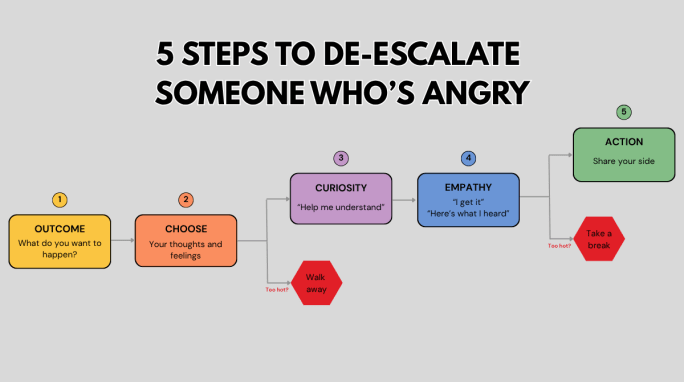
When emotions are high, following these five steps can help de-escalate anger, keep the conversation productive, and move both sides toward a resolution.
TeamWerks/School Bus Fleet
Remember that everyone involved in the school transportation conversation has the same end goal. We all want students to get to and from school safely every day. How exactly we achieve that is what is often up for debate — especially when emotions are involved.
Helping someone feel heard and understood more often than not moves them from reactive and upset to calm and ready to work together to achieve a shared goal.
Common triggers include misunderstandings, unmet expectations, excessive workloads, and communication breakdowns. Identifying these can help in addressing and preventing further conflict.
*Summarized by AI
Loading data...

Management
When should you sell an aging school bus? Learn how maintenance, mileage, corrosion, specifications, and timing can affect resale value long before the auction.

Management
What makes emotions run high, and how should you handle an angry colleague or parent? Follow these steps for staying calm, listening, showing empathy, and resolving conflict.

Management
Learn the five key elements that bus drivers and transportation directors can use to stay calm in any situation.

Management
Every day, millions of students climb aboard. But few realize the yellow school bus has helped transform education, connect communities, and come to symbolize civic responsibility.

Management
Discover five strategies for building an effective mentorship program to strengthen leadership development and support staff retention.

Special Needs Transportation
Small missteps in wheelchair securement can have serious consequences. Here are 32 tips from experts to reduce risk and increase student safety on the bus.

Management
Take the burden out of bidding. Cooperative contracts can save district transportation teams time, money, and hassle. Here’s how.

Management
Learn from school transportation leaders on how to develop bus drivers, monitors, and mechanics into future leaders through coaching and culture.
Safety
With student safety on the line, here’s a look at what’s working, what’s changing driver behavior, and what districts need to know when it comes to stop-arm programs.

Management
As we celebrate seven decades of industry coverage, let’s revisit historic milestones, timeless content, and examine the industry's progression from those who lived it.