




School Bus Shop Cuts Downtime With ‘Courtesy Checks’
Mechanics at Frederick County (Md.) Public Schools add a School Bus Courtesy Check list for buses coming to the shop to proactively check for and advise drivers of additional issues.

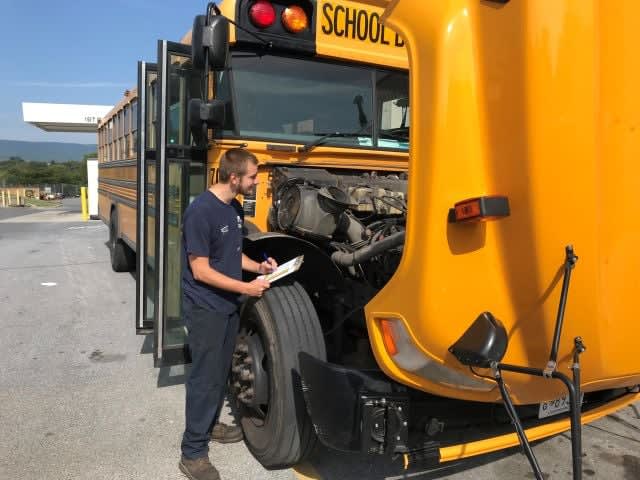
Mechanics at Frederick County (Md.) Public Schools added a School Bus Courtesy Check list for buses coming to the shop to proactively check for and advise drivers of additional issues. Shown here is Cody Burtner, one of the mechanics who developed the checklist, performing a School Bus Courtesy Check.
Mechanics at Frederick County (Md.) Public Schools added a School Bus Courtesy Check list for buses coming to the shop to proactively check for and advise drivers of additional issues. Shown here is Cody Burtner, one of the mechanics who developed the checklist, performing a School Bus Courtesy Check.
FREDERICK, Md. — A maintenance shop at a school district here has put a more proactive procedure in place to catch issues with school buses and correct them quicker, reducing downtime.
Mechanics at Frederick County Public Schools’ transportation department started using what they call the School Bus Courtesy Check on Sept. 5, the first day of school, said Mark Maggitti, fleet maintenance manager for the district.
With 430 school buses in the fleet, a small shop with limited parking space serving a large county, and about 70% of the district’s buses being parked offsite at 26 different locations, it is critical to maximize every maintenance opportunity and reduce unnecessary trips to the shop, he explained.
“We have buses that typically are domiciled 20 or 30 minutes away from the shop, so it’s not very efficient for the driver to bring that bus back into the shop.”
Additionally, many buses have had a lot of repeat visits to the shop due to other, unrelated problems being identified after the initial visit. The courtesy check helps mechanics find and repair defects that were not reported by the driver or potential problems that may result in a future breakdown.
“I used to get buses in the shop for engine diagnostic issues, and then two or three weeks later, the bus might come back because it had torn seats or a heater wasn’t working or something completely unrelated to the original problem,” Maggitti said.
Now, every time a bus comes to the shop for any type of service, a mechanic completes the School Bus Courtesy Check worksheet before the bus is returned to the driver. For example, if a bus is in the shop for engine diagnostics, mechanics also check the lights, tires, brakes, seats, heaters, etc., before putting the bus back in service.
The checklist employs a system designed to be easy to understand, using the colors green, yellow, and red to rate the items checked. Green items are “good,” yellow are “fair,” and red items are considered “poor,” and will be repaired before the bus is returned to service.
Mechanics take 10 to 15 more minutes to do a thorough visual inspection of the entire bus to avoid repeat visits. So far, mechanics have found and fixed damaged seats and heaters that weren’t working.
When finished conducting the check, the mechanic leaves the completed sheet on the driver’s seat to make sure that the driver sees it and is aware of any items that may be ranked as fair. It also makes the driver aware of any issues that were identified and corrected, and “closes the loop” with drivers, he added.
Maggitti and Fred Punturiero, the director of transportation for the district, had discussed the concept at the end of the last school year, and two mechanics developed the checklist and the color-based strategy to quickly identify the degree of seriousness of each issue the shop came across.
Just like before, the shop relies on the drivers to do their pre-trip inspections, with the checklist serving as a backup.
“The drivers are very diligent with their pre-trip and every little issue, [but] it’s another set of eyes to catch anything,” Maggitti said.
Bus drivers have reported to their managers that they appreciate the extra service that the shop provides, he added.
The courtesy check is not only designed to increase efficiency, but safety as well.
The mechanics have since revised the courtesy check to go beyond the step listed as “check tires” to include checking tire pressure, tread depth, and looking for irregular wear and loose lug nuts.
“It’s not just walking around, kicking the tires like we used to do,” Maggitti said. “That’s probably one of the most important items on the courtesy check.”
“We want to make sure the bus is not leaving here with bald tires, brakes that are worn down, or anything that could potentially be a problem on the road.”
The School Bus Courtesy Check worksheet is available here.
More Maintenance
The Essential Guide to School Bus Maintenance and Student Safety
Your district's buses carry students to school every day. This guide shows how predictive maintenance powered by fleet data helps keep buses reliable, drivers accountable and students safer from the first bell to the last stop.
Read More →
Kerry Brothers Grows Michigan School Bus Repair Network
The acquisition of Downriver Truck and Bus expands Kerry Brothers’ school bus maintenance footprint across southeast Michigan, adding repair capacity, diagnostic resources, and state inspection support.
Read More →
Noregon Introduces CAN Bus Diagnostic Tool, Expands JPRO Features
CAN Mentor and the latest JPRO update aim to simplify vehicle network diagnostics and improve repair efficiency for technicians of all experience levels.
Read More →
Cummins on Smarter, Simpler Engine Innovation
Cummins discusses its first-ever gasoline engine for school buses, EPA 2027, and why bus fleets still want durable, simpler internal combustion options.
Read More →
Report: 72% of Diesel School Buses Now Use Advanced Low-Emission Engines
New data shows advanced low-emission diesel technology continues expanding across school bus fleets, even as electric bus adoption gains momentum.
Read More →
Vampire Tools' CAIMAN 7.5-Inch Multi-Purpose Screw Extractor Long-Nose Pliers with Crimper
Vampire Tools introduced the VAMPLIERS Caiman 7.5-inch multi-purpose pliers, combining screw extraction, cutting, crimping, and gripping functions into a single tool designed for fleet maintenance professionals.
Read More →
How Advanced Diagnostics Helps Bus Fleets Stay Ahead of Repairs
Chat with Noregon’s Kevin Smallhorn at ACT Expo about bus diagnostic tools, telematics integration, CNG maintenance support, and strategies to help reduce downtime and improve uptime.
Read More →
How School Bus Fleets are Getting Ahead of Breakdowns
Don’t let bus downtime wear you down. Here’s how bus operators are shifting from manual processes to AI-powered, data-driven maintenance systems for improved reliability and safety.
Read More →
Pennsylvania School Bus Maintenance Team Praised for Dedication to Safety
Matthews Bus Company’s West Jefferson received a letter of commendation from the Pennsylvania State Police for their fleet inspections.
Read More →
From Chaos to Clarity: How School Districts Are Running Leaner Transportation Operations
Covering 38 routes on a Friday afternoon. Buses idling while routes overlap. Parents calling nonstop about late arrivals. Sound familiar? This whitepaper explores how district transportation leaders solved these exact problems — and what measurable results followed.
Read More →