




NTSB Names Michael Graham Vice Chair: Where He Stands on School Bus Safety
A former airline pilot has stepped into a new role at the independent federal agency, but where does he stand on issues like seat belts on school buses? Here’s what he’s said.

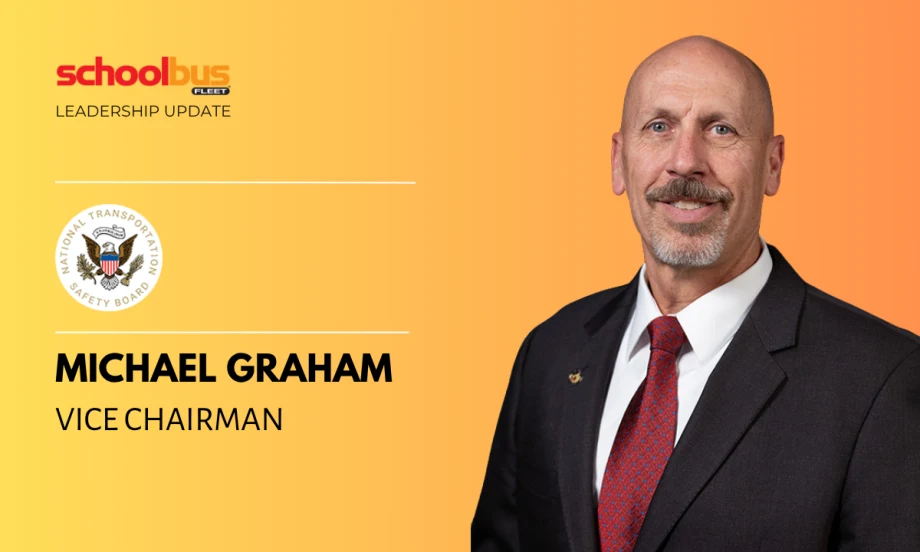
Graham joined the NTSB board six years ago. The agency recommended seat belts on large school buses in 2018.
NTSB/School Bus Fleet
On April 3, 2026, the White House appointed Michael Graham as National Transportation Safety Board (NTSB) vice chairman for a three-year term.
Graham succeeds Alvin Brown, a Biden appointee, who served as vice chair from December 2024 to May 2025, when he was removed prior to his term ending. The position was vacant until now.
Jennifer Homendy serves as chair of NTSB.
Who is Michael Graham?
Graham was previously appointed as the 45th NTSB board member by President Donald Trump, and took the oath of office on Jan. 3, 2020.
During his time on the board, Graham served as the member on scene for several major accident investigations. According to a press release, Graham has also been a dedicated advocate for advancing connected vehicle technology and reducing distracted driving on our nation’s roads.
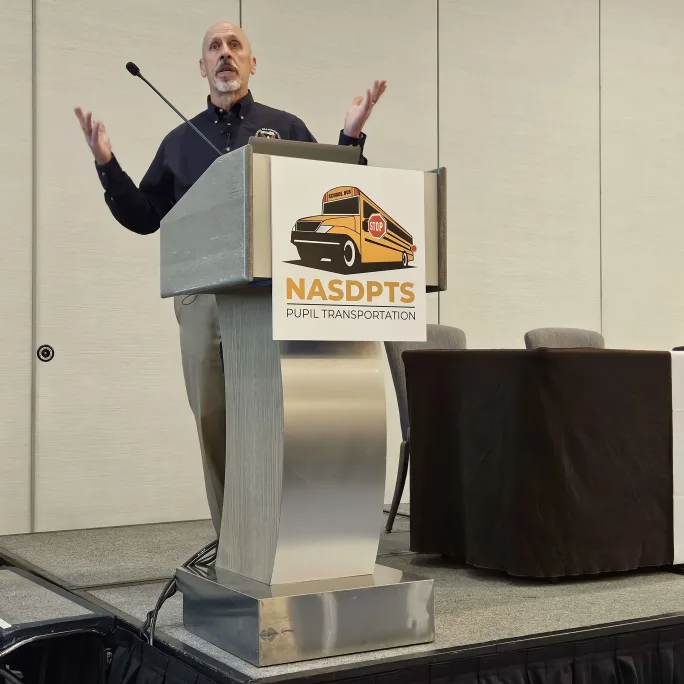
Graham presents at the National Association of State Directors of Pupil Transportation Services (NASDPTS) annual conference in November 2025.
School Bus Fleet
He played a key role in supporting the NTSB’s efforts to promote the broader adoption of safety management systems across all modes of transportation.
Before NTSB, he served as director of flight operations safety, security and standardization at Textron Aviation and served in the Navy.
Graham holds a bachelor’s degree in mechanical engineering from the University of New Mexico and is a certified airline transport pilot with more than 10,000 flight hours.
Where Does Michael Graham Stand on School Bus Safety?
Graham presented an agency update at the 2025 NASDPTS conference in Washington, D.C. last fall, where he shared agency findings from the Leander, Texas, school bus accident, and reiterated NSTB’s pro-seat belt stance.
He shared that compartmentalization alone “still doesn’t work very effectively, especially in a rollover,” referencing crashes in Anaheim, California, in 2012; Chattanooga, Tennessee, in 2016; and Helena, Montana, in 2017.
“That's why, in 2018, we recommended states specifically require lap and shoulder belts on new buses,” he said. “While some have taken action, most have not at this point. So that's why I'm here.”
At NASDPTS, Graham urged attendees to support the use of lap-shoulder belts to improve student safety, including training drivers and parents to encourage kids to wear them properly and adopting policies on their use.
“We're long past the time to know that seat belts work,” he said. “I don't care what you're on, what kind of bus. We know they work; you should be wearing them.”
“I know there's always going to be the naysayers out there,” he added. “Nobody is going to force you to always keep your seat belt on an airplane, either. At some point you … understand that you are accepting the risk. … Sometimes you just can't fix stupid. We can't put all the safety systems out there for people that are not willing to abide by what's out there already, or use what's available. You do what you can.”
Graham and NTSB also supports other safety technologies on school buses such as electronic stability control, collision avoidance systems, and cameras.
On a September 2020 NTSB podcast episode, Graham also discussed the importance of a team approach and reporting to increase safety and manage risk. “Everybody has a role in this,” he said. “There should be a non-punitive reporting system for the drivers to let their company or district know of the hazards out there. The students and the parents should be able to do the same.”
Quick Answers
Michael Graham is a former airline pilot who has been appointed as the Vice Chair of the National Transportation Safety Board (NTSB).
*Summarized by AI
More Safety

How to Build a Better School Bus Driver Training Program
Is it time to strengthen your driver training? Here’s how to pick the right talent and improve recruitment, retention, and safety. This video is brought to you by IC Bus.
Read More →
Recent School Bus Accidents Leave 2 Dead, 2 Injured
Four school bus crashes in Florida, Illinois, and Georgia highlight risks in transportation lots, at bus stops, and during student loading and unloading.
Read More →
When Every Second Matters, Clarity Keeps Routes Moving
From routine delays to urgent incidents, strong communication practices help drivers, dispatchers, schools, and families respond with confidence.
Read More →

What Happens When a School Bus Catches Fire — and What Can Help
School bus fires are rare but can be devastating. Learn how advances in fire suppression and asset protection help fleets detect fires earlier, reduce damage, and improve safety.
Read More →
Geotab Launches Tool to Help Fleets Investigate Road Incidents
Geotab Investigations combines telematics data, video, documents, and other evidence to help fleets reconstruct incidents, resolve claims, and determine what happened.
Read More →
Texas Sixth Grader Wins 2026 National School Bus Safety Poster Contest
Sai Darshana Yekolu of Moseley Middle School in Prosper, Texas, was named the newest winner for her artwork, bringing the theme of “Safe Rides, Everyday Heroes” to life.
Read More →
Doing More With Less: How Transportation Directors Can Prioritize Safety Amid Budget Uncertainty
With diesel prices soaring and nearly one-third of transportation directors expecting budget cuts, maintaining student safety has never been more challenging. Download this guide to learn how leading districts are prioritizing risk, funding critical safety technology, and building stronger budget cases with data.
Read More →
Walton County Schools Adds Gatekeeper Stop-Arm Enforcement System
The Florida district will deploy Gatekeeper’s updated Student Protector technology, which now incorporates AI to improve video evidence.
Read More →
How To Build a More Secure School Bus Yard During and After Hours
As thefts and overnight security threats continue, school transportation leaders are combining stronger operational practices with AI-enabled surveillance to better protect buses, facilities, and staff.
Read More →
FMCSA Names New Chief Safety Officer: What School Bus Operators Should Know
Steve Dowling is set to lead the federal agency's efforts to advance commercial motor vehicle safety and reduce crashes, fatalities, and injuries on the nation's roadways.
Read More →