





Prevent School Bus Dragging Incidents:Anti-Pinch Door Sensors and Maine’s New Mandate
School Bus Laws To Watch: Seat Belt Bills, Funding Fights & EV Changes
From national bills on seat belts and driver oversight to driver awareness campaigns referencing “Finn’s Rule” and ongoing transportation funding debates in Alaska, here’s the latest in school bus legislation across the U.S.
May 6, 2026
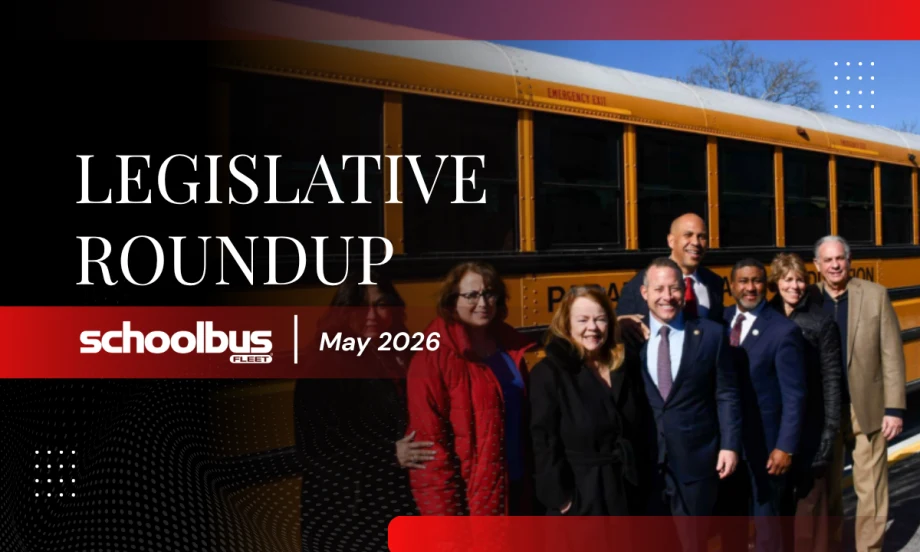
School Bus Fleet’s legislative roundup highlights recent and proposed state measures focused on stop-arm camera enforcement, school bus safety upgrades, and efforts to address ongoing driver shortages.
Credit:
Office of Congressman Josh Gottheimer/School Bus Fleet
8 min to read
- National legislation is being proposed to mandate seat belts in school buses and improve driver oversight.
- Campaigns like “Finn’s Rule” are raising awareness about driver safety and regulations.
- Transportation funding is a contentious issue, particularly in Alaska, where debates are ongoing.
*Summarized by AI
The school transportation sector continues to see policy shifts in 2026, as new bills are introduced to standardize seat belts on new school buses, strengthen driver awareness and safety measures, implement stop-arm camera programs, reconsider zero-emission school bus mandates, and more.
Below is a roundup of several school transportation laws and initiatives moving forward in 2026.
New Federal Legislation Targets Seat Belts and Driver Oversight
U.S. Congressman Josh Gottheimer (NJ-5) and U.S. Senator Cory Booker (D-NJ) introduced bipartisan, bicameral legislation in early 2026 to strengthen school bus safety in honor of Paramus student Miranda Vargas and to ensure “no family endures a similar tragedy.”
According to a release, Vargas was 10 years old when she was killed in a 2018 school bus crash along with her social studies teacher, Jennifer Williamson. The bus driver made an illegal turn and was struck by a dump truck. Reports showed that the bus driver’s license had been suspended 14 times since 1975, including just six months before the crash.
The Secure Every Child Under the Right Equipment Standards (SECURES) Act is being introduced in the House and the Senate to require three-point lap-and-shoulder seat belts on all school buses nationwide. Currently, only eight states require seat belts on large buses.
Plus, the Miranda Vargas School Bus Driver Red Flag Act, known as “Miranda’s Law,” is being introduced in the House and Senate to establish real-time background checks for school bus drivers. If a driver commits a serious traffic violation, schools and bus companies will be alerted within 24 hours, preventing unsafe drivers from transporting students.
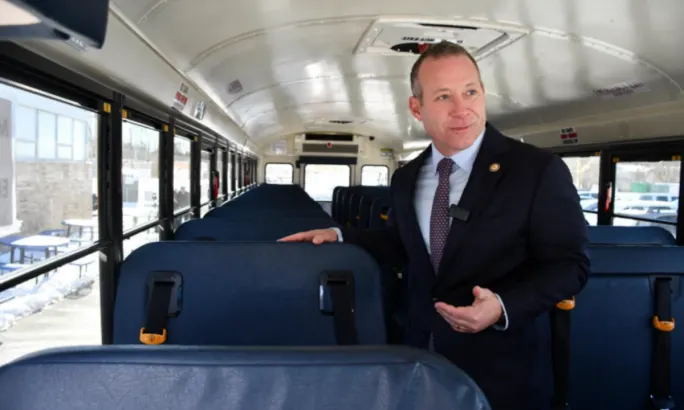
The Secure Every Child Under the Right Equipment Standards Act is being introduced in the House and the Senate to require three-point lap-and-shoulder seat belts on all school buses nationwide.
Credit:
Office of Congressman Josh Gottheimer
“Every parent should trust that when their child gets on a bus, they’ll come home safely,” said Congressman Gottheimer. “These bills turn heartbreaking loss into action. There is nothing partisan or political about protecting our children. Working together across the aisle and across the country, we can make sure tragedies like the one here in Paramus never happen again.”
“This should not be a partisan issue. This is not Republican. This is not Democrat. This is human,” said Miranda’s father, Joevanny Vargas. “If we can find funding for so many other priorities, we can find funding to protect children. You cannot put a price tag on a child’s life.”
“Finn’s Rule” Aims to Strengthen School Bus Driver Awareness Nationwide
The attorney representing the family of 5-year-old Finn Katona announced Wednesday, April 22, that a confidential settlement has been reached following the fatal Sussex school bus accident that killed the child in January 2025. As part of the agreement, FOX6 News Milwaukee reported, attorney Timothy Trecek unveiled “Finn’s Rule,” a new safety initiative aimed at improving school bus driver awareness and preventing similar tragedies.
According to Trecek, “Finn’s Rule” will be incorporated into school bus driver training programs nationwide and could eventually reach more than 130,000 drivers through Student Transportation of America and other bus companies. Drivers will receive laminated cards featuring Finn’s photo and reminders to count children, watch for danger zones and blind spots, and “expect the unexpected.”
“Finn’s Rule stands as a legacy, ensuring that Finn’s life continues to make a difference,” Trecek said. “A difference of unimaginable importance of preventing any other little boy or little girl from senseless death at the hands of a school bus.” The program is expected to launch in late fall of the next school year.
Katona was killed on January 2, 2025, outside Silver Spring Intermediate School in Sussex. Investigators found that the child accidentally stepped off the sidewalk and fell beneath the bus as the driver began pulling away. An 86-page investigative report stated there was no horseplay or involvement from other students, and the medical examiner ruled the death accidental.
In response to the settlement announcement, Hamilton School District Superintendent Paul Mielke said the district continues to mourn the loss. “Our community continues to grieve the loss of young Finn Katona,” Mielke said. “His death forever changed our entire school district.” The Waukesha County Sheriff’s Department previously concluded its investigation without issuing charges or citations.
Massachusetts Pushes for Stronger School Bus Safety Measures
In Boston, Massachusetts, Amanda Taylor, the mother of Summer Steele, testified in front of the Joint Committee on Public Safety and Homeland Security in April to advocate for passage of “An Act Creating a Special Commission to Examine School Bus Safety” (S.2861), also known as “Summer’s Law.” According to Athol Daily News, Steele was nine years old when she was killed on October 28, 2016, after her backpack got caught in the door of a school bus and she was run over.
“Right now, I should be planning for her graduation and her senior prom,” Taylor told legislators. “I don’t need my name to be remembered, but my daughter Summer deserves to be, so please remember her by passing this legislation.”
S.2861 would create a commission to examine school bus safety and “recommend updates to school bus safety standards and operator training requirements, including potential adoption of safety sensors, additional monitors, enhanced training, and other measures to protect students while on buses, during boarding, disembarking and at bus stops,” according to a summary provided by primary sponsor state Sen. Paul Mark, D-Becket.
The bill, petitioned by Mark along with state Sen. Jo Comerford, D-Northampton, and state Rep. Lindsay Sabadosa, D-Northampton, may install sensors in all new school buses, but would not add them to existing buses. If the state added the sensors to all 9,446 existing buses, as Sabadosa and Mayser USA estimate, the cost would be around $10 million. Mayser is an international company that develops anti-pinch sensor technology.
Sabadosa took the stand with Taylor, informing the joint committee that this technology exists and that “over the years, the technology has truly evolved.” If this law were to pass, Massachusetts would join Maine in adopting legislation requiring new buses to be equipped with anti-pinch sensors.
Alaska Education Funding Bill Advances in Senate
Although several bills to increase education funding have stalled in the Alaska Legislature, a bill to add nearly $82 million in one-time funding and education policy changes is moving forward with bipartisan support.
On Monday, April 27, the Senate Education Committee introduced a revised version of House Bill 28, which would provide one-time funds for energy relief, transportation, reading and vocational training, to a bill that would create a loan forgiveness program for Alaska teachers.
Chair Sen. Löki Tobin, D-Anchorage, described it as a “mini-bus” bill, explaining the new “omnibus bill includes specific education funding to areas sought by the governor and lawmakers on both sides of the aisle.” According to the Alaska Beacon, the underlying bill “establishes a new three-year student loan forgiveness program to incentivize teachers to stay in Alaska.” It would provide up to $15,000 to help pay off student loan debt for those who leave the state and return to work in Alaska. The House passed the bill last May.
As the bill moved to the Senate this year, Tobin’s office reported additional items added, including $21.8 million for reading proficiency grants, $9.7 million for career and technical education, $7.3 million for transportation, and $43 million to offset rising energy costs for school districts.
Earlier in the session, Tobin introduced a bill that would add nearly $100 million in education funding. A portion of that money would go to per-student funding through the BSA, and additional reading proficiency grants and transportation funding, but policy changes drew criticism from homeschool proponents.
New York Lawmakers Approve School Bus Stop-Arm Safety Cameras
On Tuesday, April 21, New York’s Ulster County Legislature adopted a local law establishing a countywide school bus stop-arm safety camera program. School districts can opt in to the program through an intermunicipal agreement with the county, Mid Hudson News reported.
Legislator Debra Clinton, chairwoman of the Law Enforcement and Public Safety Committee, said stop-arm cameras are “a practical, proven way” to increase student safety.
“I believe we have an obligation to use every tool available to keep our students safe, and we can tell that this does change driver behavior as there is a reduced number of repeat offenders after they have received a ticket,” Clinton said.
Violations captured by the camera systems will first be reviewed by vendor BusPatrol, and an evidence package will then be sent to a technician with law enforcement experience in the county Department of Emergency Services, who will make the final determination on whether to issue a violation.
According to Mid Hudson News, for the first 30 days of the program, only warnings will be issued to drivers. After the initial grace period, fines will be issued for violations. No points will be added to drivers’ licenses.
Connecticut Revises School Bus Electrification Timeline
An omnibus transportation bill that pushes Connecticut’s plans to electrify the state’s school and transit bus fleets was passed by the House on Wednesday, April 29, with a 99-51 vote. The legislation, House Bill 5464, would roll back sections of the state’s 2022 Clean Air Act that prohibit the state Department of Transportation from purchasing new diesel buses.
According to the CT Mirror, one section of the bill would eliminate the requirement that all school buses run on zero-emission or alternative-fuel engines by January 2035 and reduce the requirement for a complete transition to zero-emission school buses to 90% by 2040.
House Speaker Matt Ritter, D-Hartford, said disappearing federal subsidies have made the transition to electric vehicles much more costly to the state and municipalities.
Lawmakers were generally in agreement on allowing DOT to resume buying diesel buses, CT Mirror reported, but Republicans argued that the rules should also be relaxed for school districts that have to transition most of their bus fleets to zero-emission vehicles by 2040.
“The facts are that electric buses are going to be a huge expense,” said state Rep. Tracy Marra, R-Darien. “Our towns, when they’re looking at education right now, they’re already struggling just to pay for teachers’ wages, pay for health care. They have no idea what’s coming at them with these electric buses.”
After debating the mandates and allowing additional amendments, the bill heads to the Senate next.
More Policy & Regulations
Ohio Transportation Workgroup Calls for End to 'Impractical to Transport' Payments
A final report from Ohio's Pupil Transportation Workgroup proposes ending "impractical to transport" payments and expanding transportation options through regional partnerships, but not all industry pros agree on the approach.
Read More →
The BUILD America 250 Act Has Big Implications for School Buses, Too [Updated]
Buried within a sweeping federal transportation bill are provisions that could affect school bus driver requirements, illegal passing enforcement, and even the future role of autonomous technology in pupil transportation.
Read More →
School Bus Laws to Watch: New York Delays EV Mandate
Plus, federal lawmakers seek new funding for school bus safety as states weigh stop-arm enforcement, disability protections, and education spending.
Read More →
School Bus Laws To Watch: Driver Shortages, EV Debates & Safety Upgrades
From driver shortage solutions in Tennessee and rural connectivity debates in Utah to new safety laws in Wisconsin and ongoing electric bus mandate discussions in New York and Connecticut, here’s the latest in school bus legislation across the U.S.
Read More →
School Bus Laws To Watch: Stop-Arm Enforcement, EV Mandates & Seat Belts
From North Dakota public charter school regulations, tracking illegal school bus passing consequences in multiple states, and the continued debate on New York’s electric school bus mandate, here’s the latest in school bus legislation across the U.S.
Read More →
School Bus Laws To Watch: Anti-Trafficking Curriculum, Passing Loopholes & Tougher Penalties
From Nebraska CDL training add-ons, tackling stop arm passing loopholes in Minnesota, and increased penalties for school bus driver DUIs and firearm incidents, here’s the latest in school bus legislation across the U.S.
Read More →
School Bus Laws To Watch: Driver Penalties, Funding Fights & New Safety Initiatives
From New York driver penalty changes to stop-arm camera programs, reliable special education transportation, and a Kentucky budget shortfall, here’s the latest in school bus legislation across the U.S.
Read More →
School Bus Laws To Watch: Stop-Arm Cameras, Safety Retrofits & Driver Shortage Fixes
From Maine bus safety upgrades to stop-arm camera bills, electric bus funding, and an Alabama workforce solution, here’s the latest in school bus legislation across the U.S.
Read More →
State Grant Program Advances School Bus Safety Upgrades Across Ohio
$10 million in state grants will fund safety upgrades and new features on school buses serving students across the Buckeye State.
Read More →
Where EPA School Bus Funding Stands: CSBP, DERA, and Heavy-Duty Grants Update
One program ends, another looks to be reimagined, and the Clean School Bus Program is in a holding pattern — here’s where each EPA program stands and what to expect moving forward.
Read More →