





Last Month: Stop-Arm Enforcement, EV Mandates & Seat Belts
School Bus Laws To Watch: Driver Shortages, EV Debates & Safety Upgrades
From driver shortage solutions in Tennessee and rural connectivity debates in Utah to new safety laws in Wisconsin and ongoing electric bus mandate discussions in New York and Connecticut, here’s the latest in school bus legislation across the U.S.
April 17, 2026

School Bus Fleet’s legislative roundup highlights recent and proposed state measures focused on stop-arm camera enforcement, school bus safety upgrades, and efforts to address ongoing driver shortages.
Credit:
Wisconsin School Bus Association/School Bus Fleet
8 min to read
- Tennessee is exploring solutions to address the shortage of school bus drivers.
- Utah is engaged in debates regarding rural connectivity for school transportation.
- Wisconsin is implementing new safety laws, while New York and Connecticut discuss mandates for electric school buses.
*Summarized by AI
The school transportation sector continues to see policy shifts in 2026, as new bills are introduced to lower the minimum age for school bus drivers, expand internet service on rural routes, reconsider zero-emission school bus mandates, and more.
Below is a roundup of several school transportation laws and initiatives moving forward in 2026.
Tennessee Lawmakers Consider Lowering Age Requirement for School Bus Drivers
Lawmakers in Tennessee are considering a bill that would lower the minimum age for school bus drivers from 25 to 23. According to Local 3 News, SB2121/HB1790 received unanimous support in the Senate and now awaits discussion in the House.
When presenting the bill earlier this month, its sponsor, State Senator Janice Bowling, noted that Tennessee has the highest minimum age requirement for bus drivers nationwide. Bowling argued it will help address a driver shortage.
Local 3 News noted that lawmakers raised the eligible age for a school bus endorsement from 21 to 25 in 2017, in response to the fatal 2016 Woodmore Elementary School bus crash. “Six students died after the then-24-year-old driver Johnthony Walker was speeding, lost control, and hit a utility pole and a tree,” the news outlet reported.
"The majority of U.S. states set minimum age eligibility for school bus endorsement, and most of them are 18 to 21,” Bowling said. “Tennessee law is the most restrictive of the 50 states in this matter, with an age of 25. This bill just lowers the age to 23."
An effort to revert the minimum age back to 21 failed last year. If passed, the bill would allow local school districts to maintain their own stricter age requirements.
Utah Bill Providing Internet Service on Rural School Buses Vetoed
Utah Governor Spencer Cox vetoed just two bills from the 2026 legislative session, one of which sought to expand internet access for rural students. Sponsored by Representative Tiara Auxier, House Bill 462 proposed making state grants available to rural school districts to provide internet connectivity on school buses.
However, Cox, a known advocate for preventing tech devices from “encroaching on Utah’s K-12 schools,” has championed bills prohibiting cellphone use in schools and warned of the dangers posed by the growing use of AI in classrooms.
According to Deseret News, during a bill presentation to lawmakers, Auxier noted that rural students are often involved in extracurricular activities, which can make round-trip school bus rides take several hours. “Missed homework and sleep-deprived kids are often the consequences of long school bus rides,” Deseret News reported.
“When I played sports, I could do my homework on the bus and get it done with a pencil and paper,” Auxier said. “Now our kids don’t have that same luxury because everything is online and submitted through Chromebooks.”
Cox wrote in a letter explaining the veto that he respected Auxier’s goal of helping students finish their homework. “I am very concerned about signaling to our students that we value more time spent on devices rather than more time interacting with one another face-to-face. Our kids simply need less screen time and more human connection,” Cox explained. He wrote that “had this bill required schools to provide paper assignments to students in extracurricular activities,” he would have supported it.
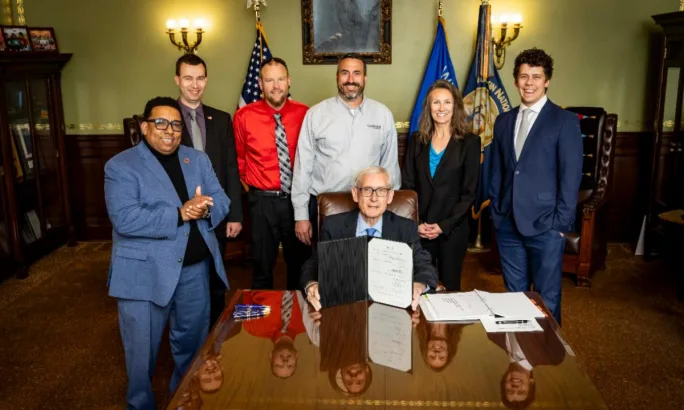
Wisconsin Governor Tony Evers signs ACT 160, permitting the installation of audio and visual recording devices on school buses for safety purposes. Pictured second from right is Cherie Hime, executive director of the WSBA.
Credit:
Wisconsin School Bus Association
Wisconsin Passes Trio of School Bus Safety and Training Laws
Three bills on audiovisual recording devices on school buses, school bus lighting, and driver education instruction in Wisconsin have now become law. These issues were actively advocated for by the Wisconsin School Bus Association and were key priorities highlighted during the 2025 WSBA Legislative Day.
Allowing the Use of Audiovisual Recording Devices on School Buses
Wisconsin Act 160 authorizes equipping a school bus with a device to record audio or video, or both, of the interior of the bus while in use to transport pupils.
A bus may be equipped if the school board adopts a policy authorizing the equipment, with a notice of the policy provided to students, parents/guardians, and posted on the interior of the bus.
According to WSBA, recordings made under the bill are confidential and may be used only by school officials and law enforcement personnel for investigations, school disciplinary actions, and criminal prosecutions related to incidents occurring in or around the bus.
The bill was authored and supported by Representative William Penterman and Senator Jesse James.
Additions to School Bus Lighting
Wisconsin Act 208 allows for additional lighting fixtures on school bus exteriors, including:
- Two additional lamps to be mounted on a school bus that illuminate the rear wheels while backing up.
- An illuminated sign placed above the front windshield, and an illuminated sign mounted on the rear above the window.
- A light-emitting diode (LED) strobe light mounted on the roof.
The bill was authored and supported by Representative Ron Tusler and Senator Cory Tomczyk.
Expanding Driver Education Instruction
Wisconsin Act 209 requires all approved driver education courses to include instruction relating to student crossings, school bus lights, and when cars must stop for a stopped school bus, including how requirements are affected by highway configuration.
The bill was authored by Representative Penterman and Senator James.
New York Bill Addresses Concerns Over Zero-Emission Bus Mandate
New York State Senator Christopher J. Ryan recently introduced legislation addressing district concerns about the state's zero-emission school bus mandate, including “costs, infrastructure, and operational demands.”
According to WRGB CBS 6 News, Ryan developed the bill after hearing from superintendents, transportation directors, and other school leaders in Central New York and elsewhere. One bill, S.9667, would delay the current mandate by five years. A second bill, S.9609, would create an exemption for school districts located within the 10-mile Plume Exposure Pathway Emergency Planning Zone of a nuclear power facility.
Ryan said the exemption is meant to “recognize the role those districts play in large-scale emergency evacuations and the demands placed on their transportation fleets.” In federally designated emergency planning zones, transportation fleets have required roles in established emergency preparedness plans.
School districts have also raised concerns about the cost of transitioning fleets, the availability of charging infrastructure, and limitations of zero-emission bus technology, particularly in rural areas and in regions with unique operational responsibilities.
“These bills reflect what we’ve heard: the need for flexibility, the need for time, and the need for policies that recognize real-world challenges,” Ryan said.
Connecticut Lawmakers Consider Extending School Bus Electrification Deadlines
In Connecticut, lawmakers have proposed a new bill that would allow school districts more time to comply with a state law requiring them to switch to zero-emission school buses. The state law requires all school districts to transition to zero-emission school buses by 2040, with deadlines for school buses to be zero-emission or to use alternative fuels by 2035.
According to CT Insider, in areas with environmental justice communities, school districts must make the full switch by 2030. Environmental justice communities are those where 30% of the population is living below 200% of the federal poverty level or that are among the “state’s most fiscally and economically distressed municipalities,” according to the state’s website.
Requirements that could change under the proposed bill:
- By July 1, 2040, 90% of the school buses serving Connecticut school districts would need to be zero-emission buses.
- By July 1, 2035, all school buses would need to be zero-emission or powered by alternative fuels.
Proposed legislation would require school districts in distressed municipalities to transition 50% of their bus fleets to zero-emission vehicles by July 2035, with full electrification by 2040. While the bill includes a grant program, supported by up to $40 million in bonding and administered in partnership with the Connecticut Green Bank, some school officials say the financial burden remains a major concern. This is especially apparent in smaller districts already struggling to fund essential infrastructure needs, such as replacing old HVAC systems.
Additional challenges include a proposed requirement for districts to use a 20% biodiesel blend in diesel buses by October 2026, which some say is unrealistic due to existing fuel contracts. Meanwhile, districts like Branford have already fully transitioned to electric fleets, highlighting both the progress made and the need for policies that account for early adopters while supporting others navigating cost and logistical barriers.
Minnesota Bus Route Proposal Sparks Safety Debate Among Parents,
A new proposal in Minnesota that would reroute school buses around dead-end roads is sparking debate among parents over safety and logistical concerns.
The Rosemount-Eagan-Apple Valley school district is considering this policy change, arguing that it’s too dangerous for buses to back up and turn around on these types of roads. However, only one road would be impacted — 120th Street West in Rosemount — is a mile-and-a-half-long with “gravel, no sidewalks and many hills,” Fox 9 Minneapolis-St. Paul reported.
Instead of continuing house-by-house pick-ups, the district wants to move the bus stop to the closest intersection, and that it “will continue to be the responsibility of the parents to ensure their children arrive safely at the bus stop, irrespective of the distance from their home...."
Last year, the district moved all six cul-de-sac bus stops, which also sparked debate over which roads fell within those parameters. The proposal would revise the policy language to include dead ends.
Parents have raised safety concerns about the proposed bus stop change that would require students as young as five to walk more than a mile along an uncontrolled dirt road and wait at an unmonitored intersection without traffic lights, streetlights, or sidewalks. One parent also shared video footage showing a school bus safely turning around nearby, questioning the need for the change.
The school board will vote on the proposed policy change on April 13. If it passes, it is unclear when the new bus stop location would take effect.
Plus, a New Minnesota School Bus Law Goes Into Effect
As of Tuesday, April 14, a new school bus safety law took effect in response to a rise in "near-miss" incidents across the state, according to local ABC affiliate KAAL. The law targets drivers who attempt to "beat the bus" by passing as soon as red lights begin to flash but before the stop arm is fully extended.
Now drivers are required to stop at least "20 ft. away from a bus the moment its red lights begin flashing." According to the Minnesota Department of Transportation, "losing the loophole will create a safer environment for children as they board and exit the bus." Failing to stop will result in a misdemeanor and a minimum fine of $500, which can be as high as $3,000 depending on the driver's actions.
The bill also requires drivers to remain stationary until the bus's stop arm is fully retracted and the red lights are no longer flashing.
More Policy & Regulations
Ohio Transportation Workgroup Calls for End to 'Impractical to Transport' Payments
A final report from Ohio's Pupil Transportation Workgroup proposes ending "impractical to transport" payments and expanding transportation options through regional partnerships, but not all industry pros agree on the approach.
Read More →
The BUILD America 250 Act Has Big Implications for School Buses, Too [Updated]
Buried within a sweeping federal transportation bill are provisions that could affect school bus driver requirements, illegal passing enforcement, and even the future role of autonomous technology in pupil transportation.
Read More →
School Bus Laws to Watch: New York Delays EV Mandate
Plus, federal lawmakers seek new funding for school bus safety as states weigh stop-arm enforcement, disability protections, and education spending.
Read More →
School Bus Laws To Watch: Seat Belt Bills, Funding Fights & EV Changes
From national bills on seat belts and driver oversight to driver awareness campaigns referencing “Finn’s Rule” and ongoing transportation funding debates in Alaska, here’s the latest in school bus legislation across the U.S.
Read More →
School Bus Laws To Watch: Stop-Arm Enforcement, EV Mandates & Seat Belts
From North Dakota public charter school regulations, tracking illegal school bus passing consequences in multiple states, and the continued debate on New York’s electric school bus mandate, here’s the latest in school bus legislation across the U.S.
Read More →
School Bus Laws To Watch: Anti-Trafficking Curriculum, Passing Loopholes & Tougher Penalties
From Nebraska CDL training add-ons, tackling stop arm passing loopholes in Minnesota, and increased penalties for school bus driver DUIs and firearm incidents, here’s the latest in school bus legislation across the U.S.
Read More →
School Bus Laws To Watch: Driver Penalties, Funding Fights & New Safety Initiatives
From New York driver penalty changes to stop-arm camera programs, reliable special education transportation, and a Kentucky budget shortfall, here’s the latest in school bus legislation across the U.S.
Read More →
School Bus Laws To Watch: Stop-Arm Cameras, Safety Retrofits & Driver Shortage Fixes
From Maine bus safety upgrades to stop-arm camera bills, electric bus funding, and an Alabama workforce solution, here’s the latest in school bus legislation across the U.S.
Read More →
State Grant Program Advances School Bus Safety Upgrades Across Ohio
$10 million in state grants will fund safety upgrades and new features on school buses serving students across the Buckeye State.
Read More →
Where EPA School Bus Funding Stands: CSBP, DERA, and Heavy-Duty Grants Update
One program ends, another looks to be reimagined, and the Clean School Bus Program is in a holding pattern — here’s where each EPA program stands and what to expect moving forward.
Read More →