





Check Out:Tips for Managing Angry Parents
Inside Parent Routing Apps: How Digital Tools Are Transforming School Transportation
From real-time tracking to instant alerts, technology is reshaping how districts communicate bus routes and changes with parents. Yet, as districts and vendors reveal, successful transportation hinges not just on apps, but also on the people and partnerships behind the screens.
August 11, 2025
"Parents often face uncertainty about school transportation, but digital tools and apps are helping districts improve communication, safety, and efficiency.
Photo: Thomas Built Buses / School Bus Fleet
9 min to read
As the yellow school bus rolls away each morning carrying precious cargo, it also takes with it a set of expectations. Families trust that drivers will navigate safely, arrive on time, and deliver students where they should be.
However, the process of getting a child to school can be riddled with uncertainty for parents. Is the bus on time? Has the route changed? Did my child make it onto the bus this morning?
Those questions have driven districts nationwide to rethink how they communicate with families about transportation. As technology evolves, school systems increasingly rely on apps and digital tools to inform parents about routes, stops, delays, and changes. The benefits of this communication ripple outward, improving parent satisfaction, safety, efficiency, and even staff morale.
Yet deploying this technology and ensuring parents can and will use it is not as simple as flipping a switch. It demands thoughtful rollout plans, staff training, and a shared commitment to clear, consistent communication.
Not so long ago, communication between transportation departments, district administration, and parents was limited to paper mailings, phone calls, or in-person conversations at school. If a bus was running late, families often didn't know until a child failed to arrive home on time.
Before these tools, the landscape shifted as more web-based portals emerged in the early and mid-2010s, with popularity increasing during the pandemic. Online portals offered a new level of transparency but weren't always user-friendly, especially on mobile devices. The real game changer came with the expansion of smartphones and the development of parent-facing transportation apps.
"When families, educators, and districts have access to the right information at the right time, student transportation becomes safer, more efficient, and less stressful for everyone involved," EverDriven said in a statement.
Why Parent Communication Matters
At its core, effective communication with parents is about more than convenience. It's a vital piece of school safety.
"You can imagine how concerned parents would be hearing about an accident or just having their children not arrive home on time," said Rick D'Errico, Transfinder's director of public relations. "Keeping parents in the loop helps reduce anxiety and gives parents even more confidence in their children's transportation provider."
Beyond easing parental concerns, strong communication reduces the strain on transportation staff. Call volumes to dispatch centers can drop dramatically when parents have direct access to accurate and timely information.
"It's extremely hard to do deep work, change routes, or dispatch when you're getting a wave of phone calls every morning," said Mahbod Haghighi, senior manager of business operations at BusPlanner. "By helping parents find their information, hours are given back to transportation folks so they can get their jobs done."
Denver Public Schools is hoping exactly for that outcome. After conducting several pilots in the spring semester of the 2024-25 school year, the district is planning a full rollout of the My Ride K-12 app from Tyler Technologies in August.
"We anticipate seeing a reduction of calls to our dispatchers asking about the location of the bus, but we have not been able to fully realize that reduction since we have not completed the rollout," said Tyler Maybee, director of operations for Denver Public Schools Transportation Services.
Other apps, like CalAmp’s Here Comes The Bus (HCTB), logs every student scan within the app, recording time and location when a child boards or exits using RFID or barcode technology. This data extends to field trips, sports, and band routes.
Access to the digital log, push notifications, and the Cancel-a-Ride feature, which allows parents to instantly notify the district if their child is not riding on any given day, helps reduce the “Where’s my bus?” calls by about 25%.
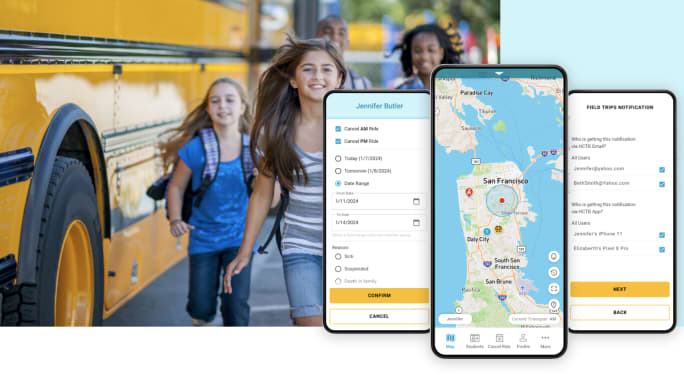
CalAmp's Here Comes The Bus offers geographical and RFID data extending to field trips, sports, and band routes.
Source: CalAmp
Key Benefits of Digital Communication Tools
Failing to communicate proactively about routes and stops can have consequences beyond inconvenience. Safety is a significant factor, especially in cases of unexpected route changes, delays, or emergencies.
"A Churchill County School District bus was involved in an accident in Nevada," D'Errico recounted. "Staff on the scene of the accident contacted parents and guardians and let them know via Stopfinder that their children were not injured but that there would be delays. The district also let parents know what the proper incident protocols were."
Moreover, real-time communication is essential for students with special needs or complex transportation plans. EverDriven shared how their app made a difference for a parent of a child with special needs in Delaware.
"The mother of the student with special needs loved being able to see exactly where the vehicle was, when her child was picked up, and when they got home," EverDriven said in a statement. "The level of visibility gave her peace of mind and added a layer of consistency to the school day."
However, today's transportation apps offer more than static schedules. The most common features include:
- Real-time bus tracking: Parents can watch the bus's progress on a map, easing concerns about delays or missed pickups.
- Geo-fenced notifications: Apps can alert families when a bus is approaching, reducing wait times at stops.
- Boarding and drop-off alerts: Some systems notify parents when a child scans on or off the bus.
- Multi-language support: Vital in districts serving diverse communities.
- Two-way communication: Parents can send messages or photos directly to transportation departments.
- Multi-guardian access: Critical for families with shared custody or complex caregiving arrangements.
Jon Wells, chief product and marketing officer at TransAct, also emphasizes accessibility as a key component in EZ A2B, its parent app that launched on June 30 for the upcoming school year.
“Features like multi-language support and ADA and Web Content Accessibility Guidelines (WCAG) compliance are key to app adoption and usability. They help foster inclusivity and clear communication across our communities, which are critical in a modern parent communication app,” Wells said.
Often, parents want to know what's going on and are willing to adjust their schedules to deal with issues that may come up. However, multiple vendors report that expectations are higher than ever due to what technology can offer and how it's integrated into daily life.
Districts Face Challenges, Too
While technology is powerful and more attainable than ever, implementing it isn't always easy.
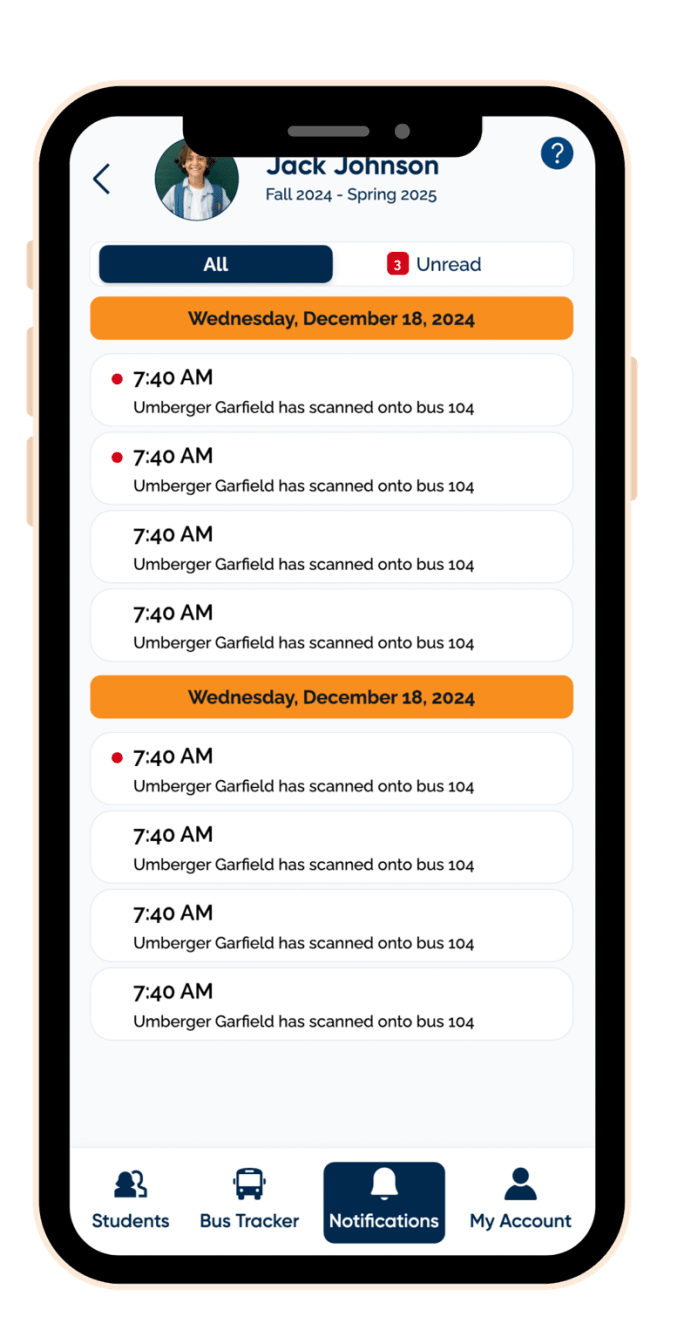
Some parent apps, like TransAct's EZ A2B, log tracking data points for parents to reference later.
Source: TransAct
"The biggest issue we face is the inability and unwillingness of a particular partner to integrate their suite of platforms with other technology partners across our department," Maybee said. "In this new age of advancing technology within and outside of transportation, it's unreasonable to assume that one company can successfully accomplish every aspect of technology needs for a student transportation department."
Another example is seen with the use of Zonar MyView in Walton-Verona Independent School District, which provides visibility into bus locations, changes, and estimated times of arrival. To help parents set up the app, the district offers video tutorials, a flyer with written instructions, and a page answering common pupil transportation questions.
Plus, the MyView back-end portal doubles as a district dashboard allowing administrators to communicate about bus changes, delays or breakdowns.
However, budget constraints also limit some districts. Even the most feature-rich apps aren't helpful if families can't access them due to a lack of smartphones or internet service — a problem in rural or high-poverty communities.
Districts also grapple with the human element: encouraging parents to use the new tools.
"We are working with schools and guardians to provide a how-to guide on downloading the app and setting up the guardian’s profile to see their student," Maybee offered.
Even though change is hard, the district works closely with Operational Service Directors (OSDs) in Denver to help operations communicate goals and ensure all schools understand the priority of integrating the My Ride K-12 app. Plus, a dispatch team will be trained on walking a family through app setup and troubleshooting, as well as disseminating information during calls about the available app.
"We truly rely on the support of our schools to help spread the word as well since they are the closest to our students and families," Maybee said.
Vendors Weigh In: Building Tools with Parents in Mind
While vendors understandably want to promote their solutions, they quickly acknowledge that technology alone isn't the answer. Simply providing an app is rarely enough.
For example, BusPlanner provides information material, training videos, and custom guides on using its services, including in-app help guides.
"But we also design the app to be as intuitive as humanly possible — parents should be able to get on the app and immediately use it without a training regimen," Haghighi said. "The more friction you remove, the happier parents (and transportation teams) will be."
Haghighi notes that BusPlanner's team constantly refines the app based on client feedback. "We work on a standard software sprint. We release updates every two weeks, and then large updates are done every half year," Haghighi said.
TransAct’s Wells says seemingly small features, like a frequently asked questions (FAQ) list, can significantly impact usability. “We provide a customizable ‘Getting Started/FAQ Guide’ up-front to districts as well as a parent communication template they can use to make it as easy as possible for parents to get started. Once they’re logged into the app, there are numerous resources available to answer any questions they may have,” Wells said.
EverDriven echoes the sentiment, noting its dedicated support team and in-app guidance to offer support and reduce the need for formal training. During rollouts where education is crucial, the company provides live support from its Denver-based team to help families troubleshoot issues one-on-one.
CalAmp’s HCTB provides school districts with a comprehensive onboarding kit to ensure parents and staff are fully supported during rollout and adoption. This includes customizable emails, flyers, social media posts, and a promotional video. Each user receives a branded microsite with direct download links, FAQs, and other resources tailored to their needs. As a result, CalAmp reports that parents can be using the app with confidence within five minutes.
Transfinder offers media kits, short and long-form how-to videos, and webinars where districts share best practices.
Maybee's district team will collaborate with school staff to map out the rollout process and fully anticipate data flow while optimizing the system to be as simple as possible for families to increase utilization.
Why High-Tech Tools Still Need Human Connection
Despite rapid technological advances, the human element remains irreplaceable in school transportation. Districts that pair high-tech tools with personal communication often see the best outcomes. A parent who receives an automated alert about a late bus may feel even more reassured if a dispatcher follows up with a personal call.
"That combination of reliable technology and real human support makes a huge difference," an EverDriven spokesperson said.
As a new school year approaches, districts nationwide are leaning into technology to keep parents informed and students safe. While apps can't solve every problem, they're a powerful ally in creating transparency, reducing stress, and freeing transportation teams to focus on getting buses where they need to go.
"I am excited to continue to work on these advancements in technology and other aspects for our communities, families, and most importantly, our students while also continuing to help build a healthy data culture for decision-making," Maybee said.
When parents have clarity about bus routes and timing, every trip is safer, more efficient, and easier for all involved.
Subscribe to Our Newsletter
More Management

How to Build a Better Driver Training Program
Ready to boost up your school bus instructor training? Here’s how to pick the right talent and improve recruitment, retention, and safety.
Read More →
CALSTART and Forth Combine to Form Catalyst Mobility
The new name represents a renewed vision for the nonprofit focused on advancing clean, equitable, and affordable transportation solutions that move people and goods.
Read More →
What Makes a Great School Bus Driver Trainer?
Choosing the right school bus driver trainer takes more than experience. Learn six keys to selecting and developing trainers and evaluating program effectiveness.
Read More →


School Bus Contractors Expand Through New Deals, Acquisitions & Partnerships
STA's Canadian division acquires Ontario-based G&L Stevenson Transport while Durham School Services adds a new district contract in California, First Student adds a New Jersey contract, and Minnesota Coaches acquires Halo Transportation.
Read More →
Logan Bus Company Rolls Out AI Phone System for NYC School Bus Families
A summer pilot found that AI agents could handle most routine calls, freeing up time for customer service staff to focus on emergencies and complex family concerns.
Read More →
From Intent to Impact: What I Learned About Leadership from TAPT
A Texas transportation supervisor shares lessons on self-awareness, accountability, managing stress and building trust — and why investing in leadership development matters at every stage of your career.
Read More →
NAPT Names 2026 Award Recipients, Hall of Fame Inductee
Who earned national recognition for their work in student transportation? This year, NAPT named five recipients of its 2026 awards for service, safety, and leadership, plus its newest Hall of Famer.
Read More →
Sponsored•September 2, 2026
2026 State of Student Transportation Report
Driver shortages. Rising costs. Growing safety expectations. More data, but not enough time to act on it. The 2026 State of Student Transportation Report reveals what transportation leaders say is putting the most pressure on their operations—and where they’re investing next. See how your priorities compare.
Read More →
How to De-Escalate an Angry Person: 5 Steps for Handling Workplace Conflict
What makes emotions run high, and how should you handle an angry colleague or parent? Follow these steps for staying calm, listening, showing empathy, and resolving conflict.
Read More →
Sponsored•September 1, 2026
What Readiness Looks Like This School Year
Learn about the challenges shaping the 2026–2027 school year, from persistent driver shortages and budget pressure to technology and readiness gaps. See how school districts are responding and adapting in Zonar’s 2026 Back-to-School Readiness Report.
Read More →