Dealing with a perturbed parent? Follow these tips for handling conflict amid emotionally charged situations on the school bus and find solutions to de-escalate.
Outside stressors can cause anyone to act out of order. Here's how to respond when someone else feels triggered by something regarding the bus.
Photo: SBF/Canva
8 min to read
If you’re a school bus driver or transportation director, you’ve likely had run-ins with students’ parents or guardians who didn’t hold back when expressing their displeasure about something that happened to their child on the bus and what they wanted you to do about it.
How do you handle this? What training have you received or given?
Ad Loading...
This topic was explored at the 2025 CASTO conference, where Dianna Poulin, director of loss control services, Southern region, for Keenan Associates, presented. There, she shared tips on how to transform your approach to parent interactions.
Poulin’s Conflict Resolution Strategies for Bus Drivers
Poulin offered many tips and reminders, including:
Remember, you can’t control others’ behavior, only your own.
Stay calm (but never tell someone else to calm down!). Emotions are contagious.
Be respectful. You get what you give!
People are angry because they believe their concern is valid.
Maintain open, positive body language.
Listen more than you talk; let them feel heard.
Ask questions to learn more about the situation.
Use “I” statements to prevent defensiveness.
Offer choices in a resolution.
Try to get to the root cause of the person’s concern so you can share information back that could ease their fears.
Speak to the person in private so other students do not have to witness the situation (even if you make an appointment with them for a future time).
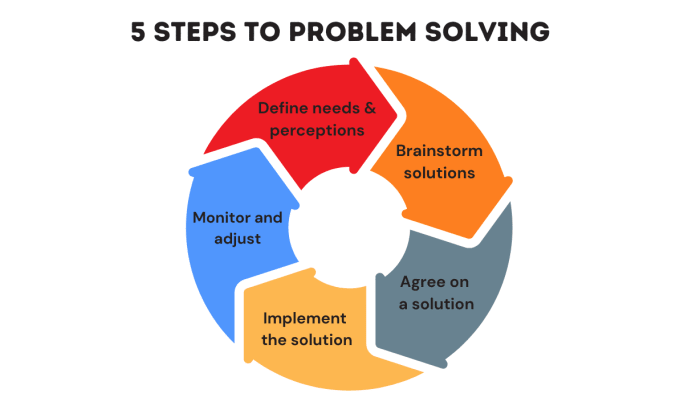
The five steps to problem solving. Note: These do not always happen in a linear fashion.
Source: SBF/Canva
Understanding what motivates a parent’s concern — such as their child's safety — can help keep conflicts at bay.
Ad Loading...
How does Kimberly Jones, director of transportation at Chicago Public Schools, handle conflict? She gives parents a peek behind the curtain for greater understanding of what factors they may not realize go into school bus operations.
“I talk to parents, and I’m 100% transparent,” Jones said. “I inform them of the things that I am facing here in the district and why I can or cannot provide services. Some conversations go well, and some do not. As a parent myself, I understand that they are concerned about their child.”
Technology’s Role in Resolution
7 Statements to Use to Diffuse Tension
“I hear you” or “What I hear you saying is…”
“I understand that you are frustrated.”
“I can tell this really bothers you.”
“Tell me more about…”
“I want to get to the bottom of this.”
“Let’s find a resolution together.”
“Here are a few options we have; which would you prefer?”
Derek Graham, pupil transportation consultant, references how parent apps and technology can step in to prevent some situations in the first place.
“What I share with districts often is that parents do not like it when the bus is late, but they really don’t like it if they don’t know the bus is going to be late,” Graham said. “Communicating about late buses in real-time can help mitigate their frustration. Parents and guardians appreciate receiving the information, even if it is not the information they want to hear.”
Radios also are a handy tool during disputes. If someone is being verbally abusive or threatening, drivers can hold down the button so that someone else can hear what was said.
Ad Loading...
Teena Mitchell, special needs transportation coordinator at Greenville (S.C.) County Schools, advises using the radio call in for direction, which takes the focus off of the driver and puts it on the dispatch. She said: “If a parent tries to talk to the bus driver about a highly charged subject, the bus driver should be trained to calmly say, ‘I would really like to help you, can you call my supervisor, here is his or her card, or can I have my supervisor call you? Due to other students being on this bus it would not be appropriate to discuss this matter at this time. I can assure you that my supervisor will address this issue for you.’ This helpful attitude seems to help calm parents because they feel they are being heard.”
A Team Approach
At Florence Unified School District #1 in Arizona, Shannon Weber uses a conduct team to manage student behavior and handle angry parents, as well as to train new drivers on how to de-escalate these scenarios.
“I like to call it curb etiquette,” Weber said. “[The conduct team] will view footage from the request and provide feedback to the supervisor for follow up or follow through to the parent. If drivers prepare conduct referrals for students, the conduct team will go to schools and speak to students to offer reminders, warnings, or seek details on what may have occurred in an incident. They are my best neutral detectives; once we have the information needed, we can give appropriate consequences per our bus conduct levels, whether it be a new seat, a call home, or sometimes a suspension.”
Greg Jackson, director of business development, School Bus Logistics, used to be a transportation administrator in Colorado and remembers handling many of these situations.
“I've talked to a lot of people across the country, and I'm seeing behaviors of parents escalating on such a high level that’s reflective of how volatile our country is right now,” Jackson said. “It's not just about the student behaviors, it’s about also parent behavior. We can't recruit people to be drivers when they see these stories on the news and want to work somewhere else they won’t be abused.”
Ad Loading...
Jackson’s top tips for dealing with parent conflict is to really listen, approach each situation uniquely and specific to the context and individuals involved. He recommends other front-line staff gather as much information and evidence from all angles and sources before escalating or tackling the issue. Knowledge is power!
When you do field a call, he suggests letting the parent fully explain the situation before jumping to the defense of your team, as much as you may want to. Back to that active listening point.
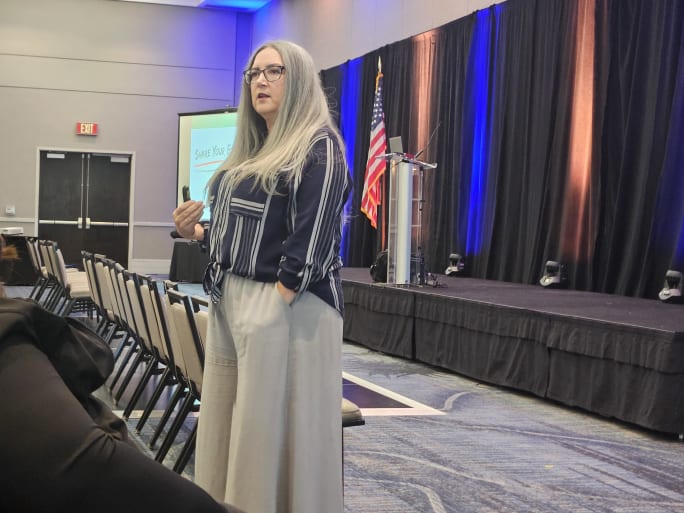
Diana Poulin presented tips for managing angry parents at the 2025 California Association of Student Transportation conference. After learning best practices, two brave volunteers participated in an activity where one posted as the driver and the other as the angry parent to practice what was learned.
Photo: Amanda Huggett
One Story in Action
Jackson refers to one incident that became physical when he worked for Jeffco Public Schools in Colorado involving a special needs bus driver. As background: That district communicated instructions to all parents, and allowed five minutes for student pickup. The driver arrived slightly early and waited seven minutes for the student, who never came out. The driver communicated to dispatch that they were departing. As the bus began moving, the parent ran out.
State policy dictates that once the bus is moving, it won’t stop, and that parents should bring their child to another pickup point. This parent got in their car and began chasing the bus. At the next stop, they blocked traffic to approach the driver and began screaming in front of the other children and parents. The driver used his radio mic to share with dispatch what was being said, and the team began recording in case it was needed for law enforcement. The other parents helped keep the angry parent away, and the bus departed again.
When the bus arrived at school, this angry parent cut in front of the bus in the lineup and got out of her car. Dispatch had already alerted the principal, who was ready and waiting with security for the bus to arrive. The parent was trying to break the glass to get in through the door when the driver would not allow her on board. When she came to the side window, she tried to climb through it to the driver.
Ad Loading...
Law enforcement offered her two choices: To let her child into the school and walk away or be detained and arrested immediately. She chose the former.
But this wasn’t the end. The parent went to the office to find the transportation director and expressed her anger over her child being left behind. Law enforcement stepped in again.
Two days later, she was still upset and called to discuss the situation. “I invited her to come to see me because I had on everything on camera,” Jackson said. “She comes over, and she's still hyped up. I showed her the recordings. I asked, ‘Why do you feel that it was OK to take it to that one situation? Here's the letter we sent to you before the first day of school, you signed it and agreed that you understand what your responsibility was. You violated that.’”
Then, Jackson level set the situation further, explaining that not only was her child autistic, but so was every other student on that bus, who were all disturbed by the altercation.
This is when the gravity of her reaction hit her. She admitted that she was in her own world and asked what she can do to make the situation right.
Ad Loading...
Jackson asked her to apologize to the staff and explained how hard it was to find bus drivers at the time. He explained what goes into driving a school bus to offer her greater clarity than she had before.
Thankfully, the district had cameras and a bus conduct agreement that all students and parents signed before starting the school year.
“School buses are an extension of the school, so if you have protections for administrators there, why not have the same on the bus?” Jackson said. “In many cases, people don’t have the same respect for transportation that they do for a school principal or teacher. But as an administrator, it's your job to put the right tools in place to protect your kids, to protect your employees, and be that voice.”
Top Tips for De-Escalating Disputes
Actively listen to the other person’s side with empathy and compassion.
Be upfront about policies and regulations that your drivers must follow. Often, parents don’t know what they don’t know until you tell them.
Build relationships with both students and their parents. Encourage parents to introduce themselves at the start of the school year or with a new driver.
Install cameras on your buses so there’s evidence of what really happened.
Get to the truth. Talk to all those involved and pull video evidence if available.
Conduct regular training with your staff on how to de-escalate verbal disagreements, including what to do if it turns physical.
When and if altercations do occur, hold a debrief with your team to share what happened and remind the proper response in case there’s a next time.
If you don’t yet have a policy, create one. Always have plans in place to know and protect your drivers’ rights.
Train your team members on conflict resolution and make sure they know district policies. Review both regularly!
Pick someone well-equipped on your team to be the point person for handling these situations to filter the information to you as a supervisor. Wait a brief amount of time to follow up with the parents so they can cool down in the interim.
Have your drivers keep their supervisor’s business cards on the bus to hand to upset parents as needed.
Leave the door shut to prevent an altercation inside the bus and ask the person to speak with you through the window.
The new name represents a renewed vision for the nonprofit focused on advancing clean, equitable, and affordable transportation solutions that move people and goods.
Choosing the right school bus driver trainer takes more than experience. Learn six keys to selecting and developing trainers and evaluating program effectiveness.
STA's Canadian division acquires Ontario-based G&L Stevenson Transport while Durham School Services adds a new district contract in California, First Student adds a New Jersey contract, and Minnesota Coaches acquires Halo Transportation.
A summer pilot found that AI agents could handle most routine calls, freeing up time for customer service staff to focus on emergencies and complex family concerns.
A Texas transportation supervisor shares lessons on self-awareness, accountability, managing stress and building trust — and why investing in leadership development matters at every stage of your career.
Who earned national recognition for their work in student transportation? This year, NAPT named five recipients of its 2026 awards for service, safety, and leadership, plus its newest Hall of Famer.
Driver shortages. Rising costs. Growing safety expectations. More data, but not enough time to act on it. The 2026 State of Student Transportation Report reveals what transportation leaders say is putting the most pressure on their operations—and where they’re investing next. See how your priorities compare.
What makes emotions run high, and how should you handle an angry colleague or parent? Follow these steps for staying calm, listening, showing empathy, and resolving conflict.
Learn about the challenges shaping the 2026–2027 school year, from persistent driver shortages and budget pressure to technology and readiness gaps. See how school districts are responding and adapting in Zonar’s 2026 Back-to-School Readiness Report.