





Previous NCST Coverage
Key Outcomes from the 17th Annual NCST
Three new sections, spirited debates on school bus specs and alternative transportation guidelines, NCST was far from boring. In fact, this year’s congress wrapped early, even after a 10-year hiatus. Delegates from 48 states worked through these new industry recommendations.
May 8, 2025
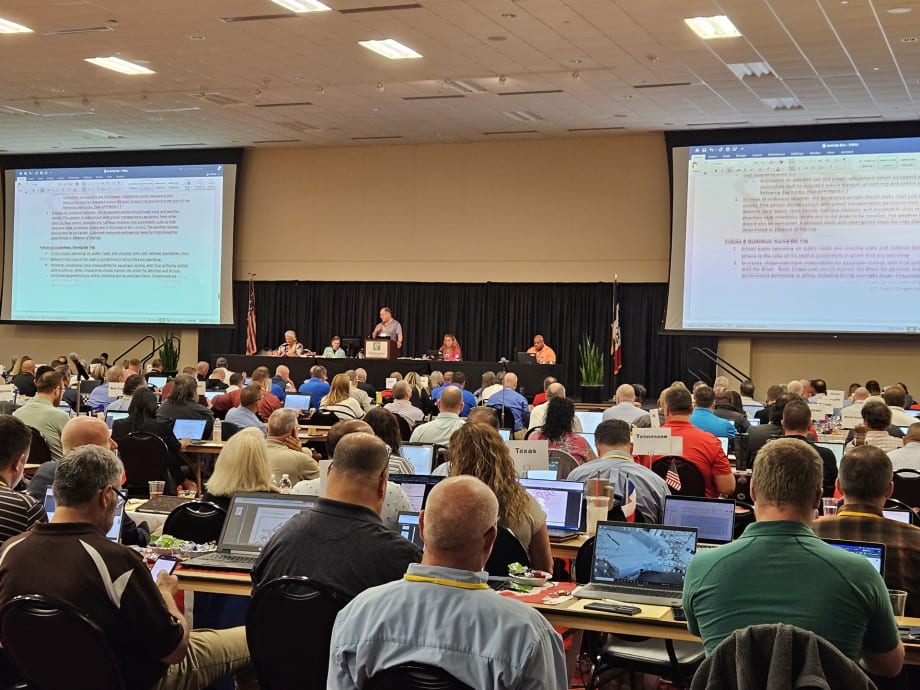
The congress was moderated by Charlie Hood, a retired director and NCST site operations and editing committee chair, with Indiana’s Mike LaRocco stepping in occasionally.
Photo: Amanda Huggett
12 min to read
DES MOINES — After 10 years due to COVID cancelling the 2020 event, the 17th annual National Congress on School Transportation (NCST) finally returned in May 2025 in Des Moines, and SBF was on the scene.
Delegates this year worked efficiently together to agree on new industry standards. In fact, it was the first time in at least decades that the congress ended a day early.
How it Worked
State transportation directors and industry professionals convened in Iowa’s capitol to determine new recommended specs and minimum standards across the industry. There were 48 states represented (North Dakota, New Hampshire, and D.C. were absent), 265 delegates, and over 300 present total.
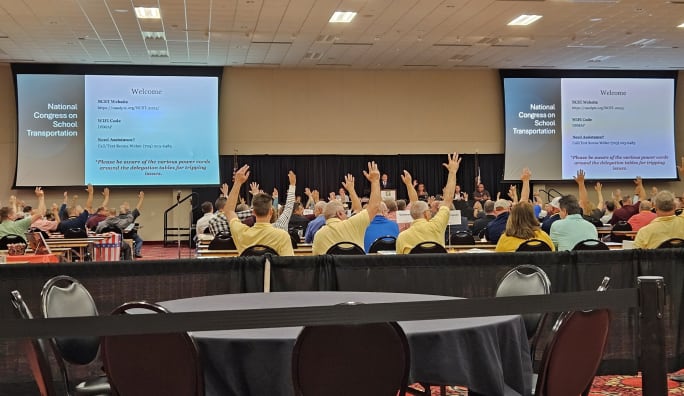
On opening night when asked all those present for the first time to raise their hands, a surprising amount of newbies were identified.
Photo: Amanda Huggett
The first NCST was held in 1939. Since 1980, the congress has been held every five years to update its best-practice recommendations, which eventually become the National School Transportation Specifications and Procedures (NSTSP) manual that eight states adopt in full and more take portions of it. For the past two years, 11 writing committees researched changes to the manual and presented proposals at the congress.
“The NSTSP manual is like the Bible,” said Sue Shutrump, a retired PT/OT supervisor and consultant. “As an expert witness, I refer to it all the time. It’s the industry-standard, our guiding light.”
For this congress, three new committees and sections formed on alternative transportation, alternative fuels, and emerging technologies.
Each state had between one and seven delegates at a table (with two alternates) to discuss and vote on each proposal using a paddle system, with one vote per state. Meanwhile, "interested parties” made up of suppliers, consultants, associations, and media, watched from the back to not disrupt the process or interfere with voting. Robert’s Rules of Order were used.
Charlie Hood set the scene on the opening night. “Delegates, we encourage you to take to heart that through this process, you are setting the standard for school transportation across the country,” he said. “The safety of the nation's children deserves nothing less than your full attention... We're here to establish national consensus on recommendations and best practices, not requirements for any state or local jurisdiction.”
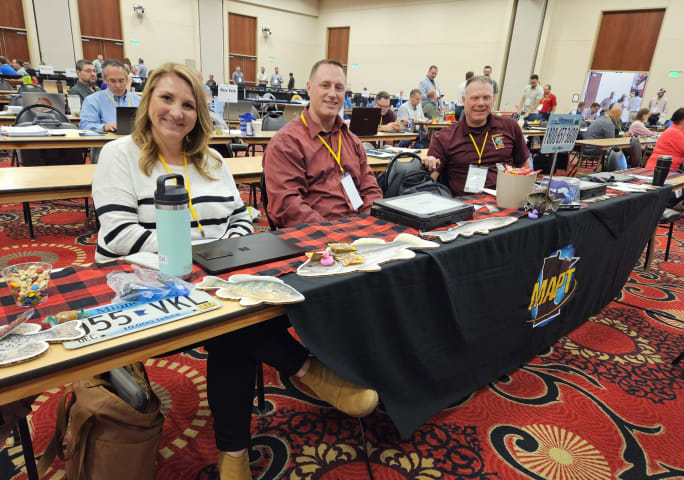
Some states got creative and showed their pride by decorating their table. Minnesota decked theirs out with flannel and walleye cutouts.
Photo: Amanda Huggett
Key Proposals & Discussions
As each committee chair took the stage to share the new proposals, many updates were made to simplify the manual’s language, match new federal initiatives and language, and mirror new manufacturing and technology practices in areas such as school bus specifications, features, and inspections, pre-K students and those with special needs, and alternative transportation.
Many proposals passed with little to no hullabaloo, as consensus was easily achieved. Others sparked debate.
For some sections, specific language was contested (“shall” versus “may” or “should” to allow local or state jurisdiction, and “student/passenger” versus “child” in special-needs cases), and in other cases, entire sections were struck out or added to. Throughout several sections, the word “school” was replaced with LEA (local educational agency), to include private and charter schools, though in others it remained school to be more appropriate to the situation.
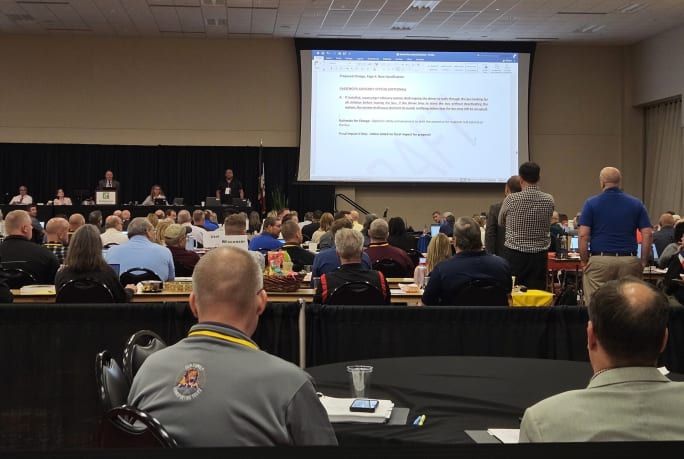
After each proposal was presented, delegates were invited to comment, ask for clarification, or propose an amendment at a mic for all to consider.
Photo: Amanda Huggett
Some issues that sparked debate revolved around heating & air conditioning systems, child check systems, LED lighting, high-voltage propulsion systems, climate control systems in specially equipped school buses, windshield cracks and obstructions, student responsibilities on the bus, crash reporting, allowing gas vouchers and transit passes for McKinney-Vento students, wheelchair lift and rear-facing CSRS protocol for infants and pre-K students, transportation’s responsibility for providing adaptive equipment, and activity bus driver breaks.
Stop Arms & Child Check Systems
The first debated issue was in school bus specifications for a proposal reading, “School buses with a body length of 30 feet or greater shall require combination front and rear stop arms/stop signs and shall comply with requirements of FMVSS 131 for the additional stop arm/stop sign.”
Many spoke up requesting double stop-arms be optional and up to state or local district control. A representative from New Jersey said, “In our personal experience, we found the second stop arm is almost irrelevant, it has absolutely no effect whatsoever on stopping or reducing drive-bys.” A rep from Utah agreed. An amendment to change “shall” to “may” had a 22-22 tie vote. Hood broke the tie, passing the amendment. The next vote on the amended proposal then failed 21-22, and the language remains “may.”
The other significant spec’ing debate was around passenger advisory systems, or child checks. These were agreed upon as optional. Much of the language around the specifics of the system was discussed as each operates differently, and an amendment to strike an entire section that detailed a process to push a button at the rear was passed.
CSRSs & Climate Control
In the specially equipped school bus specs, the proposal to change “booster seat” to conventional was amended to CSRS (child safety restraint system) shall conform to FMVSS No. 213 and received a unanimous vote.
Another proposal, “Climate control options shall be installed that include heating and air conditioning,” was debated as a national standard, with an amendment requested to change “shall” to “may.”
Dave Richard from Illinois weighed in: “You're not going to build a bus for a specific student. If you're going to build a special needs bus, you'd want to put air conditioning on it, have heat on it, so no matter what student you end up transporting down the road, you're equipped and ready.”
A representative from Michigan countered that, “‘May’ actually is probably appropriate wording, because we are a giant nation with various climates, so not everybody needs everything on all their buses.”
The amendment passed 37-7, leaving it optional.
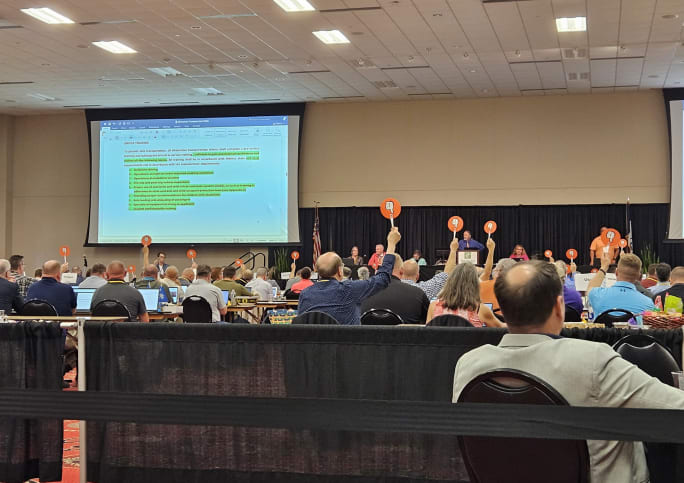
Voting was conducted using a paddle system. One side in green indicated approval, while the red side indicated rejection of a proposal or amendment.
Photo: Amanda Huggett
New Technologies, Alt Fuels
The new Emerging Technologies section and committee was chaired by Chris Ellison, director of transportation at Reynolds School District in Oregon. This section recommends best practices for developing a conceptual framework when evaluating and adopting emerging technologies or a new technical product or service.
The Alternative Fuels section, chaired by Ken Johnson, covered battery systems needing to meet FMVSS and SAE standards, and was easily passed.
General Operations
General operations was chaired by Theresa Anderson from Colorado; the first proposal in this section to receive significant discussion was around student responsibilities.
Mac Dashney from Michigan voiced concern over the wording “The student should be informed that school bus transportation is a privilege...” noting that students with IEPs requires transportation as a service, making it a right.
Tom Simpson from Iowa, also shared a concern of giving a driver the power to expel a student from the bus on the spot, proposing that a student be informed of conduct expectations, and that transportation is a privilege that can be denied due to unacceptable behavior, according to school board policy and IEP team determination. This amendment passed.
Around crash reporting, a request to change the word “bus” to “vehicle” was denied.
Another proposal around McKinney-Vento student transportation noted that school buses are not necessarily the required mode and that transit passes, gas vouchers or reimbursement, contracts with taxi companies or Medicaid be allowed with driver background checks.
John Benish of Cook-Illinois Corp in Illinois motioned to strike out transit passes and gas vouchers, saying: “Gas vouchers are tough to … make sure that they're in the right place and the money's going to the right spot. Transit passes, obviously, we don't want the children riding with the general public... And we just don't think with all the rules and regs that we comply with, a transit bus does not comply to most of the things that we have.” Others wanted both to stick.
The amendment failed 1-45; the original proposal passed 46-2.
Students with Disabilities & Infants through Pre-K
The students with disabilities section, chaired by Alexandra Robinson, made changes to use child-first language and federal and SPED law verbiage, plus new best practices for bus stop design, use of CSRSs, wheelchair lift usage, transporting children who are technology dependent, SPED travel training, and an appendix containing various sample forms and checklists.
Many changes were made to modernize the suggestions and language in the infants, toddlers, and pre-school children section chaired by Denise Donaldson. It also added a confidentiality section, expanded on staff responsibility, and updated Head Start guidance and wheelchair standards.
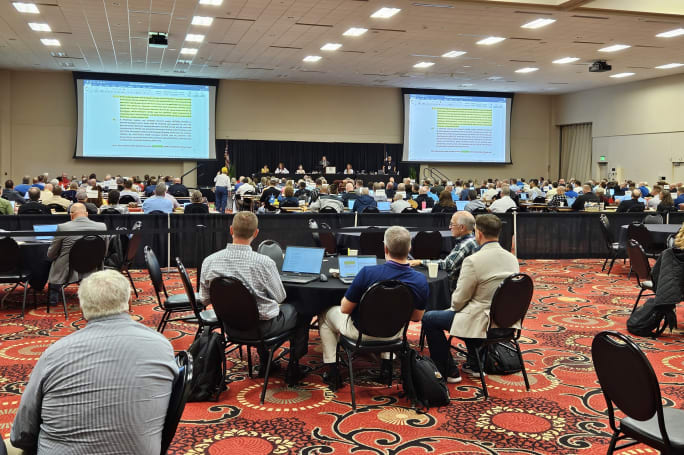
State delegates were seated in rows with alternates behind them and interested parties behind them.
Photo: Amanda Huggett
Alternative Transportation
The alternative transportation section is where things got really interesting. We witnessed amendment after amendment, many moments of murmuring, groans alternating with applause. No section had as many emotions as high and as many speakers present as passionately as alternative transportation, not to mention requests for clarity and back-and-forth debate.
Chaired by Tyler Bryan of the Delaware Department of Education, he stated that: “The committee consists of various states, districts, and alternative transportation providers. The intent was to find minimum requirements for this type of transportation that would allow us to adopt requirements to continue to find safe transportation for students, really stressing that we were looking at leaving it pretty minimum so that way it would not cause a lot of issues, as we know stuff is done differently in many states, but getting the major framework to help ensure kids are safe and that checks are being done.”
An accepted definition of alternative transportation was approved, reading: “The transportation of students by a LEA or a third party under a written agreement/contract with LEAs in any vehicle that is not a Federal Motor Vehicle Safety Standards (FMVSS) defined school bus or Multifunction School Activity Bus (MFSAB). This includes home-to-school and school-to-home transportation, as well as school-related activities. This definition excludes motor vehicles transporting students for which parents or guardians receive direct compensation from a LEA, motor coaches operating under charter operator authority, and transit buses providing regular route service.”
The section also noted that school buses, being the safest form of transportation, should always be considered the first means of transportation when feasible. However, it is recognized that school buses cannot always meet each individual student's specific needs.
Four main areas were identified to address safety standards for alternative transportation, including:
Driver credentials.
Driver training.
Vehicle design/equipment.
Special education policy considerations.
Under the first point, after heated debate about minimum driver age and background requirements, plus motions to generally match state requirements for school bus drivers, it was decided to hand it over to the technical committee for review.
For alternative transportation driver training, one proposed amendment to add diversity and sensitivity training failed 1-42 after other delegates voiced concerns about federal funding in light of recent federal events. Railroad crossing training passed 24-15, until the entire section was struck to no longer detail specific trainings and ask that it follow federal, state, and local requirements.
Seating capacities were also debated, and at what point it tips over into classifying as a school bus. It was agreed to be no more than 10 passengers, including the driver.
Another amendment was proposed from Iowa to increase the capacity to 15 (allowing for vans). This was passionately contested and legalities questioned.
“I would strongly disagree with what Iowa said, those vans are death traps,” a delegate from Arizona said. “I've got 21 years on the road as a state trooper, and I've had to pull too many kids out of vans and go tell their family that they're dead because of a piece of equipment, either because they weren't in seat belts and got ejected or they got crushed, because the structural integrity of those vehicles is not safe. There's a reason why in ’04 the federal government made it illegal for a school to purchase it…,” adding that some buy used as a workaround, but that puts dollars in front of safety.
The amendment to increase the seating to 15 failed 1-44.
Another amendment that sought to remove the fire extinguisher and webbing/seatbelt cutter from in-vehicle equipment failed to advance after not receiving a second. Other equipment outlined to be in vehicles include a lap-shoulder belt, first aid kit, bodily fluid clean-up kit, CSRS and mobility equipment, communication device, vehicle identification, and FMVSS equipment as appropriate per the vehicle classification.
Iowa proposed adding that vehicles with a mobility device such as a wheelchair lift or ramp have a fire suppression system. This failed 7-34.
The final section under alternative transportation for special education was largely copied from NHTSA’s 15-passenger van guidance.
A delegate proposed adding that no student should be transported in the front seat of a vehicle, with three states disagreeing over how it would limit getting more kids to school. Another expressed concern for additional distractions with a passenger in the front seat. Delegates voted 9-31, failing the amendment.
Wrapping up this section, Todd Rittenhouse, a Pennsylvania contractor, brought up some additional food for thought on the need for clarity around the pick-up and drop-off process. “One thing I don't see in here, and this is something that keeps me awake, and should keep some of you awake, is we don't do a good job of defining alternative transportation,” he said, noting that lights on the school bus help set a universal process we follow.
“I would challenge the committee that we’ve got to figure that out, because I can tell you from our schools’ perspective, it's to get them on and get them off, and we don't really have anything to draw from as … a best practice. We're all worried that is the most unsafe place around a school bus. Well, if you're dropping off on the edge of a road in a van, and you're trying to do it on curbside, what happens if that kid hits the button and decides they want to go out on the roadside?”
Terms & Resolutions
The congress also discussed and approved various definitions, terms, and acronyms, including "crash" over "accident," "attendant" over "monitor," and "safety and security inspection."
Resolutions passed were to…
Standardize data collection for school bus ridership data.
Encourage planning bus stops that are not in proximity to known registered sex offenders and train staff on how to spot and report human trafficking.
Ask NHTSA for clarification on the FMVSS side-impact requirements (with an effective date of June 30, 2025) for child restraint systems designed for school bus use.
Recognize NCST leadership, including Patrick McManamon as chair from 2015 to 2024, Mike Larocco as current chair, Charlie Hood, and all committee members
Thank Ronna Weber, executive director of NASDPTS, for her dedicated leadership in coordinating NCST.
Wrap-Up
In total, there were over 150 votes between proposals and amendments.
The entire congress and the conversation around each was inspiring. The passion each delegate brought, combined with their strength of experience and variety in opinion, means an NSTSP that we can all be proud of.
“The 17th NCST has successfully completed its work,” LaRocco said. “Thank you to the NCST Steering Committee, all writing committees, the editing, technical, appendices, terms and definitions, resolution committees, and most importantly, the 48 state delegations that were present.”
“It was a very productive conference,” Shutrump commented. “We moved through the proposals as efficiently as possible and came out with a document that will be very valuable for all.”
Several delegates in attendance said that many of these updates had already been made in their states, so most NCST results were not surprising.
The next NCST will be in at least five years — potentially sooner depending on the results of this year’s survey on desired frequency. Stay tuned for details and how to get involved in a committee.
The final NSTSP manual will be available in the coming months on the NASDPTS website.
Subscribe to Our Newsletter
More Management

How to Build a Better Driver Training Program
Ready to boost up your school bus instructor training? Here’s how to pick the right talent and improve recruitment, retention, and safety.
Read More →
CALSTART and Forth Combine to Form Catalyst Mobility
The new name represents a renewed vision for the nonprofit focused on advancing clean, equitable, and affordable transportation solutions that move people and goods.
Read More →
What Makes a Great School Bus Driver Trainer?
Choosing the right school bus driver trainer takes more than experience. Learn six keys to selecting and developing trainers and evaluating program effectiveness.
Read More →


School Bus Contractors Expand Through New Deals, Acquisitions & Partnerships
STA's Canadian division acquires Ontario-based G&L Stevenson Transport while Durham School Services adds a new district contract in California, First Student adds a New Jersey contract, and Minnesota Coaches acquires Halo Transportation.
Read More →
Logan Bus Company Rolls Out AI Phone System for NYC School Bus Families
A summer pilot found that AI agents could handle most routine calls, freeing up time for customer service staff to focus on emergencies and complex family concerns.
Read More →
From Intent to Impact: What I Learned About Leadership from TAPT
A Texas transportation supervisor shares lessons on self-awareness, accountability, managing stress and building trust — and why investing in leadership development matters at every stage of your career.
Read More →
NAPT Names 2026 Award Recipients, Hall of Fame Inductee
Who earned national recognition for their work in student transportation? This year, NAPT named five recipients of its 2026 awards for service, safety, and leadership, plus its newest Hall of Famer.
Read More →
Sponsored•September 2, 2026
2026 State of Student Transportation Report
Driver shortages. Rising costs. Growing safety expectations. More data, but not enough time to act on it. The 2026 State of Student Transportation Report reveals what transportation leaders say is putting the most pressure on their operations—and where they’re investing next. See how your priorities compare.
Read More →
How to De-Escalate an Angry Person: 5 Steps for Handling Workplace Conflict
What makes emotions run high, and how should you handle an angry colleague or parent? Follow these steps for staying calm, listening, showing empathy, and resolving conflict.
Read More →
Sponsored•September 1, 2026
What Readiness Looks Like This School Year
Learn about the challenges shaping the 2026–2027 school year, from persistent driver shortages and budget pressure to technology and readiness gaps. See how school districts are responding and adapting in Zonar’s 2026 Back-to-School Readiness Report.
Read More →