




15th NCST Moves Industry Forward
Topics of debate included a revision that would have made crossing arms mandatory on school buses & delegates rejected the change.

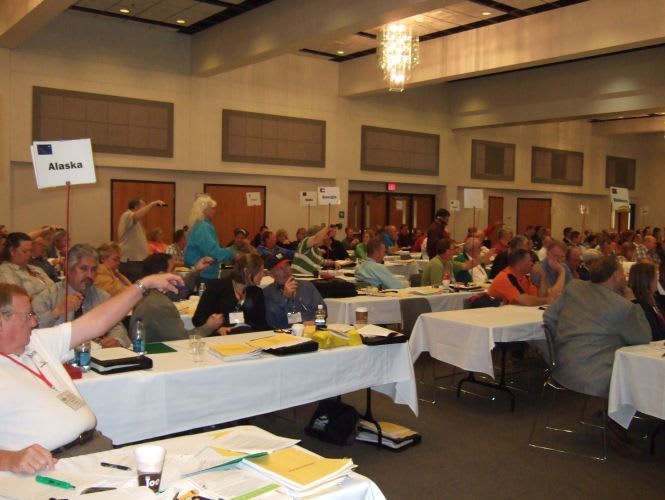
For the first time, delegation chairs were able to vote electronically with remote controls, in a move to save time and eliminate the confusion of voting with raised flags, as in previous years.
Delegates representing nearly all 50 states in the U.S. revised the 2005 National School Transportation Specifications and Procedures document in Warrensburg, Mo., during the 15th National Congress on School Transportation (NCST) in May.
The NCST is held every five years at the University of Central Missouri. The Missouri Safety Center at the university hosts the event, maintains the NCST website, administers congress activities and coordinates the revisions process and publishing of the final specifications and procedures document. The Missouri Safety Center also offers school bus driver trainer certification courses and online pupil transportation resources.
For the first time, delegates at the NCST, which is held every five years, were able to vote on revisions and amendments electronically. Also, debate was limited to the writing committees’ proposals.
Steering Committee Chair Pete Baxter said that compared to previous years, when voting was done by raising flags and any part of any section of the document could be brought up for discussion on the floor at any time, this year’s proceedings were much more efficient.
“The steering committee as a whole and all of the member organizations recognized the need to update the process,” Baxter said. “Based on our new operating rules, the Technical Assistance Committee only had a handful of items that they needed to review and advise on, versus potentially well over 125, just from 2005. You have a potential greater quality of debate because you’re focusing on things that have been vetted through the writing committee, and in turn, the writing committees have been in consultation with the manufacturers so any of those [feasibility] issues get resolved at the committee level and there aren’t surprises when you get to deliberations.”
Familiar topics spark debate
Among the first revisions brought before the delegates, the Bus Body and Chassis Specifications sections were consolidated into one, eliminating redundancies. The proposed change that spurred the most active discussion on the floor was one that would have effectively required the installation of crossing arms on school buses (the revision changed the wording to say that vehicles “shall” be equipped with the devices rather than “may”).
Among the delegates who spoke in opposition to the change was California state director John Green, who said that the state’s escorted crossing requirement makes crossing arms unnecessary.
Larry Bluthardt, Kansas state director, pointed out that most student deaths that result from being struck by their own bus occur at the rear wheels rather than the front, where the crossing arm is positioned.
Utah state director Murrell Martin suggested that this issue may reflect the necessity for training of drivers and students, rather than necessitating a blanket change to school bus specifications. Others mentioned that some buses used to transport students with special needs often do not require use of a crossing arm, and delegates from cold weather states pointed out mechanical problems that can arise in operating crossing arms during the winter.
In the end, the motion was defeated by a 35-to-11 vote.
“We don’t have [crossing arms] on our buses here, and it should still be optional,” California delegate Pam McDonald said, expressing her delegation’s satisfaction that the wording change was voted down.
This was McDonald’s first time attending an NCST, and in addition to serving in the California delegation, she participated in the activities of the General Operations Writing Committee and the School Transportation Security and Emergency Preparedness Writing Committee. Preparations included out-of-state meetings and much e-mailing back and forth among committee members over the past two years, she said.
Also in the Bus Body and Chassis Specifications section, under the portion discussing exhaust systems, new language was added to account for 2010 engines and EPA requirements. The writing committee chair, Mike Kenney, said these changes were brought forward by the manufacturers, and comprised the inclusion of the term “after treatment system” in the pertinent sections.
Notable in the revisions to the Specially Equipped School Buses section was a requirement to have two webbing cutters on board specially equipped buses (the second cutter would serve as a backup). This motion passed in a 25-to-21 vote.
Perhaps the most dramatic occurrence during the first day of deliberations was the wholesale rejection of the School Bus Inspection Writing Committee’s revisions to the section. Committee chair Sgt. Sharron VanCampen of Michigan asked delegates to approve or reject the section in its entirety, as it was written to conform to Federal Motor Vehicle Safety Standards and Federal Motor Carrier Safety Administration statutes. If approved, Sgt. VanCampen said the section would be forwarded to the federal government to challenge the U.S. Department of Transportation’s annual inspection requirement.
Among others, New Mexico state director Gilbert Perea spoke in opposition to the motion, saying that it set up a slippery slope in which the feds could then be able to impose citations for non-compliance. Delegates voted to reject the section and revert to the 2005 document.
The next day, the Transportation for Students with Disabilities and Health Care Needs section essentially was edited and revised to reflect the 2004 reauthorization and 2006 regulations regarding the Individuals with Disabilities Education Improvement Act. Most revisions to that section and the Infants, Toddlers and Pre-Schoolers Operations section were approved without much opposition from delegates.
Next, delegates moved to reconsider the inspection section as presented by VanCampen the previous day when it was rejected. After going through the section page by page, allowing delegates to make amendments, the section was eventually approved and now replaces the 2005 version.
During deliberations on the School Transportation Security and Emergency Preparedness section, delegates debated a suggested practice to install systems to allow school bus drivers to have direct communications with first responders in the event of an emergency, and in addressing emerging technology, a proposal to allow first responders access to live school bus video and audio to assess and respond to the threat in real time. (To view a video of delegate debate on this topic, click here.)
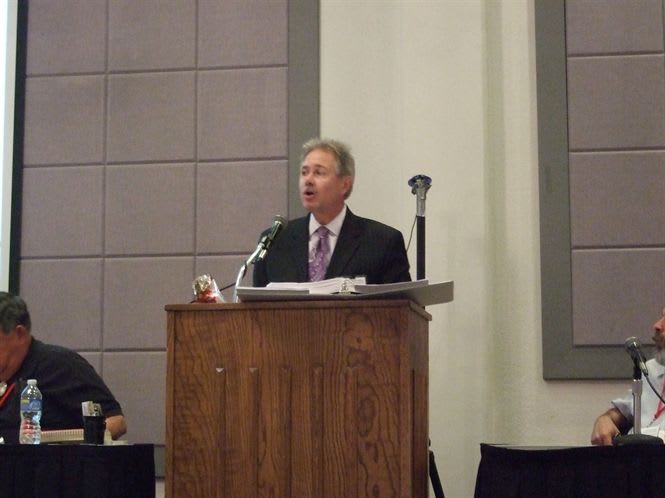
Indiana state director Pete Baxter served as the chair of the steering committee for the 2010 NCST.
Key developments
Baxter said that in his mind, two of the most significant discussion items during the congress were the crossing arm debate and the revision to the Specially-Equipped School Bus section making the second handrail optional instead of mandatory.
“The industry is still trying to come to grips with the kinds of things that are going to be consistently embraced,” he said. “The handrail and the crossing gate are ones that tend to fluctuate. But being able to state unequivocally, ‘This is what our industry believes in,’ at least on those points, that has not been consistent, and I tend to think that sends a mixed message.”
Language was approved in the introduction to the General Operations section that affirmed that students should be transported in yellow school buses. “There was a significant statement advanced by the industry that students shall be transported by a school bus, and saying that in unison, that we believe that children going to and from school need to be in this vehicle,” Baxter said. “We may have all individually and as respective organizations taken that position, but coming together as this congress and this delegation, it may not be earth-shattering, but I think it is noteworthy.”
The 2010 steering committee drafted an interim amendment process in order to provide a means for updating the document between congresses. “This interim process is designed to recognize that there are developments that occur very fast in our industry today and something shouldn’t take [five years] to make it into the nationally recommended specifications and procedures,” Baxter said.
Baxter also asked the university to compile and publish the documentation of proceedings from past congresses. Now, all versions of the document since the first one in 1939 are available at www.ncstonline.org. “I’ve asked that they get those posted so people can look back at how the document has grown from literally a small number of pages in a booklet to the hundreds of pages of documents that we have now,” he said.
Looking ahead to 2015
Going forward, Baxter said his responsibilities as chair, along with those of Vice Chair D. Leeds Pickering of Wyoming, for the most part, end with the closing of this year’s NCST. Baxter will write a foreword to the 2010 edition of the specifications and procedures document and will coordinate with the university during the publishing process.
But, he said, the National Association of State Directors of Pupil Transportation Services will soon choose a new chair for the 2015 NCST, who will eventually announce the release date for the finalized 2010 document.
“It’s an extremely rewarding experience to lead an industry event and participate in making substantial changes to a process that originated in 1939,” Baxter said. “The industry people, regardless of the organization they represent, are like-minded when they sit down at that table and their motivation is developing guidance for the districts, the drivers and the states.”
More Safety

How to Build a Better School Bus Driver Training Program
Is it time to strengthen your driver training? Here’s how to pick the right talent and improve recruitment, retention, and safety. This video is brought to you by IC Bus.
Read More →
Recent School Bus Accidents Leave 2 Dead, 2 Injured
Four school bus crashes in Florida, Illinois, and Georgia highlight risks in transportation lots, at bus stops, and during student loading and unloading.
Read More →
When Every Second Matters, Clarity Keeps Routes Moving
From routine delays to urgent incidents, strong communication practices help drivers, dispatchers, schools, and families respond with confidence.
Read More →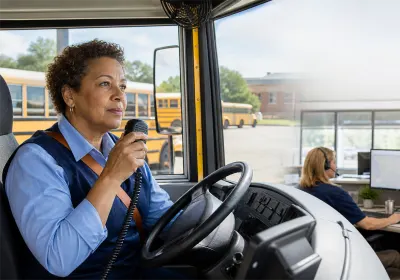

What Happens When a School Bus Catches Fire — and What Can Help
School bus fires are rare but can be devastating. Learn how advances in fire suppression and asset protection help fleets detect fires earlier, reduce damage, and improve safety.
Read More →
Geotab Launches Tool to Help Fleets Investigate Road Incidents
Geotab Investigations combines telematics data, video, documents, and other evidence to help fleets reconstruct incidents, resolve claims, and determine what happened.
Read More →
Texas Sixth Grader Wins 2026 National School Bus Safety Poster Contest
Sai Darshana Yekolu of Moseley Middle School in Prosper, Texas, was named the newest winner for her artwork, bringing the theme of “Safe Rides, Everyday Heroes” to life.
Read More →
Doing More With Less: How Transportation Directors Can Prioritize Safety Amid Budget Uncertainty
With diesel prices soaring and nearly one-third of transportation directors expecting budget cuts, maintaining student safety has never been more challenging. Download this guide to learn how leading districts are prioritizing risk, funding critical safety technology, and building stronger budget cases with data.
Read More →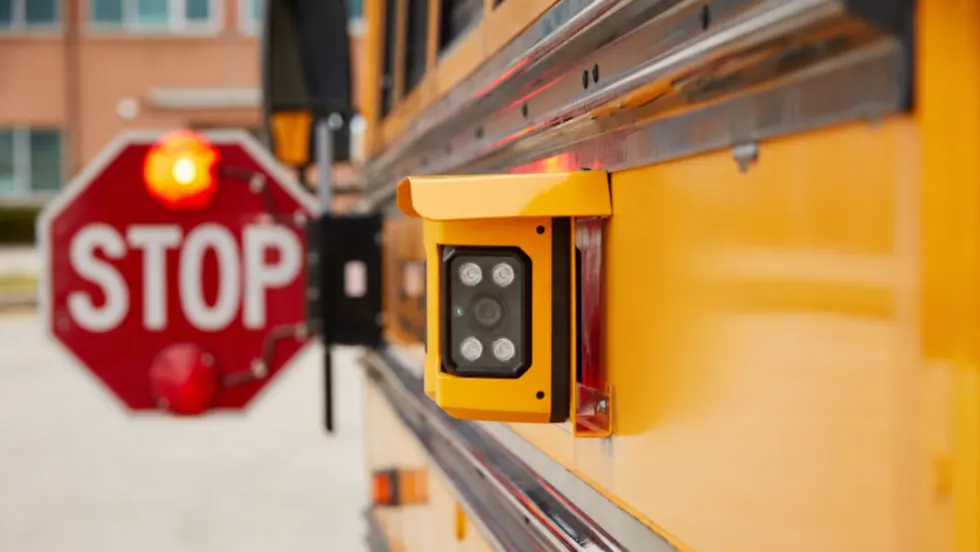
Walton County Schools Adds Gatekeeper Stop-Arm Enforcement System
The Florida district will deploy Gatekeeper’s updated Student Protector technology, which now incorporates AI to improve video evidence.
Read More →
How To Build a More Secure School Bus Yard During and After Hours
As thefts and overnight security threats continue, school transportation leaders are combining stronger operational practices with AI-enabled surveillance to better protect buses, facilities, and staff.
Read More →
FMCSA Names New Chief Safety Officer: What School Bus Operators Should Know
Steve Dowling is set to lead the federal agency's efforts to advance commercial motor vehicle safety and reduce crashes, fatalities, and injuries on the nation's roadways.
Read More →