





Don’t forget, NHTSA also offers a free online school bus driver in-service curriculum, and TSA also offers the First Observer Plus course on recognizing and reporting suspicious activity. Plus, your technology and equipment vendors are usually happy to do site visits to brush up on how to best use their products!
In-Service Planning Made Easier: Tips for Smooth Back-to-School Prep
Snag your summer prep checklist for school transportation directors, plus 40 training topic ideas to bring to your team.
April 13, 2026
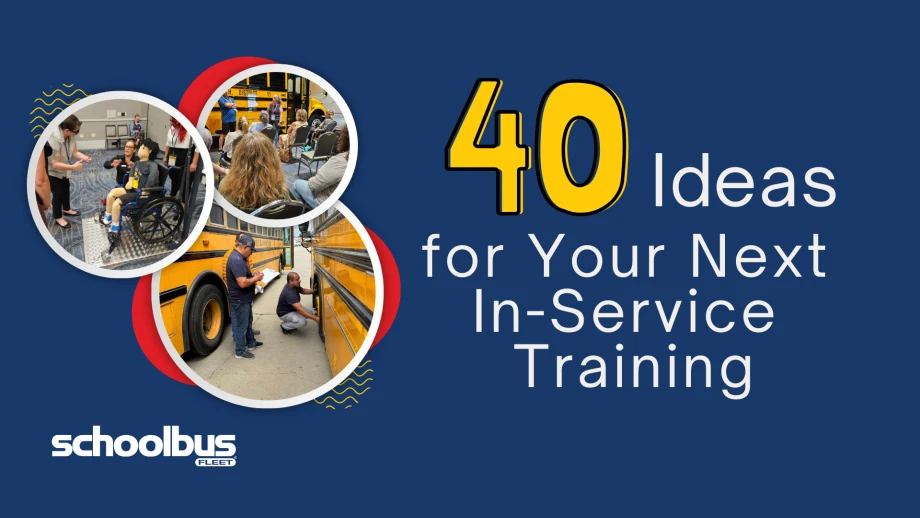
From the classroom to the bus and beyond, it's important to engage your team in both educational refreshers and interactive collaboration opportunities to increase skills and promote teamwork.
Credit:
School Bus Fleet
7 min to read
As we near the end of this school year, what are you planning to get your drivers, students, and community back up to speed after the summer slowdown? If you haven’t started planning yet, you might want to get a head start.
School Bus Logistics recommends some of the following tasks to close out this school year strong while looking ahead.
- Gauge driver availability. Send out sign-up forms for summer work and field trips and find out who’s on deck to help clean buses.
- Prepare your 2026-27 in-service and school-year training calendar. Allocate budget if needed for outside speakers.
- Communicate key dates for program or bell time changes and let drivers know about new bidding windows.
- Ask for driver feedback. Find out what training topics they want and ask for suggestions to improve route efficiency or bus features for future purchases.
- Analyze your data for the year and find trends or efficiencies for next year.
- Prepare for state reporting.
Need help planning your back-to-school training calendar? Start by reflecting on the prior year (or current if you’re ahead of the game). Evaluate what went well and what didn’t to determine priorities.
Summer Adams, director of transportation at Nacogdoches ISD, recommends using your handbook as a guide when deciding what areas need extra attention. “I didn’t make it up; I looked it up,” she frequently tells her team to remind them that the handbook is not out there to get them, but instead, a resource they should understand well.
In-Service Inspiration: 40 Topic Ideas to Bring to Your Team
Here are several training topics to engage your team any time of year.
(If you’re bringing in someone from the outside, industry consultants and speakers like Bret E. Brooks and Denny Coughlin offer a range of classes on many topics, including many from the list below.)
- Active Shooter and Intruder Response Training
- Verbal & Non-Verbal Indicators of Violence
- Concealed Weapon Identification
- De-Escalation Techniques
- Conflict and Anger Management
- Emergency Medical Response, First Aid, and CPR
- Physical Security Assessments and Training
- School Threat Awareness, Mitigation, and Response Training
- Human Trafficking Prevention
- School Bus Crash Response
- Drug Abuse, Gang, and Terrorism Awareness
- Situational Awareness and Vigilance
- Personal Safety and Risk Mitigation
- Communication Skills
- Time Management
- What Your Boss Wants from You
- Pre/Post Trip Compliance
- Effective Shop Management
- Brake Systems
- Vehicle Components
- Proper Use of Mirrors & Visibility Tools
- Emergency Evacuations & Procedures
- Accident Prevention and Collision Avoidance
- Review District or National Crash Statistics & At-Fault Reasons
- Railroad Crossing Safety
- Loading and Unloading
- Field Trip Selection & Activity Trip Rules
- Student Motivation & Behavior Management
- Bullying Prevention
- Emotional Intelligence
- Crucial Conversations
- Transporting Students with Special Needs
- Transporting Infants and Toddlers
- Wheel Securement Refreshers
- Defensive Driving
- Empathy Training
- Public and Community Relations
- Understanding Your District & Department Policies
- (for new drivers) What to Expect from Day 1 to Week 4
- Teambuilding Activities: Drunk Busters, Silent Communication, Build a Bus, etc.
Engaging Your Team During the School Year
How often should you train your team? That may vary based on many factors, but most recommend annually at minimum.
“When prepping for the new school year, I take a layered approach: communication, training, and accountability,” explained Jonquez Moore, director of transportation services at Little Elm ISD. “First, my supervisory team and I review prior year data, including accident reports, student referrals, parent complaints, on-time performance trends, and special education challenges. From here, we build our start up’ meeting together.”
Anthony Sims, executive director of transportation services at Fort Bend ISD, plans two in-services each year over the summer and winter, plus monthly meetings to address safety, security, and other topics. “These sessions allow us to pause, align, and refocus as a department,” he said.
Teri Mapengo, director of transportation at Prosper ISD, designs each training around a central theme, incorporating structured learning, interactive activities, and meals to create a well-organized experience. “I want our team to feel the level of planning and intention behind it, that we’ve put real effort into our in-service, so it feels less like a routine meeting and more like a conference-level experience,” she said.
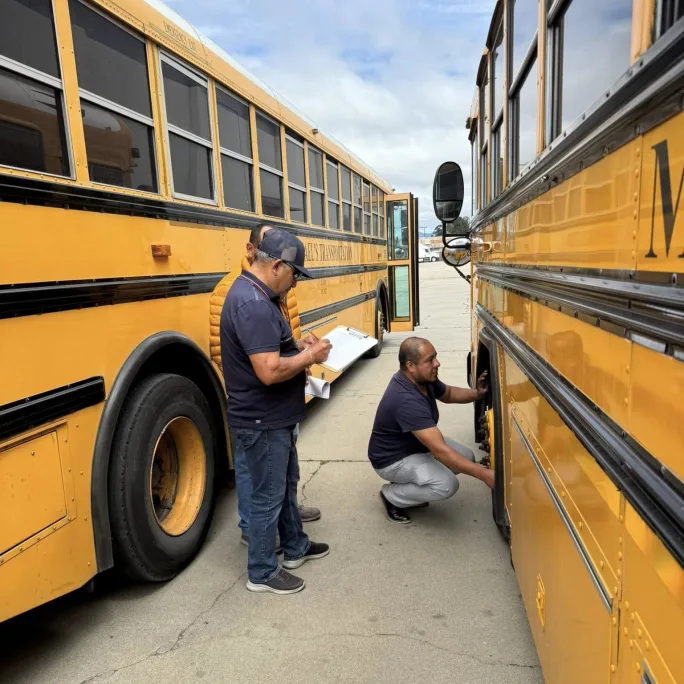
The team at Michael's Transportation Service gets hands-on during its back-to-school in-service at the Sacramento terminal.
Credit:
Michael's Transportation Service, Inc.
At MTS Training Academy, drivers receive three annual sessions: a back-to-school retraining, a mid-year safety review, and a spring refresher on emergency preparedness and student management. This is supplemented by monthly in-service training, which exceeds the requirements mandated by the state of California. Dr. Alana Shackelford, partnerships & community engagement officer, said that each session has two parts: classroom instruction and a behind-the-wheel application. The former covers current laws and regulatory frameworks, state bulletins, district policies, and relevant safety alerts, with content in line with NHTSA and NAPT guidance. In the latter, participants must demonstrate their mastery of the classroom material. This includes vehicle inspection, loading and unloading, defensive driving maneuvers, proper railroad crossing, turns, and backing.
“This blended learning approach ensures knowledge transfer to practical performance,
reinforcing muscle memory and procedural compliance,” Shackelford said. “This recurring cadence promotes retention, accountability, and continuous safety improvement.”
When structuring learning sessions, part of the process is getting to know what works best for your team. Sims notes that not everything is a home run, particularly PowerPoint-heavy presentations that make it easy for participants to disengage.
Others agree. “My team loves real-life scenarios,” Moore said. “I try not to, and I encourage my supervisors not to, overly lecture. Engagement drops quickly when training feels like ‘checking a box.’”
Make sure to offer some engaging exercises outside of the bus and the classroom, too. Sims recommends an interactive activity, such as playing Transportation Feud (a play on Family Feud), to bring energy, connection, and laughter.

At the 2026 CASTO conference, a panel presentation recommended an interactive activity like Build a Bus. Using craft supplies, have small groups build a bus out of cardboard, paper, and other materials, for a friendly competition. The goals are to exercise following instructions, promote teamwork and creativity, and spot leadership potential.
Credit:
Amanda Huggett
Sims also makes a point to share his vision and goals with the entire transportation team. “I spoke with the entire team about where we are, where we’re headed, and the importance of each individual role in shaping the future of the department,” he said. “Together, this structure allowed us to balance formal training with ongoing dialogue, keeping safety, purpose, and people at the center of our work year‑round.”
Mapengo is also exploring innovative additions to her agenda, such as immersive empathy training where staff experience transportation from a student’s perspective: riding in a wheelchair on the bus or navigating with limited vision, for example, to better understand the needs and challenges some riders face.
Adams reminds directors not to forget their new drivers. “A topic that is great (and helps with driver retention) is being transparent to all new employees on what to expect,” she said, noting that some chaos is to be expected. “Give examples on what to do if they can’t get through on the radio, what to do with a wrong student placed on your bus, and that it’s OK to be late when learning your route. Introduce your key leaders so employees know who their direct contacts are if they can’t reach a supervisor.”
Community Partnerships & Events
Partnering with local and in-district teams can highlight the importance of shared resources and wins.
For instance, Sims brings in district police to present on safety and awareness. “It highlighted the importance of keeping information in context for a transportation audience,” he said. “When training isn’t framed clearly, there’s a risk that staff walk away with confusion rather than clarity.”
Moore brought in the head football coach to offer the perspective of a stakeholder using bus services for field trips. Adams brought in PTA members and the district’s local tire vendor to meet the team.
Some districts find success in a back-to-school event to engage bus riders and their families.
Sims is planning “Meet Buster the Bus” events, allowing families to step onto a school bus, meet transportation staff and leadership, and share feedback from the previous school year.
Adams said that this year was the first time she sent drivers to their assigned elementary campuses for a “meet the teacher” night. They brought a list of all registered bus riders, and had parents meet their students' driver, obtain the route number, pickup times, and learn about the tracking system.
Shackleford said that MTS hosts bus safety orientation for school bus drivers and offers “meet the driver” events at the beginning of the school year. “These proactive efforts help build trust and create a shared safety culture between drivers, schools, and families,” she said.
What else do you at your district for in-service training and community connection? Share your tips with us anytime!
Subscribe to Our Newsletter
More Management

Changing Lanes: BusWhere, EverDriven, InterMotive, Summit School Services, Switzer-Carty & Thomas Built Buses
Check out who's been hired, promoted, and appointed to leadership positions at various school transportation suppliers, contractors, and manufacturers.
Read More →
The Most Expensive Thing You Do Before Selling a School Bus: Wait
When should you sell an aging school bus? Learn how maintenance, mileage, corrosion, specifications, and timing can affect resale value long before the auction.
Read More →
American Student Transportation Partners Acquires AJ Myers and Sons
A new deal brings a 75-year Pennsylvania student transportation provider into one of the nation’s largest private school bus contracting groups.
Read More →
What I Brought Home From SBFX: Relationships, Leadership, and Preparing What's Next
Who could lead your transportation operation tomorrow if you couldn't? Bernando Brown explores succession planning, mentorship, and preparing emerging leaders to step up.
Read More →
Inside School Bus Fleet ConneX 2026: Industry Leaders Connect in Scottsdale [Photos]
See highlights from SBFX 2026 in Arizona, where school bus operators and suppliers gathered for meetings, education, networking, awards, and more.
Read More →
School Transportation’s Biggest Pressures and Opportunities: SBFX Attendees Weigh In
School bus operators point to rising costs, staffing, and vehicle prices as immediate pressures while identifying technology, training, and routing as opportunities for growth.
Read More →
STA Acquires Sunrise Transportation
Student Transportation of America expands in Illinois and Connecticut through Sunrise's fleet of nearly 1,000 vehicles.
Read More →
EPA Opens $180M DERA Funding Round for Diesel Upgrades
The 2026 Diesel Emissions Reduction Act program seeks applications from eligible organizations to accelerate the retirement of legacy diesel vehicles.
Read More →
HopSkipDrive’s CareEngine Targets the ‘Exceptions’ in Student Transportation
The new platform works alongside districts’ existing transportation management systems to coordinate specialized rides, automate last-minute changes, and turn ride data into operational improvements.
Read More →
The Right Ride for Every Student: Navigating the New Student Transportation Ecosystem
How should districts blend school buses with small-vehicle transportation and other options? EverDriven CEO Mitch Bowling discusses safety, costs, partnerships, and strategy.
Read More →