




Getting the Most Out of In-Service Training
Theories on adult learning suggest that for it to be effective, educators must gain buy-in from the adults, get them involved in the topic and keep presentations fresh. Creating a theme for instructional sessions helps achieve buy-in and involvement.
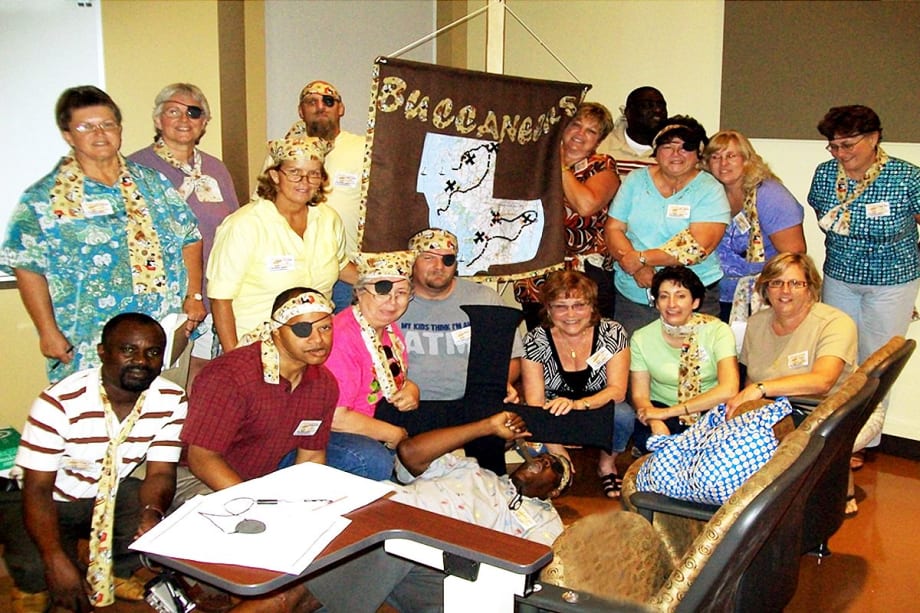
The 2009 Maryland Driver Instructor Conference had a pirate theme: “Navigating the High Seas of Transportation.”
Transportation in-service meetings are a necessary component of the annual instructional landscape of school districts and contractors everywhere.
State and local guidelines determine much of the content of these meetings, but how the curriculum is delivered is seldom discussed. What is talked about even less is the environment or atmosphere our in-service meetings are held in. Employees coming to the meetings should be thought of as adult learners — eager students desiring more knowledge in their field.
What is andragogy?
It should come as no surprise to the adult educator that adults learn differently than children. Malcolm Shepherd Knowles developed theories for the adult learner that contrasted, yet complemented, the pedagogy (ways in which children learn) theory that already existed. His ideas have been discussed throughout the 40-plus years since they were conceived, and they include six core truths about adult education (see the sidebar on the third page).
If looked at carefully, as Knowles sees it, andragogy (the methods or techniques used to teach adults) is best looked at by analyzing the roles of the learner, instructor and institution. We could apply these principles to our transportation in-service meetings by summarizing Knowles’ six points on andragogy. Boiled down, we could say the educator/institution needs to gain buy-in from the learners, get the learners involved in the program by facilitating the meeting effectively and keep presentations fresh by updating materials regularly.
Knowles also suggested that the adult learner is independent, possesses life experience, craves job enhancement knowledge and is ready to apply learning immediately to his or her present situation.
In later writings, Knowles added more to his theories on andragogy. He believed that adult learners want to know how the coursework can benefit them as a person, not so much society as a whole. And perhaps most importantly, “adult learners want to know why they need to learn something,” according to authors Maria Martinez Witte and James E. Witte in an article on adult education in the Encyclopedia of Educational Leadership and Administration, Volume 1.
Self-directed learning
Self-directed learning is often discussed by adult education theorists as it relates to the motivation of the learner. D.R. Garrison’s model of self-directed learning, found in Learning in Adulthood: A Comprehensive Guide by Sharan B. Merriam, Rosemary S. Caffarella and Lisa M. Baumgartner, provides some clarity with his simplistic, yet profound explanation of the dimensions of self-directed learning. He states, “Motivation leads to self-monitoring and self-management, which leads to self-directed learning.” This means that an adult learner needs to show some initiative in his own learning to position himself into a learning environment best suited for him. Once this happens, he can follow through on his commitment to learn by organizing his life to accomplish his academic goal.
In an article titled “Preclinical Students’ Predispositions Towards Social Forms of Instruction and Self-Directed Learning: A Challenge for the Development of Autonomous and Collaborative Learners” in Higher Education: The International Journal of Higher Education and Educational Planning, authors S.L. Raidal and S.E. Volet discuss a study that was done with students to research their preferences of learning styles.
One student commented, “I think learning is synergistic — being able to bounce ideas off one another.” Other students stressed that “they enjoyed explaining concepts to other members and were keen not to let the group down.”
The instructor who directs adult learners to work together to discover relevant information from each other promotes group self-directed learning.
This team during the 2009 Maryland Driver Instructor Conference was called the Raiders.
Themes enhance the learning process
Building a meeting around a theme can create excitement, build morale, generate anticipation and increase attention spans. The best part is, it doesn’t have to be complicated. Coming up with an appropriate theme for an in-service meeting can be as easy as typing in “theme for event” in any search engine. By using this and other, similar searches, a plethora of ideas will be at your fingertips. The difficulty will be narrowing all of the theme options to just one.
Creating a theme for your next in-service meeting fits in nicely with the principles of andragogy. The employees will enjoy learning in an “adult-oriented, cooperative, non-authoritarian setting and climate,” according to material on Knowles from Gale Virtual Reference Library. With bus operators and assistants participating in theme-related large or small group activities, they will be glad they came and eager to come to the next meeting.
Themes work for conferences, too
In 2003, having a theme for the Maryland Driver Instructor Conference started off as a creative way to get attendees to the workshops on time, ready to participate and learn. Every other summer in Maryland since then, the driver instructors use a different theme to create excitement, build teamwork and have fun.
Once the theme is chosen, a conference program is developed; the program cover helps to visualize the theme. Participants are separated into four or six teams and given a name that captures some component of the theme. Name badges are then created for each participant with his or her name on it as well as his or her group name. Since the participants come to the conference from all over the state, they are mixed together with attendees from different districts to develop new friendships and encourage networking.
A little friendly competition
A group activity takes place on the first night, and subsequent games are planned for the second, third and last day of the conference. Visuals or props are made to help each team see how they are progressing through the conference-long contest.
For the 2005 “Survivor” theme, the winning team was the last one to have at least one of its tiki torches still lit (with a paper flame).
The 2007 “music” theme highlighted popular Motown groups like the Supremes and Temptations. The objective that year was to get enough points to reach the top of a jukebox. Each of the six teams also had platinum, gold and silver records awarded to them after each competition, which were displayed on the teams’ tri-fold boards. On the final day of the conference, each of the six groups got on stage and performed a pre-selected song that the singing group made famous. The rules for the activity only required that the performances be fun, but tasteful. Some groups sang with the music, sang over the music, danced to the music or made up new words for their song.
The 2009 “pirate” theme featured sails made out of burlap, with the team name on the top and a geographic area of Maryland on the bottom. Each map resembled a treasure map, with broken lines marking the path the teams would take through Western, Central and Southern Maryland, as well as the Eastern Shore. The culminating event required each of the four groups to enter two of their members in a “scallywag fashion show.” Each group was awarded points based on the outfits, script, walk and overall presentation.
Why has the planning committee for this conference put a priority on supplementing the customary workshops with theme-related activities and events? By creating and maintaining a safe and welcoming environment, attendees get out of their comfort zone and feel free to share with other attendees their struggles, triumphs and successes.

Lowery says building a meeting around a theme can create excitement, build morale, generate anticipation and increase attention spans.
Driver instructor conference roundup
By now, the 2011 Maryland Driver Instructor Conference is over, but a discussion of its team-building activities wouldn’t hurt.
The activity for the first night resembled “The Amazing Race” reality television show. In this version, 12 teams competed — three from each of the four groups. Challenges were set up around the venue, and teams were given clues to where the challenges were located.
The four groups were named after prominent figures in history or literature who challenged people to travel where their heart told them to go. Throughout the week, each group watched their progress on their own map, marking their trip around the world. The first group back to Maryland was the winner.
Summary
Malcolm Knowles believes that learning for an adult is different than learning is for a child. It could be argued, though, that adults have more fun and perhaps learn more when they act carefree and imaginative, like a child. So the next time you plan for your transportation in-service meeting or conference, “dream a little and theme a lot!”
Quick Answers
Buy-in from adult learners is crucial because it leads to increased engagement and commitment, enhancing the effectiveness of the training. Adults are more likely to absorb and apply information when they have a personal interest or stake in the learning objectives.
*Summarized by AI
More Management

How to Build a Better Driver Training Program
Ready to boost up your school bus instructor training? Here’s how to pick the right talent and improve recruitment, retention, and safety.
Read More →
CALSTART and Forth Combine to Form Catalyst Mobility
The new name represents a renewed vision for the nonprofit focused on advancing clean, equitable, and affordable transportation solutions that move people and goods.
Read More →
What Makes a Great School Bus Driver Trainer?
Choosing the right school bus driver trainer takes more than experience. Learn six keys to selecting and developing trainers and evaluating program effectiveness.
Read More →

School Bus Contractors Expand Through New Deals, Acquisitions & Partnerships
STA's Canadian division acquires Ontario-based G&L Stevenson Transport while Durham School Services adds a new district contract in California, First Student adds a New Jersey contract, and Minnesota Coaches acquires Halo Transportation.
Read More →
Logan Bus Company Rolls Out AI Phone System for NYC School Bus Families
A summer pilot found that AI agents could handle most routine calls, freeing up time for customer service staff to focus on emergencies and complex family concerns.
Read More →
From Intent to Impact: What I Learned About Leadership from TAPT
A Texas transportation supervisor shares lessons on self-awareness, accountability, managing stress and building trust — and why investing in leadership development matters at every stage of your career.
Read More →
NAPT Names 2026 Award Recipients, Hall of Fame Inductee
Who earned national recognition for their work in student transportation? This year, NAPT named five recipients of its 2026 awards for service, safety, and leadership, plus its newest Hall of Famer.
Read More →
2026 State of Student Transportation Report
Driver shortages. Rising costs. Growing safety expectations. More data, but not enough time to act on it. The 2026 State of Student Transportation Report reveals what transportation leaders say is putting the most pressure on their operations—and where they’re investing next. See how your priorities compare.
Read More →
How to De-Escalate an Angry Person: 5 Steps for Handling Workplace Conflict
What makes emotions run high, and how should you handle an angry colleague or parent? Follow these steps for staying calm, listening, showing empathy, and resolving conflict.
Read More →
What Readiness Looks Like This School Year
Learn about the challenges shaping the 2026–2027 school year, from persistent driver shortages and budget pressure to technology and readiness gaps. See how school districts are responding and adapting in Zonar’s 2026 Back-to-School Readiness Report.
Read More →