Check out the stories of other veterans in the series:
- Dawnett Wright, Peninsula School District, Washington
- Martin Staples, Transportant
- Tracy Voigt, Pierz School District, Minnesota
 MENU
MENU SEARCH
See how Thomas Gray brings Marine Corps discipline and logistics expertise to Dayton Public Schools in this article celebrating National Military Appreciation Month.
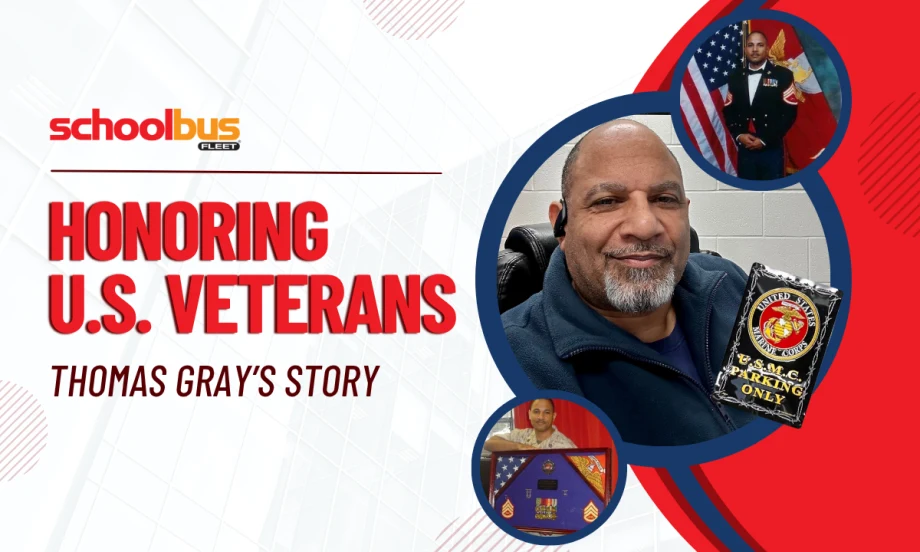
In this month-long series, we’re highlighting how military and school transportation careers intersect, beginning with Thomas Gray.
Thomas Gray/School Bus Fleet
The school bus industry and the military share more in common than we think. Both rely on precision, discipline, teamwork, and an unwavering commitment to safety. It’s why so many veterans find a natural fit in student transportation. Their experience and mindset translate quite well into the day-to-day responsibility of getting students to and from school.
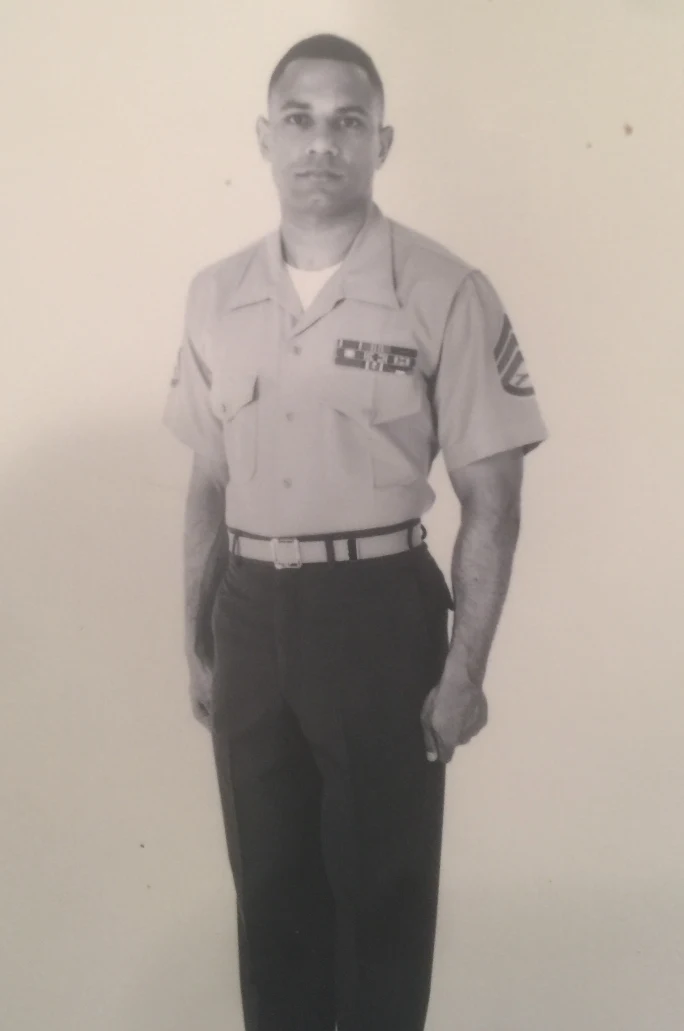
Promotion photo of Thomas Gray, taken in Iraq, 2001.
Thomas Gray
In the United States, May is National Military Appreciation Month, a time dedicated to honoring the contributions, sacrifices, and service of all members of the U.S. Armed Forces, past and present.
In this month-long series, we’re highlighting how military and school transportation careers intersect, beginning with Thomas Gray. Now serving as associate executive director of transportation at Dayton Public Schools in Ohio, Gray oversees the safe movement of thousands of students each day, drawing on more than two decades of experience in the U.S. Marine Corps.
“The experience not only shaped me as a leader, but defined the standards of discipline, integrity, and dedication that continue to guide my professional life,” Gray said.
Beginning in 1986 as an infantryman, he served four combat tours, including one during the Gulf War and three during Operation Enduring Freedom/Iraqi Freedom. Gray eventually became a logistics and transportation manager, which added the responsibility of coordinating complex logistical operations that supported the Marines at home and abroad.
I’m certain that kind of experience could prepare anyone for the challenges life throws at them, but for Gray, it instilled in him a mindset that continues to influence how he approaches student transportation today.
Gray doesn’t describe his move into pupil transportation as a career change so much as a continuation of service.
“My transition into student transportation felt like a natural extension of my 20-year career in the Marine Corps,” he said. “Student transportation is far more than just moving people. It is a mission rooted in safety, trust, service, and community.”
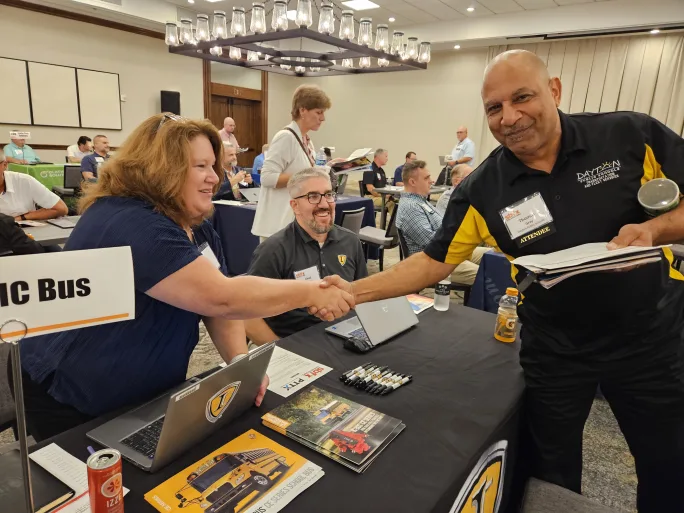
Christy Zukowski (left), senior marketing communications manager at IC Bus, and Thomas Gray met during one-on-ones at the 2025 School Bus Fleet ConneX event in Scottsdale, Arizona.
Amanda Huggett/School Bus Fleet
Although the work can seem like a set of logistical tasks, Gray sees it as a daily commitment to students, families, and the broader Dayton community. In his current role, he’s responsible for ensuring transportation systems run smoothly and reliably, as well as for building trust and maintaining a culture where safety comes first.
The leadership lessons Gray carries with him were forged under pressure, where preparation and clarity were as critical as the tools in his hands.
“Leading teams in combat zones taught me the clearest lessons about leadership: communicate honestly, prepare thoroughly, remain calm under pressure, and take care of your people,” he said. He learned to manage transportation and distribution assets under conditions where “failure was not an option.”
Those principles translate pretty perfectly into the world of school transportation, where unexpected challenges like weather disruptions or staffing shortages require quick thinking and steady leadership. His ability to stay calm and solution-oriented in difficult moments is something he sees as a direct result of his military background.
That background also gives him a strong foundation in managing complex systems, something any transportation professional can appreciate. From coordinating large-scale military supply chains and personnel to implementing technologies such as GPS routing and RFID tracking for the I Marine Expeditionary Force, Gray has long worked at the crossroads of logistics and innovation.
Today, he applies that same precision to school transportation operations, focusing on accountability and continuous improvement.
“Veterans bring a specific set of ‘battle-tested’ skills that align perfectly with the demands of school transportation,” he said. “We are trained to manage complex systems with the meticulous execution required in military operations. [We have to] stay calm and solution-oriented during emergencies or unexpected disruptions.”
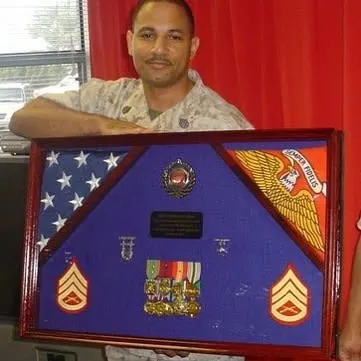
Retirement photo of Thomas Gray, 2006.
Thomas Gray
Even with such an operational outlook, Gray is quick to emphasize that transportation is ultimately a people-driven mission. His leadership centers on qualities he believes are essential for leading diverse teams and building strong relationships with drivers, school leaders, and families.
“The Marine Corps taught me that leadership is a privilege grounded in service,” he said. Whether he’s working through daily challenges or thinking about long-term improvements, this philosophy is evident in how he approaches his role with such determination.
For fellow veterans considering their next chapter, Gray sees pupil transportation as a meaningful and often overlooked opportunity.
“I believe this industry is an excellent fit for veterans. It allows you to continue a ‘tradition of service’ even after you’ve taken off the uniform,” he said
Gray encourages veterans to seek professional development opportunities through organizations such as the National Association for Pupil Transportation and state associations, which can help bridge the gap between military and civilian careers.
“My advice to fellow veterans would be to lean on the core principles instilled in you during your service: empathy, dedication, planning with precision, communicating with clarity, and leading with integrity,” he added.
Who doesn’t love a story about continuity? About carrying forward a commitment to service, even as the mission evolves? Gray has also been married to his wife, Kathy, for 21 years, raising seven children together, and eventually welcoming 11 grandchildren and one great-grandchild.
“My military service didn’t end when I took off the uniform. It lives on in how I lead, how I serve, and how I commit myself to every mission before me,” Gray said.
Ready to boost up your school bus instructor training? Here’s how to pick the right talent and improve recruitment, retention, and safety.
Read More →
The new name represents a renewed vision for the nonprofit focused on advancing clean, equitable, and affordable transportation solutions that move people and goods.
Read More →
Choosing the right school bus driver trainer takes more than experience. Learn six keys to selecting and developing trainers and evaluating program effectiveness.
Read More →
STA's Canadian division acquires Ontario-based G&L Stevenson Transport while Durham School Services adds a new district contract in California, First Student adds a New Jersey contract, and Minnesota Coaches acquires Halo Transportation.
Read More →
A summer pilot found that AI agents could handle most routine calls, freeing up time for customer service staff to focus on emergencies and complex family concerns.
Read More →
A Texas transportation supervisor shares lessons on self-awareness, accountability, managing stress and building trust — and why investing in leadership development matters at every stage of your career.
Read More →
Who earned national recognition for their work in student transportation? This year, NAPT named five recipients of its 2026 awards for service, safety, and leadership, plus its newest Hall of Famer.
Read More →
Driver shortages. Rising costs. Growing safety expectations. More data, but not enough time to act on it. The 2026 State of Student Transportation Report reveals what transportation leaders say is putting the most pressure on their operations—and where they’re investing next. See how your priorities compare.
Read More →
What makes emotions run high, and how should you handle an angry colleague or parent? Follow these steps for staying calm, listening, showing empathy, and resolving conflict.
Read More →
Learn about the challenges shaping the 2026–2027 school year, from persistent driver shortages and budget pressure to technology and readiness gaps. See how school districts are responding and adapting in Zonar’s 2026 Back-to-School Readiness Report.
Read More →