





School Bus-Train Crash Demo Highlights Need for Preparedness
Cross with Confidence: Railroad Safety Tips for School Buses
Every three hours, a person or vehicle is hit by a train in the U.S. Help stop track tragedies with these tips for keeping drivers and passengers safe aboard the school bus.
August 25, 2021
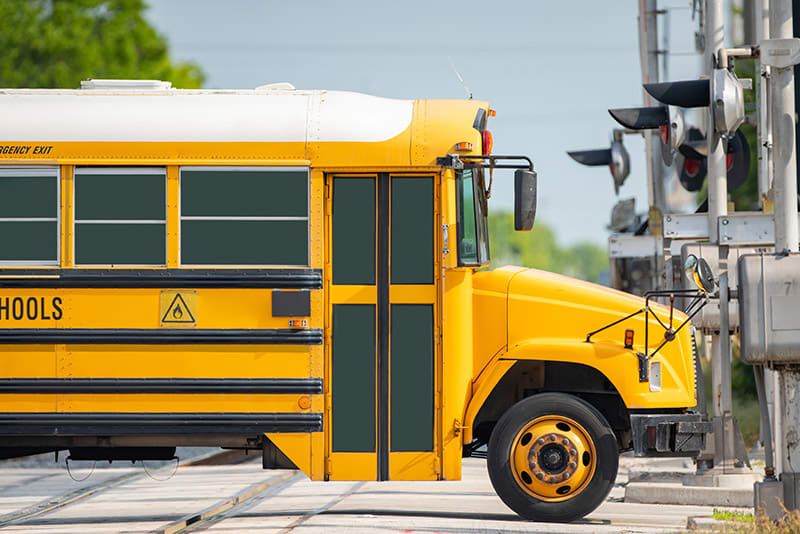
The most important tips for drivers to follow at rail crossings include obeying signs and signals, always looking both ways, knowing the length of your bus and size of the containment area, and evacuating if the bus stalls or stops on tracks.
Photo courtesy Getty Images/felixmizioznikov
6 min to read
Many factors can come into play at railroad crossings. School bus drivers must remain vigilant to keep passengers safe and be familiar with proper procedures before moving onto the tracks.
School Bus Fleet rounded up statistics, tips, and training resources, to make sure you are equipped with the information that could save lives.
What is Operation Lifesaver Inc.?
Operation Lifesaver Inc. (OLI) — a nonprofit that promotes rail safety education to prevent collisions, injuries, and fatalities on and around railroad tracks and highway-rail grade crossings — shared an alarming statistic: Every three hours in the U.S., a person or vehicle is hit by a train. And since 480,000 yellow school buses travel our nation’s roads each day according to the National School Transportation Association, it’s imperative we protect passengers and drivers aboard the bus at crossings.
“School bus driver decisions directly impact their communities, and the safe transportation of students is paramount,” Jennifer DeAngelis, director of communications and marketing for OLI, said. “If a route includes railroad crossings, it’s important to know what to do when you see railroad signs and signals.”
A silver lining of the COVID-19 pandemic is that the reduction in vehicle traffic last year led to a drop in total crossing incidents, injuries, and deaths in 2020, according to the Federal Railroad Administration (FRA). School bus-train collisions are thankfully rare; FRA data shows two in 2017 and four in 2019, with none reported since then. Although, OLI notes that there is not yet enough 2021 data to comment on whether return to school and work this year has affected incidents.
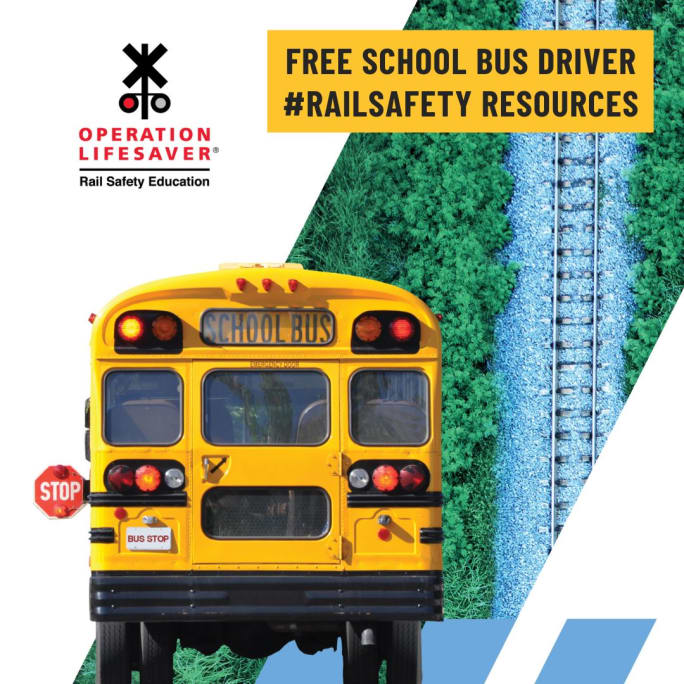
Operation Lifesaver has many materials and trainings available to help school bus transportation directors and bus drivers know proper procedures to keep passengers safe at all railroad crossings.
Graphic courtesy Operation Lifesaver Inc.
General Rail & School Bus Safety Information
DeAngelis shared the following notes and reminders with SBF.
The only safe and legal place for anyone to cross railroad tracks is at designated crossings.
Always obey warning signs and signals.
Always look for a train before proceeding.
Always expect a train.
Trains may be closer and traveling faster than they appear and can run on any track at any time in either direction. Multiple tracks may mean multiple trains.
Ensure you can clearly see down the tracks in both directions before proceeding.
Avoid crossing while lights are flashing or gates are down.
Never try to beat a train.
The average freight train traveling 55 mph can take a mile or more to stop — the length of 18 football fields.
OLI also provides tips on procedures for special situations. If the bus stalls or is stuck on tracks, evacuate immediately. If a train is approaching, run toward the train but away from the tracks at a 45-degree angle to keep students away from the point of impact. Find the Blue and White Emergency Notification System sign and call the number on the sign. No sign? Call 911.
If there is a police officer or railroad flagman at the crossing, obey their directions. If you believe the signals are malfunctioning or there is no flagman present, call your dispatcher, report the situation, and find out how to proceed. Most crossings have a sign with an 800 number posted on or near the crossbuck for reporting problems.
Plan your route for maximum sight allowance at highway-rail grade crossings. Don’t try to cross tracks unless you can see in both directions that no trains are approaching. Even with active railroad signals indicating the tracks are clear, look and listen to confirm it's safe to proceed.
Know the length of your bus and size of the containment area at any intersection. Pay attention to the amount of available room when approaching a crossing with a signal or stop sign on the opposite side. Make sure there’s enough room to completely clear the tracks.
Available Safety Training for School Bus Drivers
Operation Lifesaver provides free in-person and virtual training opportunities to help drivers make safe choices around railroad tracks and trains, including specific sessions for school bus drivers. Since 2018, OLI volunteers have made presentations to 19,000 school bus drivers across the U.S. (If you’re interested in your own training, visit OLI’s request a presentation form at oli.org and note interest in school bus driver training.)
The organization also has a multitude of facts and information available online for school bus drivers, including a printable brochure and posters reminding school bus drivers that stopping before driving over railroad tracks might be their most important stop of the day. OLI says they plan to launch an eLearning option in the coming months as well.
“Highway railroad-grade crossings are a high priority to school bus drivers and we at Region 10, and Operation Lifesaver, take it very seriously,” says Sharon Huecker, a certified instructor for School Bus Driver Safety Training for Region 10 ESC (one of 20 regional service centers established by the Texas State Legislature for delivering professional development) through the Texas Department of Public Safety (DPS).
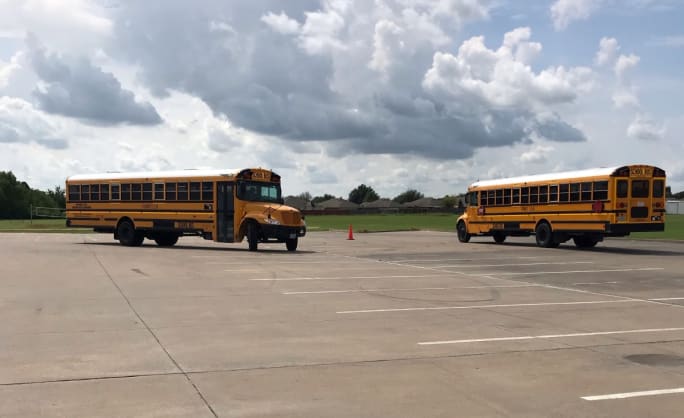
Texas instructor Sharon Huecker conducted a railroad safety training in August at Forney (Texas) Independent School District. The district’s transportation team provided the buses for the class where drivers did mock exercises to practice proper safety procedures.
Photo courtesy Sharon Huecker
Huecker reiterates the importance of drivers being alert and knowing the procedures for crossing.
“Drivers should communicate to students the importance of [being] quiet on the bus at all railroad crossings and develop a signal that alerts them well in advance,” she says. “Emergency evacuation training should also be discussed with students and practiced. Transportation directors should incorporate railroad crossing training and emergency evacuation training for bus drivers each year.”
In Texas, all school bus drivers must take an initial 20-hour course and recertify every three years with an eight-hour course, Huecker explains. She says DPS has approved the use of OLI in their required courses in Region 10.
Through Texas’ Region 10 ESC, Huecker held 14 trainings in June and another 14 this past July. Over those two months, 1,062 drivers received certification. A 20-hour course includes four hours of laboratory activities consisting of driving a school bus in a parking lot and demonstrating safety skills. One of those skills is a mock railroad crossing, whereby drivers must use proper procedures when crossing. A mock student pick up/drop off, diminishing lane, off-set backing, and serpentine, complete the required skills during the lab.
“At conclusion, drivers will have knowledge of their role as a school bus driver, licensing and certification, bus maintenance, vehicle inspection, loading and unloading procedures, student management, controlling stress and attitude, avoiding collisions, railroad crossings, and the effects of alcohol and other drugs,” Huecker says.
Rail Safety Week: Sept. 20-26, 2021
Rail Safety Week (RSW) is held in September every year, with a goal to raise awareness of the need for rail safety education. RSW is spearheaded by OLI in collaboration with state programs and rail safety partners across the U.S., Canada, and Mexico.
“Empowering the public to make safe choices around railroad track and trains is an everyday effort,” DeAngelis says. “We want everyone to ‘think train’ every time they ‘see tracks.’ Know the facts, recognize the signs, make good decisions, and share the rail safety message.”
Thursday, Sept. 23, 2021, will be focused on highlighting school bus drivers.
For more rail crossing safety information and materials, visit oli.org.
Subscribe to Our Newsletter
More Safety

How to Build a Better School Bus Driver Training Program
Is it time to strengthen your driver training? Here’s how to pick the right talent and improve recruitment, retention, and safety. This video is brought to you by IC Bus.
Read More →
Recent School Bus Accidents Leave 2 Dead, 2 Injured
Four school bus crashes in Florida, Illinois, and Georgia highlight risks in transportation lots, at bus stops, and during student loading and unloading.
Read More →
Sponsored•September 8, 2026
When Every Second Matters, Clarity Keeps Routes Moving
From routine delays to urgent incidents, strong communication practices help drivers, dispatchers, schools, and families respond with confidence.
Read More →

What Happens When a School Bus Catches Fire — and What Can Help
School bus fires are rare but can be devastating. Learn how advances in fire suppression and asset protection help fleets detect fires earlier, reduce damage, and improve safety.
Read More →
Geotab Launches Tool to Help Fleets Investigate Road Incidents
Geotab Investigations combines telematics data, video, documents, and other evidence to help fleets reconstruct incidents, resolve claims, and determine what happened.
Read More →
Texas Sixth Grader Wins 2026 National School Bus Safety Poster Contest
Sai Darshana Yekolu of Moseley Middle School in Prosper, Texas, was named the newest winner for her artwork, bringing the theme of “Safe Rides, Everyday Heroes” to life.
Read More →
Sponsored•August 27, 2026
Doing More With Less: How Transportation Directors Can Prioritize Safety Amid Budget Uncertainty
With diesel prices soaring and nearly one-third of transportation directors expecting budget cuts, maintaining student safety has never been more challenging. Download this guide to learn how leading districts are prioritizing risk, funding critical safety technology, and building stronger budget cases with data.
Read More →
Walton County Schools Adds Gatekeeper Stop-Arm Enforcement System
The Florida district will deploy Gatekeeper’s updated Student Protector technology, which now incorporates AI to improve video evidence.
Read More →
How To Build a More Secure School Bus Yard During and After Hours
As thefts and overnight security threats continue, school transportation leaders are combining stronger operational practices with AI-enabled surveillance to better protect buses, facilities, and staff.
Read More →
FMCSA Names New Chief Safety Officer: What School Bus Operators Should Know
Steve Dowling is set to lead the federal agency's efforts to advance commercial motor vehicle safety and reduce crashes, fatalities, and injuries on the nation's roadways.
Read More →