





Supporting Students with Trauma-Informed School Transportation
The Science Behind Improving Student Behavior on the School Bus
Behavior change is a science. Here’s what you need to know about child development to better understand the riders on your bus. Plus, how to clarify expectations and build positive relationships with students.
June 10, 2025

“You never know just how many people you may be a lighthouse for,” Patrick Mulick said to a room at California’s state conference. Knowing your student’s struggles and celebrating their successes can help pave their way to a bright future.
Credit:
School Bus Fleet
9 min to read
- Understanding child development is crucial for predicting and influencing student behavior on school buses.
- Clear communication of student expectations helps manage and improve behavior effectively.
- Building positive relationships with students fosters a better and safer environment on the school bus.
*Summarized by AI
About every bus driver wishes they had more control of the students on the bus. Without an aide, it’s challenging to focus on the road and safe driving while also watching students behind them and handling issues as they arise.
The key to handling these behavioral issues is implementing practices to prevent them in the first place and knowing how to react for a better outcome next time. Understanding the science behind child development and behavior and building personal relationships with riders is paramount to success.
Know Your Audience
Patrick Mulick, a board-certified behavior analyst, coach, consultant, and director of student engagement at Auburn School District in Washington, presented a session on student behavior at the 2025 California state association conference.
Mulick began with an overview of some of the burdens our riders face, noting that when something changes in a student’s behavior, it often means there’s something behind it.
Student Makeup in America
- 2.3% have a parent who has been incarcerated.
- 3.3% are homeless.
- 9.5% are English Language Learners.
- 5-10% have ADHD.
- 10% will be sexually abused by the time they turn 18.
- 13% have a labeled disability.
- 19% live in poverty.
In addition to the above, cultural differences and upbringing can also affect how some students behave on the bus. All of these layers of who someone is and what they’re dealing with affects how they act and react.
The point is: Remember that you never know the burden that someone else is carrying. As Mulick said, a backpack is not the only baggage some of our students carry every day.
The Science Around Behavior
Never forget, the students on your bus are not adults, so they can’t be held to the same standard.
Students on your bus are (in most cases) literal children with brains that aren’t yet fully formed (the brain’s self-regulation center doesn’t fully mature until age 25). These youngsters are constantly taking in new information and learning how to navigate the world around them. It can be a lot to learn, not to mention remembering rules they must follow at home, in public, and in the classroom, too. Testing boundaries is part of their development. And sometimes, foul language and disrespect is them trying to cope with an underlying issue.
Amy Chiu, an early childhood education instructor & consultant, wrote on LinkedIn that: “We often expect young children to calm down, use their words, and be patient long before their brains are fully capable of doing so. Self-regulation is not just about behavior. It is about brain development and how children's coping skills develop in relationship with others.”
She also says that punishment may stop behavior in the short-term, but that teaching a skill and letting them talk about their feelings will lead to lasting change. Sometimes, adults need to help guide them through regulating big emotions before they can do that on their own (because remember, not all of your riders have a stable parent at home to do that).
Essentially, they’re not misbehaving on purpose; they’re struggling with various stressors and don’t know what to do about that yet. “They’re not giving you a hard time; they’re having a hard time,” Mulick said.
So, what does help encourage better bus behavior? A predictable routine that removes uncertainty, helping children feel heard and supported, and an atmosphere where adults model good behavior (that’s why keeping your cool amid chaos is so important).
Tips for Improving Behavior
Mulick says there are four functions of behavior:
- Attention: Getting (desired or undesired) attention from someone.
- Escape/avoidance: Trying to get out of a particular situation or expectation.
- Tangible: Trying to obtain an object. (If the desired object was easy to obtain, the behavior wouldn’t happen in the first place.)
- Automatic: The action of taking part in the behavior is reinforcing itself.
When we want to address any problem behavior, we first have to look inward.
“How are we creating that welcoming environment and giving kids opportunities to be successful, treating them like number one when they come in every single day?” he asked. “Getting this work right, it starts as a foundational piece.”
What about when things do go wrong?
“Take a deep breath and remember that you are the professional,” Mulick said. “They are the student. You are the influencer on the bus. We need to be professionals to stand up every day and set the tone of how people treat each other. Now, if we do the work right, we eliminate most of the behaviors.”
Learning de-escalation techniques, especially for students who may become physical, is important.
“I know what you guys are saying. It's a rude, disruptive, entitlement,” Mulick said. “I would challenge you to identify what is it that they're doing. Rude or disrespectful means different things to different people. Let's specifically call out what the behavior is that they're doing, so that we can all be very clear on what we need to change. So I challenge you to use the terms that are both measurable and observable.”
Once you know what the behavior is, figure out if there is a trigger you can change to prevent it. That may mean changing who sits by who.
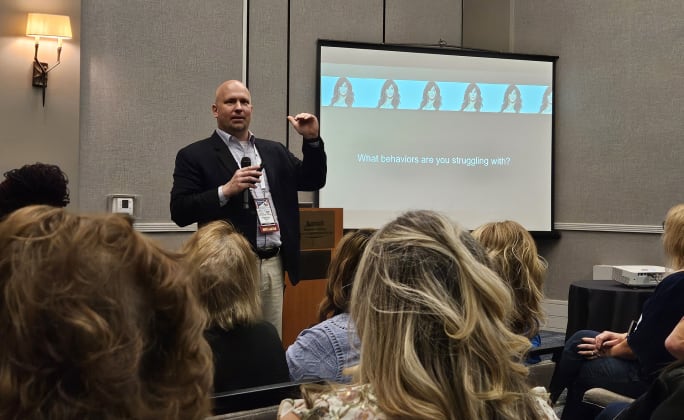
Patrick Mulick, certified behavior analyst, presents a session on managing student behavior at CASTO last February.
Photo: Amanda Huggett
Some students with sensory sensitivities can be triggered easily, even by things like a bumpy ride or brightness. Assistive tools may be able to come to the rescue and help redirect their energies or focus.
Teena Mitchell, special needs coordinator at Greenville County Schools, says we also need to build situational awareness, knowing what tools to use when behaviors become extreme. Sometimes, it’s subtle: knowing when to give space, or how body language affects others.
Learn what a student cannot do and will not do. “Some of our students, ADHD, they need to move,” Mulick added. “If we're asking our students to do things that they do not have the skill set to do, and then they're getting in trouble because of that, that's on us. If it's a will not, then we advance the conversation.”
If the list of problem behaviors is long, prioritize. Focus on the most disruptive first. If you tackle everything at once, the student is likely to feel picked on, and your relationship will suffer.
Last, realize that punishment is in the eye of the beholder. If you stop the bus to talk to a student, you may be giving them the attention they’re desperately seeking. If a student is suspended, what you view as a punishment may be viewed by them as a reward (especially if it means they got to watch movies and play video games at home).
“We have to be thoughtful around what these interactions look like,” Mulick said. “Because really, education is about how we are empowering them to be a better person in the future.”
Build Rapport with Students
You can build positive relationships with students through personalized interactions, clear communication, and consistent reinforcement.
“If you don't take the time to make connections with kids, they're going to have a hard time listening to you, especially when they're doing something they shouldn’t be doing,” he said.
At the CASTO session, attendees crowd-sourced rapport-building examples. These included:
- Say “good morning” or “see you later.”
- Make eye contact and smile.
- Use their name.
- Acknowledge their individuality.
- Learn what each student likes or values. (Example: Wish them luck on their video game at home that night. Give them an Angry Birds sticker for good behavior.)
- Ask about their day or other open-ended questions.
- Use language that is at their developmental level.
- Acknowledge good behavior.
“You have science around that says when you smile at someone, they see that, there are neurons that increase the likelihood that they feel connection,” he said.
Mulick also recommends the 5:1 rule, developed by John Gottman, which advises that stable relationships require a ratio of at least five positive interactions to one negative interaction during a conflict.
“Those drivers who build positive relationships every single day, where it's a natural part of the work, they find greater success,” he said. “If this isn't a part of your repertoire of skills, if this isn't something you focus on, it needs to be. We need to make sure we're checking our box first. And if that's not there, we shouldn't be surprised when it doesn't go well. So reach before you teach, connect before you correct.”
Be Clear on Expectations
Never assume that students know how they should behave on a bus. Some may be new riders, while others may have experienced different rules on another bus with a different driver. Set expectations at the start of the year and maintain them throughout.
Expectations should be:
- Positively stated.
- Clearly posted.
- Clearly reviewed.
- Clearly understood.
- A manageable number (aim for 3-5 key rules; more than that becomes too much).
Don’t only communicate what is not allowed. Tell them what to do.
“When you're not telling them what to do, it becomes a guessing game,” Mulick said. “We need to be very direct on what we want them to do. Stay in your seat, window up, hands to yourself. The more we say, don't, stop, quit, it gets more confusing and less to the point of what we want them to do.”
Mulick also said it’s important to acknowledge context. What being quiet or sitting still means may look different in one environment than others.
Some students are visual learners. Point out what the desired behavior does look like. Offer pictures. Say, “Look at Johnny. That’s what I meant by sit still. See how he’s keeping his hands to himself, staying in the seat, not jumping up and down.”
(Note: Not all students want to be singled out. For some, you can maintain their respect by offering a head nod or a fist bump to acknowledge them more subtly.)
If a rule is to respect one’s self, others, and property, break down how that should play out in a range of situations, how it should look like while loading and unloading and while the bus is in motion.
Another idea: Ask students and their parents to sign a code of conduct at the start of each school year. This ensures there is no confusion about what you will and won’t tolerate, and gives you a leg to stand on if issues escalate later on.
A Positive Reinforcement Example

Credit:
Evelyn Bell
In a private Facebook group for school bus drivers, Orange County Public Schools driver and trainer Evelyn Bell shared her method of rewarding good behavior.
She writes: “I have developed an innovative approach to encourage positive behavior among my elementary-aged students, inspired by Tik Tok. Each student is assigned a number, and every Monday, I randomly select a numbered duck from the Lucky Duck jar. Throughout the week, I discreetly observe the student corresponding to the selected number, monitoring their adherence to rules, safety, and behavior, as well as their willingness to assist others without prompting. On Fridays, if the student has successfully met these expectations, I publicly announce the Lucky Duck number, rewarding them with a gift from the treasure box and appointing them as the Safety Duck Patrol for the following week, complete with a duck badge. In instances where the student falls short, I refrain from public announcement, instead offering a collective message of encouragement.”
Be a Cheerleader
When you build positive relationships with your students, recognize their success, and coach them when they need redirection, you become someone they trust and respect.
Our students should think of us as cheerleaders on their team. For impressionable children, how they perceive being treated impacts their self-image and becomes a soundtrack to their life. So let’s make it a good one.
Quick Answers
Behavior change in children is grounded in principles of child development, which include understanding cognitive and emotional growth stages and how they impact children's behavior.
*Summarized by AI
Subscribe to Our Newsletter
More Management
How to Build a Better Driver Training Program
Ready to boost up your school bus instructor training? Here’s how to pick the right talent and improve recruitment, retention, and safety.
Read More →
CALSTART and Forth Combine to Form Catalyst Mobility
The new name represents a renewed vision for the nonprofit focused on advancing clean, equitable, and affordable transportation solutions that move people and goods.
Read More →
What Makes a Great School Bus Driver Trainer?
Choosing the right school bus driver trainer takes more than experience. Learn six keys to selecting and developing trainers and evaluating program effectiveness.
Read More →

School Bus Contractors Expand Through New Deals, Acquisitions & Partnerships
STA's Canadian division acquires Ontario-based G&L Stevenson Transport while Durham School Services adds a new district contract in California, First Student adds a New Jersey contract, and Minnesota Coaches acquires Halo Transportation.
Read More →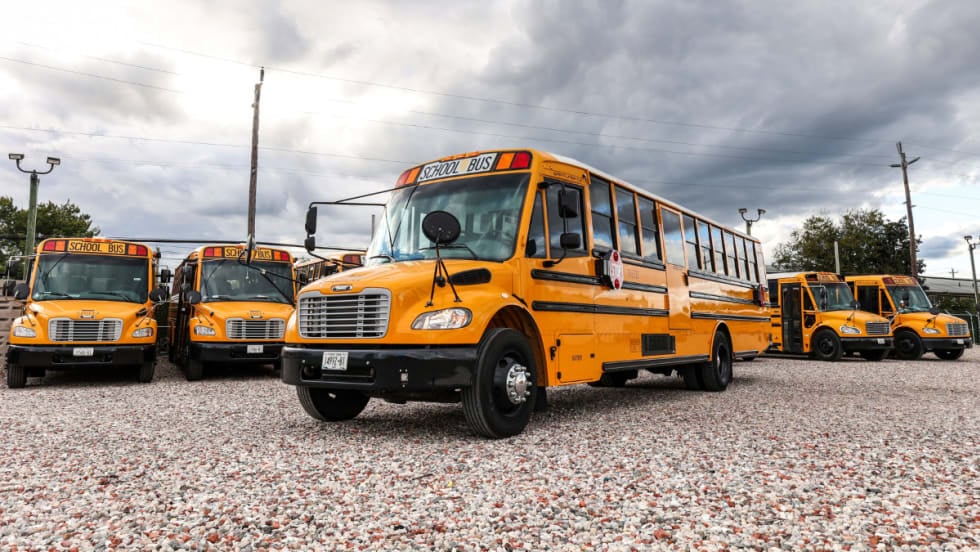
Logan Bus Company Rolls Out AI Phone System for NYC School Bus Families
A summer pilot found that AI agents could handle most routine calls, freeing up time for customer service staff to focus on emergencies and complex family concerns.
Read More →
From Intent to Impact: What I Learned About Leadership from TAPT
A Texas transportation supervisor shares lessons on self-awareness, accountability, managing stress and building trust — and why investing in leadership development matters at every stage of your career.
Read More →
NAPT Names 2026 Award Recipients, Hall of Fame Inductee
Who earned national recognition for their work in student transportation? This year, NAPT named five recipients of its 2026 awards for service, safety, and leadership, plus its newest Hall of Famer.
Read More →
Sponsored•September 2, 2026
2026 State of Student Transportation Report
Driver shortages. Rising costs. Growing safety expectations. More data, but not enough time to act on it. The 2026 State of Student Transportation Report reveals what transportation leaders say is putting the most pressure on their operations—and where they’re investing next. See how your priorities compare.
Read More →
How to De-Escalate an Angry Person: 5 Steps for Handling Workplace Conflict
What makes emotions run high, and how should you handle an angry colleague or parent? Follow these steps for staying calm, listening, showing empathy, and resolving conflict.
Read More →
Sponsored•September 1, 2026
What Readiness Looks Like This School Year
Learn about the challenges shaping the 2026–2027 school year, from persistent driver shortages and budget pressure to technology and readiness gaps. See how school districts are responding and adapting in Zonar’s 2026 Back-to-School Readiness Report.
Read More →