





Keep Reading: Why the Time Is Now to Modernize Student Transportation
Driving Made Safer: AI Cameras as a Bus Driver’s Co-Pilot
See how AI-powered driver assistance technology works as a partner on the road, offering timely alerts and coaching to keep students and drivers safe.
October 21, 2025

First Student now uses Samsara's AI technology to boost driver awareness and cut accidents across its school bus fleet.
Photo: Christian Ramirez/School Bus Fleet
10 min to read
On any given morning, afternoon, or extracurricular trip, a school bus driver can have 40 or more pairs of eyes on them. Even if some students are wide awake or half-asleep, everyone on board depends on the driver's focus.
What if the bus had a wingman watching over the driver, ready to catch unexpected hazards on the road and signs of distraction or fatigue before disaster strikes? That's exactly the focus of AI-powered in-vehicle monitoring systems.
Driver monitoring is a budding safety technology in school transportation that uses driver-facing dashcams equipped with artificial intelligence to detect unsafe behaviors, including distracted driving, drowsiness, or speeding.
Unlike traditional interior cameras, which are typically used reactively and reviewed only after an incident occurs, AI-based monitoring systems work proactively, detecting risks in real time and providing alerts that can help prevent accidents before they happen.
The distinction highlights how long-established systems provide evidence after the fact, while emerging AI tools act as a "co-pilot," offering continuous oversight and generating safety scores that guide coaching and training. The technology from companies like Samsara, Safety Vision, and Safe Fleet, among others, has been widely adopted in the trucking, delivery, and commercial fleet industries for some time. However, its adoption in the school bus sector is relatively new.
According to Clint Bryer, vice president of pupil transportation at Safety Vision, student transportation tends to adopt fleet innovations later than other sectors, mainly due to budget constraints and the unique responsibility of transporting children.
By introducing this type of live in-vehicle technology into school buses, districts and contractors now have the opportunity to improve safety for both drivers and students while reshaping their safety culture across operations.
What Driver Monitoring Technology Is and How It Works
AI-enabled driver-facing dashcams are designed to detect unsafe behaviors, such as drowsiness, distraction, phone use, speeding, and harsh braking. Unlike traditional interior cameras that only record for later review, these systems actively analyze driver behavior in real time.
Key features of driver monitoring systems include:
- Real-Time In-Cab Alerts: According to Marco Parlato, senior product manager for Safe Fleet's driver behavior technology, in-cab alerts coach drivers to self-correct before a potential safety event occurs. Drivers may hear audible alerts, such as beeps or pre-recorded messages, to draw attention to any unsafe behavior that has been built into a system’s parameters.
- Event Flags for Managers: Most systems use AI to automatically flag unsafe driving behaviors and generate video clips for fleet managers to review.
- Safety Scores for Coaching: According to Samsara's SVP of product and engineering for safety and AI, Johan Land, safety scores serve as a great starting point for safety conversations, as they provide fleet managers with a quantifiable way to measure performance, recognize top drivers, and focus coaching on those who need it most.
- Integration with Other Fleet Systems: Depending on the system, this technology can be integrated with a combination of routing, telematics, payroll, parent communication tools, and other fleet management systems into a single platform.
Vendors like Zonar, Rosco Vision, and Samsara are pushing this envelope with systems that combine in-cabin driver alerts with telematics integration. Their solutions can detect drowsiness, monitor head position and eye movement, and issue in-the-moment warnings. That information is then transmitted to centralized fleet platforms, which can provide visibility into performance across an entire fleet.
"Dash cameras and driver assistive technologies are ideal for creating awareness of practices that a driver may not even know they do," said Tim Ammon, strategic advisor, Zonar. "Fleet managers can use these metrics to identify areas for improvement, provide targeted coaching, and foster a culture of safety within the fleet."
"If a warning gauge lights up, a mechanic can start diagnosing the problem right from a tablet, so they’re best prepared when responding to a road call,” North Carolina’s New Hanover County Schools Director Deb Trafton said, citing their multi-use of Samsara. “The platform also sends alerts when drivers idle too long, which helps cut down on fuel costs.”
Driver monitoring technology provides immediate and corrective feedback for drivers and actionable data for transportation managers, enabling districts to continuously improve safety rather than relying on reactive measures after an incident has occurred.
In-Cabin Monitoring and Driver Attention Tech Providers
Several technology providers are helping bring these onboard safety companions into the school transportation market. Each has unique features but shares the common goal of driver safety and operational efficiency.
For example, Safe Fleet’s Duet AI delivers real-time driver coaching and video review to enhance safety, and Nexus Cloud, which school transportation managers use to access onboard video, routing, and telematics data to aid in management oversight.
Samsara provides AI-driven driver monitoring that automatically detects unsafe behaviors and generates safety scores. Its open API ecosystem allows integration with a wide range of fleet systems. "For instance, many customers use bus routing software like Edulog, and Samsara's direct integration provides real-time data on our platform," Land said.
Safety Vision focuses on advanced camera systems and emphasizes coaching opportunities, which can be as detailed as how a driver uses their feet during a route. "Cameras are now starting to be used as preventive methods, not just capturing what happened, but maybe even preventing it from happening," Bryer said.
These providers, along with others such as Geotab, Netradyne, and Motive, demonstrate the growing ecosystem of technology available to school transportation leaders, offering scalable and customizable solutions for districts of all sizes.
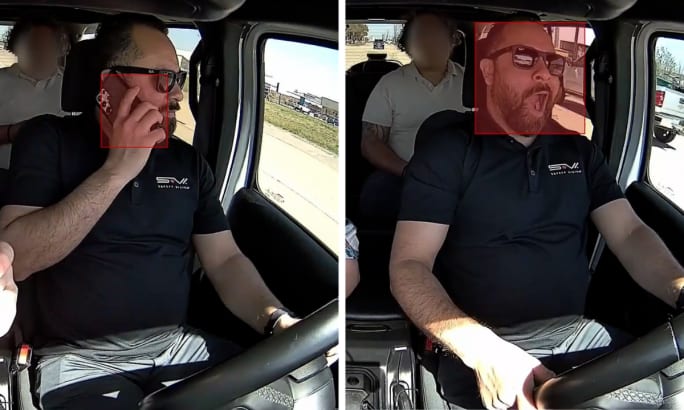
Safety Vision's AI cameras provide real-time notifications to help school bus drivers stay alert and prevent accidents.
Photo: Safety Vision
Implementing an In-Vehicle Safety and Assistance Program
For many school bus drivers, the idea of a dashcam watching them can feel intrusive or even threatening at first. However, when technology is introduced with transparency, clear policies, and recognition for safe driving, skepticism often gives way to support.
Implementing AI-based driver assistance technology in school transportation requires careful planning, communication, and collaboration. The key is making drivers partners in the process, not subjects of it. To do so, districts and contractors should consider the following steps:
1. Address Driver Concerns Early
Resistance from drivers is common and often due to fears of being "spied on." As some industry leaders explain, the key to overcoming that hesitation is clear communication and transparency by demonstrating how the technology is designed to support drivers, improve safety, and prevent mistakes, rather than punishing or surveilling them.
"Drivers in the pilot became more receptive as they experienced the benefits," John Kenning, CEO and president of First Student, said in reference to the addition of Samsara to First Student's HALO technology platform. "Increasingly, drivers see the system as a tool that supports them, enhances safety and strengthens their professionalism."
2. Emphasize the Protective Role
It's important to note that driver monitoring isn't about punishment — it's about safety. These systems help drivers self-correct in the moment and provide managers with coaching opportunities rather than discipline.
3. Establish Clear Policies
Districts and contractors should outline when and how data will be used. Will footage only be reviewed after an incident? Will safety scores be tied to recognition programs? Clarity builds trust and sets expectations.
4. Provide Coaching and Recognition
Instead of focusing solely on corrective action, successful programs use safety scores to highlight top-performing drivers. Celebrating safe driving builds morale and encourages buy-in across the workforce.
5. Train Staff and Drivers, and Listen to Their Feedback
Like any new technology, training is essential. Managers and drivers must understand how the system works, what the alerts mean, and how to respond. Additionally, listen to the drivers' experience as they begin using new technologies.
"I'm always listening to the drivers," Michael Shedlock, safety and training manager at American Student Transportation in Minnesota, said. "You have to be open-minded and listen to your drivers to grow with them and be able to hear what they have to say, because it's just as important as what I have to say to them."
6. Start Small, Then Scale
Piloting a system on a limited number of buses can help refine implementation before rolling it out to the entire fleet. Feedback from drivers in the pilot group can shape policies and procedures.
Elizabeth Martinez, a special needs school bus driver with Storer Transportation, who was named to the inaugural Samsara Verified Safest Drivers list, said that “Samsara helped me become a safer and more confident driver. When I’m on the road, it’s not just about me, I’m making sure students get to and from school safely. The AI Dash Cam is there to help keep us protected.”

Zonar Coach captures driving behaviors and provides real-time feedback.
Photo: Zonar/School Bus Fleet
How Safety Scores Build Accountability and Recognition
Being current is the most effective tool a safety manager has in enhancing their coaching ability and bringing knowledge to their drivers. Insights from generated safety scores can guide coaching techniques, help tailor coaching dashboards, and allow districts to be even less picky.
Bryer notes that yawning at 6 a.m. shouldn’t automatically lower a safety score, and because districts approach safety differently, driver monitoring platforms need the flexibility to adapt to those varying perspectives.
Through Samsara, Shedlock’s 400 drivers have maintained an average safety score of 96 out of 100 since May 2024. In their first year using Samsara, their score averaged 47. In addition to monthly safety meetings, Shedlock uses the platform as a communication tool by sending coaching notes or videos directly to drivers.
Shedlock highlights how Samsara’s app can replace individual vehicle scores with individual driver scores that follow them, regardless of the vehicle they’re in. A future use for Shedlock would be to incorporate articles and news into the app, informing drivers about incidents in other districts and explaining how to prevent them in the future.
"If you can get innovative with the technology that's provided to you, you will grow and you will get that support and buy-in from your drivers,” Shedlock said. “This is where [Samsara] is being really receptive to listening to my ideas about school bus drivers and the safety that entails around our industry. They're flexing and moving in our direction more and more every day."
For First Student, alerts and post-trip insights from Samsara are heavily used, with pilot programs revealing a more than 40% reduction in harsh braking and a nearly 30% reduction in accidents.
Safe Fleet even has a built-in recognition tool to reward safe driving, which helps districts, according to Parlato, “Spend less time reviewing video and more time building a culture of safety and accountability.”
In some cases, drivers can view their live safety scores, which adds a gamification element to the tech. Casey Foster from Birmingham City Schools used safety scores in Samsara to spark a friendly competition with his team, boosting safety goals and reducing driver turnover.
Overall, this in-vehicle technology is proving itself a game-changer by making driver coaching more precise and individualized. “Supervisors can quickly identify areas where support is needed, recognize safe driving in real-time, and reinforce positive behaviors,” Kenning said.
Why This Matters for School Transportation
The stakes in pupil transportation are uniquely high. Every day, millions of students rely on buses to get to school and to get there safely. Distracted or drowsy driving is a risk in every sector, but when children are the passengers, the margin for error is nonexistent.
Driver monitoring provides a way to support drivers, rather than just watching them. Real-time alerts give drivers an extra set of eyes, while safety scores and coaching opportunities help build a stronger safety culture. As the technology becomes more accessible, it may well become the baseline for school bus fleets, just as it already has in trucking and delivery.
For one, the speed at which footage and data are available almost instantaneously can help transportation directors and safety managers address safety concerns much more quickly.
“In most cases, we can meet with a driver within hours of reviewing the safety alert reported in our telematics,” said Dave Bittner, assistant director of transportation at New Hanover County Schools. “It is also helpful in coaching drivers, as they get to watch the event and discuss best practices with their supervisor.”
Ultimately, AI-powered driver monitoring is not a replacement for human judgment, but rather a tool to augment it. This technology represents the next evolution in student transportation safety as it combines real-time detection, proactive coaching, and integration with other fleet systems while supporting drivers.
For school transportation, technology can strengthen safety, but people will always be at the center. The future lies in balancing both.
Subscribe to Our Newsletter
More Management
How to Build a Better Driver Training Program
Ready to boost up your school bus instructor training? Here’s how to pick the right talent and improve recruitment, retention, and safety.
Read More →
CALSTART and Forth Combine to Form Catalyst Mobility
The new name represents a renewed vision for the nonprofit focused on advancing clean, equitable, and affordable transportation solutions that move people and goods.
Read More →
What Makes a Great School Bus Driver Trainer?
Choosing the right school bus driver trainer takes more than experience. Learn six keys to selecting and developing trainers and evaluating program effectiveness.
Read More →


School Bus Contractors Expand Through New Deals, Acquisitions & Partnerships
STA's Canadian division acquires Ontario-based G&L Stevenson Transport while Durham School Services adds a new district contract in California, First Student adds a New Jersey contract, and Minnesota Coaches acquires Halo Transportation.
Read More →
Logan Bus Company Rolls Out AI Phone System for NYC School Bus Families
A summer pilot found that AI agents could handle most routine calls, freeing up time for customer service staff to focus on emergencies and complex family concerns.
Read More →
From Intent to Impact: What I Learned About Leadership from TAPT
A Texas transportation supervisor shares lessons on self-awareness, accountability, managing stress and building trust — and why investing in leadership development matters at every stage of your career.
Read More →
NAPT Names 2026 Award Recipients, Hall of Fame Inductee
Who earned national recognition for their work in student transportation? This year, NAPT named five recipients of its 2026 awards for service, safety, and leadership, plus its newest Hall of Famer.
Read More →
Sponsored•September 2, 2026
2026 State of Student Transportation Report
Driver shortages. Rising costs. Growing safety expectations. More data, but not enough time to act on it. The 2026 State of Student Transportation Report reveals what transportation leaders say is putting the most pressure on their operations—and where they’re investing next. See how your priorities compare.
Read More →
How to De-Escalate an Angry Person: 5 Steps for Handling Workplace Conflict
What makes emotions run high, and how should you handle an angry colleague or parent? Follow these steps for staying calm, listening, showing empathy, and resolving conflict.
Read More →
Sponsored•September 1, 2026
What Readiness Looks Like This School Year
Learn about the challenges shaping the 2026–2027 school year, from persistent driver shortages and budget pressure to technology and readiness gaps. See how school districts are responding and adapting in Zonar’s 2026 Back-to-School Readiness Report.
Read More →