"We are seeing districts expect more from contractors. Not just safe and reliable transportation, but stronger communication, better data, and real partnership," said Judith Crawford, CEO of Beacon Mobility.
Credit:
Beacon Mobility/School Bus Fleet
11 min to read
School transportation contractors are observing significant shifts due to recent trends in the industry.
Rising operational costs and a persistent driver shortage are affecting school transportation services.
There is an increasing interest in multimodal student transportation solutions to address current challenges.
*Summarized by AI
Contractors are navigating one of the most dynamic periods the school transportation industry has seen in decades.
What was once a low-bid, transactional service is rapidly evolving into a service-driven model shaped by rising costs, workforce challenges, technology demands, and changing student needs.
Ad Loading...
In this roundtable, School Bus Fleet brings together leading voices from across the contractor landscape to explore how these pressures are reshaping operations and long-term strategy.
We spoke with:
Aaron Sepkowski, President, Pocono Transportation; President, Pennsylvania School Bus Association
Judith Crawford, CEO, Beacon Mobility
Tim Flood, Executive Vice President, The Trans Group
Summit School Services
Dan Cecchin, Senior Vice President of Commercial Development
John Juniker, Fleet Services Manager
Carrie Steben, Vice President of HR Operations
Mitch Bowling, CEO, EverDriven
Joanna McFarland, CEO and Co-founder, HopSkipDrive
The following interviews were compiled individually and edited for length and clarity.
Q: What are the biggest shifts you’re seeing in the school transportation contracting market right now?
Crawford: We are seeing districts expect more from contractors. Not just safe and reliable transportation, but stronger communication, better data, and real partnership. The market is moving from transactional contracts to relationships built on trust, transparency, and performance. Technology is foundational and transformative to the shift underway.
Flood: School transportation is no longer a low-bid service. It’s a complex, service-driven operation requiring scale, technology, and specialized expertise.
Sepkowski: The workload of the smaller contractor being bought out or overtaken by national or publicly traded companies. If you think about this industry, it's generational, especially on the smaller side. One person or one family might have a school district for, say, 90 years, and they take it for granted that they'll just keep winning. Well, if you're not staying in the loop of technology, of nuances, of advocacy with legal challenges, you’re not going to know how to price or market yourself. The bigger guys have whole departments that do that for them.
Ad Loading...
Cecchin: Funding constraints by school districts have become a major challenge, often requiring more efficiency or reduced service levels, with alternative student transportation and smaller vehicles becoming increasingly attractive. Electrification and alternative fuels continue to be of interest despite slowing federal funding, though the cost point is still too high for most districts. Significant advancements and expectations in technology, particularly around safety and live monitoring, have also changed the landscape and customer expectations in a short period of time. While these shifts occur, we are using this opportunity to actively explore mergers and acquisitions.
Q: How do you see alternative student transportation fitting into the broader contracting market?
Bowling: Alternative student transportation is a complement to traditional busing, not a replacement. Certain students and trips aren’t well-served by fixed-route buses — whether due to distance, special learning needs, or individual circumstances. Alternative student transportation providers like EverDriven ensure districts can meet the needs of every student, safely, reliably, and efficiently.
More broadly, districts are moving toward a modern student transportation model where the student is at the center, and districts match the right mode to the right student. In this model, traditional buses handle scale, and alternative student transportation providers handle trips with unique, often individualized, requirements. This approach helps districts operate more efficiently, ensuring every student has access to transportation that fits their needs.
McFarland: School buses are, and will remain, the backbone of student transportation. HopSkipDrive is built to complement them by handling the trips that are hard to route on a 72-passenger bus: McKinney-Vento students who move multiple times a year and need a confirmed ride by the next morning, IEP riders whose needs don't fit a shared route, or small groups traveling to CTE programs where a half-empty bus isn't financially justifiable. By taking on those individualized exceptions, district teams can direct their CDL drivers and large vehicles toward the high-density, fixed routes where they are most effective and most needed.
What we're seeing across the country is a growing shift toward multimodal thinking, driven by driver shortages, tightening budgets, and a sharper focus on matching the right transportation option to each student's actual situation. Rather than defaulting to a single mode, more districts are getting intentional about which students belong on a bus and which are better served by a smaller, more flexible vehicle in a way that is both safe and resource-conscious.
Ad Loading...
Q: Consolidation appears to be accelerating. What’s driving that, and what does it mean for competition and pricing?
Flood: Consolidation is being driven by the need for scale. Operators need the resources to manage insurance, workforce, and capital demands, particularly those facing electrification mandates.
Crawford: Consolidation is being driven by scale pressures. Labor costs, insurance, technology, and compliance are all becoming more complex and expensive. Well‑run organizations that can invest across those areas are better positioned to stay stable and deliver a high level of service. When done right, consolidation can actually strengthen competition by raising standards, not suppressing them. Pricing still ultimately reflects local labor markets and service expectations.
Cecchin: Driver challenges, rising insurance costs, and increased demand/expectation for safety and technology standards have driven consolidation, along with an influx of capital from private equity sponsors. The industry still has a fairly long tail of smaller companies, with the large national players making up less than half of the outsourced market. It is likely that these pressures will continue to push consolidation.
Q: How has the driver shortage evolved over the past year? What new strategies are proving most effective in recruiting and retention?
Crawford: The shortage has shifted from crisis to chronic. It is no longer just about hiring more people. It is about creating a job people want to stay in. What works today is flexibility, respect, predictable schedules, and strong local leadership. Drivers stay where they feel supported and heard.
Flood: The shortage hasn’t disappeared, but it was improving. Now, new restrictions on non-domiciled drivers are creating a fresh challenge, particularly in markets that have historically relied on that segment of the workforce.
Ad Loading...
Steben: Over the past year, [Summit] has introduced new technology into the application process that uses automation and innovative candidate relationship management tools to better engage with job seekers and improve recruiting at high volumes with greater efficiency.
This technology allows us to expand our reach to engage and re-engage with both large and existing candidate pools via the methods that work best for them, accelerates advancement from application to interview through automation and self-scheduling, and improves conversion by keeping candidates engaged through critical decision points.
In a tight labor market, this technology is a key driver of faster hiring, lasting engagement, reduced drop-off, and more predictable outcomes in our high-volume roles.
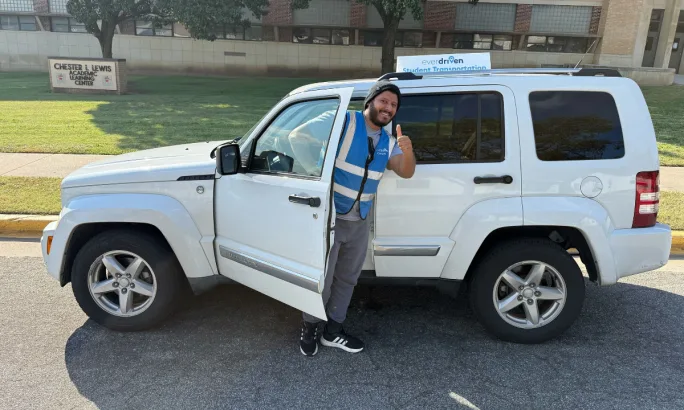
EverDriven driver Ricardo outside the Chester Lewis Academic Learning Center in Wichita, Kansas.
Credit:
EverDriven
Sub-Q: Are you seeing more contracts shift toward alternative providers?
Bowling: Districts are increasingly building out modern student transportation strategies. Often, they expand their mix to ensure efficient, safe coverage when routes can’t be staffed or when buses simply aren’t the right solution. This isn’t a shift away from buses; it’s a more intentional and strategic use of every available option.
The drivers are well documented: persistent school bus driver shortages, increasing student complexity, growing compliance requirements under IDEA and McKinney-Vento, and the need for flexible, on-demand transportation options. Alternative student transportation can scale with a district’s evolving needs in ways that fixed-route models cannot. EverDriven saw 94% year-over-year growth in new business in FY2025 — a clear signal that this shift is already well underway.
Ad Loading...
Q: How are rising insurance and operating costs impacting your business, and how are those pressures showing up in contracts with districts?
Flood: Insurance and operating costs are reshaping the economics of this business. Contracts today have to be sustainable, not just competitive. Our industry has become significantly more complex and volatile, with rising insurance premiums, increasing driver wages, more resource-intensive specialized transportation, and the growing capital demands of fleet replacement, particularly with electric vehicles.
In this environment, a purely low-bid, “competitive” contract that fails to account for these realities can lead to service disruptions, mid-contract renegotiations, and instability in staffing and performance. By contrast, a sustainable contract ensures service reliability for the district, supports financial stability for the contractor, and minimizes unexpected challenges over the life of the agreement.
Cecchin: This has been one of the most difficult challenges we have faced in negotiations with customers, many of whom are in their second cycle of contract renewals since the significant wage pressure began. In the first cycle, the conversation was focused on investment in driver wages. Many districts faced significant double-digit price increases, and while that was challenging, the conversations are usually easier when it is about taking care of the employees with whom they interact every day.
After this first cycle of renewals, there was an expectation that the contract economics were fixed and future contracts would return to normal increases. However, not only have there been continued pressures on driver wages, but insurance costs, healthcare premiums, and the cost of new vehicles and tariffs have jumped drastically over the last few years, along with higher inflation on other operating expenses. This has led to another wave of large price increases, which has put a lot of pressure on both contractors and customers.
Q: With more students requiring specialized transportation, how are your operations, fleet mix, and training evolving?
Flood: It’s an area where we already have depth and experience, which shows up in a few ways in our day-to-day operations.
Ad Loading...
First, a significant portion of our fleet is configured specifically for special needs service, including wheelchair-accessible vehicles, and school bus vans designed for more individualized routing. Second, we consistently deploy bus attendants on a large percentage of our routes to enhance safety and support for the students we’re transporting. Third, our routing and scheduling tend to be more customized, with door-to-door service, varied bell times, and coordination around IEP-driven requirements rather than standard tiered routing, as well as multiple types of child securement items.
Finally, our training programs have long emphasized specialized instruction for both drivers and aides, focusing on student management, securement, communication, and consistency of care.
Cecchin: Alternative student transportation continues to be a hot topic in the industry, as customers look for a more efficient and flexible way to transport these students. We are seeing increased interest in smaller vehicles, including vans.
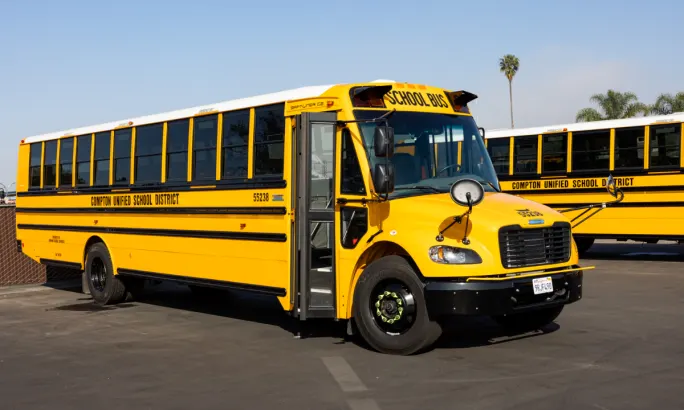
Compton Unified School District in California is just 3,000 miles shy of reaching 100,000 clean miles with its fleet of 25 electric buses.
Credit:
Summit School Services
Q: How has your fleet strategy shifted in light of changing EV funding and policy? Are your plans different today than they were two, five, 10 years ago?
Crawford: Our approach has become more measured. We believe in electrification, but we also believe in operational reality. Infrastructure readiness, utility partnerships, maintenance capabilities, and route design all matter. Ten years ago, the focus was replacement. Five years ago, it was acceleration. Today, it is a disciplined deployment where EVs truly make sense both operationally and financially.
Flood: Electrification is clearly part of the long-term direction here in New York, but the execution has to align with operational realities. That includes route structure, charging infrastructure, vehicle range, and total cost. Maintaining fleet flexibility remains critical as technology, funding, and policy continue to evolve.
Ad Loading...
Juniker: [Summit’s] fleet strategy has always been grounded in operational reality, and that hasn’t changed. Ten years ago, EVs were largely aspirational for commercial fleets. Five years ago, federal incentives and state mandates pushed electrification from a long-term idea to something we needed to actively plan for. We responded by piloting EVs, investing in infrastructure, and building them into our long-term strategy.
Today, the environment is different. Funding has shifted, some incentives have been reduced, and the policy outlook is less predictable than it was even a couple of years ago. That hasn’t changed our direction, but it has changed how we approach it.
We’re focusing on routes where EVs work today, while keeping flexibility across the broader fleet. We’re also placing greater emphasis on full-lifecycle cost, not just on incentive-driven decisions.
Q: As union representation among school bus drivers continues to grow, how is the rise in union activity impacting the contractor business overall?
Crawford: We have many locations that are unionized and many that are not. We treat our drivers the same. At its core, drivers want stability, fairness, and a voice. The impact depends on how contractors engage. When companies communicate clearly and operate with trust, those relationships can be constructive rather than disruptive.
Flood: We are not seeing any rise in unionization in the areas we service, but wherever it may be on the rise, I think it’s less about unionization itself and more about what’s driving it — the continued evolution of the workforce and the need to make this a more attractive, stable profession long-term.
Ad Loading...
Sepkowski: On the contractor side, there’s not a lot of grievances because we treat people with respect, and we really do treat people well and pay them as much as we can pay them. When you get into a government entity, politics play a huge role, and you may need some protection. If there’s a need for it, I think you should work with your employer.
Q: Looking ahead, what’s one trend that will most significantly reshape the contractor market in the next few years?
Crawford: Technology that supports people, not replaces them. Whether it is routing, communication, safety monitoring, or analytics, contractors that use technology to simplify work and improve the daily experience for drivers, students, and districts will pull ahead.
Bowling: The biggest shift will be toward modern, student-centered transportation models — moving away from one-size-fits-all routing to more flexible, needs-based approaches. EverDriven’s research shows that 88% of district leaders already identify access disparities as a major concern, and 68% say technology will play a significant or critical role in their transportation strategy going forward. Those who build the right solution now will be better positioned to serve every student with the right mode of transportation, regardless of what challenges the next school year brings.
Flood: Success in this industry now requires excellence across multiple dimensions at once: workforce management, safety, insurance risk, specialized service delivery, technology integration, and fleet strategy. The companies that can consistently execute across all of those areas will be the ones that define the next phase of the industry. The trend that will most significantly reshape the industry is deeper technology integration, particularly the use of AI to drive efficiency, improve decision-making, and enhance overall operational performance.
McFarland: Looking ahead, the trend we think will most reshape the market is the demand for verifiable safety and genuine transparency with contracted partners. Districts increasingly want direct accountability and real-time visibility into every ride. The contractors best positioned for the next few years are those who can demonstrate that standard of accountability.
Ad Loading...
Sepkowski: I learned very quickly that you can work in your business. Or, you can work on your business. You don’t have time to do both. The technology boom, the new nuances in transportation with electric-powered units versus diesel or propane, and what school districts are looking for in special needs transportation. That’s what you have to concentrate on.
The new name represents a renewed vision for the nonprofit focused on advancing clean, equitable, and affordable transportation solutions that move people and goods.
Choosing the right school bus driver trainer takes more than experience. Learn six keys to selecting and developing trainers and evaluating program effectiveness.
STA's Canadian division acquires Ontario-based G&L Stevenson Transport while Durham School Services adds a new district contract in California, First Student adds a New Jersey contract, and Minnesota Coaches acquires Halo Transportation.
A summer pilot found that AI agents could handle most routine calls, freeing up time for customer service staff to focus on emergencies and complex family concerns.
A Texas transportation supervisor shares lessons on self-awareness, accountability, managing stress and building trust — and why investing in leadership development matters at every stage of your career.
Who earned national recognition for their work in student transportation? This year, NAPT named five recipients of its 2026 awards for service, safety, and leadership, plus its newest Hall of Famer.
Driver shortages. Rising costs. Growing safety expectations. More data, but not enough time to act on it. The 2026 State of Student Transportation Report reveals what transportation leaders say is putting the most pressure on their operations—and where they’re investing next. See how your priorities compare.
What makes emotions run high, and how should you handle an angry colleague or parent? Follow these steps for staying calm, listening, showing empathy, and resolving conflict.
Learn about the challenges shaping the 2026–2027 school year, from persistent driver shortages and budget pressure to technology and readiness gaps. See how school districts are responding and adapting in Zonar’s 2026 Back-to-School Readiness Report.