Pocono Transportation at a Glance
- Founded: 1936
- Service Region: Northeastern Pennsylvania
- District Partners: 3
- Students Served: 3,500
Fleet Size: 75+ School Buses | 35 Vans
Employees: 104
 MENU
MENU SEARCH
With nearly two decades at the helm of Pocono Transportation, Aaron Sepkowski has transformed a family-run operation into a modern, safety-focused contractor, while championing innovation, workforce development, and advocacy across Pennsylvania’s school transportation industry.
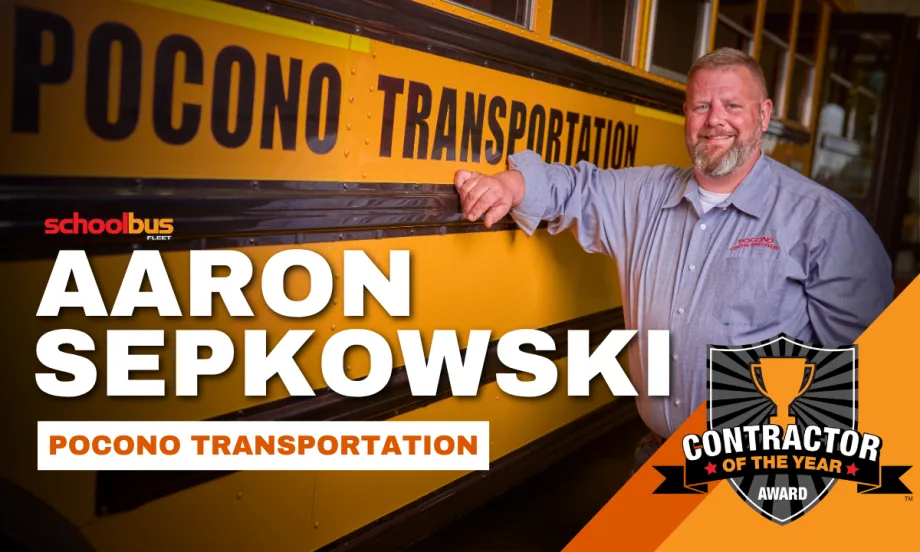
Pocono Transportation President Aaron Sepkowski, named School Bus Fleet’s 2026 Contractor of the Year, has expanded the Pennsylvania-based company from nine buses to more than 100 vehicles while emphasizing safety, technology, and hands-on leadership.
Aaron Sepkowski/School Bus Fleet
*Summarized by AI
In school transportation, longevity can be what people describe as “both a gift and a curse.” A long-standing contract or decades-old company history might open doors, but it won’t keep them open.
Aaron Sepkowski understands that better than many.
As owner and president of Pocono Transportation and president of the Pennsylvania School Bus Association (PSBA), Sepkowski has built his career on the idea that every generation in this industry has to re-earn its place.
“Just because you have that 90-year-old sticker on the side of the bus doesn’t mean you’re a shoo-in,” he said. “We have to work all the harder to maintain that.”
Coming from a place that is equal parts humility and urgency, Sepkowski’s mindset has shaped both his company’s growth and his influence across the broader industry. It’s also what ultimately earned him recognition as School Bus Fleet’s 2026 Contractor of the Year.
Pocono Transportation’s history dates back to 1936, part of a wave of family-owned contractors that helped define school transportation in Pennsylvania and across the country. Sepkowski represents the continuation of that legacy, but his path into the business was shaped more by his lived experience than any kind of inheritance.
“I grew up on the school bus,” he said. His great-grandfathers were in the business in the 1930s, and his mother later became a school bus driver, not just for work, but to care for his father, a Vietnam veteran living with multiple sclerosis. Watching that shaped how Sepkowski views the industry today.
“I always admired my mother for choosing that career to help her family,” he said.
That early exposure framed transportation as something deeply tied to family and service, and it also informed how Sepkowski would later approach leadership with a focus on operations and people.
When he took over the company in 2006, Pocono Transportation operated just nine buses. Growth since then has been steady but intentional, expanding to more than 100 vehicles serving a mix of general education, special needs, and emergency transportation needs.
A differentiator for the contractor would be his early emphasis on special needs transportation, an area that continues to grow in complexity and demand across the industry. Drawing from earlier work at Lackawanna County Coordinated Transportation, Sepkowski pushed to equip vehicles with advanced accessibility features and tailor operations to better serve that student population.
“Once I learned how that was done on a county level, I thought, there’s no reason the students of North Pocono, my home district, shouldn’t have the same abilities as everybody else,” he said.
For many small- and mid-sized contractors, technology adoption is often driven by district requirements or competitive pressure. Sepkowski has taken a different approach, using modernization as a proactive strategy to set Pocono Transportation apart in a crowded and increasingly consolidated market.
The company’s 2018 rollout of GPS tracking and telematics across its entire fleet marked a turning point. At the time, that level of investment was far from standard for an operation of its size.
“It’s hard to justify ideas of GPS and telematics monetarily,” Sepkowski said. “At some point, you have to realize the savings. I was a little hesitant, given the size of our fleet in our region. No one else had them at the time. We went with it, and it paid off in the long run.”
Currently, the company uses systems from Samsara, Pro-Vision, and FleetMate to support real-time dispatching, AI-driven safety monitoring, and flexible routing, specifically for special needs transportation. They also provide confidence, which some could argue is something less tangible but equally important.
“The districts love it. The parents love it. The drivers got used to it. And we're proud to say that we saw the vision,” he said.
Internally, the transition required cultural change as much as operational change. Like many fleets, Pocono Transportation initially faced resistance from drivers wary of increased oversight. Over time, a combination of transparency, training, and performance-based incentives helped shift that perception. In one example, if a parent calls to say their child’s school bus didn’t stop at the pickup location that morning, Sepkowski’s team can go back into the GPS log to verify the bus did make its scheduled stop, which has helped drivers warm up to the technology’s integration.
The model that emerged is becoming more and more common across the entire pupil transportation industry. That is, to use technology not as surveillance, but as a tool for coaching, protection, and accountability.
Plus, in an industry where leadership can easily become disconnected from day-to-day operations, Sepkowski has built a reputation for staying close to the work and the people doing it. His approach is deliberately hands-on, whether that means stepping in on routes, spending time in the shop, or maintaining direct communication with drivers and staff.
“Don’t be afraid to jump in on a trip to show them you’re not above them, you’re with them,” he said.
Visibility plays a critical role in workforce stability, one of the most pressing challenges facing school transportation today. While compensation remains a factor, Sepkowski emphasizes culture and respect as key drivers of retention.
Recruitment, in particular, reflects that approach. Rather than relying solely on traditional advertising, Pocono Transportation has seen the most success through employee referrals, signaling internal confidence in the organization.
“The best [recruiting] is other drivers recruiting your folks,” he said.
So, if modernization is the engine behind Pocono Transportation’s growth, safety is its foundation. Sepkowski is clear that regulatory compliance is only a starting point or a minimum, not an end goal.
"Aaron and his staff are literally available at any time to help our students and school community," said Ian Farr, assistant superintendent of the North Pocono School District. "We have worked collaboratively through detours, global pandemics, interstate travel, staff shortages, and emergency situations. I can pick up a phone or my radio and call at any time to get information, seek assistance, or find a solution."
That perspective has translated into a layered safety approach that combines formal training, real-time data, and continuous feedback, including monthly safety meetings, driver performance metrics, and telematics-based coaching, which are all integral parts of the system.
"I am invited regularly to [Pocono Transportation's] safety meetings, provided with updates and information that comes back from their drivers as they complete their daily work, and communicate regularly with Aaron and his staff," Farr said. "That confidence isn’t just based in the world of training and theoretical situations, though. I have been on scene with Aaron and his team when we have been faced with emergency situations. His staff is confident and prepared. This isn’t an accident. It is the result of careful planning and communication all year long."
Echoing Farr's comments, there is an emphasis on openness and approachability. It’s an acknowledgment with Sepkowski’s drivers that improvement requires visibility into both strengths and weaknesses.
“People are human. Humans make mistakes. Humans have different ideas. Let’s see what actually is the safest and what works. What mitigates risks, and what causes risks? You have to be comfortable enough with your employees and your own leadership to bring up things that may not feel good to a specific person,” he said.
Using technology, Sepkowski gauges distinct areas of improvement for each employee to help them grow individually. If one driver is doing well in all areas, but is at 98% for non-violations, Sepkowski knows how to direct their safety conversations to focus on real goals.
For school districts, that kind of culture truly matters. Increasingly, contractors are evaluated not just on cost or reliability, but on their ability to demonstrate a proactive approach to safety. Pocono Transportation’s model aligns closely with that expectation.
Sepkowski’s impact extends well beyond his own operation. As president of the Pennsylvania School Bus Association, he has played a central role in shaping policy discussions, strengthening advocacy efforts, and advancing initiatives that directly affect contractors across the state.
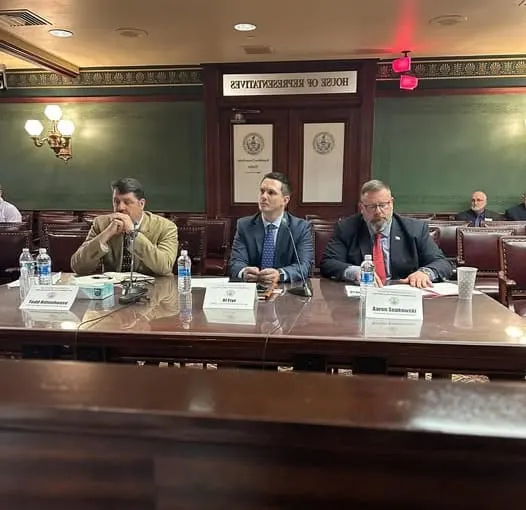
PSBA Members Todd Rittenhouse (Rittenhouse Bus Lines), Dan Frye (Frye Transportation Group), and Aaron Sepkowski testified at the "Effective School Transportation for Our Drivers and Our Students" hearing on May 2, 2023, in Harrisburg, Pennsylvania.
Pennsylvania House of Representatives
His effectiveness in that role stems from a combination of industry knowledge and practical understanding of government processes. According to PSBA Executive Director Gerry Wosewick, Sepkowski’s influence was evident even before he assumed the presidency.
“He was super involved in his community. He had run for local office and was involved in the legislative process. He’s very well respected up in Northeast Pennsylvania,” Wosewick said. Sepkowski’s reputation in both transportation and local government does precede his leadership role in the association, having run for election to the Pennsylvania House of Representatives in 2022 to represent District 113, but ultimately lost.
Wosewick also pointed to Sepkowski’s ability to quickly move long-standing regulatory issues forward, particularly by leveraging relationships and focusing on realistic outcomes. One of the clearest examples is his involvement in advancing Pennsylvania’s stop-arm camera grant program, which channels revenue from violation fines into student transportation safety improvements.
Equally important is his role as a connector within the industry. Wosewick described him as someone who actively supports others, whether that means mentoring new members or helping peers navigate complex challenges, a trait stemming from his early schooling to become a teacher.
“He’s always been really focused on trying to make sure that if you are a member of the association, you’re getting a benefit out of this,” Wosewick said. “He almost searches out the folks that want to learn more, that want to be more involved. He’s a person who wants to empower others.”
Like many contractor leaders, Sepkowski is operating in a period of significant transition. Consolidation, workforce shortages, evolving student needs, and rapid technological change are all reshaping the landscape.
He sees particular pressure on smaller, family-owned operators and businesses that have historically formed the backbone of school transportation in states like Pennsylvania.
At the same time, he views these cycles as part of a broader pattern. While large operators may dominate in the short term, he believes there will be renewed interest in local control and community-based service models. For contractors looking to remain competitive, his advice is direct: stay informed, stay adaptable, and don’t assume past success guarantees future stability.
“Education, education, education. Don’t be afraid to be humbled,” he said.
Despite his accomplishments, Sepkowski remains notably understated about his own success. “I like to stay in the background and just do the right thing,” he said.
This way of operating is echoed by those who work with him. Wosewick noted both Sepkowski's humility and his willingness to engage, regardless of how busy his schedule may be.
“If you have a question, if you need to understand something, he’s the person you call,” Wosewick said.
A lot of times, recognition often follows visibility, but Sepkowski’s approach stands out precisely because it doesn’t seek attention. Instead, it reflects a steady, consistent focus on doing the work well.
We’re searching for the next generation of leaders making an impact across the K-12 student transportation industry to recognize as SBF’s 2027 Trailblazers. Nominations are open now!
Read More →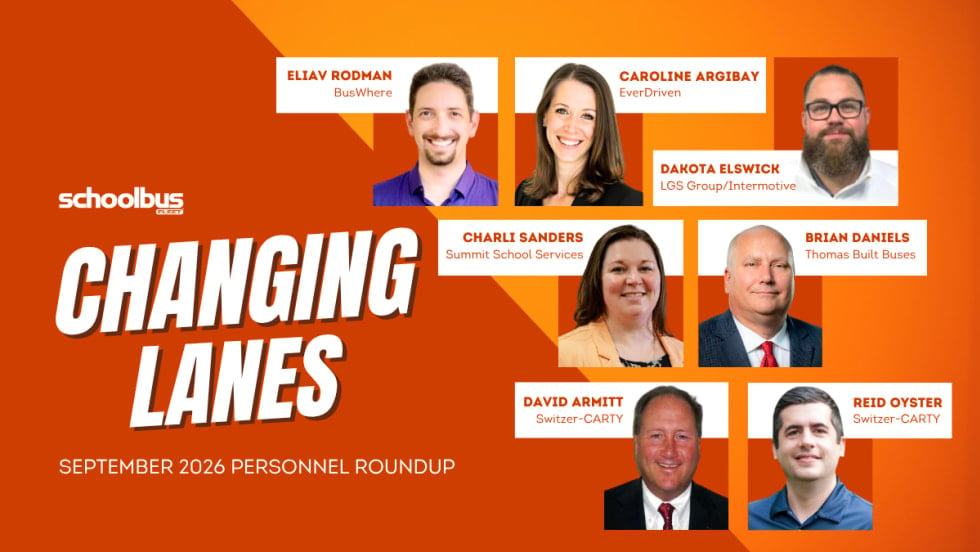
Check out who's been hired, promoted, and appointed to leadership positions at various school transportation suppliers, contractors, and manufacturers.
Read More →
When should you sell an aging school bus? Learn how maintenance, mileage, corrosion, specifications, and timing can affect resale value long before the auction.
Read More →
A new deal brings a 75-year Pennsylvania student transportation provider into one of the nation’s largest private school bus contracting groups.
Read More →
Who could lead your transportation operation tomorrow if you couldn't? Bernando Brown explores succession planning, mentorship, and preparing emerging leaders to step up.
Read More →
See highlights from SBFX 2026 in Arizona, where school bus operators and suppliers gathered for meetings, education, networking, awards, and more.
Read More →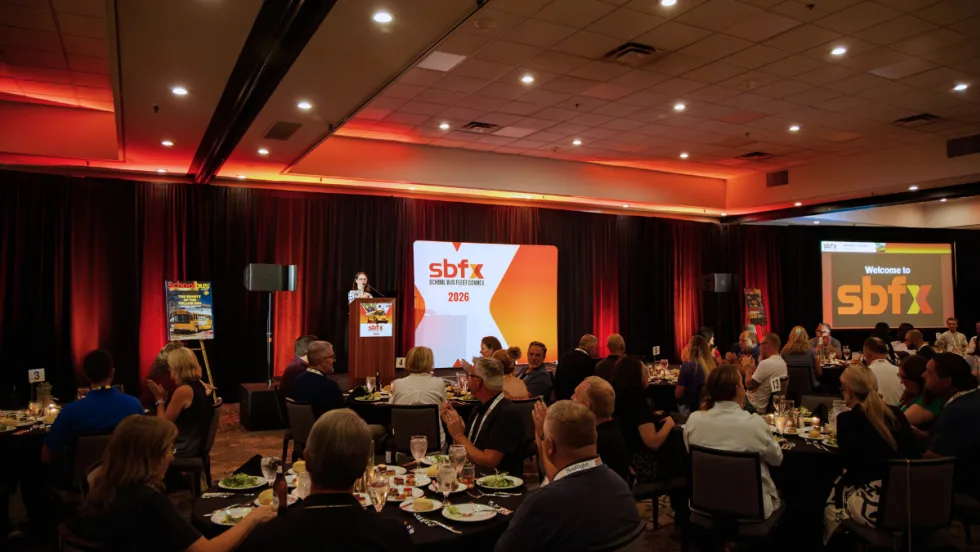
School bus operators point to rising costs, staffing, and vehicle prices as immediate pressures while identifying technology, training, and routing as opportunities for growth.
Read More →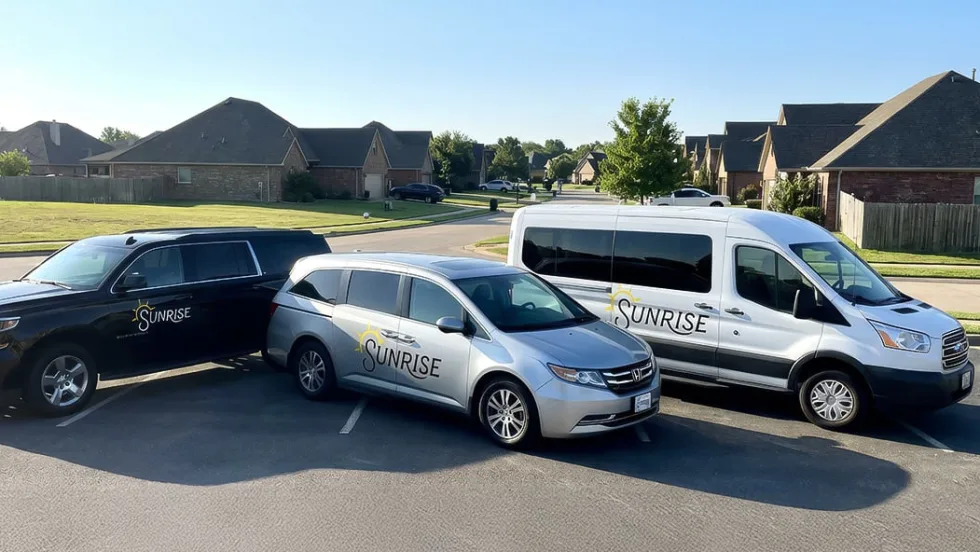
Student Transportation of America expands in Illinois and Connecticut through Sunrise's fleet of nearly 1,000 vehicles.
Read More →
The 2026 Diesel Emissions Reduction Act program seeks applications from eligible organizations to accelerate the retirement of legacy diesel vehicles.
Read More →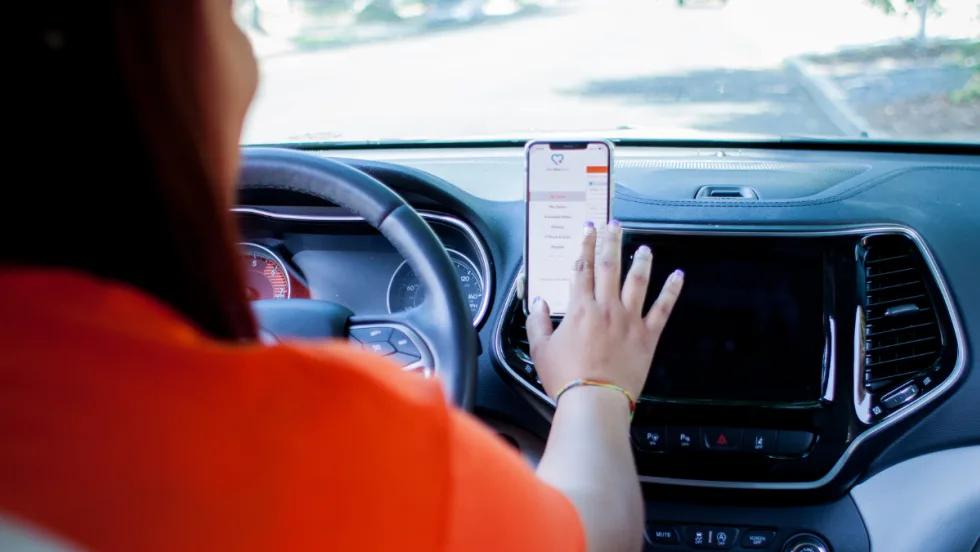
The new platform works alongside districts’ existing transportation management systems to coordinate specialized rides, automate last-minute changes, and turn ride data into operational improvements.
Read More →