




EVs, AI & the Future of School Transportation: ACT Expo 2026 in Photos
ACT Expo 2026 went down May 4-7, 2026, at the Las Vegas Convention Center, drawing about 12,000 attendees and hundreds of exhibitors to showcase the newest fleet vehicles and technology. School Bus Fleet was on the scene to capture the key trends and takeaways for pupil transportation operators. Here are the highlights.
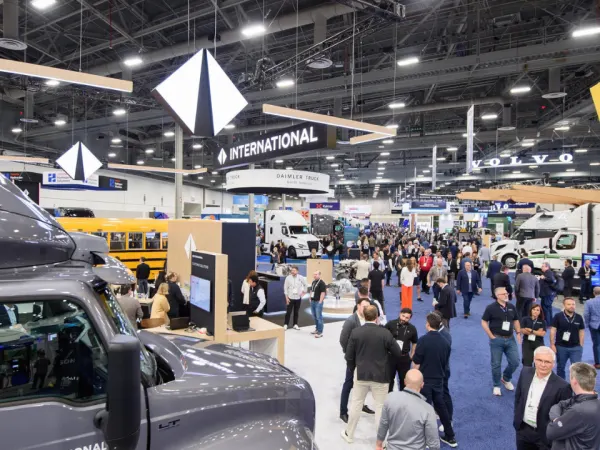
While many industries were served at the event, there were plenty of school buses and related tools to check out. The expo hall included OEMs Blue Bird, Thomas Built Buses, IC Bus, and RIDE.
TRC Companies

Multiple clean vehicles were available for ride and drive opportunities for attendees.
TRC Companies
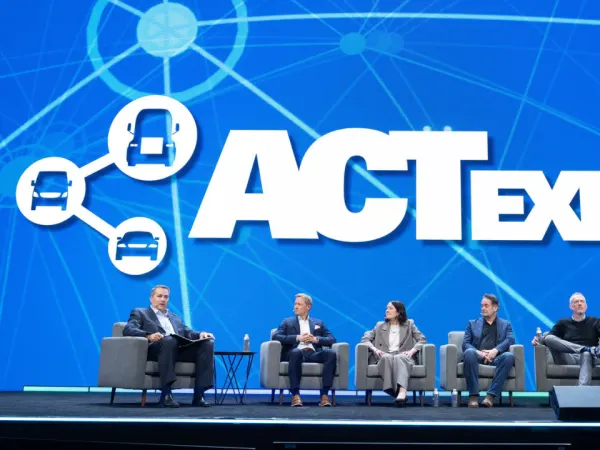
A morning session on the AI ecosystem brought in a panel of experts to discuss best-practice tips for integrating AI and LLM tools into daily fleet operations. With half of all fleets (from all industries) reporting using AI, knowing your purpose, managing data, and integrating it with human oversight are key to success. Jack Kennedy, CEO of Platform Science, encouraged attendees to evaluate what they are good at as a business that can be accelerated by AI.
TRC Companies
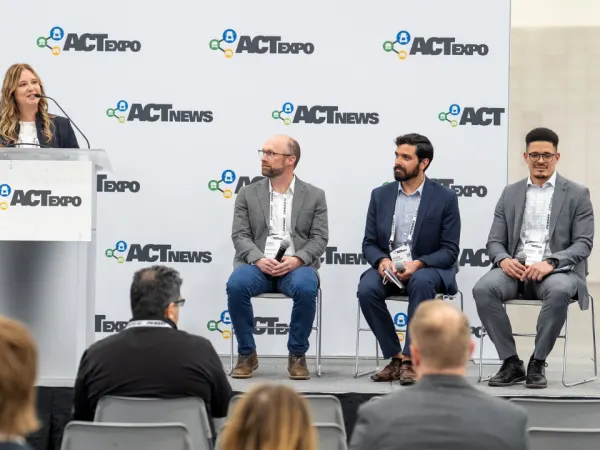
Micro Bird, Zenobe, MassCEC, and National Grid presented a talk on public-private partnerships for an electrification project with a New England school district. Michaël, Daguilh, senior project manager – EV, for Micro Bird, called the following the key takeaways:
-Successful EV deployments require public-private partnerships
-OEM responsibilities do not end after the sale
-Fleets need to demand training from directly from OEMs
-Training needs to be structured to address concerns at every role level
TRC Companies
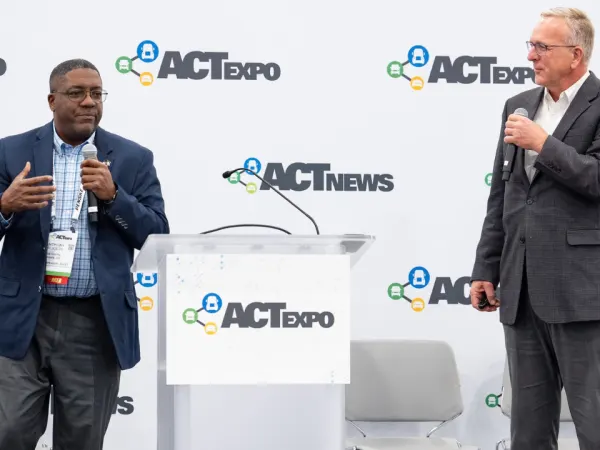
Steve Whaley, propane segment leader at Blue Bird, and Anthony Jackson of Bibb County School District, presented a talk on “The Advantages of a Mixed Energy Fleet,” discussing the use of both EV and propane-powered buses. Jackson provided cost comparisons between propane and diesel: Propane in his fleet costs 27 cents less per mile than diesel, and 23 cents less per mile to maintain. Since his fleet travels over 2 million miles a year, this saves the district about $1 million a year!
TRC Companies
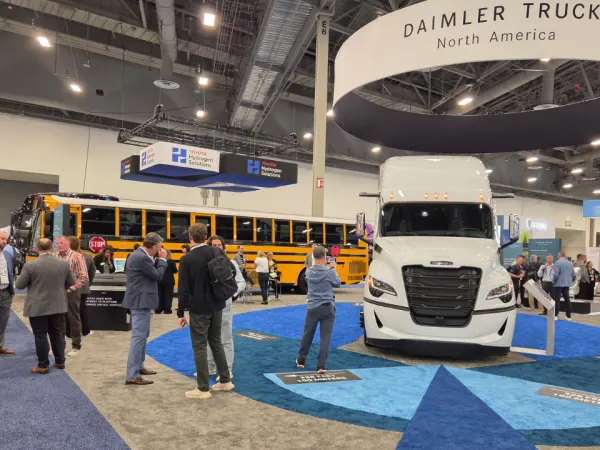
Thomas Built Buses featured Wattson, its new electric Type D school bus, at ACT Expo. Wattson is built on the same platform as the company’s second-generation Jouley. Mark Childers met with us to explain some of its features, such as lighted signs, auto-reversing door, driver camera and rear-view mirror, LED display in the driver cockpit, regen braking, and ability to both accept AC and DC charging.
Amanda Huggett
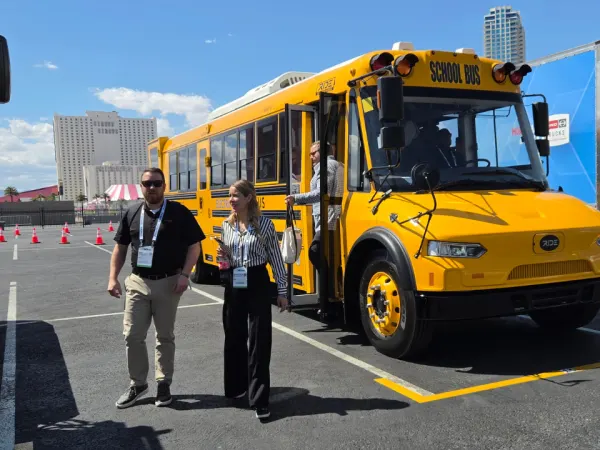
RIDE’s Type C bus, the Creator, was in the show’s ride and drive, allowing attendees to experience the clean and quiet on-board experience against the Las Vegas backdrop.
Amanda Huggett
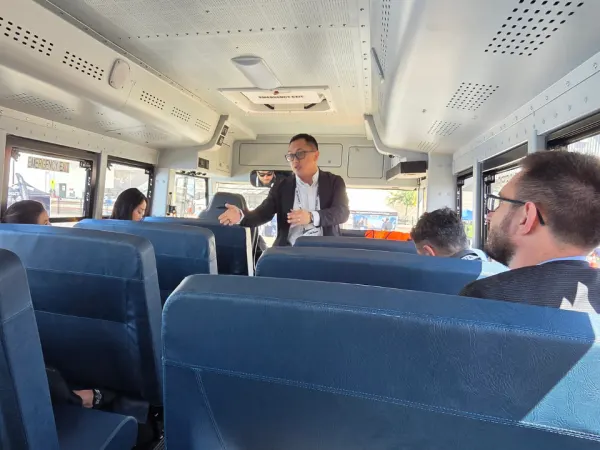
Jason Shi, VP of sales, for RIDE walks ride and drive participants through the benefits of an electric school bus. He explained that RIDE, and its parent company BYD, are the only school bus manufacturer that makes its own Blade batteries, using iron phosphate. The company’s Type C bus has a 175-mile range. Watch our video with RIDE here!
Amanda Huggett
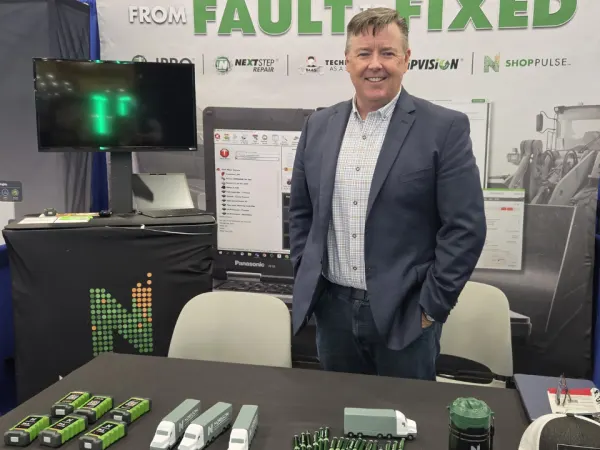
Kevin Smallhorn, director of strategic partnerships at Noregon, shared how the company’s J-Pro diagnostics platform is helping fleets improve uptime, support CNG vehicle maintenance, and simplify troubleshooting with live wiring diagrams and predictive repair tools. He emphasized the growing need for technician training and proactive maintenance as fleets work to extend vehicle life amid tight budgets. Check out our video interview with Noregon here!
Amanda Huggett
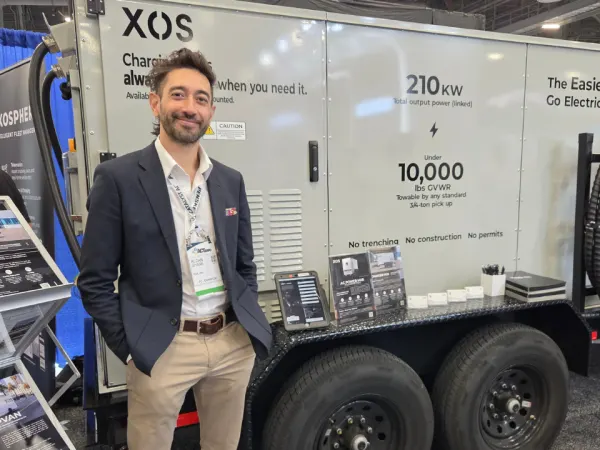
After just announcing in April that Xos will debut a V2G project for a major electric school bus platform in North America, the company showcased its mobile EV charger hub; “skateboard” powertrain system used by OEMs like Blue Bird for its electric step van; and its AC power hub, which can act as a mobile power generator during natural disasters. Xos is now entering V2G production, with a roadmap to extend bidirectional capability across its full product portfolio.
“One of the key use cases for [the mobile power unit] that we're developing is if a school district has a whole yard full of school buses and also has bi-directional EV chargers, a system like this will allow that district to pull energy from the buses to the charger onto our system, and then from our system to the school itself, or to lights or equipment or emergency response,” said Aldan Shank, Xos director of mobile charging (pictured). “It's basically a way to take the energy that's on the vehicles and channel that into whatever you need.”
Amanda Huggett
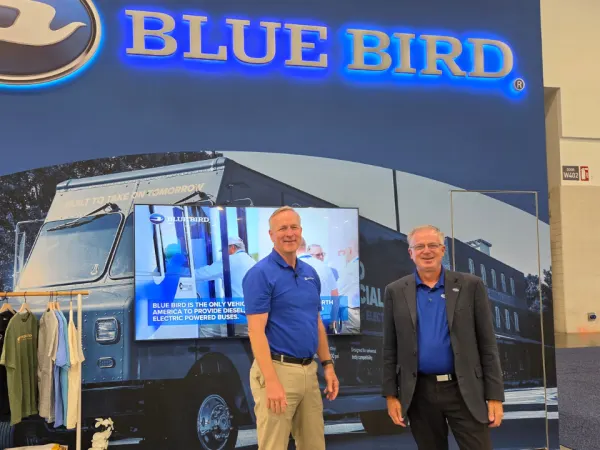
With Blue Bird and Micro Bird now fully integrated, the OEM is even better positioned to serve customers interested in greening their fleets. Already, 60% of its buses sold are not diesel-powered. Through the acquisition, Blue Bird has inherited the Ecotuned EV drivetrain integrator, and now they’re helping prove V2X’s role in disaster recovery and grid utilization. Steve Whaley and Brad Beauchamp, the company’s alternative fuel managers for propane and EVs, respectively, were on-site at ACT, to show off the Vision school bus and talk about the progress we’ve seen in clean transportation over the years. Catch their conversation on video here!
Amanda Huggett
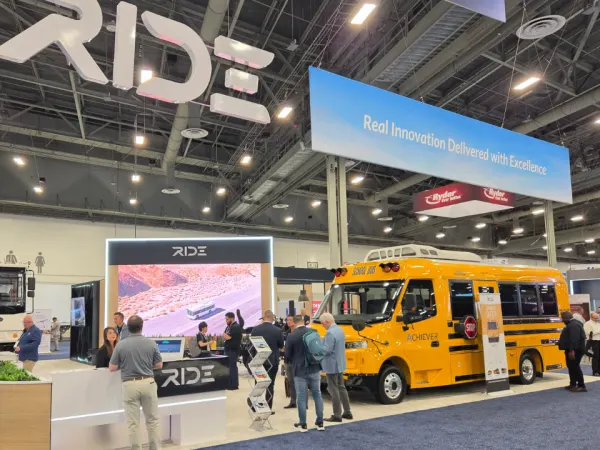
RIDE showcased its Type A bus, the Achiever, at its booth inside the show, while its Type C was outside for the ride and drive. Frank Girardot, senior director of communications, said that the company is seeing increased interest in EVs right now, as state funding increases and both drivers and kids like the quiet nature of an electric bus.
Amanda Huggett

Battery pack provider Proterra not only had their own booth, but was proud that their industry partner Thomas Built Buses was nearby using its technology. Mabel Feng explained the fifth-generation Onyx modular platform. “What's new this year is options to bring more localized content for a more resilient supply chain,” she explained. Proterra has made safety, software, and cybersecurity improvements, as well as in its service and diagnostics, “because at the end of the day, the battery needs to not just work out of the factory, but it needs to be serviceable.”
Amanda Huggett
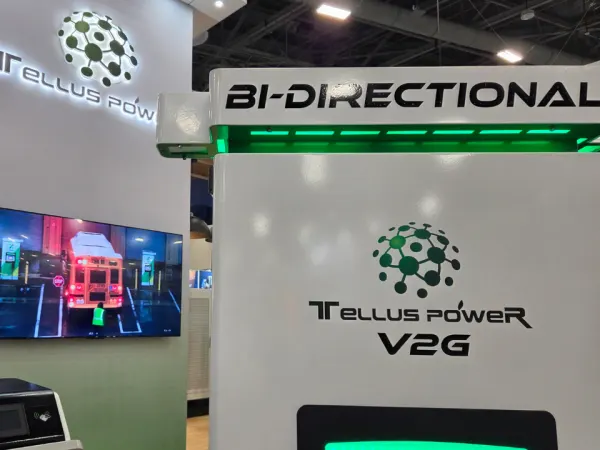
Srikanth Kanaparthi, Tellus Power’s senior VP of technology, believes that EV infrastructure has caught up to the market’s needs over the past 10 years, and he spoke about the increase in battery technology range and decrease in prices. “We were a little bit late into the industry, but we caught up really fast with that,” he said of their recent electrification project with Zum in Oakland for 74 EV buses and chargers. Since then, about one-third of the 500 gigawatt-hours of power sent to chargers has been given back to the grid. “This has given a hope for the industry that this can happen at scale,” Kanaparthi said. Check out our interview here!
Amanda Huggett
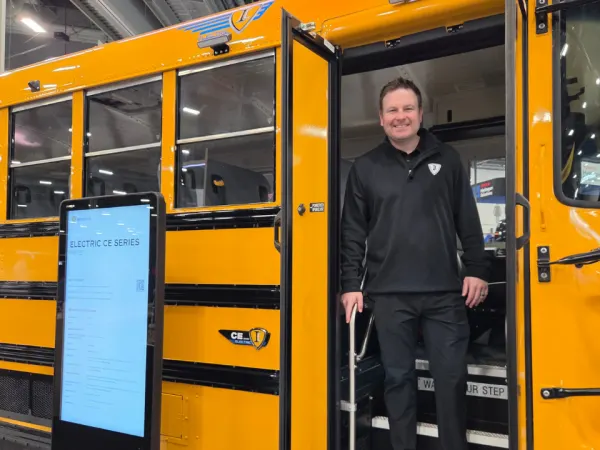
IC Bus has recently upgraded its Type C electric school bus with a new front end and better driver experience. With about 1,000 orders of the next-gen model in the pipeline, they believe the EV market is strong through 2027. Alec Borror, sales director - EV Bus, recapped some of the company’s recent announcements, including factory-installed Samsara technology and My International, and said it only takes a driver about 30 minutes to get the hang of the bus and begin to love it. Later this year, they’ll have the Octane engine-bus in production as well. Check out our interview here!
Amanda Huggett
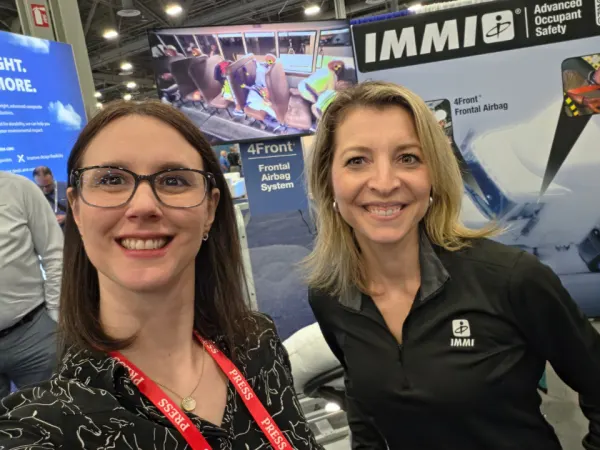
SBF editor Amanda Huggett found 2026 Trailblazer Katia Dubas at the IMMI booth promoting the company’s driver airbags that are now standard on all new Blue Bird buses, as well as its seat belts and child restraint systems.
Amanda Huggett
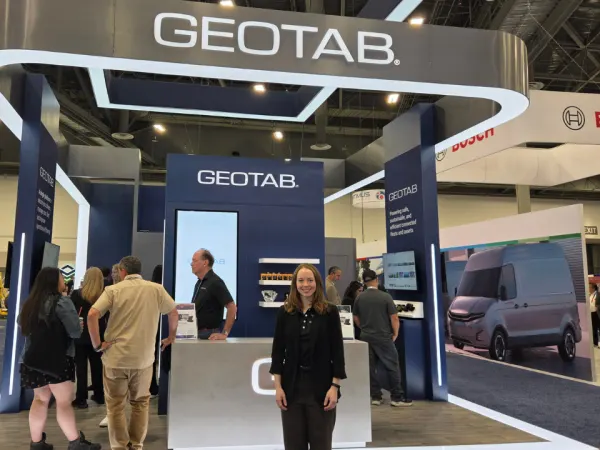
Geotab was at ACT Expo to showcase its next-generation telematics devices and the Go Focus camera system, which reports on vehicle data like engine diagnostics and fuel consumption. Charlotte Argue, senior manager, sustainable mobility (pictured), explained in the former, that they also wire in third-party sensors so you can access things like door openings and closings, and if the stop arm signals are on.
Amanda Huggett
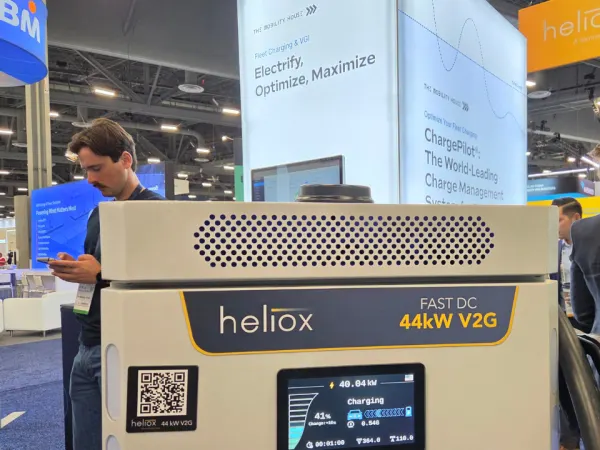
We're at a tipping point where V2G is moving from pilots into commercial deployments, said Sam Hill-Cristol, director of strategy, The Mobility House - North America, during the event's V2G ecosystem tour. At ACT Expo, the company showed off its Cascade EV Aggregator, which enables reliable and efficient charging of electric vehicles and cost optimization with vehicle-to-grid integration. At its booth, they partnered with Heliox, to showcase the company’s bidirectional DC fast‑charging technology.
Amanda Huggett
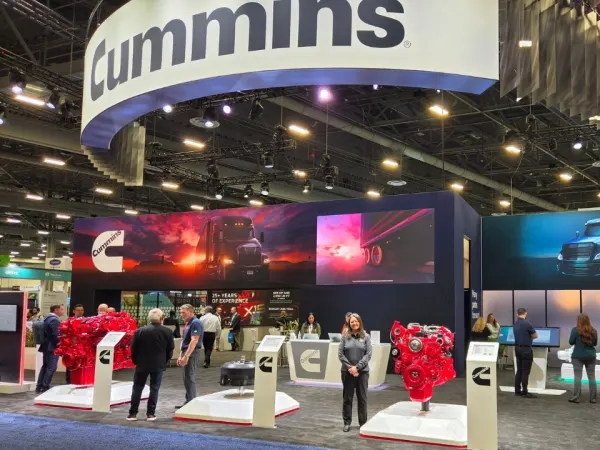
Cummins had a large presence at ACT Expo, showcasing its truck and bus engines. Andrea Lukas, director of product management at Cummins, shared that the 6.7 engine is sunsetting this year as they roll out the new B6.7 Octane. She’s excited to see it integrated with various bus OEMs; for the school bus market, she says notable features are its maintenance intervals, simple gasoline engine design, optional compression engine brake, and various horsepower ratings. “[Our customers] are really excited about it because they see this as the durability of the diesel with the simplicity of the gasoline,” she said.
Amanda Huggett
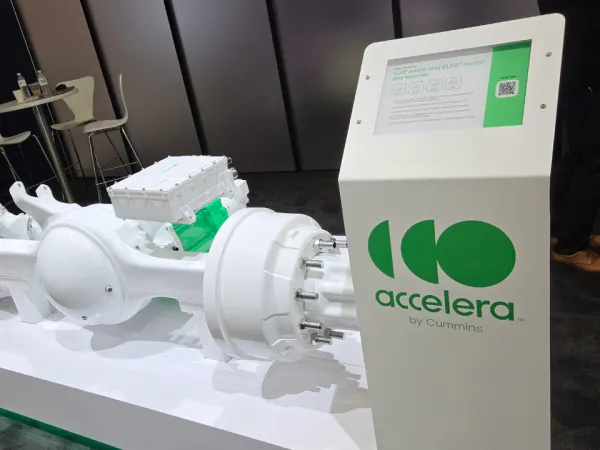
Accelera by Cummins was also at the show displaying its e-axle powertrain and its LFP batteries for electric buses.
Amanda Huggett
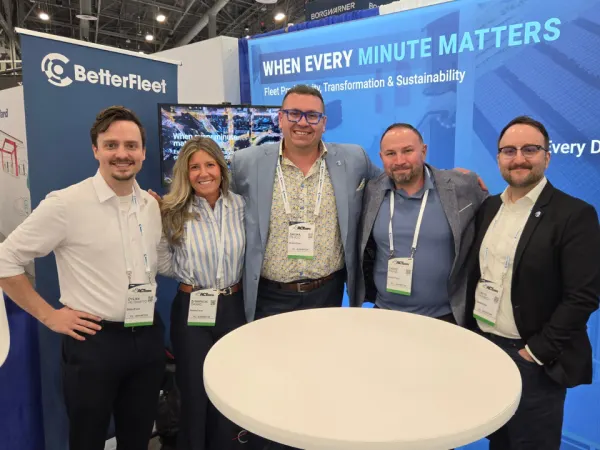
BetterFleet offers AI-powered EV charging software support for bus fleets. They recently worked with Dean Transportation in Michigan on planning for the EV bus deployment. Here, their team poses at their booth at ACT Expo. Sasha Pejcic, managing partner for North America (pictured center), says there's still strong interest in electrification. “There's a desire to do it,” he said. “The trend is looking at vehicle-to-grid and how that plays into this equation and whether it makes sense. And the utilities themselves being ready to receive that electricity. A lot of times there's a desire for V2G, but there's no G to accept the electricity. That's part of the equation that still needs to be solved.”
Amanda Huggett
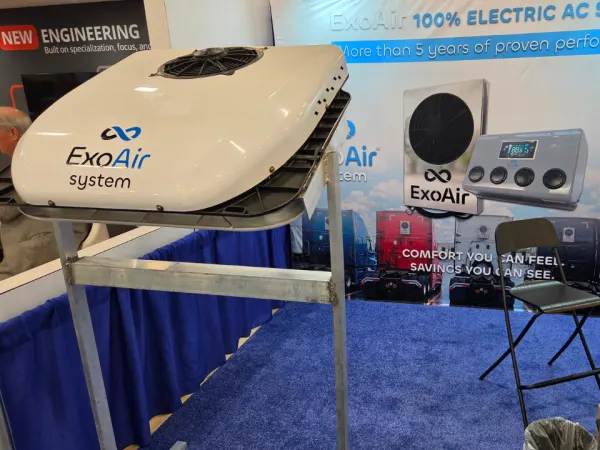
ExoAir System offers an electric-powered integrated AC unit for school buses. Its best features is the ability to run and cool the bus even when it’s not running, meaning no idling necessary! Jeff Weiss, national fleet sales manager, told us that it will run at 72 degrees in a bus for up to 10 hours, with a base price of $2,599 and a one-year warranty.
Amanda Huggett