Beyond the Dash: Safety Tech Helping Drivers See It All
From AI-driven monitoring to 360-degree cameras, automated braking, and smarter mirrors, the latest school bus technology redefines how buses protect students — and empower drivers.
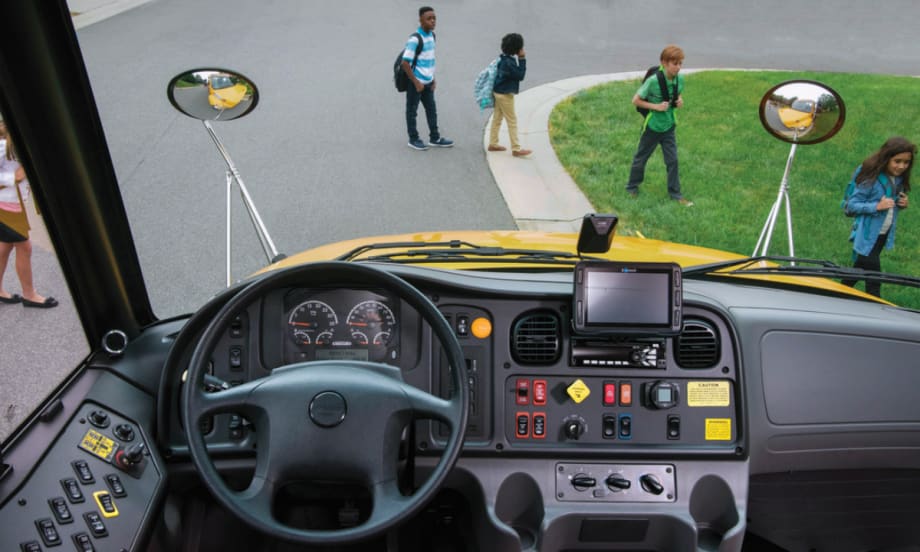
Advanced Driver Assistance Systems (ADAS) now bring features like automatic emergency braking, adaptive cruise control, and electronic stability control to student transportation.
Photo: Thomas Built Buses
9 min to read
For decades, school bus safety has relied on proven, low-tech tools like stop arms, flashing lights, and the watchful eye of a skilled driver. These fundamentals remain at the heart of student transportation. Now, the industry is navigating a new era where advanced technology can assist drivers in ways that seemed too far in the future to matter.
With millions of students riding buses daily through crowded streets, unpredictable traffic, and complex loading zones, the stakes couldn't be higher. The question isn't whether technology will change school bus safety — the industry is well past that — it's how it can best work alongside the people who keep students safe.
Ad Loading...
ADAS: The New Baseline for School Bus Safety
Stop arms and flashing lights may remain the most recognizable tools in school bus safety, but a quieter instrument works away beneath the surface. Advanced Driver Assistance Systems (ADAS) are bringing features once groundbreaking in luxury vehicles into student transportation through automatic emergency braking, adaptive cruise control, and electronic stability control (ESC).
These tools help school buses "think" on the move and are meant to detect threats, issue alerts, and take limited corrective actions to mitigate accidents. But how exactly do these systems work, and are they really moving the needle?
ADAS refers to active and passive suites of electronic technologies designed to assist the driver in avoiding collisions and improving vehicle control. Although this seems on the verge of autonomy, systems that work together this way aren't taking the wheel, just helping steer the outcomes. For example, an active system will apply the brakes, while a passive one pushes out audible and visual alerts to the driver.
Platforms like the Bendix® Fusion™ family of ADAS systems integrate forward-facing radar, camera, and the Bendix® ESP® Electronic Stability Program brake system to create a more responsive vehicle. According to Bendix, sensor fusion cross-checks from multiple sources like radar, camera, and brakes, to provide fewer false alerts than previous single-sensor systems.
According to National Safety Council data cited by Rosco Vision, ADAS has been linked to a 40% drop in large vehicle front-to-rear collisions. With pedestrian detection, like Thomas Built Buses' Saf-T-Zone Pedestrian Protection, overspeed alerts, and enhanced emergency braking now part of most packages, the potential for incident prevention is huge. However, experts stress that ADAS tech is only as effective as the human behind the wheel.
Ad Loading...
"Bendix emphasizes that advanced technologies complement safe driving practices," TJ Thomas, director of marketing and customer solutions at Bendix Commercial Vehicle Systems, said. "No commercial vehicle safety technology, including Bendix safety technologies, replaces a skilled, alert driver exercising safe driving techniques and proactive, comprehensive driving training. Responsibility for the safe operation of the vehicle remains with the driver at all times. Every driver should carefully review the operator's manual and be trained by the fleet or vehicle owner on the proper operation and limitations of the ADAS system during operation."
Ten years ago, Blue Bird introduced ESC to school buses, and in 2019, made it standard on all vehicles with air brakes, along with backup camera systems.
The technology itself has come a long way. The move from anti-lock braking systems to ESC in the early 2000s, as reported by Thomas, marked a foundational shift in how braking systems could intervene. Then, adding camera-based vision unlocked a new level of environmental awareness.
More and more features are rolling out across newer models, so the adoption curve remains steep. Yet, cost, training, and spec approvals still hinder many districts. There's a main insight for those already spec'ing buses with Bendix Fusion, Bendix® Intellipark® electronic parking brake system, or Rosco Vision’s Shield+ suite.
ADAS is no longer "nice to have." It's the future baseline for safety.
Ad Loading...
Thomas Built Buses’ Saf-T-Zone Pedestrian Protection, overspeed alerts, and enhanced emergency braking are now included in most packages — greatly increasing the potential for incident prevention.
Photo: IC Bus
Proactive Safety Starts with a Second Set of Eyes
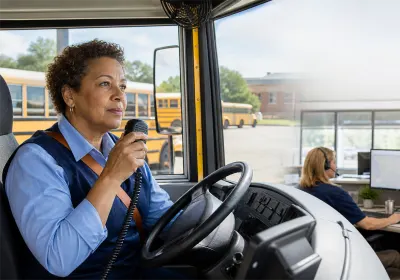
Inside the bus, in-cabin driver monitoring systems are quickly becoming a valuable safety item in modern school buses. Besides crash prevention, cameras can help cultivate better driving habits and accountability behind the wheel.
Using a combination of AI-driven cameras and telematics, some platforms can track driver fatigue, distraction, seatbelt use, smoking, mobile phone use, and sudden maneuvers like harsh braking or rapid acceleration. With this kind of information at the fingertips of school districts, the next steps move away from reactive discipline to proactive coaching.
Videos can highlight areas where drivers need reinforcement and be used as a teaching tool in initial and ongoing training sessions. As Meg Sweeney, project manager and accident investigator at the National Transportation Safety Board, emphasized, footage doesn't just support investigations — it supports prevention.
By pairing behavior monitoring with analytics dashboards, districts could identify trends, compare performance across drivers, and make data-driven decisions about training and route assignments. This could mean an informed safety culture rather than one driven by guesswork.
Adding to this evolution, 247Security has built on two decades of experience in video surveillance, resulting in a cloud-connected monitoring ecosystem. "From VHS tapes to the latest solid-state storage, there have been quantum leaps in technology that keep students safe," Robert Scott, senior vice president of strategy at 247Security, said.
Ad Loading...
Scott notes that its ShieldCam windshield unit and 360-degree interior cameras provide visual coverage for drivers and passengers. With another leap forward, users of 247Security's wireless video management system can remotely wake up the DVR, retrieve footage on demand, and view live feeds, which, combined with built-in GPS tracking, can allow districts and transportation departments to respond immediately.
Plus, 247Security uses strong encryption and privacy tools to protect video data while exploring integration with other applications. As districts face staffing challenges, driver monitoring systems are becoming essential for oversight and driver support.
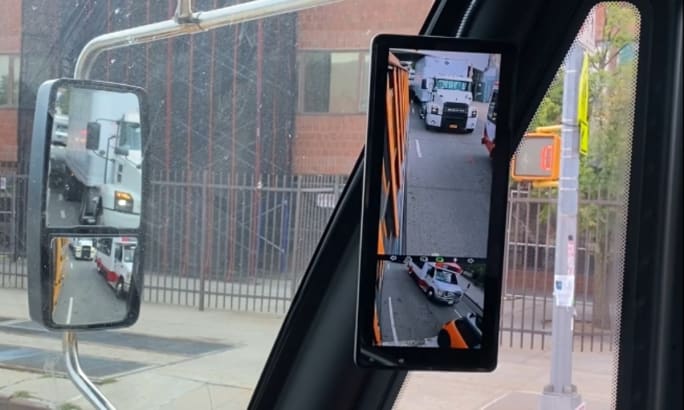
E-mirrors are replacing traditional glass with high-definition digital displays, giving drivers a clearer view in all lighting and weather conditions.
Photo: Rosco
How New Tech Is Eliminating School Bus Blind Spots
Visibility and safety don't stop at the dashboard. Outside of the bus, the stakes are often highest. The exterior of a school bus presents numerous blind spots that can be hazardous if left unaddressed. New mirror systems, camera arrays, and bus body design improvements give drivers a better view of their surroundings, especially during critical loading and unloading times.
Design Innovations That Boost School Bus Driver Visibility
Beyond mirrors and external cameras, structural improvements to bus design directly impact visibility. Newer bus models are introducing more and more features designed to give drivers a clearer view of the environment. For example, IC Bus includes:
A sloped hood to increase forward visibility by allowing drivers to see up to almost a foot closer to the front of the bus.
Single-pane glass entrance doors without central separators to provide enhanced side visibility.
LED headlights with automatic twilight sensors to aid in low-light situations.
A built-in door latch alert system to warn drivers via the dash cluster if the entrance door is not fully closed.
Down Lit Crossview Mirrors, used on IC Bus vehicles, can provide a ground-level visibility near the front of the bus while illuminating hard-to-see zones where students may cross or stand. In contrast, e-mirrors are gaining attention for replacing traditional reflective glass with high-definition digital displays. These electronic mirrors can offer a clearer field of vision regardless of lighting or weather conditions.
Smart radar systems with 4D detection are also helping a Florida district pilot its new collision avoidance and blind spot detection tech using radar sensors that scan for pedestrians near the bus.
Ad Loading...
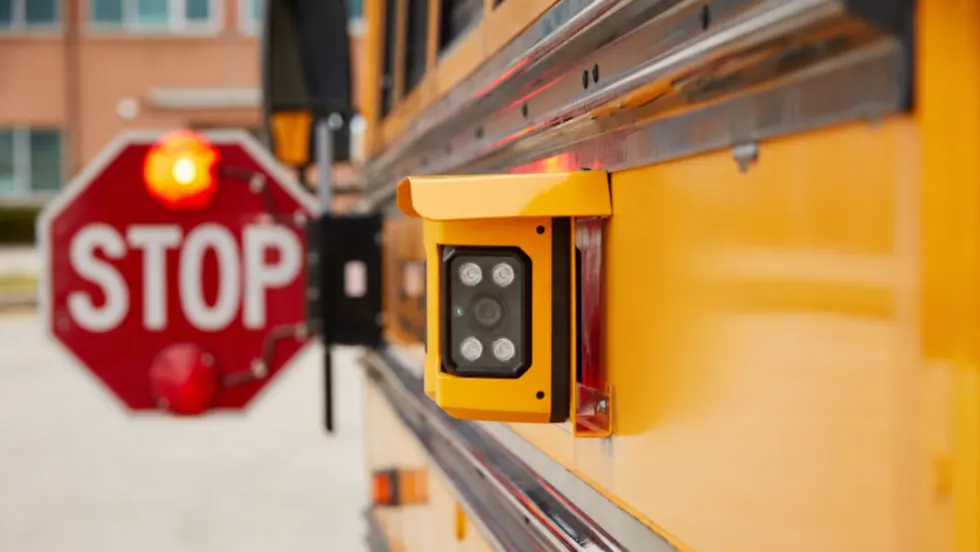
247Security's stop-arm cameras and customizable external 360-degree views help drivers monitor blind spots via dash-mounted screens. However, some 360 systems have their risks due to camera screen “stitching”. This innovation stitches screens together to create one seamless image, which can potentially cause its own blind spots. But, 270-degree views are also an option for extended maneuverability and situational awareness for drivers.
Collectively, these features aim to reduce pedestrian and cyclist accidents while supporting a driver's decision-making and navigation in congested areas. Plus, substitute or less familiar drivers could benefit, as these tools could remove some guesswork that goes into backing, turning, or approaching crowded zones.
When the Bus Won't Budge: New Tech That Keeps It Secure
As onboard systems grow smarter, even traditional functions like parking brakes are getting an upgrade. Electronic parking brake systems like Bendix Intellipark are now offered as standard on bus models like IC Bus' Next Generation CE Series.
These systems replace manual handbrakes with a software-controlled mechanism that automatically engages under certain conditions, like when the driver exits their seat without securing the brake.
Another tech advancement, Hill Hold, helps prevent vehicles from rolling backwards on inclines when transitioning between the brake and accelerator, which can be especially valuable for school buses operating in hilly terrain or stop-and-go routes where momentary rollbacks can lead to accidents.
Ad Loading...
What makes these features stand out isn't just the tech itself, but how seamlessly they integrate with existing safety systems. Plus, visual and audible alerts can be built directly into the dash cluster or speaker system, making it near impossible to overlook critical safety steps and reduce human error.
Ultimately, these safeguards are designed to ensure that if a driver is distracted, the bus isn't.
Future Safety Frontiers: What's Next
As much as safety technology has already evolved, the next wave of innovation is coming into view. Thomas notes advanced sensor systems, like LIDAR and ultrasonic detection, are being explored for school bus and commercial applications, particularly in pedestrian-heavy areas or for collision avoidance at low speeds.
"As good as commercial vehicle ADAS technologies are today, there is always room for improvement," Thomas said.
Most technologies are already common in passenger vehicles and autonomous shuttles, but they may soon be needed to navigate complex urban or school environments.
Ad Loading...
Other areas of potential are V2X (vehicle-to-everything) integration, which allows vehicles to communicate with infrastructure, other vehicles, and mobile devices, as well as cloud-based updates. For school buses, this could offer real-time responsiveness and continual improvement.
But innovation isn't without friction. Budget constraints, inconsistent state-level specifications, and lengthy approval processes are roadblocks to progress and adoption. Every new feature must be tested for integration, performance, and compliance.
"Items that have been available in the automotive world, sometimes for years, won't find their way into the bus industry until those technologies are tried and true," said Max Christensen, SBF editorial advisory board member and senior safety advocate at First Light Safety Products. "It's always been that way, and it's how it should be — you don't 'test' new tech on kids."
Still, there are clear opportunities for growth as districts become increasingly interested in student behavior monitoring, incident reporting, and fleet-level analytics. As AI becomes more embedded in these platforms, there's also a case for more predictive safety tools, too.
School buses equipped with LED headlights and automatic twilight sensors enhance visibility and safety in low-light conditions.
Photo: IC Bus
The Future Is Bright — If Drivers and Tech Evolve Together
Across the industry, manufacturers, regulators, and transportation leaders all agree on one thing. The path forward is about enhancing, not replacing, the role of the driver.
Ad Loading...
OEMs like IC Bus and Thomas Built Buses are paying more attention to customers' voices by introducing safety features based on real-world input and operational pain points. Whether it's illuminated stop arms, electronic braking, or visibility enhancements, these upgrades often stem from direct feedback from districts and contractors.
From a federal perspective, Sweeney emphasizes that NTSB recommendations like ADAS and driver monitoring aren't just for school buses, but a broader push across all vehicle types. However, the difference is that school buses, given their cargo, require the highest standard of validation before implementation.
Longtime transportation leaders, like Christensen, caution against overreliance on automation. "The most important piece of safety 'equipment' on a school bus is the driver," he said.
With new tech flooding the market, Christensen stresses the need for ongoing driver training and a commitment to basic skills.
"Technology can, and does, fail on occasion. When that happens, do school bus drivers know the basics of keeping kids safe on and around the bus?" Christensen said.
Ad Loading...
At the heart of it all, today's technology is not meant to replace drivers. It's meant to support them. Safety tools can offer real benefits, like earlier warning, sharper visibility, and automation that can prevent everyday mistakes, but to unlock the full potential of these systems, training must evolve alongside technology.
But the main takeaway? Advanced safety tech is quickly becoming the new baseline for school buses. Current tools can improve oversight and support drivers, while future innovations hold promise, but cost, regulations, and validation needs remain hurdles.
Is it time to strengthen your driver training? Here’s how to pick the right talent and improve recruitment, retention, and safety. This video is brought to you by IC Bus.
Four school bus crashes in Florida, Illinois, and Georgia highlight risks in transportation lots, at bus stops, and during student loading and unloading.
School bus fires are rare but can be devastating. Learn how advances in fire suppression and asset protection help fleets detect fires earlier, reduce damage, and improve safety.
Geotab Investigations combines telematics data, video, documents, and other evidence to help fleets reconstruct incidents, resolve claims, and determine what happened.
Sai Darshana Yekolu of Moseley Middle School in Prosper, Texas, was named the newest winner for her artwork, bringing the theme of “Safe Rides, Everyday Heroes” to life.
With diesel prices soaring and nearly one-third of transportation directors expecting budget cuts, maintaining student safety has never been more challenging. Download this guide to learn how leading districts are prioritizing risk, funding critical safety technology, and building stronger budget cases with data.
As thefts and overnight security threats continue, school transportation leaders are combining stronger operational practices with AI-enabled surveillance to better protect buses, facilities, and staff.
Steve Dowling is set to lead the federal agency's efforts to advance commercial motor vehicle safety and reduce crashes, fatalities, and injuries on the nation's roadways.