





Don't miss the list of the 20 largest school transportation providers, our companion article to this post! Read "The 20 Largest School Bus Contractors in 2026."
School Bus Contracting in 2026: Fleet, Fuel, and Workforce Trends
Shifting fuel strategies, evolving workforce pressures, rising costs, and growing technology adoption define today’s transportation providers. Here’s what the data reveals about key issues shaping the contractor industry.
May 28, 2026
Fewer contractors plan to buy new buses for the upcoming school year, but of those who do have purchase plans, alternative fuel usage is again on the rise as traditional diesel remains unchanged.
Credit:
Student Transportation of America/School Bus Fleet
3 min to read
School bus contractors are adjusting to a changing industry as new pressures arise and others begin to ease. This year’s survey of both small and large private operators shows caution blending with innovation and modernization.
Here’s a look at what trends contractors from across North America reported this year.
What Trends Stood Out from This Year’s Survey Responses?
- The largest contractors are generally getting larger, as mergers and acquisitions reduce competition.
- There was a large gap in average fleet size across respondents this year. A few mega-contractors dominate volume, while most remain small to mid-sized.
- The driver shortage continues to affect contractor fleets, though to a lesser extent than in previous years. Pay rebounded this year, crossing the $25/hour threshold.
- Diesel remains dominant, though its use is not growing. Instead, we’re seeing much more diversification. Gasoline and propane usage both saw sizeable jumps in 2026. Electric adoption is still on the rise, but not by much, likely due to changes in federal funding and regulations.
- New bus purchases are more uncertain compared to recent years, a likely result of fuel price volatility, general cost pressures, and policy uncertainty.
- More drivers are represented by a union, with driver memberships jumping from 17% two years ago to 29% last year and 35% this year.
- Technology adoption increased again, with over half of contractor fleets using parent apps, tablets, in-cab cameras, and predictive maintenance.
- Operational challenges saw a sharp shift this year, as insurance and staffing topped contractors’ concerns, and supply chain strain fell off. In short, we appear to be moving from disruption management to cost and risk management.
Note: All data was compiled from qualified survey respondents at private contracting companies, collected in February and March 2026. To see your voice represented in these results next year, watch for announcements about 2027 survey dates and share your insight to help us identify challenges, opportunities, and report on the state of school bus contracting.
2026 Survey Results
- Contractor Fleet Size in School Buses: Average: 4,476 | Median: 86
- School District Contracts: Average: 155 | Median: 7
- Students Transported Daily: Average: 322,545 | Median: 8,500
- Average Terminal Manager Salary (Annual):$72,952
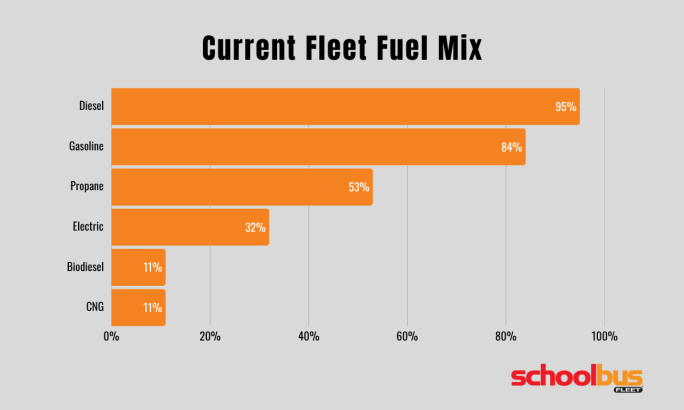
Alternative fuel use increased again this year, with propane and gasoline gaining popularity more than electric. Diesel use remains the same, suggesting that fleets are seeking greater fuel diversity.
Credit:
School Bus Fleet
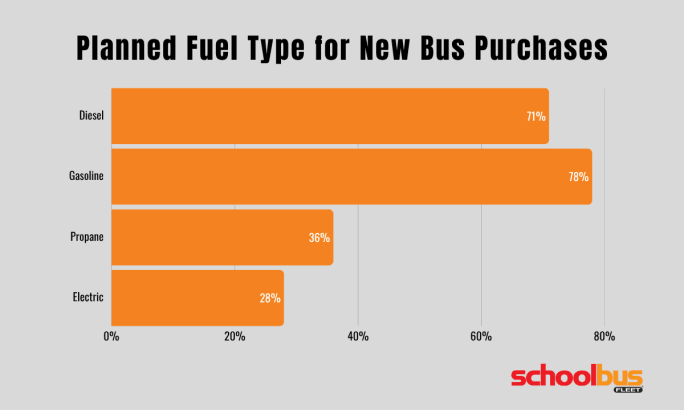
Of the 65% of contractors planning to buy new buses soon, diesel interest remains steady year over year. Electric saw slight growth, while propane continues to rise, up about 10 percentage points since 2024. The biggest shift is gasoline, which rebounded sharply after dropping last year (56% were interested in gasoline in 2024).
Credit:
School Bus Fleet
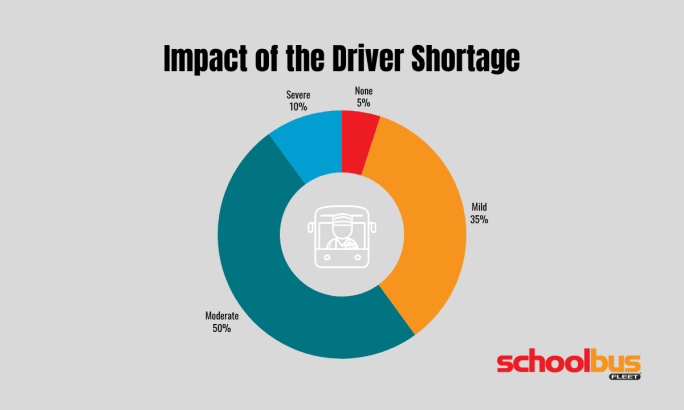
A trend reflected in our other surveys this year. Contractors also report that the driver shortage strain is easing. This year, no one reported desperate levels; severe reports dropped by half, and moderate shortages rose from 32% last year.
Credit:
School Bus Fleet
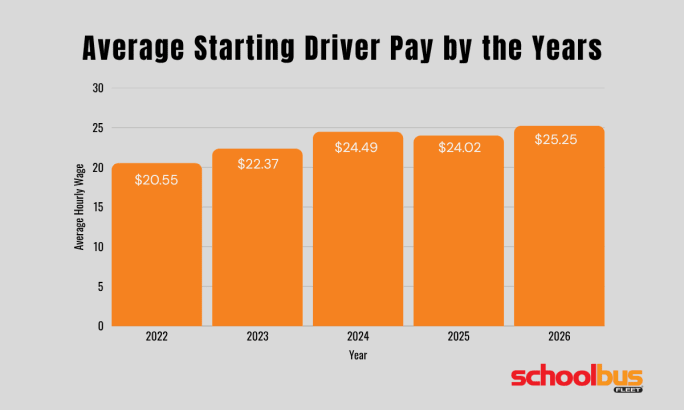
Pay for new drivers is back up after a dip in last year's results.
Credit:
School Bus Fleet
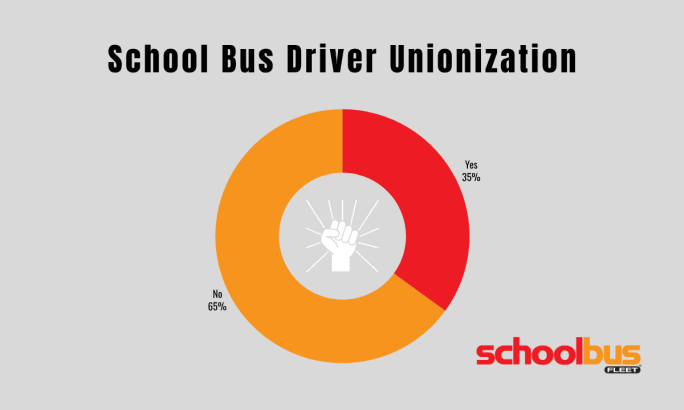
Union membership for school bus contractor drivers rises again this year, up from 29% last year and 17% the year before.
Credit:
School Bus Fleet
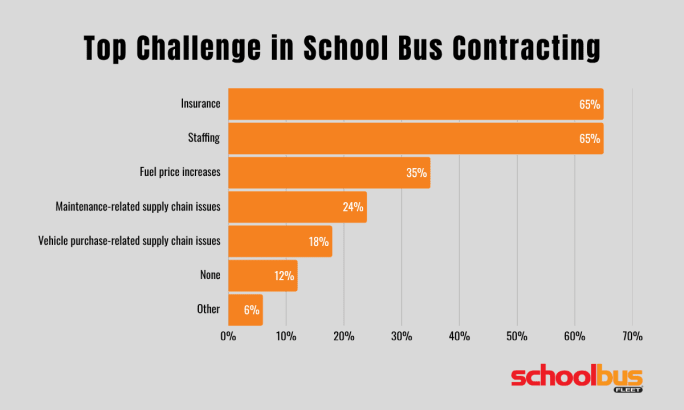
Supply chain issues dropped this year as the largest contracting headache. “Other” answers mentioned compliance with state mandates.
Credit:
School Bus Fleet
Technology in Contractor Fleets
- Parent communication increased again this year, with over half (60%) of contractors using parent communication technology, up from 50% last year and 39% the year before.
- Camera usage jumped this year, with 82% of contractors equipping all buses and 18% some buses with video surveillance. Last year, 69% of contractors had cameras installed across their entire fleet.
- Tablet adoption is increasing again as more contractors report using mobile data terminals on their buses (12% have mobile data terminals on all buses, 53% on some, and 35% on no buses). Last year, 50% said they didn’t use any, compared to 69% the year prior.
- 71% of respondents said all or some of their buses are equipped with predictive maintenance technology. Last year, 56% did.
Find the full results in the June/July 2026 issue of the magazine, coming soon!
Quick Answers
Transportation providers are shifting toward alternative fuels and more efficient technologies to reduce costs and environmental impact.
*Summarized by AI
Subscribe to Our Newsletter
More Management

Meet the 2025 School Bus Driver Hero Winner: Annette Brown
We caught up with Wa-Nee Community Schools' Annette Brown on site at SBFX, where she was named the 2026 School Bus Driver Hero Award winner. Hear about her reaction, what she loves most about being a school bus driver, and more!
Read More →
Predictability Is Like Ketchup (According to 6-Year-Olds)
To students, a different school bus can feel like a full-blown crisis. One driver reflects on why familiar routines, showing up on time, and being reliably boring matter more than we think.
Read More →
Samsara Launches Free Driver Rewards Program
The new Driver Perks program gives eligible professional drivers access to discounts and offers without adding a cost for participating fleets.
Read More →

How Tax-Exempt Municipal Leases Can Help Finance School Buses
Let’s explore school bus financing options, including municipal leases, vendor payable accounts, and balloon payments, and how they can help stretch fleet budgets.
Read More →
Nominate Rising School Transportation Pros Under 40!
We’re searching for the next generation of leaders making an impact across the K-12 student transportation industry to recognize as SBF’s 2027 Trailblazers. Nominations are open now!
Read More →
Changing Lanes: BusWhere, EverDriven, InterMotive, Summit School Services, Switzer-Carty & Thomas Built Buses
Check out who's been hired, promoted, and appointed to leadership positions at various school transportation suppliers, contractors, and manufacturers.
Read More →
The Most Expensive Thing You Do Before Selling a School Bus: Wait
When should you sell an aging school bus? Learn how maintenance, mileage, corrosion, specifications, and timing can affect resale value long before the auction.
Read More →
American Student Transportation Partners Acquires AJ Myers and Sons
A new deal brings a 75-year Pennsylvania student transportation provider into one of the nation’s largest private school bus contracting groups.
Read More →
What I Brought Home From SBFX: Relationships, Leadership, and Preparing What's Next
Who could lead your transportation operation tomorrow if you couldn't? Bernando Brown explores succession planning, mentorship, and preparing emerging leaders to step up.
Read More →
Inside School Bus Fleet ConneX 2026: Industry Leaders Connect in Scottsdale [Photos]
See highlights from SBFX 2026 in Arizona, where school bus operators and suppliers gathered for meetings, education, networking, awards, and more.
Read More →