





Last Year's Results: Driver Shortage Lessens Over Last Year: Top School Bus Contractors in 2024
The State of School Bus Contracting [2025 Survey Results]
Who are the largest contractors in North America? What fuels make up their fleet, what is the average pay, and contractors’ plans and top challenges? Find out in this annual report.
April 21, 2025
![The State of School Bus Contracting [2025 Survey Results]](https://assets.bobitstudios.com/image/upload/f_auto,q_auto,dpr_auto,c_limit,w_920/2025-contractor-survey-results_1768068987428_ytxnps.png)
A few trends from this year's survey respondents: the driver shortage is still in play, though by less extreme than before. More drivers are unionized, new bus purchase plans are complicated, and technology adoption has increased.
Photo: SBF/Canva
4 min to read
- The report identifies the largest private school bus contractors across North America and examines the composition of their fleets, including the types of fuels used.
- It provides insights into the average pay within the contracting industry, highlighting compensation trends and benchmarks.
- The survey explores contractors' strategic plans, identifying their primary challenges and future objectives within the school bus sector.
*Summarized by AI
School bus contractors have dynamic jobs made even more challenging with recent market trends. Of course they deal with some of the same challenges school districts do — routing, student behavior, budgets, staffing shortages, and more — but they also have some unique dynamics.
Tim Flood, EVP of The Trans Group, shared with SBF that he’s juggling route reductions with rising costs for both drivers and buses (including a 40% increase in price for a new large bus!), prompting the need to evaluate budgets and contracts to make it all work. Amid all that, he’s waiting to see how the impact of the new tariffs further changes things.
Balancing general operations with state-specific requirements can be a challenge. In New York, Flood mentions that eight electric buses must be sold before one ICE, which makes new bus purchasing tricky. In his case, the power company cannot accommodate the charging needs to support an electric bus fleet in two of their yards.
Shae Harkleroad, president of Raystown Transit in Pennsylvania, cites accommodating demand for spring sports trips, increased student behavior issues, and van usage as other new trends.
School Bus Contracting Trends in 2025
- This year, the driver shortage continued to affect fleets, though by less extremes than previous years.
- While we know that some companies have increased pay to combat the shortage, of survey respondents this year, pay hovered around the same rate, actually slightly less than last year.
- More drivers are represented by a union, jumping from 17% to 29%.
- Fewer contractor fleets plan to buy new buses next year, and more are unsure of their purchase plans. Likely an effect of inflation, uncertainty around new tariffs, and federal funding question marks.
- Of those who do plan to purchase new buses, interest went down slightly for diesel, gasoline, and propane, but increased for electric and CNG.
- Most technology adoption increased, with more fleets using parent apps, mobile data terminals, and predictive maintenance. Interestingly, fewer respondents this year marked the use of video surveillance.
- Some respondents noted that insurance rates have jumped dramatically over the last few years, inflation is a major concern, and the student transportation landscape is evolving quickly with new tactics needed to accommodate emotionally disturbed students on buses and vans.
All data presented was compiled from qualified survey respondents, which included about 35 private contracting companies, collected in February and March 2025. To see your voice represented in these results next year, watch for announcements about 2026 survey dates and share your insight to help us identify challenges, opportunities, and report on the state of school bus contracting.
15 Largest School Bus Contractors
Rank | Company | Fleet 2025 | Fleet 2024 | Loss/Gain | District Contracts | Students Transported |
|---|---|---|---|---|---|---|
1 | First Student (Cincinnati) | 45,000 | 45,000 | No Change | 1,400 | 2,250,000 |
2 | National Express (Lisle, Ill.) | 20,000 | 20,000 | No Change | 400 | 1,200,000* |
3 | Student Transportation of America (Wall, N.J.) | 18,000 | 16,000* | +2,000* | 325+ | 1,500,000 |
4 | Beacon Mobility (North Reading, Mass.) | 12,000 | 7,000* | N/A | 1,000 | 300,000 |
5 | North America Central School Bus (Chicago) | 5,950 | 5,920 | +30 | 100 | 400,000 |
6 | Landmark Student Transportation (Aurora, Ontario) | 5,291 | - | - | 188* | 254,000* |
7 | Logan Bus Company (Ozone Park, N.Y.) | 2,790 | - | - | 21 | 57,000 |
8 | Krapf School Bus (West Chester, Penn.) | 2,400* | - | - | 45* | 110,000* |
9 | Cook-Illinois Corp. | 1,800* | - | - | - | 100,000* |
10 | Dean Transportation (Lansing, Mich.) | 1,577 | 1,800 | -223 | 60 | 60,000 |
11 | The Trans Group (Spring Valley, N.Y.) | 1,335 | 1,420 | -85 | 18 | 70,000 |
12 | Dattco, Inc. (New Britain, Conn.) | 865 | 790 | +75 | 30 | 52,000 |
13 | Suffolk Transportation Service (Bay Shore, N.Y.) | 707 | - | - | 22 | 60,000+ |
14 | Palmer Bus Service (Mankato, Minn.) | 600 | - | - | 28 | 40,000 |
15 | 4Seasons Transportation (Calgary, Alberta) | 600 | - | - | 5 | 6,000 |
* Latest data available.
First Student remains the largest contractor in North America, followed by National Express and STA. (Note: This list represents those who either responded to our survey or submitted data in previous years.)
Contractor Bus Fleet Size
- Average: 2,551
- Median: 93
Number of School District Contracts
- Average: 72
- Median: 6
Number of Students Transported Daily
- Average: 158,106
- Median: 500
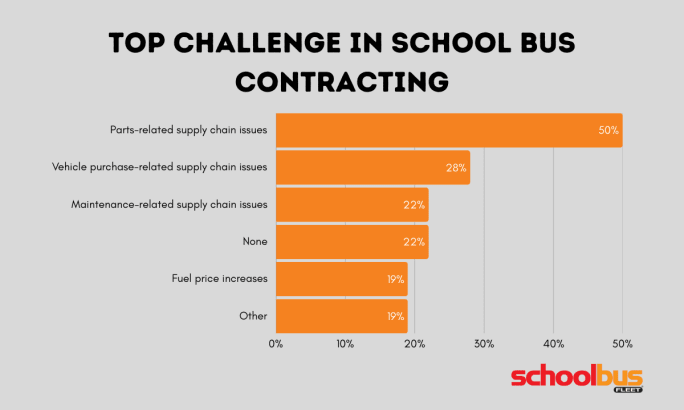
Supply chain issues topped the list of impacts felt by contractors. “Other” responses included insurance, staffing, state legislation, and new bus prices.
Source: SBF
Average Annual Salary for Terminal Managers
$74,916
Average Starting Driver Pay (Hourly)
$24.02
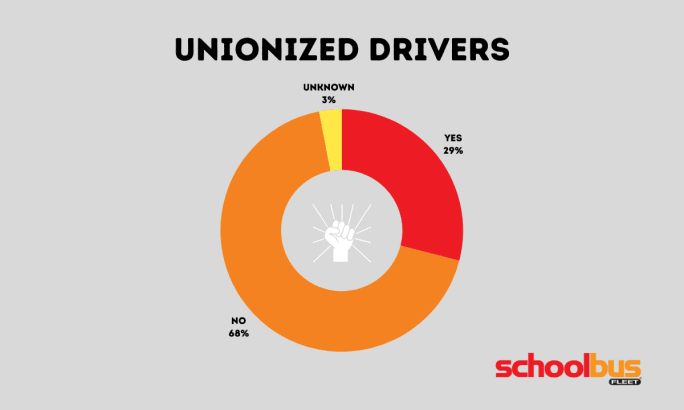
Last year's survey showed that just 17% of contracted drivers were represented by a union.
Source: SBF
Buying New Buses?
Most contractors (69%) plan on buying new school buses for the 2025-26 school year, though less than last year (75%).
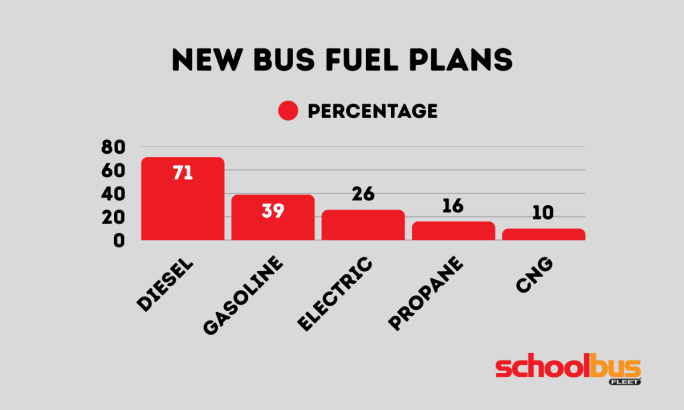
Fewer respondents than last year (71% compared to 81%) said they are purchasing new diesel buses. Gas and propane both slightly declined in interest, while electric grew.
Source: SBF
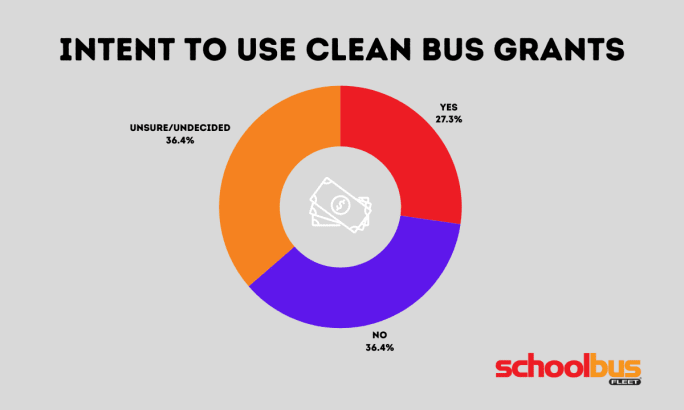
Contractors are split on whether they plan to use federal, state, or local grants to fund future clean school bus and charging infrastructure purchases. Last year, half said they had no interest in clean school bus technologies, and 36% were considering electric purchases through the EPA program.
Source: SBF
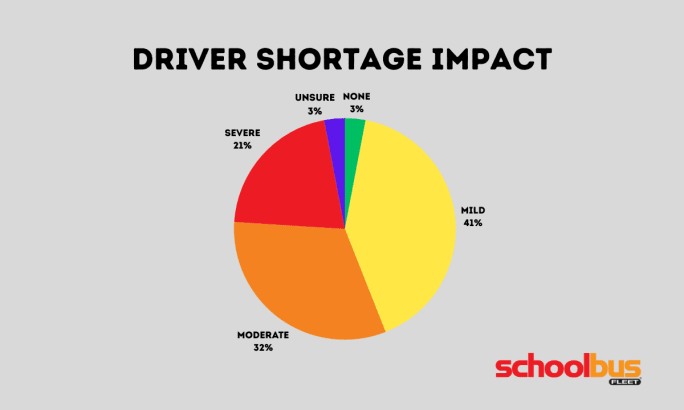
Most respondents (73%) reported mild to moderate levels of driver shortage, about the same as last year. More reported a severe shortage, but none said they were desperate.
Source: SBF
Technology in Contractor Fleets
- Parent communication increased this year, with half of contractors using the tech compared to just 39% last year.
- Many contractor buses are equipped with video surveillance: 69% said all their buses are and 22% said some are.
- Tablet adoption is increasing as more contractors report using mobile data terminals on their buses. Last year, 69% said they didn’t use any.
- 56% of respondents said all or some of their buses are equipped with predictive maintenance. Last year, just 6% reported all buses having this.
Find the full results in the June/July 2025 issue of the magazine!
Subscribe to Our Newsletter
More Management

How to Build a Better Driver Training Program
Ready to boost up your school bus instructor training? Here’s how to pick the right talent and improve recruitment, retention, and safety.
Read More →
CALSTART and Forth Combine to Form Catalyst Mobility
The new name represents a renewed vision for the nonprofit focused on advancing clean, equitable, and affordable transportation solutions that move people and goods.
Read More →
What Makes a Great School Bus Driver Trainer?
Choosing the right school bus driver trainer takes more than experience. Learn six keys to selecting and developing trainers and evaluating program effectiveness.
Read More →


School Bus Contractors Expand Through New Deals, Acquisitions & Partnerships
STA's Canadian division acquires Ontario-based G&L Stevenson Transport while Durham School Services adds a new district contract in California, First Student adds a New Jersey contract, and Minnesota Coaches acquires Halo Transportation.
Read More →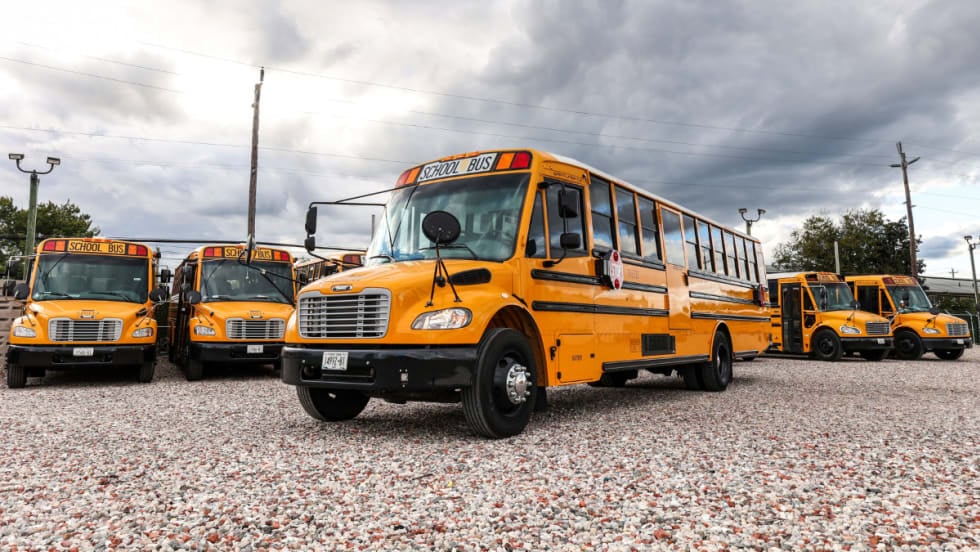
Logan Bus Company Rolls Out AI Phone System for NYC School Bus Families
A summer pilot found that AI agents could handle most routine calls, freeing up time for customer service staff to focus on emergencies and complex family concerns.
Read More →
From Intent to Impact: What I Learned About Leadership from TAPT
A Texas transportation supervisor shares lessons on self-awareness, accountability, managing stress and building trust — and why investing in leadership development matters at every stage of your career.
Read More →
NAPT Names 2026 Award Recipients, Hall of Fame Inductee
Who earned national recognition for their work in student transportation? This year, NAPT named five recipients of its 2026 awards for service, safety, and leadership, plus its newest Hall of Famer.
Read More →
Sponsored•September 2, 2026
2026 State of Student Transportation Report
Driver shortages. Rising costs. Growing safety expectations. More data, but not enough time to act on it. The 2026 State of Student Transportation Report reveals what transportation leaders say is putting the most pressure on their operations—and where they’re investing next. See how your priorities compare.
Read More →
How to De-Escalate an Angry Person: 5 Steps for Handling Workplace Conflict
What makes emotions run high, and how should you handle an angry colleague or parent? Follow these steps for staying calm, listening, showing empathy, and resolving conflict.
Read More →
Sponsored•September 1, 2026
What Readiness Looks Like This School Year
Learn about the challenges shaping the 2026–2027 school year, from persistent driver shortages and budget pressure to technology and readiness gaps. See how school districts are responding and adapting in Zonar’s 2026 Back-to-School Readiness Report.
Read More →