





Did You See This? The Secret Life of an Electric School Bus Battery
Why Gasoline School Buses Are Making a Comeback
Gasoline is gaining ground in full-size school buses. See how today’s options stack up against diesel on cost, maintenance, emissions, performance, and more.
October 2, 2026
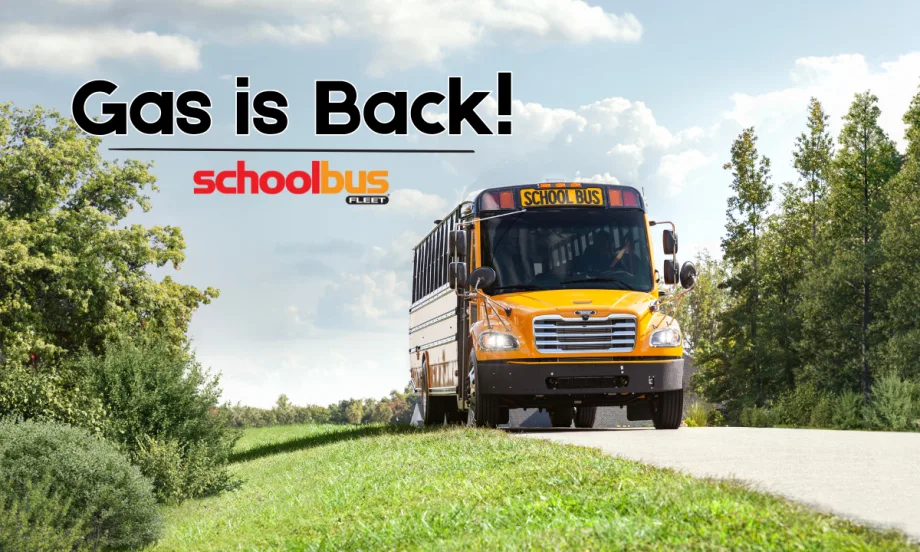
Thomas Built Buses is proud to now offer a Type C in three powertrain options: diesel, electric, and now its first gasoline.
Credit:
Thomas Built Buses/School Bus Fleet
13 min to read
- Gasoline-powered school buses are becoming more popular due to their competitive costs compared to traditional diesel options.
- Reduced maintenance requirements and improved emissions standards make gasoline buses an attractive choice for school districts.
- Gasoline buses offer comparable performance to diesel buses, contributing to their increasing adoption in the school transportation sector.
*Summarized by AI
For decades, diesel has been by far the dominant fuel of choice for large school buses. But those who’ve been around for awhile might remember that they once were powered by gasoline.
The shift to diesel happened around the 1970s and ‘80s. By 1987, some manufacturers shifted to only offering diesel-powered Type Cs. Then, more modern alternative fuels like propane and CNG became options, and gasoline was back in the mix — but not by much.
Blue Bird’s Vision gasoline school bus became available in 2016, and IC Bus said it had a strong showing of orders for its new gasoline CE Series Type C then too. At the time, our staff predicted that gasoline sales for large buses would soon increase.
Turns out, we were right.
Why Gasoline School Buses Are Gaining Ground
Several factors suggest gasoline could be entering a new phase of growth, largely thanks to Cummins’ new B6.7 Octane engine, announced in 2025 and entered into production this year.
But a few other factors are influencing the shift:
- Model year 2027 heavy-duty emissions requirements, including tighter nitrogen oxides (NOx) standards
- The EPA’s Clean School Bus Program shifting focus from exclusively electric buses
- A shortage of diesel mechanics and gasoline’s simplified maintenance needs
- Operators’ frustrations with servicing diesel aftertreatment systems
- Operators’ need to reduce their emissions without the high entry point and infrastructure needs of electric; gasoline is widely available and accessible
- Gasoline’s strong cold-weather performance without the need for block heaters
- More operators seeking diversification, with multiple fuel and powertrain types represented across the fleet
“For a lot of districts, it’s a pragmatic bridge rather than a compromise,” a Thomas Built Buses representative said.
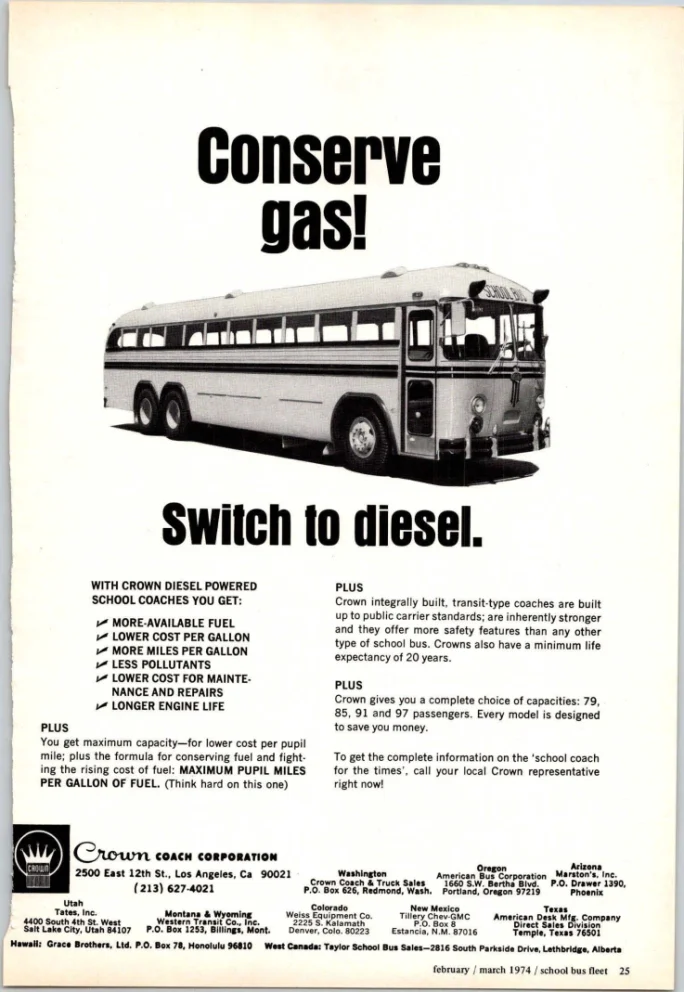
An actual ad from School Bus Fleet’s February 1974 issue.
Credit:
School Bus Fleet
In 2017, School Bus Fleet’s research showed that gasoline accounted for 5% of large school bus sales. And according to our 2026 maintenance survey, gasoline adoption jumped 42% year over year.
Contractors this year also reported that diesel use has not increased (nor has it decreased), though gasoline purchase intent increased significantly from 56% to 78% (which includes Type As).
“To be clear, gasoline isn’t replacing diesel or electric,” Matt Milewski, segment marketing director at IC Bus, said. “By offering all three powertrain options, we are able to help customers find the right solution that balances cost, serviceability, driver acceptance, infrastructure requirements, and long-term fleet strategy.”
In short, what started as a niche option is now fully supported by all three major school bus manufacturers.
A Growing Lineup of Full-Size Gasoline Buses
IC Bus
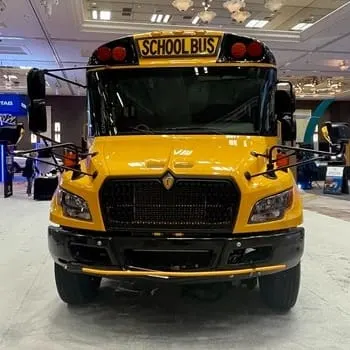
IC’s CE Series bus offered its first gasoline engine option in 2016 and is now pivoting from PSI to the new Cummins engine.
Credit:
IC Bus
IC Bus’ first gasoline bus in 2016 was powered by PSI’s 8.8L V8 engine. It’s now shifting to the Cummins Octane engine as part of its next-gen CE Series strategy, which shares its chassis architecture with the International MV Series platform. Its low-end torque and overall performance make it particularly well suited to the demands of its customers, the company said.
With its partnership with Cummins and Allison Transmission, IC Bus believes it has delivered a powertrain that delivers on the performance and durability customers demand, for a product they’re truly proud of.
Blue Bird
Blue Bird has had almost a decade to flesh out its gasoline offering. In 2016, its first Vision gas bus was built with a Ford 6.8L V10 engine and ROUSH CleanTech powertrain system. Two years later, it had sold 2,500 gas buses to more than 800 school districts. By 2019, it delivered its 5,000thgas bus, with vehicles running in 1,000 districts.
In 2021, the OEM upgraded to an exclusive and narrower Ford 7.3L V8 engine that allowed more room for service work and incorporated new wiring and fuel line routing.
At the time, then-president and CEO Phil Horlock said that customers were excited about the compact, more powerful, and easier-to-maintain engine with better fuel economy.
Current Vision gasoline buses feature fuel tanks mounted between the frame rails and an in-tank fuel pump. They are Colorado Rack Test- and Kentucky Pole Test-certified. Cold-weather startup is listed as reliable to -20°F.
Thomas Built Buses
Thomas Built Buses, which had only offered its Type A bus in gasoline until now, announced its entry into the full-size gasoline market with its Saf-T-Liner C2. Production is expected to start Q1 2027.
The OEM says the bus was built around the Octane engine to give school districts another powertrain option while still delivering the durability and torque that operators expect.
“With the Cummins B6.7 Octane engine, fleets gain a dependable solution that complements our proven diesel and electric offerings, giving them more choice in how they operate,” T.J. Reed, president and CEO of Daimler Truck Specialty Vehicles, said when the bus debuted. “We’re proud to expand our lineup with solutions that reflect the real-world needs of school districts — whether that’s simplifying maintenance, managing costs, or planning for the future with diesel, electric, or now gasoline.”
Why now? “We introduced gasoline because school districts told us they wanted more options,” a company representative said. “Many districts aren’t ready for full electrification — whether because of infrastructure, climate, route demands, or budget — but they’re also looking for alternatives to diesel that simplify their operations. For us, it was about bringing the right solution to market and meeting districts where they actually are today.”
Under the Hood: Comparing Today’s Gasoline Engines
In addition to Cummins and Ford, Detroit and GM once made gasoline engines for full-size school buses but have since shifted focus to clean diesel and small buses, respectively.
Among the three major Type C school bus manufacturers, today’s gasoline offerings rely on two engine platforms: Ford’s 7.3L V8 in the Blue Bird Vision, and Cummins’ B6.7 Octane in the IC Bus CE Series and Thomas Built Saf-T-Liner C2.
Cummins B6.7 Octane
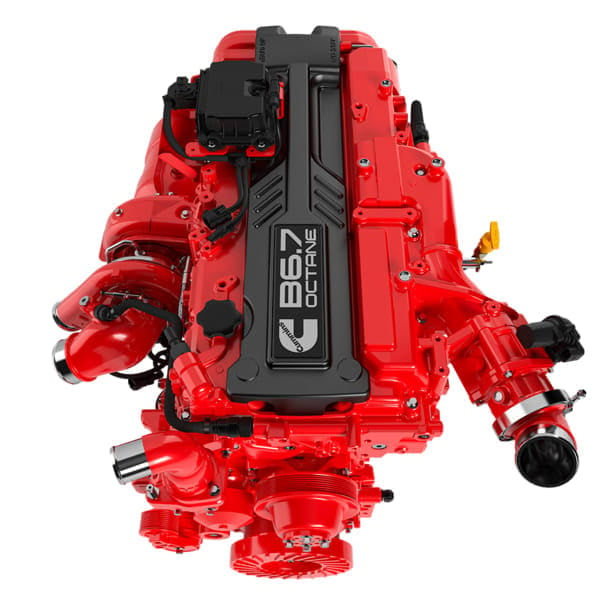
The new Octane B6.7 engine from Cummins is available for 2027-MY vehicles from both Thomas Built Buses and IC Bus.
Credit:
Cummins Inc.
Cummins’ Octane runs on 87-octane gasoline and offers between 200 and 300 hp and 600 to 660 lb.-ft. of torque, with up to 10% better fuel economy based on the application and duty cycle over other gasoline-powered engines, according to the company. It is EPA 2027 certified and meets CARB’s NOx requirements.
The engine features a broad, flat torque curve that mirrors Cummins’ trusted B6.7 diesel platform, with service intervals up to 15,000 miles, an optional integrated compression brake, and diesel-like performance.
“The B6.7 Octane has been designed to be the most robust gasoline engine in the medium-duty space, as it has been developed using the same principles Cummins uses today in developing our diesel products,” said Nicole Wheeldon, Cummins’ general manager, North America bus sales. “Same test, same warranty, same engine life, all while delivering familiar drivability. It truly does offer the durability of a diesel, with the convenience of gas.”
Wheeldon says the school bus market was a key consideration during the engine’s development. “Its design incorporates the durability, power, and duty cycle requirements, ensuring reliable performance for this application,” she said.
According to IC Bus, there is often a misconception that a gasoline bus requires significant compromise on performance and durability relative to diesel. “Our experience shows that isn’t necessarily the case,” Milewski said. “We’ve put our gasoline-powered bus through demanding testing and seen it confidently climb 20% and 30% inclines at the International Proving Grounds in New Carlisle, Indiana.”
Ford 7.3L V8
Nicknamed the “Godzilla,” Ford’s school bus engine is exclusive to Blue Bird. Launched in 2020, it delivers 350 hp and features a 6R140 6-speed automatic transmission with a standard 60-gallon tank and optional 100-gallon tank.
Blue Bird says it offers a smooth, quiet operation with no loud regeneration cycles, and will meet 2027 compliance standards.
How Do Gasoline Bus Emissions Compare?
Gasoline’s appeal isn’t that it necessarily produces fewer emissions than today’s diesel. It’s more that every gasoline bus — regardless of manufacturer — eliminates the need for diesel-specific aftertreatment components and processes, including diesel exhaust fluid (DEF), diesel particulate filters, and regeneration.
Gasoline is still a fossil fuel and produces tailpipe emissions, including greenhouse gases (GHG). But more stringent emissions standards have dramatically reduced NOx and particulate emissions from newer diesel engines.
Of note: EPA has rescinded its previous GHG standards for highway vehicles, but the 2027 criteria-pollutant rule remains in place. It sets a 35 mg/hp-hr NOx standard for applicable heavy-duty engines — an 82.5% reduction from the previous 200 mg/hp-hr diesel standard.
While both new diesel and gasoline are set to meet that, individual engines can certify below the federal NOx threshold. For comparison, Blue Bird lists its propane Vision at 20 mg/bhp-hr, while battery-electric buses produce no tailpipe emissions.
For operators weighing environmental impact, a best practice is to compare engine-specific emissions certifications and fuel consumption rather than assuming gasoline is lower-emission across every category.
Purchase Price Is Only Part of the Cost Equation
No fuel is perfect cost-wise, and diesel and gasoline have both seen recent price fluctuations. That volatility can be tricky to navigate without a long-term bulk contract.
Diesel can carry higher maintenance costs than gasoline because of its more complex emissions aftertreatment system. Those savings can help gasoline offset some of diesel’s fuel-economy advantage over the life of the bus.
Electric buses have the lowest operating cost per mile, but higher upfront costs might mean a longer ownership window or need for incentives.
Gasoline buses can offer a relatively low upfront cost and less maintenance complexity than diesel, without the charging infrastructure required for electric buses.
Blue Bird boasts that its Vision gasoline bus has the lowest acquisition cost among all its fuel types.
For Frederick County Public Schools, which received Blue Bird’s 2,500th gas-powered bus, Transportation Director John Grubbs said the district was looking for alternative fuels when diesel required an exhaust additive, adding to cost. “Gasoline is cheaper to purchase at the initial purchase price, and it’s cheaper to maintain,” he said.
When Pocatello/Chubbuck School District 25 in Idaho solicited bids for five conventional buses earlier this year, one dealer quoted about $15,500 more per bus than its diesel bid, while another dealer’s gasoline option was about $3,100 less per bus. A third dealer didn’t bid gasoline at all. The district ultimately went with the lower diesel bid.
Fuel economy remains one of diesel’s advantages. IC Bus says its diesel bus can deliver up to 25% better fuel economy than gasoline, even as the new B6.7 Octane promises up to 10% better fuel economy than competing gasoline engines.
IC Bus expects gasoline to offer a compelling total cost of ownership (TCO), with acquisition costs competitive with diesel. “Fuel economy will vary by application, so the real opportunity is looking at the complete cost of ownership rather than purchase price alone,” Milewski said.
What Operators Are Seeing in the Real World
When Georgia’s Cobb County School District added its first gasoline buses in 2016, drivers said they liked the buses’ quick acceleration, lack of cold starts, and quiet operation. “We saw long-term savings and better cost of ownership based on the savings to purchase [gasoline buses] and the annual upkeep costs versus a diesel engine,” said then-Executive Director of Transportation Rick Grisham.
The department saw immediate savings of about 5% after adding the buses to its fleet. Now, 10 years later, Associate Director of Fleet Maintenance Michael Warner says they’re showing cost per mile about 55% lower on gasoline buses than diesel. He reported that their Blue Birds average 5.75 mpg. “Although mpg is lower, the cost to operate is lower due to fuel cost and maintenance cost,” he said. “The Blue Bird gasoline engines have performed very well, and we believe gasoline is still the best option for an alternative fuel to diesel. The cost of ownership, reliability of the engine, and ability to keep the bus on the road has been proven over the past 10 years.”
Cobb County plans to order 30 new Cummins Octane-engine buses. “We have completed considerable research on the newly released engine and feel it will be a good fit for our operations,” Warner said.
One of the largest contractors, Beacon Mobility, runs buses of all fuel types. Five years ago, CEO Judith Crawford said they would not have considered gasoline for its Type Cs. “The engines weren’t proven at scale, and diesel still had a clear advantage in durability and operating costs,” she said. “Today, the technology has matured, diesel has become more complex and expensive to maintain, and it is more difficult to find qualified diesel mechanics.”
Those newer engines narrowed gaps in torque and efficiency while eliminating the added cost and complexity of today’s diesel aftertreatment systems. And, it’s a boon to have reduced maintenance complexity and downtime.
For Beacon, the question mark remains around long-term durability, resale value, fuel economy, and TCO since the Octane is just coming to market. “We also want confidence that OEMs and dealers will fully support the product over its life,” she said.
While Beacon doesn’t intend to shift to gasoline as its primary fuel, Crawford says it fills a niche with clear advantages over diesel rather than replacing diesel entirely. This includes certain duty cycles that rely less on diesel’s higher torque, such as flat terrain, cold-weather locations, and districts intent on cutting diesel emissions. “Over time, its role will depend on real-world performance and customer acceptance,” she said.
PJ Adam, co-owner of Pennsylvania-based Adam Transportation, runs all fuel types and was excited to add gasoline back for its Type Cs years ago. Now, he plans to make gasoline buses the fleet’s primary fuel moving forward.
“We consistently have problems with DEF systems throughout our fleet, where our gasoline and propane buses just keep going,” he said.
Adams’ one concern? “The longevity of the engine, but that being said, newer diesels don’t seem to last as long as our pre-emissions ones, so it’s become a back-of-our-mind concern,” he said.
As for range, Adams said their gas buses outperform their propane buses on fuel mileage, but gasoline and diesel buses on similar routes have been comparable in range.
Joe Baca, transportation/maintenance director at Savoy ISD, said his gas bus runs well, but does not have the power or the range of a diesel bus of the same size. “We have purchased other buses since 2023, and my recommendation is and always will be diesel,” he said. “Coming out of the agriculture industry, there is a good reason why gasoline and propane tractors are virtually nonexistent. From experience, a tractor run on gasoline or propane had to be filled up at lunchtime. A tractor running on diesel was filled up once a day, in the morning, and ran all day using the same-size fuel tank.”
The Future of Gasoline Buses
While gasoline may not represent the same emissions shift as propane or electric, it does offer operators a familiar path away from diesel.
Thomas Built Buses predicts demand for gasoline rising and expects that trajectory to continue as more districts look for ways to simplify operations and add fuel flexibility. “While clean diesel remains the backbone of the industry, gasoline is already carving out a meaningful share,” they shared. “We see that as a strong early signal of appetite for a simpler, flexible alternative. We expect adoption to build steadily as districts evaluate it against their diesel and propane buses.”
Blue Bird is committed to its gasoline (and propane) platforms for the next few years; it’s exclusively partnered with Ford and ROUSH through 2030.
IC Bus says gasoline will be a significant part of its product portfolio in the coming years.
Will there be a gasoline option for Type Ds? Thomas Built says it’s focusing on Type C now but is always listening to customers and evaluating the market.
IC Bus says don’t rule it out, but the bigger question for Type D is what the vehicle needs to do every day. “As vehicles get larger, efficiency, range, durability, and TCO become increasingly important,” Milewski said. “That’s where diesel has historically been strong, and where electric is becoming a serious option as charging infrastructure and technology continue to develop.”
Finding the Right Fuel for the Fleet
With factory-provided and aftermarket retrofit options, and with the trend toward diversified fleets, market choice is a good thing.
“Cummins believes there is no single technology solution for every application,” Wheeldon said. “School districts should have the ability to choose a powertrain option that best aligns with their operational and transportation goals, with gasoline being key in doing so.”
As fleets monitor rising fuel costs, maintenance frustrations, changing emissions targets, and a shifting federal funding landscape, gasoline offers another option for operators trying to find the best path forward.
Quick Answers
Gasoline school buses are becoming popular again due to their competitive cost, simpler maintenance, and improved emissions compared to traditional diesel buses.
*Summarized by AI
Subscribe to Our Newsletter
More Alternative Fuels

EPA Opens $180M DERA Funding Round for Diesel Upgrades
The 2026 Diesel Emissions Reduction Act program seeks applications from eligible organizations to accelerate the retirement of legacy diesel vehicles.
Read More →
The Secret Life of an Electric School Bus Battery
Batteries change throughout years of daily routes, but degradation doesn’t necessarily mean the end. Here’s what operators should know about performance, safety, and second life.
Read More →
CALSTART and Forth Combine to Form Catalyst Mobility
The new name represents a renewed vision for the nonprofit focused on advancing clean, equitable, and affordable transportation solutions that move people and goods.
Read More →
Alt-Fuel Moves: New Buses, Charging Hubs & Real-World EV Testing
Propane and electric school bus deployments continue to grow as districts add new vehicles, expand charging infrastructure, and gather more real-world operating data.
Read More →
Fewer Electric School Bus Models Reshape the U.S. Market
WRI’s latest buyer’s guide points to a consolidating electric school bus market, but fewer options may reflect a maturing industry rather than fewer meaningful choices for school bus operators.
Read More →
The Fuel Budget You Can Actually Predict: How Propane Autogas Keeps Money in the Classroom
Learn how propane autogas helps school districts manage fuel costs with predictable pricing, lower maintenance, and reduced emissions from former transportation director Joel Stutheit.
Read More →
Hendrickson, Driventic Introduce New Electric Powertrain for School Buses
ELECTRAAX, the electrified, lightweight drive axle offers integrated ePowertrain efficiency and modular flexibility for Class 6–7 school bus use.
Read More →
The Mobility House Joins PowerFlex in Fleet Electrification Deal
The acquisition combines intelligent charging software, bidirectional charging expertise, and fleet electrification services to support the growing adoption of electric school buses across North America.
Read More →
Alt-Fuel Moves: Electric School Bus Investments Hit the Road
See which districts across the U.S. are putting electric school buses into service, expanding charging infrastructure, and planning the next phase of fleet electrification.
Read More →
With Fuel Volatility Ahead, School Districts Turn to Propane
While diesel prices peaked above $5 this spring, districts with propane autogas-powered fleets paid under $2 per gallon, according to PERC.
Read More →