





Previously: Where EPA School Bus Funding Stands: CSBP, DERA, and Heavy-Duty Grants Update
EPA Officially Rolls Back Federal GHG Standards
The federal administration called its 2009 Endangerment Finding rescission "the single largest deregulatory action in U.S. history." It eliminates greenhouse gas emission standards for all vehicles and engines for model years 2012 to 2027 and beyond.
February 18, 2026
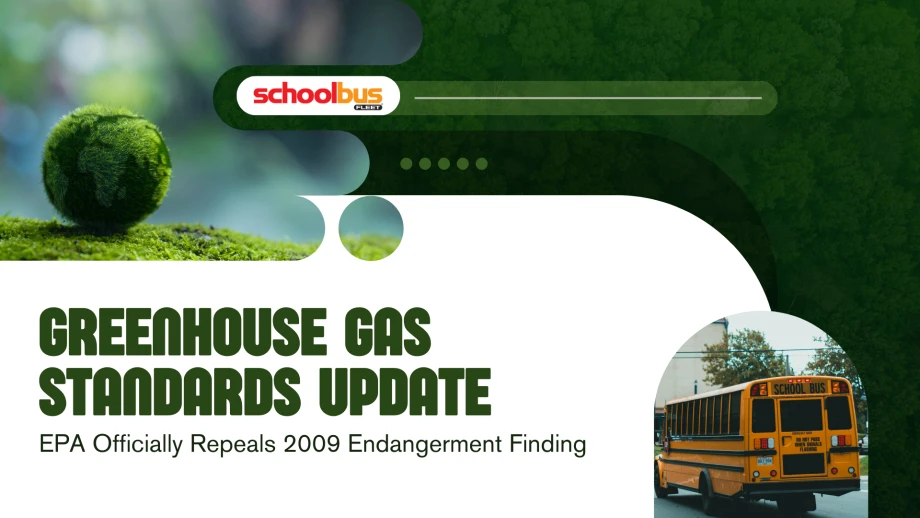
In 2009, the EPA found that greenhouse gases were harmful to the public and launched these now-rescinded stricter regulations requirements.
Credit:
School Bus Fleet
4 min to read
- The EPA has rescinded its 2009 Endangerment Finding, reversing federal greenhouse gas emission standards.
- This action is described by its administration as the largest deregulatory effort in U.S. history.
- The rollback eliminates emission standards for all vehicles and engines during the specified model years.
*Summarized by AI
On Feb. 12, the U.S. Environmental Protection Agency (EPA) removed Obama-era federal emissions standards on new vehicles that includes school buses. The intent was announced last summer.
The ruling rescinds the 2009 Greenhouse Gas Endangerment Finding, which served as a prerequisite for regulating emissions from new motor vehicles and new motor vehicle engines. This means that engine and vehicle manufacturers no longer have any future obligations for the measurement, control, and reporting of GHG emissions for any highway engine and vehicle.
The agency concluded that Section 202(a) of the Clean Air Act did not provide statutory authority for EPA to prescribe motor vehicle and engine emission standards in the manner previously utilized, including for the purpose of addressing global climate change, and therefore "has no legal basis."
The EPA said it now finds that even if the U.S. were to eliminate all GHG emissions from all vehicles, there would be no material impact on global climate indicators through 2100.
Note: This action does not eliminate rules for traditional air pollutants like NOx or particulate matter, so emissions standards that affect engine performance and air quality will still apply.
The agency held an extended 52-day public comment period, which included four days of virtual public hearings where more than 600 individuals testified. EPA received about 572,000 public comments on the proposed rule and made substantial updates to the final rule in response to comments.
According to an NBC News report, environmental groups have disputed the administration's stance and are preparing to sue in response to its repeal.
Industry Reactions
Environmental Groups
The World Resources Institute, which powers the Electric School Bus Initiative, broke down the repeal on its website, warning of how the change may affect the U.S.' global standing. Referencing the Clean Air Act, WRI wrote that: "By repealing this finding, the EPA removes the scientific and legal basis that requires federal regulation of greenhouse gases, weakening protections for people, the environment and the economy... In practical terms, without the endangerment finding, regulating greenhouse gas emissions is no longer a legal requirement."
CALSTART’s CEO, Michael Berube, also issued the following statement in response to the action: “The U.S. transportation sector accounts for more GHG emissions than any other sector of the economy. At a time when countries across the world are reducing emissions from vehicles while improving affordability and building a new clean transportation industry, the U.S. is taking a step backwards on its blueprint for transportation decarbonization.
“Today’s EPA announcement ignores the significant progress U.S. industry has made toward a lower-emissions economy and represents a major step back for clean transportation and American competitiveness. Weakening vehicle standards and undermining the endangerment finding injects uncertainty into the market at a moment when global competition for clean vehicle leadership is accelerating.
“Private-sector innovators and manufacturers have invested hundreds of billions of dollars into developing cutting-edge, cleaner, more-efficient vehicle technologies — strengthening our domestic supply chains, creating high-quality jobs, and positioning U.S. companies to compete in a rapidly growing global market."
School Districts
The School Transportation Association of Indiana shared the news on Facebook, commenting "Bus manufacturers are no longer legally mandated by the federal government to meet the specific 2027–2032 decarbonization targets. This rule makes it easier and cheaper for school districts to continue buying diesel and gas-powered buses."
One Indiana director said in response: "It will be interesting to see how the OEMs respond with pricing, since the diesel engine innovation and associated development expenses have already been incurred in anticipation of the previously-scheduled January 1, 2027 EPA emissions restrictions."
OEMs
A spokesperson from Thomas Built Buses shared the following comment in response to the news: "Daimler Truck North America appreciates the recent EPA actions that rescinded all federal GHG standards for commercial vehicles and continues to meet all applicable emissions regulations, including current federal NOx standards. This added flexibility reinforces the importance of a market-driven, technology-neutral approach, and supports long-term investment decisions of manufacturers and customers to reduce emissions while reflecting manufacturing realities and customer needs.
"Our future truck, bus and engine development continues to be driven by those NOx regulations, along with customer expectations for efficiency, durability, and total cost of ownership. So, while the GHG rollback offers more flexibility, it does not change the technologies pathway for 2027 and beyond."
School Bus Fleet has reached out to several other school bus industry manufacturers for comment and will update this post accordingly.
Quick Answers
The Endangerment Finding was a 2009 declaration by the federal administration that greenhouse gases pose a threat to public health and welfare, which justified imposing restrictions on emissions.
*Summarized by AI
More Alternative Fuels
Alt-Fuel Moves: Electric Bus Rollouts, Bidirectional Charging & Propane Growth
See which fleets are adding electric and propane school buses as districts and operators invest in charging infrastructure, bidirectional technology, and alternative-fuel expansion.
Read More →
Nobody Told Diesel Prices They Were Supposed to Come Down
With diesel prices surging, school bus fleets have new reason to stress-test fuel costs, consider diversification, and calculate what each route really costs to operate.
Read More →
Why Gasoline School Buses Are Making a Comeback
Gasoline is gaining ground in full-size school buses. See how today’s options stack up against diesel on cost, maintenance, emissions, performance, and more.
Read More →
EPA Opens $180M DERA Funding Round for Diesel Upgrades
The 2026 Diesel Emissions Reduction Act program seeks applications from eligible organizations to accelerate the retirement of legacy diesel vehicles.
Read More →
The Secret Life of an Electric School Bus Battery
Batteries change throughout years of daily routes, but degradation doesn’t necessarily mean the end. Here’s what operators should know about performance, safety, and second life.
Read More →
CALSTART and Forth Combine to Form Catalyst Mobility
The new name represents a renewed vision for the nonprofit focused on advancing clean, equitable, and affordable transportation solutions that move people and goods.
Read More →
Alt-Fuel Moves: New Buses, Charging Hubs & Real-World EV Testing
Propane and electric school bus deployments continue to grow as districts add new vehicles, expand charging infrastructure, and gather more real-world operating data.
Read More →
Fewer Electric School Bus Models Reshape the U.S. Market
WRI’s latest buyer’s guide points to a consolidating electric school bus market, but fewer options may reflect a maturing industry rather than fewer meaningful choices for school bus operators.
Read More →
The Fuel Budget You Can Actually Predict: How Propane Autogas Keeps Money in the Classroom
Learn how propane autogas helps school districts manage fuel costs with predictable pricing, lower maintenance, and reduced emissions from former transportation director Joel Stutheit.
Read More →
Hendrickson, Driventic Introduce New Electric Powertrain for School Buses
ELECTRAAX, the electrified, lightweight drive axle offers integrated ePowertrain efficiency and modular flexibility for Class 6–7 school bus use.
Read More →