




Where EPA School Bus Funding Stands: CSBP, DERA, and Heavy-Duty Grants Update
One program ends, another looks to be reimagined, and the Clean School Bus Program is in a holding pattern — here’s where each EPA program stands and what to expect moving forward.

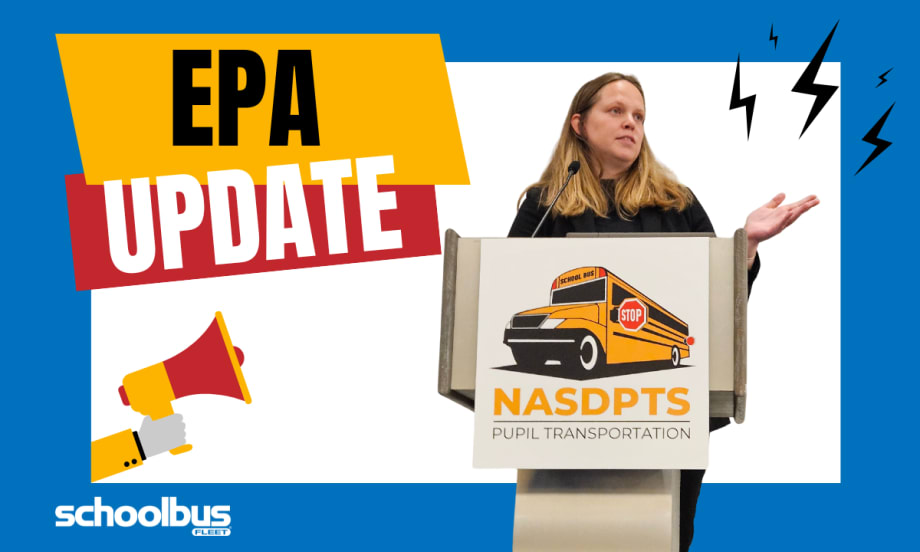
Billions in school bus funding are still in play — but not all programs will continue. Here, Christine Koester breaks down the EPA’s three programs to attendees at NASDPTS on Nov. 16, 2025.
Photo: Amanda Huggett/School Bus Fleet
We’ve all heard about the turbulence in the federal government’s funding for alternative fuels, but where exactly do some of the most popular programs stand?
At last week’s NASDPTS conference, select federal industry partners presented updates on their agencies’ activities, regulations, and plans. Representing the U.S. Environmental Protection Agency (EPA) was Christine Koester, director of the Legacy Fleets Incentives and Assessment Branch.
Koester provided attendees an overview of and update on the status of the EPA’s three primary school bus replacement and funding programs:
- Clean School Bus Program (CSBP)
- Clean Heavy-Duty Vehicles Grant Program
- Diesel Emissions Reduction Act (DERA)
Clean School Bus Program
Arguably the most visible EPA funding program for the industry as of late, CSBP has awarded $3 billion for 8,500 school buses over five years, with prioritization factors for low-income and high-need districts.
The first three rounds have been awarded, and most of the buses from the first round are on the road. Some selectees received extensions for reasons like utility upgrade delays, maintenance concerns, or bus delivery delays.
The 2023 program selectees saw 65 grants for about 2,500 buses, and are about midway through the process and expected to close later this year.
Regarding the 2024 round announced last fall, Koester said the agency has not yet made an announcement, but the funding is with the EPA.
As for what’s next, $2 billion remains to be spent in the last two rounds, which includes those yet to be awarded funds and those from prior rounds that withdrew.
[Update in 2026] In January 2026, the EPA posted the following message to its website: "EPA is actively reviewing and revamping the Clean School Bus Program in accordance with President Trump’s Executive Order ... Administrator Zeldin has cancelled roughly $30 billion in wasteful grants and contracts since being confirmed as EPA Administrator. EPA anticipates providing additional information about the revamped and modernized Clean School Bus Program in the near future."
Clean Heavy-Duty Vehicles Grant Program
The $1 billion Clean Heavy-Duty program launched in 2024, a result of President Biden’s Inflation Reduction Act of 2022. In its one round, it funded 60 awards for 2,000 vehicles — 1,200 of which were for school transportation.
Those selectees are currently working on implementing their projects, and must submit reporting updates every six months.
Koester said there is no anticipated future funding for this one. “Congress swept the remaining funds as part of the Reconciliation Law this summer, so there will not be funding available for a further program for Clean Heavy-Duty,” she said.
Diesel Emissions Reduction Act
DERA is the agency’s most popular program, according to Koester — even though it’s faced uncertainty as far back as almost a decade ago.
This program began in 2008 and receives an annual appropriation from Congress, about $90 million in recent years. In its most recently awarded round in FY 2022-23, nearly $125 million funded about 70 school bus replacement projects across the U.S.
While the program has been quiet over the past year (and President Trump asking for cuts to the program), Koester said “the agency is working towards a new funding opportunity there in 2026.”
Lessons Learned & What Now
Koester said the EPA “remains very focused on oversight. It's an administration priority.” So, the program staff, as well as the EPA Office of Inspector General, have been conducting site visits over the last year,” which are done separately and at random.
As far as lessons learned in implementing these programs, she encouraged selectees to keep paperwork for old buses. “I love to declutter as much as the next person, but when you get audited, you want to be able to have that paperwork in hand for the auditor and see to specifically to demonstrate usage of the old bus,” she said.
For awardees having operability issues with new buses, EPA partners with National Renewable Energy Laboratory (NREL), which can provide technical assistance through site visits to assist with troubleshooting.
She also clarified that the new buses do need to serve the school district they were selected for for five years, and there was a congressional law passed in 2023 that allows contract termination for the school district to move a bus to a similarly prioritized school district.
“Another lesson learned has been that school board approval is pretty crucial to the success of the program,” Koester said. “We have had a number of withdrawals from the program because they couldn't get their school board to approve.” EPA has added extra forms to the program to work around that.
Koester also acknowledged the high cost of electric buses as a barrier. “We have heard from a number of stakeholders who are interested in bus standardization for specification as a tool to reduce costs,” she said, which is something they’re interested in hearing more about.
As for those with vehicles from a manufacturer that has voided warranties, Koester called the situation difficult and quite frustrating. Because a court stay is still applicable, there is little EPA can do, though she said once it’s lifted they may be able to offer more assistance. She said they are “working through the options that we might pursue for those who have the buses that are inoperable,” and that in some instances, a district can switch to a different manufacturer.
Koester said a clean school bus report and DERA report to Congress is expected “very early next year.”
She encouraged those with questions to email each program help line, and those interested in the EPA’s programs to subscribe to their newsletter for updates as programs open and key information as these programs move along.
Editor's Note: This post was originally published Nov. 20, 2025, and updated Feb. 18, 2026.
More Policy & Regulations
Ohio Transportation Workgroup Calls for End to 'Impractical to Transport' Payments
A final report from Ohio's Pupil Transportation Workgroup proposes ending "impractical to transport" payments and expanding transportation options through regional partnerships, but not all industry pros agree on the approach.
Read More →
The BUILD America 250 Act Has Big Implications for School Buses, Too [Updated]
Buried within a sweeping federal transportation bill are provisions that could affect school bus driver requirements, illegal passing enforcement, and even the future role of autonomous technology in pupil transportation.
Read More →
School Bus Laws to Watch: New York Delays EV Mandate
Plus, federal lawmakers seek new funding for school bus safety as states weigh stop-arm enforcement, disability protections, and education spending.
Read More →
School Bus Laws To Watch: Seat Belt Bills, Funding Fights & EV Changes
From national bills on seat belts and driver oversight to driver awareness campaigns referencing “Finn’s Rule” and ongoing transportation funding debates in Alaska, here’s the latest in school bus legislation across the U.S.
Read More →
School Bus Laws To Watch: Driver Shortages, EV Debates & Safety Upgrades
From driver shortage solutions in Tennessee and rural connectivity debates in Utah to new safety laws in Wisconsin and ongoing electric bus mandate discussions in New York and Connecticut, here’s the latest in school bus legislation across the U.S.
Read More →
School Bus Laws To Watch: Stop-Arm Enforcement, EV Mandates & Seat Belts
From North Dakota public charter school regulations, tracking illegal school bus passing consequences in multiple states, and the continued debate on New York’s electric school bus mandate, here’s the latest in school bus legislation across the U.S.
Read More →
School Bus Laws To Watch: Anti-Trafficking Curriculum, Passing Loopholes & Tougher Penalties
From Nebraska CDL training add-ons, tackling stop arm passing loopholes in Minnesota, and increased penalties for school bus driver DUIs and firearm incidents, here’s the latest in school bus legislation across the U.S.
Read More →
School Bus Laws To Watch: Driver Penalties, Funding Fights & New Safety Initiatives
From New York driver penalty changes to stop-arm camera programs, reliable special education transportation, and a Kentucky budget shortfall, here’s the latest in school bus legislation across the U.S.
Read More →
School Bus Laws To Watch: Stop-Arm Cameras, Safety Retrofits & Driver Shortage Fixes
From Maine bus safety upgrades to stop-arm camera bills, electric bus funding, and an Alabama workforce solution, here’s the latest in school bus legislation across the U.S.
Read More →
State Grant Program Advances School Bus Safety Upgrades Across Ohio
$10 million in state grants will fund safety upgrades and new features on school buses serving students across the Buckeye State.
Read More →