





Miss the Last Installment? Manufacturing Growth & Energy Storage Expansion
Alt-Fuel Moves: Product Innovations & Funding Outlooks
Check out some of the latest moves where alternative fuels and school buses intersect, including electric and propane bus deployments, new EV products, and an update from CARB.
January 30, 2026
On top of multiple alternative fuel deployments, read more on product announcements from Heliox and The Mobility House, as well as updates from the California Air Resources Board.
Credit: Trobec's Bus Service/School Bus Fleet
8 min to read
In this alternative fuel roundup, we take a look at the latest moves, product announcements, and deployments, including news from Zenobē, KWRL Transportation, Highland Electric Fleets, Trobec’s Bus Service, Heliox, The Mobility House, and the California Air Resources Board.
New Alternative Fuel Deployments
School districts and transportation providers across the U.S. are accelerating the deployment of alternative fuels as fluctuating incentives and sustainability goals converge. The following projects highlight how electric and propane-powered school buses are being rolled out through scalable, real-world implementations.
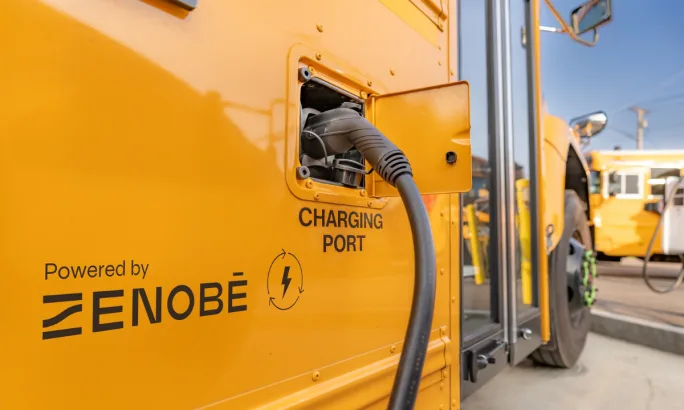
Zenobē will develop and manage the charging infrastructure at the site, including a scalable design that allows EBT and its managing company, The Trans Group, to continue expanding the electric fleet.
Credit: Zenobē
Inside a NY Mandate-Ready ESB Deployment: 10-Bus Pilot with Scalable Charging
Zenobē has partnered with Educational Bus Transportation, Inc. (EBT), a school transportation provider in New York's Nassau and Suffolk Counties, on a fleet electrification project serving Long Island's Copiague Public Schools.
The project encompasses an initial phase of 10 electric school buses and associated charging infrastructure. The 10 electric school buses will be placed into service, providing zero-emission transportation for the district's 4,500 K-12 students. It is supported by the New York School Bus Incentive Program, administered by the New York State Energy Research and Development Authority (NYSERDA). Zenobē provided additional funding.
Zenobē will develop and manage the charging infrastructure at the site, including a scalable design that allows EBT and its managing company, The Trans Group, to continue expanding the electric fleet.
"As a long-time provider of transportation services to Long Islanders, we're excited to continue the process of bringing clean school buses to our students and drivers," said Tim Flood, executive vice president, The Trans Group. "The combination of NYSERDA funding and Zenobē's experience and knowledge are vital to keep our successful transition to clean rides for our students on track."
"We see our role as providing more than just technical services and support,” said Maggie Clancy, executive vice president for Zenobē. “We're delivering confidence and peace-of-mind through battery performance guarantees, cost-efficient charge management services, and partnership to make this fleet both operationally reliable and financially sustainable."
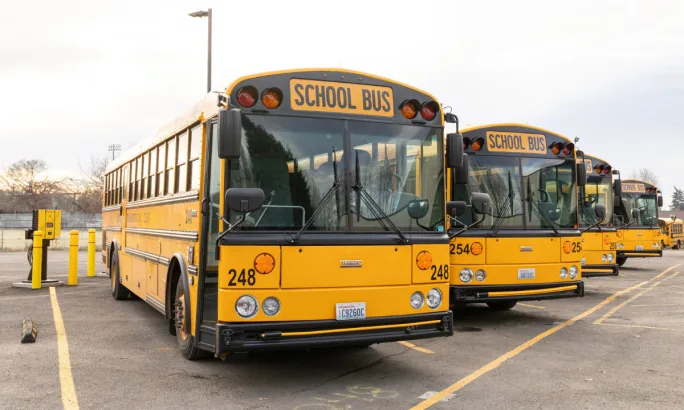
KWRL Transportation's new fleet will operate from depots in Woodland and Ridgefield, Washington, and will be supported by on-site charging infrastructure, including 16 Zerova 30 kW chargers.
Credit: Highland Electric Fleets/KWRL Transportation
KWRL Transportation Deploys 14 Electric School Buses
The KWRL Transportation Cooperative is set to deploy 14 Thomas Built electric school buses serving students across the Kalama School District, Woodland Public Schools, Ridgefield School District, and La Center School District in Washington.
The new fleet will operate from depots in Woodland and Ridgefield, Washington, and will be supported by on-site charging infrastructure, including 16 Zerova 30 kW chargers. The electric school buses are expected to travel approximately 700 miles each day, transporting between 1,000 and 1,200 students across the four districts.
According to a release, Woodland Public Schools and KWRL anticipate approximately $400,000 in operational savings and efficiency gains over time from the transition. These savings include an estimated $200,000 annually from reduced diesel fuel use and lower maintenance costs.
“By working together to diversify transportation methods, we have unlocked new efficiencies that will benefit the Kalama, Woodland, Ridgefield, and La Center school districts for years to come," said Shannon Barnett, transportation director, KWRL. "Moving this venture from the application phase to daily operations was a shared endeavor, and it simply would not have been possible without the collaboration of our dedicated partners."
Highland Electric Fleets is supporting the project through its Electrification-as-a-Service (EaaS) model, helping coordinate the electric buses, charging infrastructure, and ongoing fleet support to reduce complexity for the participating districts. Additional project partners include Schetky as the Thomas Built dealer, Clark Public Utilities, Cowlitz Public Utility District, Accurate Electric Unlimited, and Maddox Industrial Transformer.
The project was made possible through a combination of federal, state, and local funding, including $2.8 million from the EPA Clean School Bus Rebate Program (Round 3), nearly $3.0 million from the Washington Department of Ecology for vehicle and infrastructure support, and $300,000 in infrastructure funding from Clark Public Utilities for the Ridgefield depot.
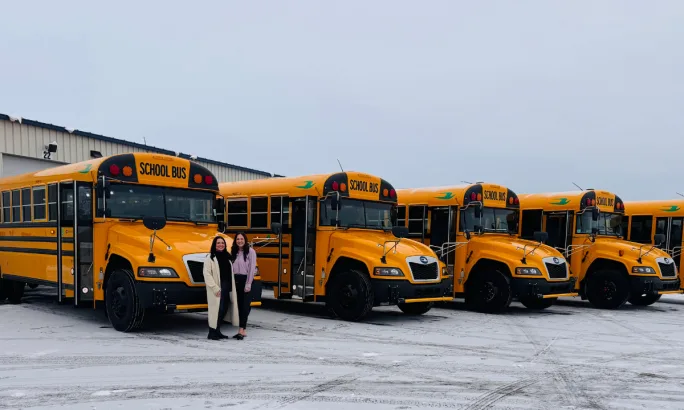
The Trobec’s Bus Service ownership team poses in front of a newly welcomed fleet of five Blue Bird propane-powered school buses.
Credit: Trobec's Bus Service
Trobec’s Bus Service Adds Propane School Buses to Fleet
A Minnesota business recently welcomed sustainable school buses to its fleet. In December 2025, Trobec’s Bus Service in St. Joseph added 2026 Blue Bird propane-powered school buses to its fleet, which was made possible through a partnership with North Central Bus and Equipment.
Like electric buses, propane buses offer school transportation fleets cleaner emissions and run quieter than traditional buses. The additional buses, according to WJON, reflect Trobec’s commitment to “environmental responsibility, operational excellence, and student safety.”
The company also posted on social media that they are “excited about what this growth means for our drivers, our passengers, and our future.”
New EV Products
In the school bus industry, new EV products continue to target both fleet operations and grid integration, addressing the infrastructure and energy management challenges that come with electrification. The following launches highlight new charging hardware and software platforms designed to support electric school bus fleets at scale.
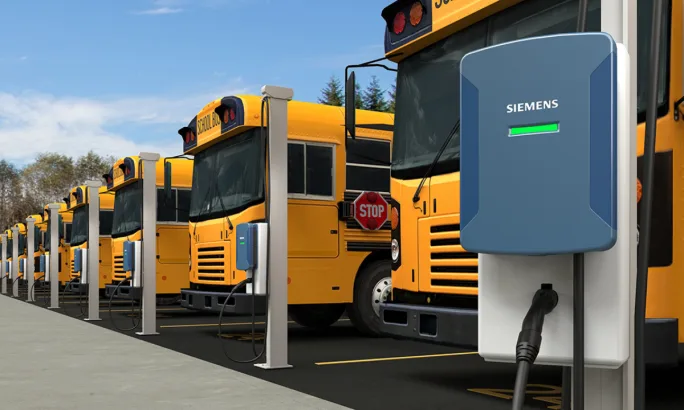
The VersiCharge Blue 80A also includes embedded metering for accurate energy tracking and cost management.
Credit: Heliox
VersiCharge Blue 80A Brings Scalable Charging to School Bus Fleet Sites
Heliox, a Siemens business, recently highlighted the VersiCharge Blue 80A as a high-performance Level 2 AC charging solution purpose-built for demanding fleet and commercial EV environments. Delivering up to 80A (19.2 kW) through a J1772 connector and a 24-ft. cable, the charger supports a wide range of vehicles, including EVs, electric trucks, and school buses.
According to a release, the VersiCharge Blue 80A is engineered with durability, safety, and compliance in mind. It is Buy America-compliant, ENERGY STAR-certified, and backed by a 3-year warranty, making it suitable for government and commercial procurement. The products hold multiple UL listings, along with NEMA 4 and IK10 ratings, ensuring performance in harsh environments, protecting the unit against extreme temperatures and physical impact.
Although smart connectivity is a core component of the charger, with installation and configuration streamlined through the Sifinity Setup mobile app, retractable cable management improves safety and maintains a clean site appearance.
The charger also includes embedded metering for accurate energy tracking and cost management. Flexible wall- or post-mounting options and over-the-air software updates further enhance adaptability and long-term value.
With scalable performance, advanced diagnostics, and dependable construction, Heliox delivers a future-ready solution that could support the growing demands of electrification.
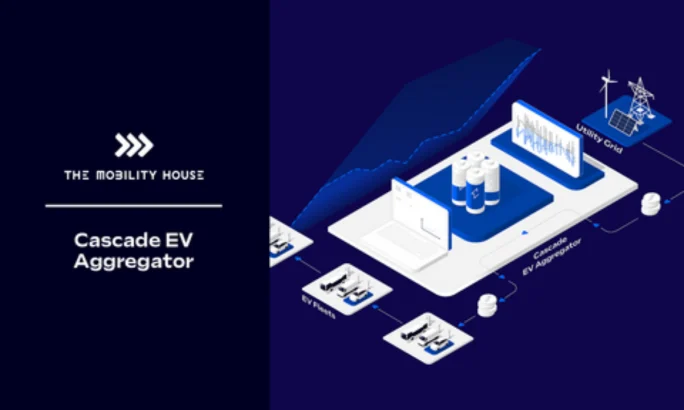
The Mobility House North America has built Cascade to address EV load challenges and grid constraints alongside electric utility partners in the United States and Canada.
Credit: The Mobility House
The Mobility House North America Launches Cascade EV Aggregator
The Mobility House North America recently unveiled Cascade EV Aggregator, a vehicle-grid integration platform for utilities. According to a company release, this technology allows charging and discharging optimization across a variety of charger and vehicle asset classes, from home chargers to electric school bus fleets.
"Electric vehicle batteries can play a substantial role in meeting the tremendous challenge of load growth on the electrical grid,” said Greg Hintler, CEO of The Mobility House North America. “The Mobility House is committed to developing the technology that harmonizes EV charging with reliable grid operations.”
A recent report from BNEF forecasted that electric vehicle battery capacity on U.S. roads will reach 4 TWh in the next ten years, which would make them the largest Distributed Energy Resource (DER) if aggregated and optimized, or a significant burden on grid infrastructure if unmanaged. This rapid load growth, combined with massive new load from data center installations, is already creating significant, unprecedented challenges for electric utility providers.
The Mobility House North America has built Cascade to address EV load challenges and grid constraints alongside electric utility partners in the United States and Canada. Fleet customers and utilities can now benefit from the charging flexibility offered by the platform’s optimization. While a charge management system (CMS), such as The Mobility House’s ChargePilot, manages charging optimization for a fleet operator, Cascade can work with each CMS across thousands of sites to create flexibility for the distribution grid. Cascade is also unlocking vehicle-to-grid (V2G) value for school bus fleets currently being deployed in California, Massachusetts, and New York.
"The electric school buses in our fleet work hard every day to get students to school safely,” said Ernest Epley, transportation director, Fremont Unified School District in California. “And now as a part of The Mobility House’s Cascade Aggregator, they can earn revenue for the district supporting the energy grid while they are parked at the depot.”
California Leads the Nation in Replacing Diesel School Buses
A new report from the California Air Resources Board shows that California remains the national leader in replacing aging, polluting school buses with zero-emission models.
The report details how the state has invested more than $2 billion in school bus cleanup programs, including nearly $1.4 billion specifically for zero-emission school buses and infrastructure. That state’s investments have supported the deployment of over 3,400 zero-emission school buses across more than 350 school districts.
However, progress could be slowed by federal funding reductions, as the Trump administration paused all awarded federal funds for clean school buses last year.
“Kids shouldn’t be poisoned by toxic fumes just to get to school,” said CARB Chair Lauren Sanchez. “Clean air and climate action aren’t optional — they’re how we protect our children’s health right now.”
California’s Electric School Bus Funding Outlook
According to the World Resources Institute, California leads the nation in funding for electric school buses, with nearly four times as many funded buses as the next leading state, New York.
CARB and the California Energy Commission are responsible for distributing state funds for school bus replacement, including the necessary charging infrastructure, and have done so for over a decade. In April 2024, the agencies announced $500 million in funding for 1,000 zero-emission school buses and associated charging equipment.
The new report highlights the need for increased funding to achieve California's target of a fully zero-emission school bus fleet. School districts have used a combination of federal, state, and local funds to modernize their school bus fleets.
While some federal funds have since been released, the future of an additional $2 billion in federal support remains unclear.
In 2022-23, California received about $146 million from the federal program. Current awards have not been finalized.
More Alternative Fuels

CALSTART and Forth Combine to Form Catalyst Mobility
The new name represents a renewed vision for the nonprofit focused on advancing clean, equitable, and affordable transportation solutions that move people and goods.
Read More →
Alt-Fuel Moves: New Buses, Charging Hubs & Real-World EV Testing
Propane and electric school bus deployments continue to grow as districts add new vehicles, expand charging infrastructure, and gather more real-world operating data.
Read More →
Fewer Electric School Bus Models Reshape the U.S. Market
WRI’s latest buyer’s guide points to a consolidating electric school bus market, but fewer options may reflect a maturing industry rather than fewer meaningful choices for school bus operators.
Read More →
The Fuel Budget You Can Actually Predict: How Propane Autogas Keeps Money in the Classroom
Learn how propane autogas helps school districts manage fuel costs with predictable pricing, lower maintenance, and reduced emissions from former transportation director Joel Stutheit.
Read More →
Hendrickson, Driventic Introduce New Electric Powertrain for School Buses
ELECTRAAX, the electrified, lightweight drive axle offers integrated ePowertrain efficiency and modular flexibility for Class 6–7 school bus use.
Read More →
The Mobility House Joins PowerFlex in Fleet Electrification Deal
The acquisition combines intelligent charging software, bidirectional charging expertise, and fleet electrification services to support the growing adoption of electric school buses across North America.
Read More →
Alt-Fuel Moves: Electric School Bus Investments Hit the Road
See which districts across the U.S. are putting electric school buses into service, expanding charging infrastructure, and planning the next phase of fleet electrification.
Read More →
With Fuel Volatility Ahead, School Districts Turn to Propane
While diesel prices peaked above $5 this spring, districts with propane autogas-powered fleets paid under $2 per gallon, according to PERC.
Read More →
EPA Unveils Proposed Changes to 2027 Heavy-Duty Engine Rules
The federal agency has proposed changes to next year’s targets that would eliminate DEF derates, ease warranty requirements, and retain current NOx emissions standards.
Read More →
Alt-Fuel Moves: EV Charging & Infrastructure Projects Gain Momentum
The latest developments include new funding, charging infrastructure, utility investments, and fleet technologies designed to support the transition to electric school buses nationwide.
Read More →