




What Happens When a School Bus Catches Fire — and What Can Help
School bus fires are rare but can be devastating. Learn how advances in fire suppression and asset protection help fleets detect fires earlier, reduce damage, and improve safety.

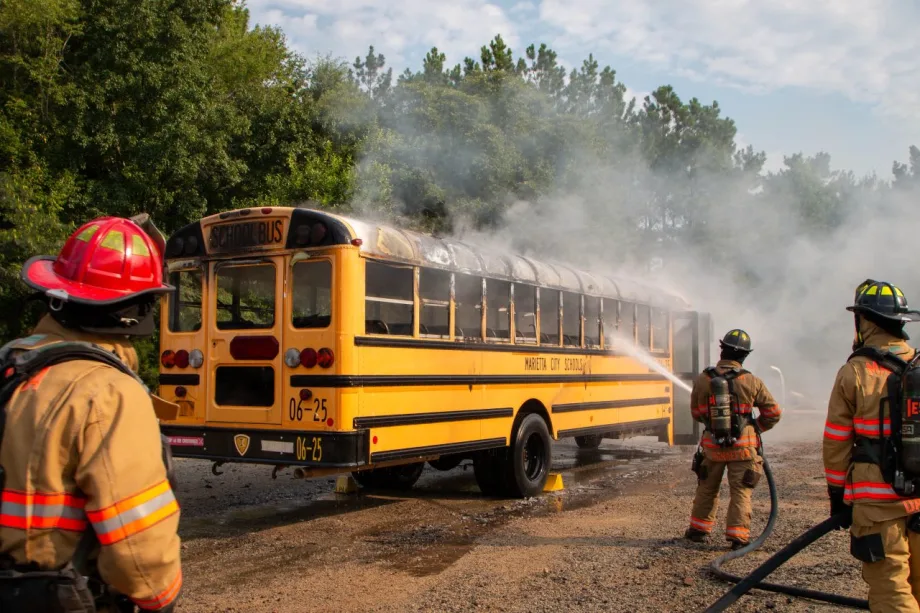
The best way to learn how to react during a bus fire is to practice. Marietta City Schools in Georgia worked with their fire department on a live safety demonstration, setting this retired bus on fire to illustrate how quickly heat and fumes release.
Ivy Brown, Marietta City Schools
- School bus fires, though rare, have the potential to cause significant harm and disruption.
- Advances in fire suppression systems enable earlier detection of fires, mitigating potential damage.
- Improved asset protection measures enhance safety by reducing the impact of fires on school bus fleets.
*Summarized by AI
School bus fires happen every day. Most end with successful evacuations and no serious injuries (though smoke inhalation has been proven to shorten one’s life). When things don’t, the consequences can be devastating.
Major advances are now helping mitigate devastating consequences and addressing smoke inhalation for both drivers and passengers.
Most school buses (90%!) don’t have fire suppression systems. Whether you didn’t know they exist or thought they were too complex or expensive, let’s break down what options exist, new innovations in technology, current price points, and what can protect not only your bus, but the people inside.
A Tale of Tragedy: Iowa’s Fatal School Bus Fire
The most recent fatal school bus fire occurred in Oakland, Iowa, in 2017. There, both the driver, Donald Hendricks, and the only student on board, 16-year-old student Megan Klindt, died.
Former Iowa state transportation director Max Christensen was on the scene during the investigation and recalled the details leading up to the tragedy.
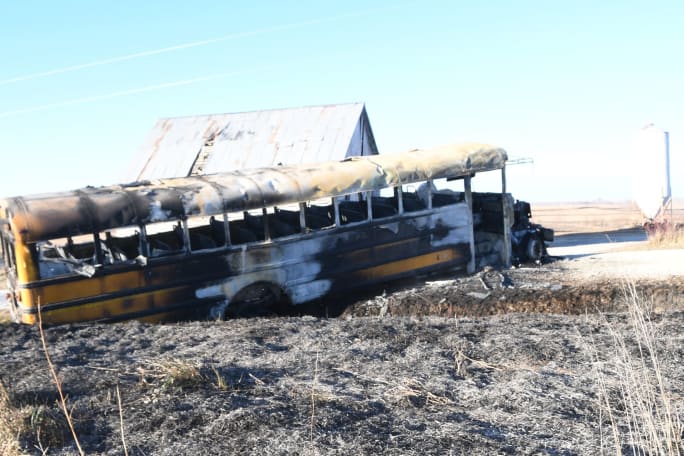
After investigating the 2017 fatal school bus fire in Iowa, the NTSB recommended 10 new safety recommendations, addressing issues like driver physical fitness, fire safety, and emergency evacuation training.
Pottawattamie County Sheriff's Office
“We had a bus driver whose first stop of the day was a turnaround out in the country,” he said. “He made a turnaround in the driveway, and he backed off into the ditch and was stuck. Bus drivers being bus drivers try to get out so you don't have to call a tow truck. So he kept spinning, digging, and revving his engine. But the problem was that the back side of the bus had actually gone back against the back of the ditch and his tailpipe got plugged up with dirt. … it ended up starting the turbocharger on fire, which then shot a hole into the passenger compartment. There are so many factors here, and with the bus sitting at the angle it was in the ditch, he was unable to get out of his seat. The student was found at his feet, so the theory was that she was probably trying to help him get out… It happened right in front of this farm where the girl lived. The mother saw the bus on fire. She went running out, and she had a hammer, so she was trying to break windows. I can't even imagine what she saw or thought.”
By 2020, the district agreed to a $4.8 million settlement.
Regulation & Recommendations for Fire Suppression Systems
The National Transportation Safety Board (NTSB) investigated the Oakland accident and ultimately issued a safety recommendation that all new and in-service school buses be equipped with automatic fire suppression systems. The National Highway Traffic Safety Administration rejected the recommendation in 2019, citing circumstances surrounding the Oakland fire and the overall cost of installing and maintaining a system. Instead, it asked for standards for new buses to ensure that no hazardous quantity of gas or flame can pass from the engine to the passenger compartment.
There is no U.S. federal requirement for fire suppression systems — yet. And not for lack of effort. The School Bus Safety Act, introduced multiple times into Congress, calls for seat belts and fire suppression systems, among other things, on all buses. It has not yet passed.
Christensen said that the state of Iowa considered adding a fire-suppression requirement after the Oakland tragedy and even ran a pilot, but decided not to enforce it — mainly due to cost and the fact that there were no fires during the pilot to test against.
Currently, Georgia and Hawaii require fire suppression systems on buses equipped with wheelchair lifts.
How Fire Suppression Systems Work
Brian Lyons, founder and managing partner for FireGator, is confident a fire suppression system can save lives. Here’s how it works.
FireGator’s product uses an exclusive Stat-X aerosol potassium generator that triggers a chemical reaction to put out the fire. It’s non-pressurized until discharged, at which point it floods the area. But the agent is safe for inhalation and is eco-friendly.
George Davis, a shop supervisor at Fayette County Public Schools in Georgia, says that a nonpressurized system requires less maintenance over time. “The reason that corrosion is important is when you have an accidental discharge and don't want damage to the bus,” he told us in 2021.
Modern fire suppression systems can be configured to detect a fire, alert the driver, notify fleet personnel remotely, and/or automatically deploy a suppression agent. FireGator's system, for example, is electrically controlled and can send remote notifications when a fire is detected.
“If you think about all the modern advances in a vehicle and all the sensors and different technologies, we can incorporate right into that ecosystem,” Lyons said.
“We’re focused on making it simple, affordable, and giving [districts] a clean, safe solution.” — Brian Lyons, FireGator
All of FireGator’s systems are active even when the bus is off. It can send a signal to emergency services when an event is detected and a text with location information to school officials. And, a 113-decibel horn alerts the driver and passersby to an emergency.
Additionally, it is maintenance-free for 15 years and has no tubing to prevent false discharges or fittings that require constant monitoring.
What’s the Price Tag?
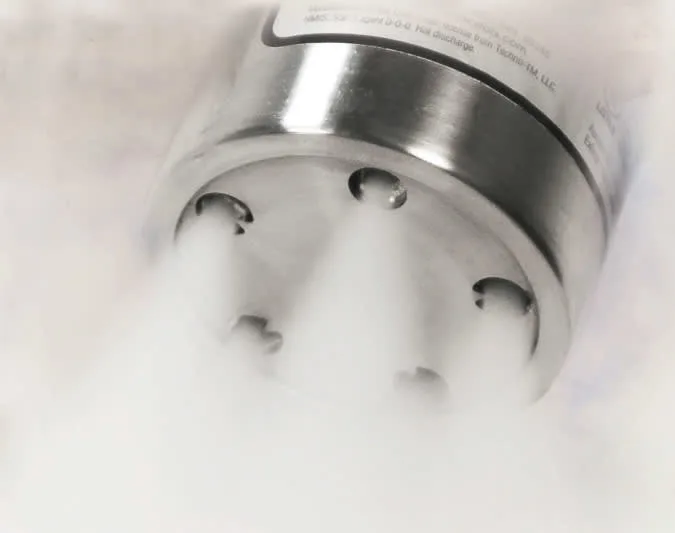
The Stat-X generator releases its aerosol suppression agent, flooding the compartment.
FireGator
Complete-system options, which include both personnel safety and asset protection platforms, five years of SMS notifications, heat detection, and fire suppression, are:
- $1,790 for a cutaway chassis
- $2,850 for front-engine buses
- $4,420 for rear-engine buses
An entry-level option offers the same as above, minus fire suppression, which can be added at any time.
Other available options include:
- $995 for an ICE-vehicle safety system that includes theft notification, heat detection, fire suppression, discharge and loss of power notifications, and EV battery warning system with driver alert and five years of SMS notifications.
- $695 for lithium-ion battery detection with driver alert, and 60 months of wireless service for SMS alerts.
According to Lyons, the EPA Clean School Bus Fund will pay for the installation when included in the EV bus at the time of purchase, and he encourages grant writers to explore additional state and federal funding opportunities.
Considerations for Fire Suppression on Electric Buses
Let’s address an elephant in the room: What happens when a fire happens on an EV bus compared to an ICE vehicle? Well, it escalates quicker is the short answer.
“It’s an explosive start versus growing,” Lyons said.
He explained that an EV battery fire typically begins when a battery cell is damaged or develops an internal short circuit, causing the cells to overheat. As the temperature rises, the cell's liquid electrolyte turns into gas. If enough flammable gases build up, they can ignite and trigger a controllable release of the massive amount of energy contained in the battery pack.
“The majority of these mixed gases are hydrogen, which is the gas that can actually combust at just 4% concentration,” he said. “This is why early detection is key.”
Some fires have occurred on electric school buses, but they do so less often compared to internal combustion engine (ICE) buses. “In fact, there have been fewer than 30 fires involving electric buses worldwide in 15 years,” Valerie Tremblay, sustainable mobility lead with Green Communities Canada, said last year. “None of these incidents resulted in fatalities, and the majority occurred in depots, which were out of service.”
“The electric school bus manufacturers got it right,” Lyons added. “We track school bus fires daily. At first, we observed very few electric bus fires. However, over the past eight to 10 months, the number of fires is sadly becoming much more common. We are blessed to be able to provide electric bus manufacturers with a low-cost solution that provides as much time as possible for emergency evacuations to begin.”
Industry experts note that battery management systems and protective enclosures have made thermal events in school buses rare, and manufacturers continue to improve detection and mitigation technologies.
As fire suppression systems evolve to support electric buses alongside ICE vehicles, manufacturers are adapting detection and suppression strategies for different powertrains. Lyons said FireGator’s system uses different calculations depending on the powertrain but provides the same level of protection for all.
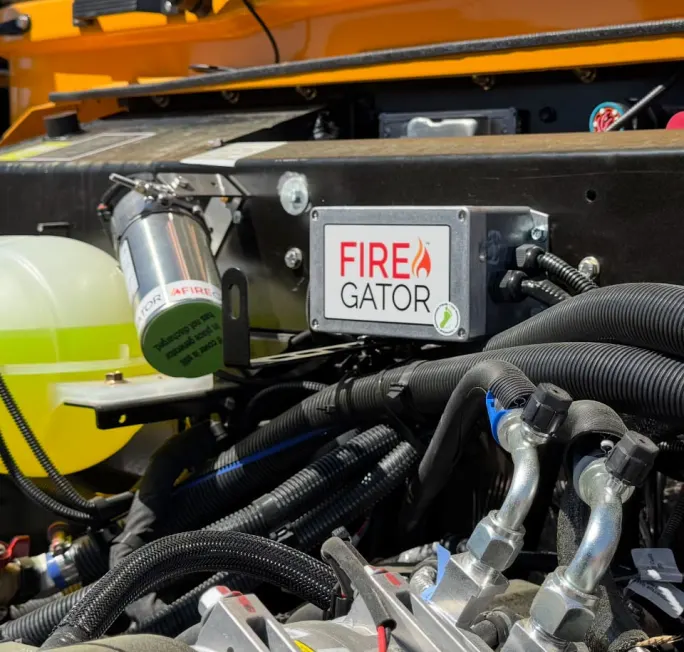
Installed in the engine compartment, an automatic fire suppression system is designed to detect and suppress a fire while alerting drivers and fleet personnel.
FireGator
“With the frequency and the occurrence of these events taking place predominantly at night when they’re on charge, and a very viable concern when the units are parked in close proximity, we look at the earliest detection possible to get everybody safely out of harm's way and minimize collateral damage,” Lyons said.
He explained that as a failing lithium-ion battery cell overheats, it can begin releasing flammable gases — a process known as off-gassing — which may signal the early stages of thermal runaway.
“The opportunity for the best defense on the battery pack is early detection of off-gas as soon as it occurs,” he said, so occupants have enough time to get off the bus and alert emergency responders.
Thanks to new advances, FireGator’s system can now send a text alert when it detects an off-gas leak and potential battery failure, too.
Despite concerns around the nature of battery fires, Lyons believes electric vehicles still have a place in the future of our industry and says he’s happy to contribute to making them safer.
How Fire Suppression Technology Is Evolving
Fire suppression technology is now evolving beyond simply extinguishing fires with costly systems.
Lyons said newer capabilities include earlier detection of battery off-gassing, remote notifications to school officials or fleet managers, theft detection for high-value vehicle components, and integration with emergency alerts and warning beacons. FireGator is developing each of these features for its own system.
“We’re constantly adding value and benefits so that one day our solutions will be in all buses,” he said.
But what Lyons is most excited about is that not only has the price dropped dramatically, which he says makes it a default option, but the product and its TCO are being well-received. (Bonus: Insurance companies may even reduce your rate knowing you’ve minimized risk!)
Beyond Fire Suppression: Protecting School Bus Assets
Another thing Lyons is excited about for ICE vehicles is FireGator’s new theft-detection and temperature-monitoring platform, AssetTXT. This means real-time text alerts notify personnel immediately of dangerous engine compartment heat levels, theft of high-value emissions-control components, such as a diesel particulate filter (DPF), battery theft, or vehicle power loss.
“Instead of just targeting catalytic converters, now they’re going after the diesel buses,” he said. “Those components have more precious metals and are of more value. For instance, I know of one repair that was around $50k, and it took months to repair.”
The feature is now available as a standalone option or integrated into its fire suppression technology and can signal to onboard telematics systems.
A Call to Action
Many school transportation pros don't realize fire suppression systems are even an option. That’s what Lyons wants to change.
“Early detection combined with real-time notification represents the most practical approach available today,” he said. “We encourage school districts, contractors, fleet operators, OEMs, and bus purchasers to take a proactive — not reactive — approach by requesting these technologies as part of future vehicle specifications.”
Lyons references a recent incident in Los Angeles where a driver was hospitalized for minor smoke inhalation after the bus caught fire during operation. No students were on board, but he poses the question: “Imagine if that bus had been loaded with students. That'd have been a horrific event… It’s time for connected safety to become the new standard.”
The Future of Fire Suppression
So, what’s next for the technology?
Lyons says advancements show that the quickest factory-line installation is to integrate with existing telematics platforms that are already being installed. The telematics providers he has engaged with so far have been very receptive, he shared.
Until then, FireGator is happy to offer field installs — taking just about 45 minutes. Installs on new Blue Birds are available through Yancey Bus, Thomas Built Buses through Carolina Thomas, and others can be coordinated through FireGator.
As fleets adopt more data-driven mindsets and lean into automation, Lyons believes fire suppression is the fourth leg of the telematics stool, alongside driver performance, vehicle health monitoring, and location.
As for that price tag, which is arguably the biggest deterrent, Lyons says there is a price point at which fire suppression would be a default installation. “And I think we're really close to that point.”
It can be easy to think that a fire won’t happen to you. But if one does, can you say you did everything you could to detect and prevent it?
Quick Answers
School bus fires are considered rare due to stringent safety standards and regular maintenance that significantly reduce the likelihood of such incidents occurring.
*Summarized by AI
More Safety

Geotab Launches Tool to Help Fleets Investigate Road Incidents
Geotab Investigations combines telematics data, video, documents, and other evidence to help fleets reconstruct incidents, resolve claims, and determine what happened.
Read More →
Doing More With Less: How Transportation Directors Can Prioritize Safety Amid Budget Uncertainty
With diesel prices soaring and nearly one-third of transportation directors expecting budget cuts, maintaining student safety has never been more challenging. Download this guide to learn how leading districts are prioritizing risk, funding critical safety technology, and building stronger budget cases with data.
Read More →
How To Build a More Secure School Bus Yard During and After Hours
As thefts and overnight security threats continue, school transportation leaders are combining stronger operational practices with AI-enabled surveillance to better protect buses, facilities, and staff.
Read More →
FMCSA Names New Chief Safety Officer: What School Bus Operators Should Know
Steve Dowling is set to lead the federal agency's efforts to advance commercial motor vehicle safety and reduce crashes, fatalities, and injuries on the nation's roadways.
Read More →
New Study Finds School Zone Speed Safety Cameras Cut Speeding Violations 97%
A Florida university's research demonstrates that Verra Mobility's automated enforcement changes driver behavior and significantly improves school zone safety.
Read More →
What Changed in DOT’s New National Roadway Safety Strategy?
The federal agency's new plan shifts its focus to safer people, roads and vehicles, with a new three-pronged approach instead of five. One outlined action even addresses a key industry concern around illegal school bus passing.
Read More →
Are Autonomous Vehicles Ready to Safely Navigate School Bus Stops?
NHTSA is accelerating autonomous vehicle deployment through new safety standards and commercial approvals. See why school transportation leaders are watching.
Read More →
NFL Star Lomas Brown Kicks Off New Illegal School Bus Passing PSA
Just in time for the back-to-school season, the former Detroit Lions offensive tackle took time to record a video encouraging motorists to slow down around school buses.
Read More →
How Two Texas Districts Built Award-Winning Safety Programs
Learn how Prosper ISD and Rockwall ISD earned National Safety Council honors through hands-on training, safety culture, and strategies that reduced transportation incidents.
Read More →
NHTSA Releases 10-Year Review of Fatal School Bus Crashes
The latest federal analysis reinforces the safety of school buses while identifying where school-age pedestrians and other motorists remain most at risk.
Read More →