




School Bus Fire Demo Shows Importance of Evacuation Training
Missouri firefighters and NAPT staff show how quickly a school bus can catch fire and how long evacuation can take as the association kicks off its annual conference.

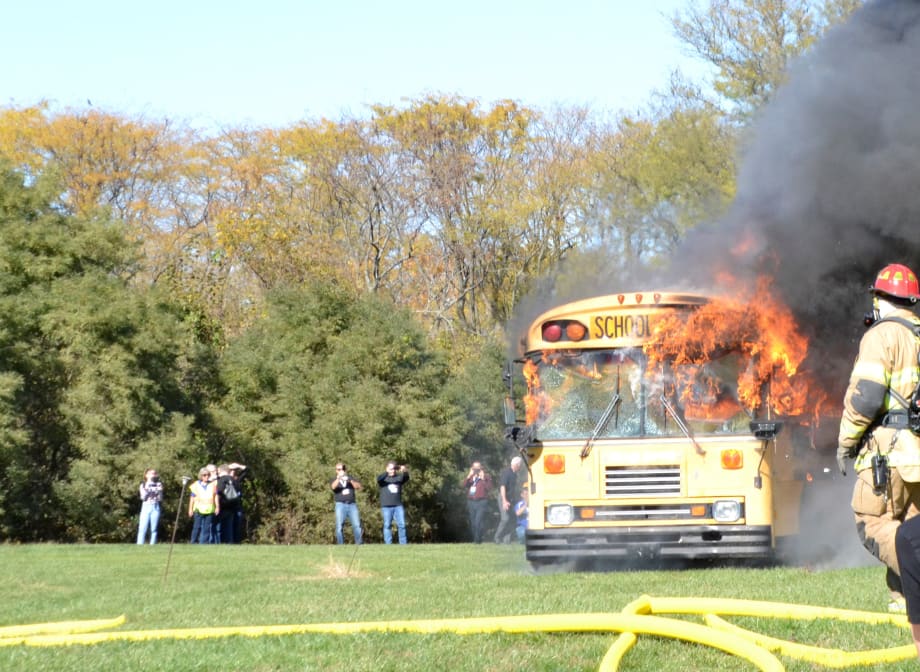
Firefighters and NAPT staff show how quickly a school bus can catch fire and how long evacuation can take in a demonstration that kicked off the association's annual conference.
Firefighters and NAPT staff show how quickly a school bus can catch fire and how long evacuation can take in a demonstration that kicked off the association's annual conference.
LEE’S SUMMIT, Mo. — How quickly can fire and smoke consume a school bus, and how long can it take to evacuate that student-filled bus, with or without seat belts involved? Conference attendees got to find out in a sobering demonstration on Saturday.
National Association for Pupil Transportation (NAPT) staff members partnered with the Lee’s Summit Fire Department to enact on one school bus the length of time it takes for flames to engulf the vehicle. That bus was placed a safe distance away from another, that was not set on fire but was intended to show the “students” (played by 30 volunteers from the audience) aboard, and how long it might take them to evacuate.
Once a fire was set on the first bus, the volunteers on the second bus began evacuation procedures in three different scenarios. In one, the volunteers were not wearing seat belts. In the other two, they were wearing seat belts, but in one of those enactments, they closed their eyes to simulate the lack of visibility due to thick smoke filling the bus.
Then, a third, overturned bus was used to show how long a passenger might take to evacuate in that situation. Footage from cameras inside the bus streamed onto a screen showed firefighters enacting the struggle to escape that passengers in such a scenario would encounter as smoke filled the bus.
Personal items that students normally bring aboard, such as backpacks, were included on the buses.
Dan Manley, the assistant chief of Lee’s Summit Fire Department, told the audience that straw was used to create the fires in the demonstration, and that the batteries and fuel tanks had been removed from the buses to eliminate any hazards.
He also advised the audience to keep in mind that the demonstration was being conducted with adults, and that a real-life, panic-filled situation with students of various ages would likely be more challenging.
As firefighters set the first bus on fire, the evacuation time for the volunteer “passengers” not having to unbuckle seat belts was one minute and 16 seconds. The second scenario, in which seat belts were worn, clocked in just two seconds longer, but the third, in which volunteers wore seat belts and closed their eyes to simulate reduced visibility due to smoke, the evacuation time was significantly longer: two minutes and 27 seconds.
Meanwhile, the overturned bus had become completely filled with smoke by the three-minute mark, and at that point, Manley said, temperatures inside it had reached 900 degrees to 1,000 degrees Fahrenheit, which would start breaking windows and increasing flame production.
He added that the total response time from when the fire department personnel would receive a call about such an incident to the time they would be able to respond and arrive on scene is about five minutes.
After the demonstration, some volunteers commented on their experience. One said that the smoke was so “thick, black, and heavy,” that “panic can set in pretty quickly.” Another noted that school staff members and students go through regular fire drills “nonchalantly,” but that scenarios like these are “evidence of why we do them.”
NAPT’s goal in presenting the demonstration was to show bus fire evacuation scenarios in a way that is as realistic and action-oriented as possible, Michael Martin, the executive director for NAPT, explained in the opening session on Saturday morning. He pointed to the recent school bus fire and crash in Mesquite, Texas, in which a student was killed, and the Iowa school bus fire in December 2017 that killed a student and a bus driver, as examples for the urgent need for school bus fire evacuation training.
More Safety

Geotab Expands Fleet Safety Tools With Video Coaching, Risk Insights
New safety and video capabilities aim to help fleet managers assess risk, support drivers, and take targeted action through video coaching, red-light violation detection, and more.
Read More →
How to Build a Better School Bus Driver Training Program
Is it time to strengthen your driver training? Here’s how to pick the right talent and improve recruitment, retention, and safety. This video is brought to you by IC Bus.
Read More →
Recent School Bus Accidents Leave 2 Dead, 2 Injured
Four school bus crashes in Florida, Illinois, and Georgia highlight risks in transportation lots, at bus stops, and during student loading and unloading.
Read More →

When Every Second Matters, Clarity Keeps Routes Moving
From routine delays to urgent incidents, strong communication practices help drivers, dispatchers, schools, and families respond with confidence.
Read More →
What Happens When a School Bus Catches Fire — and What Can Help
School bus fires are rare but can be devastating. Learn how advances in fire suppression and asset protection help fleets detect fires earlier, reduce damage, and improve safety.
Read More →
Geotab Launches Tool to Help Fleets Investigate Road Incidents
Geotab Investigations combines telematics data, video, documents, and other evidence to help fleets reconstruct incidents, resolve claims, and determine what happened.
Read More →
Texas Sixth Grader Wins 2026 National School Bus Safety Poster Contest
Sai Darshana Yekolu of Moseley Middle School in Prosper, Texas, was named the newest winner for her artwork, bringing the theme of “Safe Rides, Everyday Heroes” to life.
Read More →
Doing More With Less: How Transportation Directors Can Prioritize Safety Amid Budget Uncertainty
With diesel prices soaring and nearly one-third of transportation directors expecting budget cuts, maintaining student safety has never been more challenging. Download this guide to learn how leading districts are prioritizing risk, funding critical safety technology, and building stronger budget cases with data.
Read More →
Walton County Schools Adds Gatekeeper Stop-Arm Enforcement System
The Florida district will deploy Gatekeeper’s updated Student Protector technology, which now incorporates AI to improve video evidence.
Read More →
How To Build a More Secure School Bus Yard During and After Hours
As thefts and overnight security threats continue, school transportation leaders are combining stronger operational practices with AI-enabled surveillance to better protect buses, facilities, and staff.
Read More →