




Fire Suppression Systems: Saving Lives & Reducing Damage
Stop playing with fire! Many fire suppression systems are available for school buses, and with special technology that catches flames early, it can mean all the difference in saving lives and equipment.

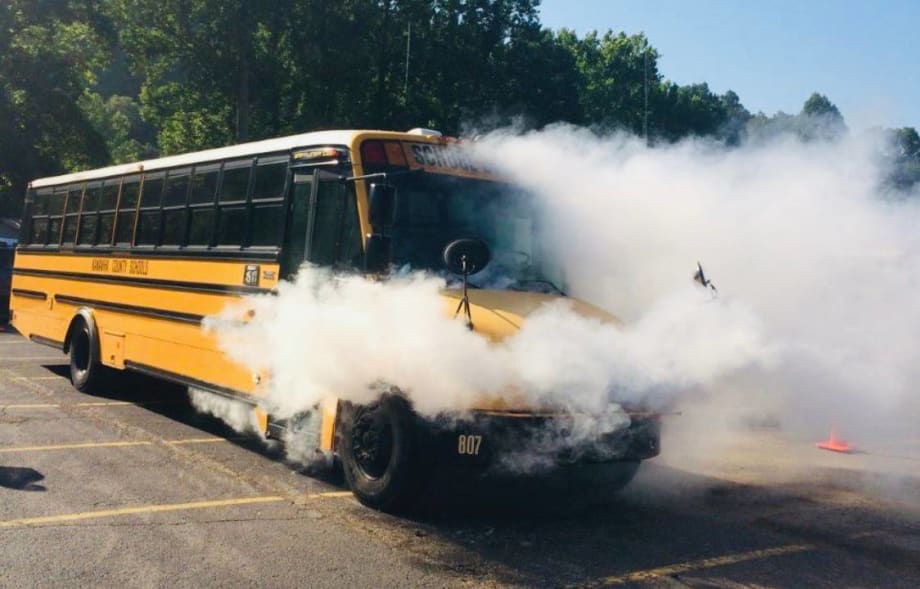
To increase awareness of the need for fire suppression systems and educate school and public officials on how they work, FireGator representatives hosted a demo of their system for the Kanawha County Schools’ transportation department last summer. Pictured here is the system discharging.
Photo courtesy of FireGator
When 74-year-old school driver Donald Hendricks turned his bus to pick up 16-year-old Megan Klindt at a rural Iowa farm in 2017, he never thought the ride would end in disaster. But when the bus’s rear wheel became stuck, an engine fire broke out when Hendricks tried to drive out of the ditch. The fire claimed the lives of both Hendricks and Klindt.
This very incident paved the way for new safety recommendations from the National Transportation Safety Board (NTSB) to reduce the chances of a similar event happening again.
After its investigation of the Iowa accident, in 2019, the NTSB called for all school buses to be equipped with fire suppression systems and suggested standards for all new school buses to prevent gases or flames passing from the engine to the passenger compartments. However, formal regulations and mandates have yet to be passed. Senator Tammy Duckworth, with Congressmen Spires and Cohen, did introduce the School Bus Safety Act, which is currently under review by the Committee on Commerce, Science, and Transportation. 73% of the NTSB recommendations are adopted into law. Only a small handful of states require a system to be installed in new buses. In Georgia, the requirement stands only for wheelchair-lift buses.
Fire suppression system provider Kidde Technologies Inc. notes that there is a significant gap in the use of fire suppression on school buses versus transit buses. “The transit market currently equips nearly 90% of their buses with AFES (automatic fire extinguishing systems); compared to less than 10% of school buses,” Matthew Clapp, Kidde OEM account manager, says. “School bus manufacturers respond to demands from their customer base, and so far, the recommendation has not really moved the needle with regards to increased usage.”
While the industry awaits further action, there is a silver lining for some suppliers. Brian T. Lyons, founder and national sales manager for FireGator, says that the NTSB’s 2019 recommendations, along with the delay from COVID, has allowed his company the time to move operations to 100% web-based. One manufacturer is installing FireGator on the assembly line.
A 2017 report from the John A. Volpe National Transportation Systems Center for the Federal Motor Carrier Safety Administration (FMCSA) found that school bus fires occur a little more than once a day in the U.S. It also noted a general downward trend in fire frequency from 2004 to 2013. But one fire is too many, and that’s where fire suppression systems can help.
Behind the Technology
While fires on school buses can start in a variety of ways, and many districts had already begun installing new technologies to prevent them, several suppliers stand ready to help equip every bus with a system to keep it safe.
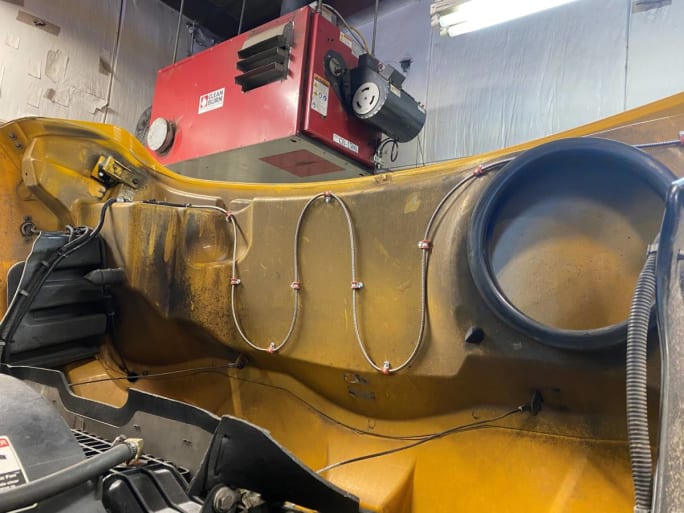
The Kidde Technologies system uses a special agent called “Purple K” to suppress fires, even when the school bus is off or idling, and self-monitors to quickly advise of maintenance issues.
Photo courtesy of Kidde Technologies
Automated fire suppression systems work by detecting and suppressing a fire before it spreads. It targets the three key aspects of a fire — oxygen, heat, and fuel — which together produces a chemical reaction. A good system will remove any one of these elements, thereby reducing vehicle damage, making response time shorter, and requiring minimal maintenance.
Fires are often the result of leaked fuel, engine overwork, faulty wires, or other equipment failure — and can spread in less than a minute. Many of today’s systems can suppress any kind of fire in any type of engine, including gasoline or alternative fuels like battery-electric, propane, compressed natural gas, and hydrogen.
It’s worth noting that there are five official classes of fire extinguishers: Class A, B, C, D, and K. The difference in each type lies in how a fire starts, what materials are involved, and what agents are needed to extinguish the flames.
One supplier, Firetrace, describes the process on its blog. “The system routes linear pneumatic detection tubing throughout the engine compartment to detect the fire,” the post reads. “Should a fire start in the engine compartment, the increase in temperature or direct contact with flame will cause the tubing to burst, releasing pressure on the cylinder. The change in pressure signals the system to discharge the agent through strategically placed diffuser nozzles, flooding the engine compartment quickly to suppress the fire.”
United Safety and Survivability Corporation manufactures Fogmaker, a system comprised of aluminum canisters, stainless steel tubing, and a quarter-inch hose. Although maintenance is minimal, there is a requirement for an annual inspection.
The Fogmaker system is an UL-approved (which stands for Underwriters' Laboratories, meaning a product has been tested and recognized for its safety standards) clean water mist. The company says that this environmentally sound solution results in easy cleanup, requiring a simple pressure wash of the impacted area. The key feature of the system is its discharge time of 45 to 70 seconds, resulting in a reduced likelihood of a re-flash event as it attacks all three elements of a fire.
“The system works in any orientation, even in the event of a rollover, which is a critical consideration in pupil transportation,” Ken Hedgecock, national sales manager for United Safety, says. “Our system is designed to protect not only the engine compartment, but also the battery box. The system is fully automatic and requires no electronic activation as it is designed to activate at 375 degrees through the loss of pressure in the detection line.”

Fogmaker fights fire with water — specifically a clean water mist that makes for easy cleanup and is environmentally friendly.
Photo courtesy of United Safety and Survivability Corporation/Fogmaker
Hedgecock says the Fogmaker system recently introduced a new fluorine-free suppression fluid that provides an enhanced environmental footprint without any impact to the efficacy of the system. The fluid offers freeze protection to -45 degrees centigrade.
Meanwhile, Kidde offers its KT100 system, which is also fully automatic, needing no action from the driver. The system uses a dry powder called Purple K to suppress the fire, and is always active, even when the bus is off or idling. The company says Purple K is an environmentally friendly agent that’s “easy to clean up after discharge and does an excellent job of suppressing a fire quickly and efficiently.”
Kidde’s only required maintenance is a guided visual inspection of the system’s components. The system self-monitors and advises if there are maintenance issues requiring a technician. The company provides hands-on training for all customers, making schools and bus operators less reliant on outside service providers.
Another solution is the FireGator automatic fire suppression system, which uses an exclusive Stat-X aerosol potassium generator that is non-pressurized until discharged. Lyons explains that during discharge, the system floods the entire area, unlike nozzles that aim at areas a fire will likely occur. The agent is EPA approved for human inhalation for up to one hour and is even used by the Department of Defense and NASA.
FireGator also offers an axle detection kit to go along with battery and under-dash protection. All of its systems are active even when the bus is off and can send a signal to emergency services when an event is detected.
Lyons says that school bus operators can save between $400 and $1,600 a year on inspections with a fire suppression system.
George Davis, bus shop supervisor for Fayette County (Ga.) Public Schools, also sits on the NCST school bus specifications committee that consults with Congress and makes recommendations for fire suppression in Georgia. He advises schools to ask their fire suppression provider whether the chemical will damage the wiring, engine, or other components in the compartment; if the system will fully discharge if the bus is on its side; and what maintenance is involved with the product. “A non-pressurized system will require less maintenance over the years,” he says. “The reason that corrosion is important is when you have an accidental discharge and don't want damage to the bus.”
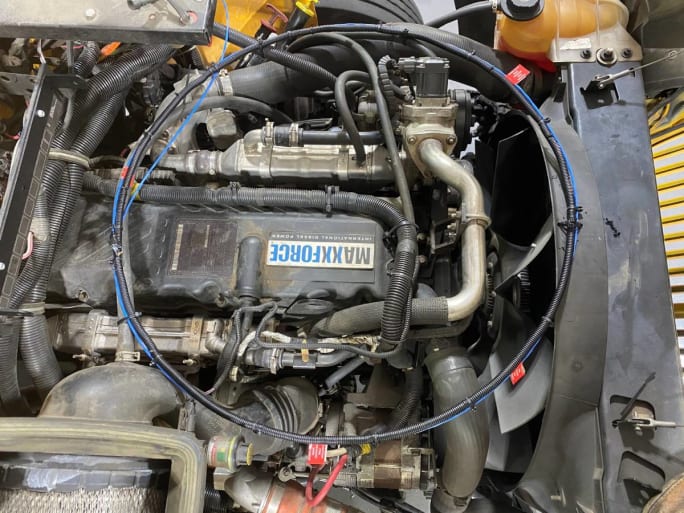
FireGator’s HALO sits on top of the engine and is easy to remove for any routine bus maintenance.
Photo courtesy of FireGator
Addressing EV Fires
It’s not just traditionally fueled buses that pose a problem. With EV buses on the rise, new concerns around battery and electrical fires have mounted.
“When considering a thermal event on an EV, there are two considerations,” Hedgecock explains. “First, it is imperative to protect the batteries from any fire that may occur in ancillary equipment. Second, consideration must be given to the batteries themselves should an event occur within the power source.”
Hedgecock also shares that an FAA-issued report states that water-based systems are best-suited to address lithium-ion battery thermal incidents.
FireGator’s suppression agent is UL approved to handle Class A, B, and C fires. The company notes that water-based systems are not approved for Class C or electric fires.
Systems In Use at School Districts
In Georgia, Michael Warner, associate director fleet maintenance for the Cobb County School District, has been installing fire suppression on all special needs lift buses since 2003 and has about 150 total buses with fire suppression on them. Most of their systems are from Amerex, but have some buses use Kidde.
“We work with our local fire departments and have supplied them with old buses to train on,” Warner explains. “And after seeing how fast a school bus can burn, I can see that fire suppression would give those extra couple minutes to evacuate the students. Especially on special needs buses.”
Brette S. Fraley, executive director, transportation, for the Kanawha County (W.Va.) Schools, shares that the district has had fire suppression for six years and added them to all new buses for five years.
“We need to ensure we have done everything possible to ensure the student, staff, and public are safe daily,” he says. “Fire suppression is just another layer of that protection.”
New Features
FireGator’s system also includes a 113-decibel horn to alert passersby of an emergency. “You want to notify a passing motorist or everybody around that’s something happening,” Lyons said in a Charleston Gazette-Mail news article. “The mindset behind that is to get passing motorists and everybody involved to stop at the bus and help give the kids an assist.”
Kidde commented on a newer trend of schools requesting to connect systems to the bus’s on-board telematics. Partnering with the Kanawha County School District and Zonar recently, their system provides a proactive notification by text if there was a fire on one of the district’s buses. Zonar confirms this was the company’s first integration with a fire suppression system to capture events and alert the end user.
“Our system provides on-screen, SMS text, and email notifications if and when the Kidde system is engaged,” Alex Kapcar, Zonar regional account manager, explained. “If there is an alert, Brette is able to identify the bus’s exact location and know who is on the bus using our ZPass system. We are excited to explore additional integrations with Kidde as we share a joint commitment to student safety.”
Clapp also notes that the near real-time notification also alerts directors of transportation and emergency personnel that a fire has occurred while the suppression system takes care of protecting the bus.
More Safety

How to Build a Better School Bus Driver Training Program
Is it time to strengthen your driver training? Here’s how to pick the right talent and improve recruitment, retention, and safety. This video is brought to you by IC Bus.
Read More →
Recent School Bus Accidents Leave 2 Dead, 2 Injured
Four school bus crashes in Florida, Illinois, and Georgia highlight risks in transportation lots, at bus stops, and during student loading and unloading.
Read More →
When Every Second Matters, Clarity Keeps Routes Moving
From routine delays to urgent incidents, strong communication practices help drivers, dispatchers, schools, and families respond with confidence.
Read More →

What Happens When a School Bus Catches Fire — and What Can Help
School bus fires are rare but can be devastating. Learn how advances in fire suppression and asset protection help fleets detect fires earlier, reduce damage, and improve safety.
Read More →
Geotab Launches Tool to Help Fleets Investigate Road Incidents
Geotab Investigations combines telematics data, video, documents, and other evidence to help fleets reconstruct incidents, resolve claims, and determine what happened.
Read More →
Texas Sixth Grader Wins 2026 National School Bus Safety Poster Contest
Sai Darshana Yekolu of Moseley Middle School in Prosper, Texas, was named the newest winner for her artwork, bringing the theme of “Safe Rides, Everyday Heroes” to life.
Read More →
Doing More With Less: How Transportation Directors Can Prioritize Safety Amid Budget Uncertainty
With diesel prices soaring and nearly one-third of transportation directors expecting budget cuts, maintaining student safety has never been more challenging. Download this guide to learn how leading districts are prioritizing risk, funding critical safety technology, and building stronger budget cases with data.
Read More →
Walton County Schools Adds Gatekeeper Stop-Arm Enforcement System
The Florida district will deploy Gatekeeper’s updated Student Protector technology, which now incorporates AI to improve video evidence.
Read More →
How To Build a More Secure School Bus Yard During and After Hours
As thefts and overnight security threats continue, school transportation leaders are combining stronger operational practices with AI-enabled surveillance to better protect buses, facilities, and staff.
Read More →
FMCSA Names New Chief Safety Officer: What School Bus Operators Should Know
Steve Dowling is set to lead the federal agency's efforts to advance commercial motor vehicle safety and reduce crashes, fatalities, and injuries on the nation's roadways.
Read More →