





Read More: WRI Releases Electric School Bus Training Standards
School Bus Safety Act Tries Again
Congressman Cohen and Tammy Duckworth reintroduce the school bus safety act that has been in and out of consideration since 2018.
March 11, 2025
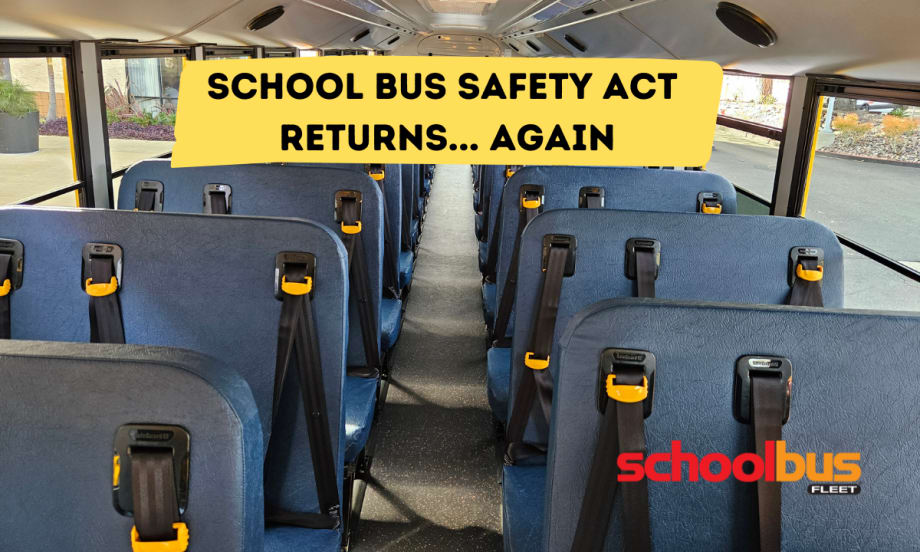
After first appearing in Congress in 2018, the School Bus Safety Act returns for the fourth time looking to implement requirements for seatbelts and automatic breaking systems on yellow buses nationwide.
Photo: Amanda Huggett/Canva
4 min to read
Editor's Note: This post was originally published on November 6, 2024, and was updated and republished on March 11, 2025, after the act was resurrected again.
Congressman Steve Cohen (TN-9) and Senator Tammy Duckworth of Illinois have reintroduced the School Bus Safety Act, now with the added "of 2025" at the end.
Last fall's version was filed as HR 10022 to implement safety recommendations from the National Transportation Safety Board (NTSB), including the installation of seat belts for every seat and other safety measures. The 2024 measure, introduced during National School Bus Safety Week, sought to also create a grant program to help school districts modify their school buses to implement the specifications. These same goals are outlined in the 2025 version.
History of the Bill
Congressman Cohen first introduced a version of the bill in 2018 as HR 6773 (115th), with revisions appearing in 2019 as HR 3959 (116th), 2021 as HR 3381 (117th), and 2023 as S.2746. Senator Tammy Duckworth of Illinois and Senator Sherrod Brown of Ohio introduced a companion measure to the current bill in the Senate.
“There is no more precious cargo than school-aged children entrusted by their parents for a ride to school,” Congressman Cohen said in a news release. “The commonsense measures recommended by the NTSB and called for in this legislation will save young lives. I am pleased to reintroduce this legislation with Senators Duckworth and Brown to make school buses across the country safer while helping financially strapped school districts modify their school bus fleets to meet the new specifications. We’ve seen too many deaths and serious injuries in school bus accidents in Tennessee and elsewhere, and it is past time we act to save young lives.”
While seat belt requirements have been unsuccessful at the federal level, there are less than a dozen states that have legislation for seat belts on the books. However, several of these laws can only be enforced if there is available funding for seat belts.
Proposed Requirements
The School Bus Safety Act would require the Department of Transportation to issue rules requiring all school buses to include:
A three-point safety belt, which includes a seat belt across a lap, as well as a shoulder harness, to protect passengers by restraining them in case of a collision.
An Automatic Emergency Braking System, which helps prevent accidents and crashes by detecting objects or vehicles ahead of the bus and braking automatically.
An Event Data Recorder (EDR) that can record pre- and post-crash data, driver inputs, and restraint usage when a collision does occur.
An Electronic Stability Control (ESC) System that uses automatic computer-controlled braking of individual wheels to assist the driver in remaining in control of the vehicle.
A Fire Suppression System, which addresses engine fires.
A Firewall that prohibits hazardous quantities of gas or flame to from passing from the engine compartment to the passenger compartment.
According to the National Highway Traffic Safety Administration (NHTSA), from 2023 to 2022 there were 976 fatal school transportation-related crashes, and 1,082 people of all ages were killed in those crashes, averaging at 108 fatalities per year.
The School Bus Safety Act hopes to reduce those numbers and is supported by the National Safety Council (NSC), Advocates for Highway and Auto Safety, the Center for Auto Safety, the National Sheriffs’ Association, the American Academy of Pediatrics, the National Parent Teacher Association, and Consumer Reports.
A grant program would be implemented under the bill if approved to help schools fund these upgrades. The legislation would take one year to take effect after the rules are issued.
Stopping Illegal Stop Arm Passings
While seatbelts and other safety systems are the focus of the School Bus Safety Act, the National School Transportation Association (NSTA) has been highlighting another safety concern.
During the 2024 NSTA Capitol Hill Bus-In, they focused on advocating for enhanced safety measures for reducing the number of illegal school bus passings across the country.
These measures were recently brought to the House by Congressman Rudy Yakym (IN-2) and Congresswoman Julia Brownley (CA-26) with HR3998, the Enhancing Necessary Data (END) Illegal School Bus Passings Act.
When the School Bus Safety Act was reintroduced in 2019, the NSC made a statement in support of the act. They emphasized the lifesaving benefits of seat belts along with the need to incorporate technology on buses to record illegal school bus passings and make prosecuting violators easier.
More Safety

How to Build a Better School Bus Driver Training Program
Is it time to strengthen your driver training? Here’s how to pick the right talent and improve recruitment, retention, and safety. This video is brought to you by IC Bus.
Read More →
Recent School Bus Accidents Leave 2 Dead, 2 Injured
Four school bus crashes in Florida, Illinois, and Georgia highlight risks in transportation lots, at bus stops, and during student loading and unloading.
Read More →
Sponsored•September 8, 2026
When Every Second Matters, Clarity Keeps Routes Moving
From routine delays to urgent incidents, strong communication practices help drivers, dispatchers, schools, and families respond with confidence.
Read More →

What Happens When a School Bus Catches Fire — and What Can Help
School bus fires are rare but can be devastating. Learn how advances in fire suppression and asset protection help fleets detect fires earlier, reduce damage, and improve safety.
Read More →
Geotab Launches Tool to Help Fleets Investigate Road Incidents
Geotab Investigations combines telematics data, video, documents, and other evidence to help fleets reconstruct incidents, resolve claims, and determine what happened.
Read More →
Texas Sixth Grader Wins 2026 National School Bus Safety Poster Contest
Sai Darshana Yekolu of Moseley Middle School in Prosper, Texas, was named the newest winner for her artwork, bringing the theme of “Safe Rides, Everyday Heroes” to life.
Read More →
Sponsored•August 27, 2026
Doing More With Less: How Transportation Directors Can Prioritize Safety Amid Budget Uncertainty
With diesel prices soaring and nearly one-third of transportation directors expecting budget cuts, maintaining student safety has never been more challenging. Download this guide to learn how leading districts are prioritizing risk, funding critical safety technology, and building stronger budget cases with data.
Read More →
Walton County Schools Adds Gatekeeper Stop-Arm Enforcement System
The Florida district will deploy Gatekeeper’s updated Student Protector technology, which now incorporates AI to improve video evidence.
Read More →
How To Build a More Secure School Bus Yard During and After Hours
As thefts and overnight security threats continue, school transportation leaders are combining stronger operational practices with AI-enabled surveillance to better protect buses, facilities, and staff.
Read More →
FMCSA Names New Chief Safety Officer: What School Bus Operators Should Know
Steve Dowling is set to lead the federal agency's efforts to advance commercial motor vehicle safety and reduce crashes, fatalities, and injuries on the nation's roadways.
Read More →