SchoolBus logo in red and orange
MenuMENU
SearchSEARCH

Earlier Fire Warnings Could Save Property and Lives in Bus Fleets

How can the combination of telematics and automatic fire suppression systems reduce the risk of catastrophes in school bus fleets?

Wes Platt
Wes PlattFormer Executive Editor
Read Wes's Posts
July 19, 2024
Zonar and Kidde Technologies

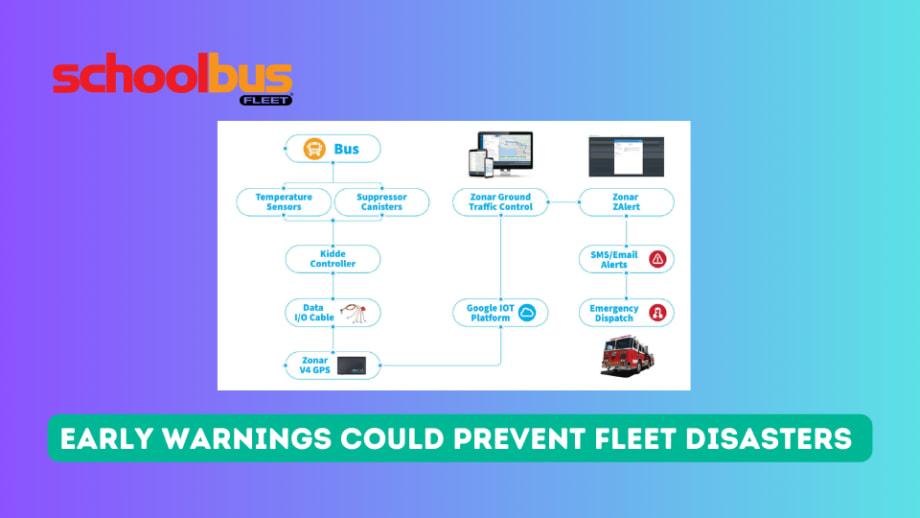
The Kidde Technologies fire system sends an alert to Zonar's telematics system, making it possible to alert fleet managers before a fire can spread.

Source: Zonar

4 min to read


One night in West Virginia last year, a school bus caught fire in the middle of the night. Unattended, unnoticed, the blaze spread to two nearby buses and destroyed them as well. Lacking an automatic fire suppression system (AFSS) and telematics, disaster couldn’t be averted, says Jason Redman, school transportation director for neighboring Kanawha County: “If they had the AFSS and telematics, the system would have automatically alerted someone of a fire event before it could have escalated.”

School buses are a lifeline for millions of students, taking them safely between home and school. But, like any vehicle, buses are susceptible to fires, which can pose critical risks to the lives of children and drivers. The integration of advanced fire safety technologies, such as telematics and AFSS developed by companies like Kidde Technologies, helps improve the chances of preventing catastrophes.

Ad Loading...

Advanced Fire Detection and Suppression

At the heart of Kidde's modern fire safety systems are linear heat detectors (LHD) installed in the engine and battery compartments of school buses. Tim Ammon of Zonar explains: "Each bus has detectors in the engine and battery box. One of these is called a linear heat detector (LHD). This detects heat along the entire length of a sensor cable, which is a twisted pair of wires that run in a circuit around the box. Should the temperature rise to 465 degrees, the coating around those two wires melts and the wires touch, creating an electrical short. This sends a signal to the fire alarm panel, and that’s the alert."

EXAMPLES OF FIRE SUPPRESSION PROVIDERS

Companies that develop fire suppression systems for school buses include:

  • Fogmaker North America: Water-mist technology that deploys mist mixed with foam to suppress fires.

  • Kidde Technologies: Uses linear thermal detection wires to identify potential fire risks.

  • Stat-X: Advanced aerosol fire-suppression technology.

  • FireGator: Using potassium-based aerosol agents to extinguish fires in engine compartments and enclosed areas.

This early detection mechanism is crucial in identifying potential fires before they escalate.

Once a fire is detected, the suppression system activates automatically. "Two nozzles under the hood deploy the extinguisher and put out the fire," Ammon continues. This rapid response is essential in preventing small fires from becoming catastrophic incidents, thereby protecting the students and the bus.

Seamless Integration for Enhanced Safety

The integration between telematics systems and AFSS plays a pivotal role in ensuring swift and efficient fire response. This integration allows for real-time communication and automatic alerts to emergency services. "The system connects to our GPS unit, so when an event occurs, the GPS box triggers an alert, which can send emails and text messages to local emergency dispatch," says Ammon. This automated alert system ensures that emergency responders are notified immediately, even if the driver is focused on evacuating the students.

Redman, the West Virginia transportation director, elaborates on the benefits of this integration, particularly in rural areas: "If a fire event occurs in the presence of a driver, their priority would be to unload the students as quickly as possible. This means communicating to emergency personnel that a fire event is present several minutes after the initial fire is discovered. With these systems onboard, the task of notifying emergency services is taken off the driver and they can focus on unloading passengers and getting to safety."

Ad Loading...

This division of responsibilities allows for a more coordinated and effective emergency response.

Operational Efficiency and Cost Savings

Beyond safety, the integration of these technologies also enhances operational efficiency. School buses are significant investments for school districts, and the cost of replacing a burned bus can be substantial. Ammon points out, "From an operational efficiency standpoint, if a bus has burned, it could take up to 18 months to rebuild or the district can buy a used bus, which may be hard to come by given supply chain issues." Preventing fires not only saves lives but also preserves valuable assets and reduces financial strain on school districts.

In Kanawha County, all school buses equipped with wheelchair lifts have AFSS installed. Redman emphasizes the improvement in emergency response times.

"These systems are great on their own, but with the ability to identify a suppression event and communicate the bus’s real-time location with emergency services, their response time will greatly improve,” Redman says. “Any firefighter will tell you that every second counts."

Looking ahead, the industry is committed to advancing fire safety technologies for school buses. Ammon discusses potential innovations: "One thing we’re looking at is using data to provide some form of early warning so that drivers can shut down an engine before a fire occurs. For example, EV bus lithium-ion batteries emit hydrogen gas prior to a thermal runaway, which can lead to a fire. One possible solution would be to detect that off-gas and alert the driver before a fire occurs."


Subscribe to Our Newsletter

More Safety

Fatal School Bus Accident in New York graphic dated Jan. 29, 2026, showing a close-up of a yellow school bus with cracked-glass overlay and School Bus Fleet logo.
Safetyby StaffFebruary 3, 2026

New York 5-Year-Old Killed by School Bus, Investigation Ongoing

A Rockland County child was struck by their school bus late last week. Here's what we know so far about this and other fatalities and injuries in the area over the years.

Read More →
A red, orange and yellow graphic with anti-pinch door sensor products and text reading "Maine's New Mandate: Anti-Pinch-Sensors & Bus Safety."
Safetyby Elora HaynesJanuary 29, 2026

Prevent School Bus Dragging Incidents: Anti-Pinch Door Sensors and Maine’s New Mandate

As Maine becomes one of the first states to require anti-pinch door sensors on new school buses, manufacturers like Mayser offer a look at how the technology works and why it's a critical fail-safe.

Read More →
SponsoredJanuary 29, 2026

8 Ways To Simplify and Streamline School Bus Fleet Operations

What if your fleet technology actually worked together? Learn eight practical strategies to integrate multiple systems into one platform, unlocking clearer insights, stronger safety standards, and smoother daily operations.

Read More →
Ad Loading...
an illustration of a survey on a mobile phone with a hand on it, and the words Survey Says on it
Safetyby News/Media ReleaseJanuary 28, 2026

Survey: Most Parents Want Automated Enforcement on School Buses

A recent Verra Mobility survey reports that 82% of parents support safety cameras to penalize stop-arm violators and 70% favor automated enforcement in school zones.

Read More →
Image of an extended stop-arm with text reading "School Bus Safety: Funding Provides Bus Upgrades Across Ohio."
Safetyby StaffJanuary 27, 2026

State Grant Program Advances School Bus Safety Upgrades Across Ohio

$10 million in state grants will fund safety upgrades and new features on school buses serving students across the Buckeye State.

Read More →
A white Waymo vehicle waits at a crosswalk as a family crosses.
Safetyby StaffJanuary 26, 2026

Waymo Scrutiny Intensifies as NTSB Launches Investigation

After complications in multiple cities when self-driving taxis failed to stop for school buses, the NTSB joins NHTSA in a probe to determine what's behind the tech and related safety concerns.

Read More →
Ad Loading...
Transportant stop arm camera shown on an orange “new product” graphic with School Bus Fleet branding.
SafetyJanuary 20, 2026

Transportant Debuts First Full-Color Stop Arm Camera for School Buses

Transportant introduced a next-generation stop arm camera designed to improve image quality and reliability for documenting illegal school bus passings.

Read More →
SponsoredJanuary 19, 2026

3 New Ways Fleet Software Pays: ROI opportunities for modern fleet managers

Keeping buses safe, reliable, and on schedule requires more than manual processes. This eBook explores how modern fleet software supports school transportation teams with automated maintenance scheduling, smarter video safety tools, and integrated data systems. Discover practical ways fleets are reducing breakdowns, improving safety, and saving valuable staff time.

Read More →
An image of a student with a backpack walking with text reading "Walking School Bus: Grant Fuels Safer Pedestrian Routes to School in New Mexico."
Safetyby Elora HaynesJanuary 15, 2026

New Mexico District Receives $2.7M Grant to Expand Walking School Bus Programs

See how a federal grant will help Albuquerque Public Schools expand supervised walking routes and improve student safety.

Read More →
Ad Loading...
Illustration showing a school bus with a standard stop arm and a deployed retractable safety barrier extending across the roadway to block passing vehicles.
Safetyby News/Media ReleaseJanuary 13, 2026

Florida Inventor Creates Retractable 10-Foot Stop-Arm

A newly developed school bus safety device introduces a retractable barrier designed to deter illegal passing during student loading and unloading.

Read More →