




NTSB Calls for New Safety, Training Standards Based on Fatal Iowa School Bus Fire
After investigating the 2017 fatal school bus fire in Iowa, the National Transportation Safety Board recommends several new school bus safety requirements and calls for fire suppression systems on school buses.

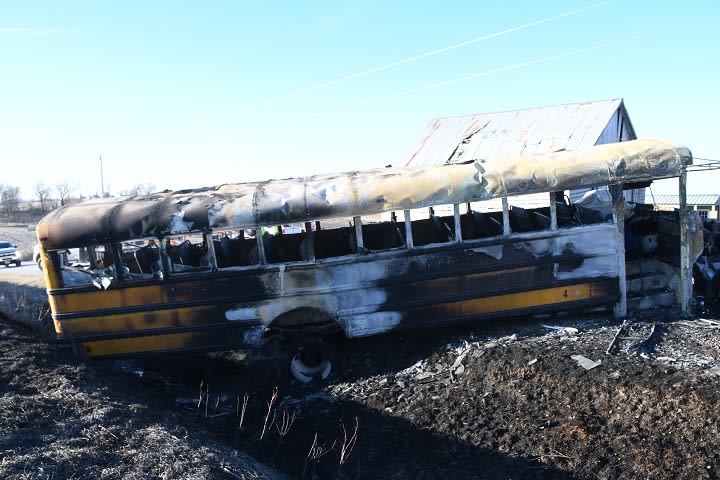
After investigating the 2017 fatal school bus fire in Iowa, the NTSB has recommended several new school bus safety requirements and called for fire suppression systems on school buses. Photo courtesy Pottawattamie County Sheriff's Office
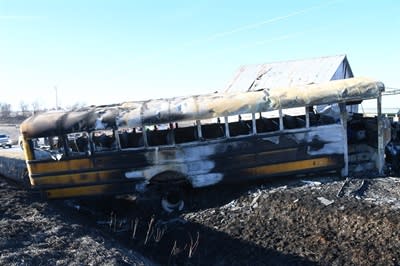
After investigating the 2017 fatal school bus fire in Iowa, the NTSB has recommended several new school bus safety requirements and called for fire suppression systems on school buses. Photo courtesy Pottawattamie County Sheriff's Office
WASHINGTON, D.C. — The National Transportation Safety Board (NTSB) on Tuesday concluded its investigation into the 2017 fatal school bus fire in Iowa, and called for several new school bus safety requirements, including the use of fire suppression systems on all school buses.
As SBF previously reported, the Dec. 12, 2017 school bus fire occurred when 74-year-old bus driver Donald Hendricks turned from a rural gravel road onto a driveway to pick up 16-year-old Megan Klindt at the farm where she lived in a rural area near the small town of Oakland.
According to a preliminary report released by the NTSB in January 2018, as Hendricks reversed out of the driveway, the bus’s rear wheels dropped into a 3-foot-deep-ditch. While Hendricks attempted to drive the bus out of the ditch, a fire began in the engine compartment and spread throughout the school bus.
The Iowa Office of the State Medical Examiner confirmed that both Hendricks and Klindt died from “smoke and soot inhalation and thermal injuries.”
In the report released on Tuesday, the NTSB determined that the probable cause of the fire was due to Hendricks’ failure to maintain control of the school bus — for reasons that could not be determined — and the failure of the Riverside Community School District to provide adequate oversight by allowing a driver with a known physical impairment to operate a school bus.
As SBF previously reported, a medical report recently released by the NTSB revealed that Hendricks had a history of medical issues leading up to the fire, including back pain and difficulty sleeping. However, the medical report did note that Hendricks was found to be qualified for a commercial driver’s license on an exam dated March 6, 2017, and that the certificate was valid for two years.
In opening the meeting, NTSB Chairman Robert Sumwalt pointed out that “drivers should be medically fit not only to operate the vehicle but also to assist in its evacuation in an emergency.” However, in the case of the Iowa school bus fire, Riverside Community School District allowed Hendricks to continue driving “despite the fact that the transportation supervisor, the school principal, and the driver’s coworkers knew of the driver’s physical impairment.”
The NTSB also noted in the report on Tuesday that the origin of the fire was the exterior of the engine’s turbocharger, and that investigators found that when the bus came to rest in the ditch, the exhaust was blocked. As Hendricks attempted to drive the bus out of the ditch, repeatedly accelerating the engine, it caused turbocharger overload with significant heat output which resulted in the fire, according to the report. Also contributing to the severity of the fire was the spread of flames, heat, and toxic gases from the engine into the passenger compartment through an incomplete firewall.
At the end of the meeting on Tuesday, NTSB approved a total of 10 new safety recommendations. The recommendations addressed issues that included school bus driver physical fitness, school bus fire safety, and emergency evacuation training.
Among the most notable recommendations were the NTSB’s calls on the U.S. Department of Transportation (U.S. DOT) and the National Highway Traffic Safety Administration (NHTSA) to require all school buses to be equipped with fire suppression systems.
The agency also urged the NHTSA to “develop standards for newly manufactured school buses, especially those with engines that extend beyond the firewall, to ensure that no hazardous quantity of gas or flame can pass through the firewall from the engine compartment to the passenger compartment.”
In addition, the NTSB recommended that 44 states, including the District of Columbia and Puerto Rico, mandate annual physical performance tests for all school bus drivers, and also whenever their physical condition changes in a manner that could affect their ability to physically perform school bus driver duties, including helping passenger evacuate a bus in an emergency.
The agency also advised members of the National Association of State Directors of Pupil Transportation Services (NASDPTS), National Association for Pupil Transportation (NAPT), and National School Transportation Association (NSTA) to “verify that students are educated on how to operate the manual release handle for front-loading doors on school buses during evacuation training and drills.”
Barry R. Sudduth, president of NAPT, said in a statement on Tuesday that the organization “appreciates NTSB’s efforts to help bring clarity to this tragic event,” and that it “continues to believe possible scenarios in which drivers and students may be unable to extricate themselves — or not extricate themselves fast enough — merits special attention from the U.S. DOT and its component agencies.”
On Wednesday, NASDPTS and NSTA also released statements in support of the NTSB’s report and safety recommendations.
NASDPTS said in its statement that it “will consider all aspects of the report to support our shared goal of raising our safety bar even higher,” and that the association’s board “will discuss drivers’ fitness to perform their duties, including assisting in evacuation and training of students, and improving fire safety standards for school buses.”
The NSTA, however, did caution that initiatives that include retrofitting existing vehicles with fire suppression systems may not be consistent with original vehicle design, integrity, and warranty standards. The NSTA also said that these efforts should be fully funded or should be made at the state and local level where school budgets are resolved.
To view the full report and recommendations, go here.
More Safety
Illegal School Bus Passing Drops 24% in New York Districts
With fewer than 5% of citations involving repeat offenders, Westchester County officials said enforcement, education, and community partnerships are helping change driver behavior.
Read More →
School's Back. Here's What Happened to Traffic, Speeding & Distraction
What happens to traffic when school resumes? New data analysis examines changes in distracted driving, congestion, and speeding around schools.
Read More →
Geotab Expands Fleet Safety Tools With Video Coaching, Risk Insights
New safety and video capabilities aim to help fleet managers assess risk, support drivers, and take targeted action through video coaching, red-light violation detection, and more.
Read More →

How to Build a Better School Bus Driver Training Program
Is it time to strengthen your driver training? Here’s how to pick the right talent and improve recruitment, retention, and safety. This video is brought to you by IC Bus.
Read More →
Recent School Bus Accidents Leave 2 Dead, 2 Injured
Four school bus crashes in Florida, Illinois, and Georgia highlight risks in transportation lots, at bus stops, and during student loading and unloading.
Read More →
When Every Second Matters, Clarity Keeps Routes Moving
From routine delays to urgent incidents, strong communication practices help drivers, dispatchers, schools, and families respond with confidence.
Read More →
What Happens When a School Bus Catches Fire — and What Can Help
School bus fires are rare but can be devastating. Learn how advances in fire suppression and asset protection help fleets detect fires earlier, reduce damage, and improve safety.
Read More →
Geotab Launches Tool to Help Fleets Investigate Road Incidents
Geotab Investigations combines telematics data, video, documents, and other evidence to help fleets reconstruct incidents, resolve claims, and determine what happened.
Read More →
Texas Sixth Grader Wins 2026 National School Bus Safety Poster Contest
Sai Darshana Yekolu of Moseley Middle School in Prosper, Texas, was named the newest winner for her artwork, bringing the theme of “Safe Rides, Everyday Heroes” to life.
Read More →
Doing More With Less: How Transportation Directors Can Prioritize Safety Amid Budget Uncertainty
With diesel prices soaring and nearly one-third of transportation directors expecting budget cuts, maintaining student safety has never been more challenging. Download this guide to learn how leading districts are prioritizing risk, funding critical safety technology, and building stronger budget cases with data.
Read More →