




New NTSB Investigation Report Highlights Driver Impairment and Medical Requirements
The recent investigative report found driver impairment and fatigue from prescription medications led to a fatal school bus crash in 2024 in Illinois.

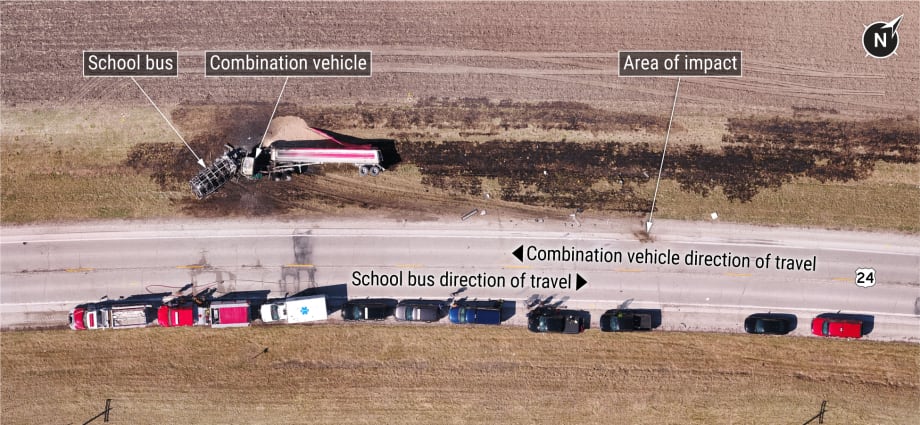
Post-crash orthomosaic aerial image showing the final rest positions of the school bus and combination vehicle. Emergency and first-responder vehicles were parked on the south shoulder and were not present at the time of the crash.
Illinois State Police/Annotated by NTSB
The National Transportation Safety Board (NTSB) released an investigative report on March 6 of a 2024 crash near Rushville, Schuyler County, Illinois, linked to driver fatigue and multiple prescription medications while driving.
The report revealed NTSB’s findings from a March 11, 2024, crash where a 57-year-old school bus driver drifted over the center line into the path of a semi-truck, resulting in a collision that killed the female bus driver, all three children on board, and the driver of the tractor-trailer.
According to the report, “As the school bus negotiated a right-hand curve, it crossed the centerline and collided head-on with a westbound 2001 Mack CH613 truck-tractor in combination with a 2001 Vantage 39-foot end-dump semitrailer. The impact ignited an immediate fire involving the school bus. Both vehicles then departed the north side of the roadway, where the combination vehicle’s semitrailer overturned. The postcrash fire spread, engulfing both vehicles.”
The witness following the school bus stated that no brake lights were illuminated, and investigators found no tire marks on the roadway, indicating that the school bus driver had braked to avoid the collision.
Despite the school bus being equipped with driver assistance technologies, the investigation determined the driver did not react in time due to impairment and fatigue from a combination of prescription medications and medical history.
Investigation Finds Driver Impairment, Not Vehicle Failure, at Root of Crash
After the crash, postmortem toxicology testing revealed multiple CNS depressants in the school bus driver’s system, including promethazine, baclofen, tramadol, and gabapentin, as well as phentermine, an amphetamine.
According to the NTSB report, “CNS depressants can cause drowsiness, slowed reaction times, impaired coordination, and reduced attention, all of which negatively affect driving performance.”
Many prescription and over-the-counter medications can impair driving ability, and the risks significantly increase when multiple medications are used together. Communicating these risks to patients remains a “persistent challenge, and the NTSB has advocated for clearer, more consistent drug labeling and increased driver awareness.”
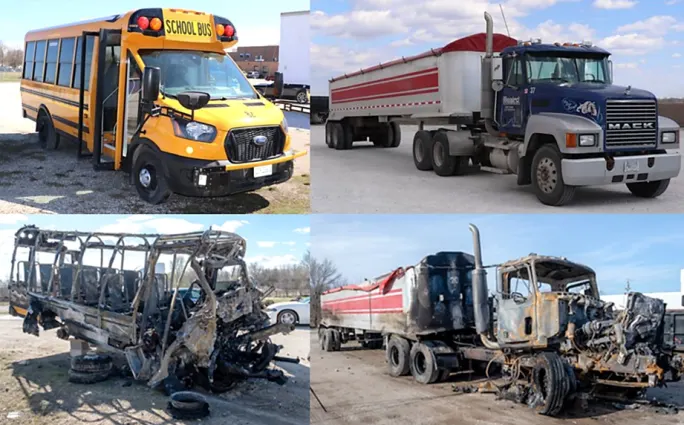
Top, an exemplar school bus and combination vehicle. Bottom, the crash-involved vehicles at the time of examination.
National Transportation Safety Board
In terms of the vehicle’s function, the postcrash examination of the school bus found no operational issues with the electrical, steering, or brake systems, nor with its powertrain, suspension, tires, or wheels.
The school bus was equipped with driver assistance technologies, including a lane-keeping system (LKS), also known as a lane-departure prevention system. However, due to the fire damage, investigators could not determine whether the LKS had been enabled at the time of the crash.
The driver was wearing a lap/shoulder belt, and the students were wearing lap belts. According to the report, the best protection for the preschool-age children would have been a child restraint system that meets Federal Motor Vehicle Safety Standard (FMVSS) 213. However, given the crash severity and the immediate postcrash fire that overtook the school bus, “it is unlikely that proper use of [child safety restraint systems] would have prevented fatal injuries to the school bus passengers.” The 72-year-old male truck driver was also unbelted.
NTSB Calls Attention to School Bus Driver Medical History Reporting
Although school buses are one of the safest modes of transportation, the NTSB continues to advocate for further improvements in school bus safety. A 2025 study analyzing NTSB accident data found that 31% of medically related transportation accidents involved operators failing to disclose conditions or medications during regulatory exams.
The Rushville crash emphasizes two critical areas where improvements can significantly reduce risk:
- Eliminating the use of impairing prescription medication by school bus drivers.
- Ensuring that driver assistance technologies are enabled.
The NTSB has repeatedly stressed the importance of school bus drivers being medically fit for duty. Several pieces of evidence suggest the school bus driver was also fatigued on the day of the crash. The driver self-reported, and friends and family confirmed, that she suffered from chronic fatigue, likely from chronic pain and medication.
The switch from central standard time to central daylight time also occurred the previous day. Interviews and cell phone records determined that waking earlier than usual, combined with the time change, caused her to wake one and a half hours earlier than her typical schedule, resulting in six hours of sleep opportunity.
The NTSB has also recommended that the Federal Motor Carrier Safety Administration provide explicit guidance encouraging certified medical examiners to request a complete list of medical conditions and medications from commercial drivers’ healthcare providers.
In Illinois, school bus drivers must meet the requirements set forth in 92 Illinois Administrative Code Section 1035.20. However, NTSB investigators noted that the form titled “Physical Examination and Certificate for Illinois School Bus Driver,” which was in use at the time of the Rushville crash, was limited in scope. The medical form in use at the time of the crash did not include two pertinent questions: disclosure of medications and sleep disorders. In 2026, the Illinois form was modified to include these types of questions.
“It is essential that school bus drivers accurately and completely disclose their health history and all medications they are taking during the hiring and certification process and throughout their employment,” the report read. “In addition to understanding the risk of prescription medications, driver assistance technologies must remain enabled.”
Even though the school bus in this scenario was equipped with a lane departure prevention system consistent with past NTSB safety recommendations, the circumstances of the crash likely “fell within the system’s operational design parameters,” meaning that if the system had been active, it could potentially have issued a warning and provided temporary steering assistance as the school bus began to drift from its lane.
More Safety
Illegal School Bus Passing Drops 24% in New York Districts
With fewer than 5% of citations involving repeat offenders, Westchester County officials said enforcement, education, and community partnerships are helping change driver behavior.
Read More →
School's Back. Here's What Happened to Traffic, Speeding & Distraction
What happens to traffic when school resumes? New data analysis examines changes in distracted driving, congestion, and speeding around schools.
Read More →
Geotab Expands Fleet Safety Tools With Video Coaching, Risk Insights
New safety and video capabilities aim to help fleet managers assess risk, support drivers, and take targeted action through video coaching, red-light violation detection, and more.
Read More →

How to Build a Better School Bus Driver Training Program
Is it time to strengthen your driver training? Here’s how to pick the right talent and improve recruitment, retention, and safety. This video is brought to you by IC Bus.
Read More →
Recent School Bus Accidents Leave 2 Dead, 2 Injured
Four school bus crashes in Florida, Illinois, and Georgia highlight risks in transportation lots, at bus stops, and during student loading and unloading.
Read More →
When Every Second Matters, Clarity Keeps Routes Moving
From routine delays to urgent incidents, strong communication practices help drivers, dispatchers, schools, and families respond with confidence.
Read More →
What Happens When a School Bus Catches Fire — and What Can Help
School bus fires are rare but can be devastating. Learn how advances in fire suppression and asset protection help fleets detect fires earlier, reduce damage, and improve safety.
Read More →
Geotab Launches Tool to Help Fleets Investigate Road Incidents
Geotab Investigations combines telematics data, video, documents, and other evidence to help fleets reconstruct incidents, resolve claims, and determine what happened.
Read More →
Texas Sixth Grader Wins 2026 National School Bus Safety Poster Contest
Sai Darshana Yekolu of Moseley Middle School in Prosper, Texas, was named the newest winner for her artwork, bringing the theme of “Safe Rides, Everyday Heroes” to life.
Read More →
Doing More With Less: How Transportation Directors Can Prioritize Safety Amid Budget Uncertainty
With diesel prices soaring and nearly one-third of transportation directors expecting budget cuts, maintaining student safety has never been more challenging. Download this guide to learn how leading districts are prioritizing risk, funding critical safety technology, and building stronger budget cases with data.
Read More →