




As Performance Testing Recommendation Is Handed Down, A New York District Shares Success
School Bus Driver Fitness Remains Concern, Despite Lessons Learned
As a result of a fatal Iowa school bus crash, the NTSB made 10 safety recommendations to prevent a similar tragedy. One recommendation called for 44 states to implement a driver physical performance test.

Christy Grimes・Former Senior Editor

4 min to read
Transportation leaders are reflecting on what they’ve learned five years after a horrific school bus crash killed a driver and its lone passenger in Oakland, Iowa. It exposed the lack of driver fitness among many school bus drivers across the country.
Max Christensen with the Iowa Department of Education’s bureau of school business operations spoke about bus driver fitness issues, including the fatal Iowa crash, at the 53rd annual National Association of State Directors of Pupil Transportation Services Conference this week. It was part two of the virtual conference, which had its first workshops in December.
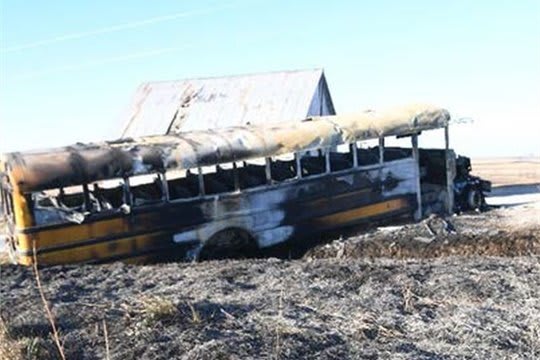
In a 2017 school bus crash, driver Donald Hendricks and a student were killed when he backed into a ditch, igniting the bus.
Photo Courtesy Pottawattamie County Sheriff's Office
On Dec. 12, 2017, bus driver Donnie Hendricks and 16-year-old student passenger Megan Klindt were killed when Hendricks backed the bus into a ditch and the engine burst into flames, spreading throughout the entire bus. Neither Hendricks nor Klindt were able to escape.
Documents from the National Transportation Safety Board later revealed 74-year-old Hendricks had several medical issues.
Then-NTSB chairman Robert Sumwalt said “drivers should not only be able to operate the vehicle, but also be able to assist in the evacuation of passengers in an emergency.”
Said Christensen: “The potential school bus driver must consistently meet minimum standards to even get behind the wheel of that school bus. And yet we still have accidents. We still have drivers out there who shouldn't be driving."
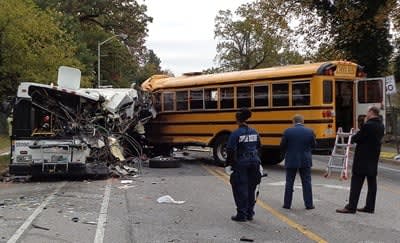
In a 2016 crash, school bus driver Glenn Chappell was killed when his bus collided with a public transit bus. Five other people were killed.
Photo Courtesy Maryland Transportation Authority Police
Christensen highlighted a handful of fatal bus crashes involving drivers he deemed unfit. In a 2016 Baltimore crash, 67-year-old Glenn Chappell was killed when the school bus he was driving collided with a public transit bus. The driver of the other bus and four passengers also were killed. An NTSB report revealed the driver had a history of seizures, diabetes, and hypertension. Chappell also was involved in at least 12 crashes in the previous five years.
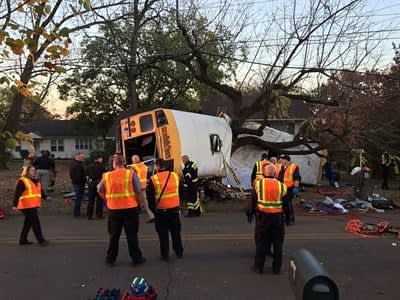
In a 2016 crash, school bus driver Johnthony Walker flipped a bus and crashed it into a tree. Six students were killed.
Photo Courtesy Chattanooga Fire Department
In a 2016 Chattanooga, Tenn. crash, 24-year-old school bus driver Johnthony Walker flipped the bus and smashed into a tree, killing six children. Prosecutors alleged that Walker was on the phone at the time of the crash, and was speeding. He was charged in connection to the crash. School records revealed there were numerous complaints against Walker for alleged reckless driving practices. He also was in a minor accident several months prior, sideswiping a car after he failed to yield.
In 2018, a Mount Olive, N.J., crash, 77-year-old school bus driver Hudy Muldrow, Sr. collided with a truck when he attempted to cross lanes of traffic to make a U-turn after missing an exit. A teacher and student onboard the bus were killed. Muldrow was indicted in the crash. It was later discovered Muldrow had 14 license suspensions on his records, with the most recent one happening just six months before the crash. Muldrow had also been cited a handful of times for speeding, received two tickets, and was involved in at least one other crash previously.
As a result of the Iowa crash, the NTSB made 10 safety recommendations to prevent similar tragedies. Four were related to drivers, one targeted students, and five referenced school bus manufacturing standards.
One of the major recommendations suggested that 44 states, the District of Columbia, and Puerto Rico revise requirements so that all school bus drivers must pass a physical performance test upon hiring, and at least once a year after that. The recommendation also suggested the test be performed when a driver’s physical condition changes in a way that could affect their ability to perform duties, including helping passengers evacuate a bus.
Based on a recent survey Christensen conducted, it appeared very few states implemented the recommendation. Out of 24 survey responses he received, only one state now requires a physical performance test. The Iowa Department of Education currently allows local districts to determine whether to require it.
The NTSB is currently in communication with 21 states about their responses to its recommendation. The agency has deemed 15 of those states’ responses as “acceptable.” It lists six states’ responses as “unacceptable.” It has not received responses from 25 states. Click here to see each states’ responses.
Christensen said most states’ physical performance tests are modeled after the test implemented for New York school bus drivers. He said in order to avoid discrimination, the test needs to be required for all drivers—regardless of weight or age. In order to best implement a physical performance test for drivers, Christensen suggested announcing the new requirement several months in advance, to allow drivers time to prepare.
“We certainly have made some progress in our driver fitness, [but] we've got a long ways to go,” said Christensen.
More Safety

How to Build a Better School Bus Driver Training Program
Is it time to strengthen your driver training? Here’s how to pick the right talent and improve recruitment, retention, and safety. This video is brought to you by IC Bus.
Read More →
Recent School Bus Accidents Leave 2 Dead, 2 Injured
Four school bus crashes in Florida, Illinois, and Georgia highlight risks in transportation lots, at bus stops, and during student loading and unloading.
Read More →
Sponsored•September 8, 2026
When Every Second Matters, Clarity Keeps Routes Moving
From routine delays to urgent incidents, strong communication practices help drivers, dispatchers, schools, and families respond with confidence.
Read More →

What Happens When a School Bus Catches Fire — and What Can Help
School bus fires are rare but can be devastating. Learn how advances in fire suppression and asset protection help fleets detect fires earlier, reduce damage, and improve safety.
Read More →
Geotab Launches Tool to Help Fleets Investigate Road Incidents
Geotab Investigations combines telematics data, video, documents, and other evidence to help fleets reconstruct incidents, resolve claims, and determine what happened.
Read More →
Texas Sixth Grader Wins 2026 National School Bus Safety Poster Contest
Sai Darshana Yekolu of Moseley Middle School in Prosper, Texas, was named the newest winner for her artwork, bringing the theme of “Safe Rides, Everyday Heroes” to life.
Read More →
Sponsored•August 27, 2026
Doing More With Less: How Transportation Directors Can Prioritize Safety Amid Budget Uncertainty
With diesel prices soaring and nearly one-third of transportation directors expecting budget cuts, maintaining student safety has never been more challenging. Download this guide to learn how leading districts are prioritizing risk, funding critical safety technology, and building stronger budget cases with data.
Read More →
Walton County Schools Adds Gatekeeper Stop-Arm Enforcement System
The Florida district will deploy Gatekeeper’s updated Student Protector technology, which now incorporates AI to improve video evidence.
Read More →
How To Build a More Secure School Bus Yard During and After Hours
As thefts and overnight security threats continue, school transportation leaders are combining stronger operational practices with AI-enabled surveillance to better protect buses, facilities, and staff.
Read More →
FMCSA Names New Chief Safety Officer: What School Bus Operators Should Know
Steve Dowling is set to lead the federal agency's efforts to advance commercial motor vehicle safety and reduce crashes, fatalities, and injuries on the nation's roadways.
Read More →