




NTSB: School Bus Driver in Baltimore Crash Had History of Seizures
A preliminary report finds that Glenn Chappell had hypertension, diabetes, and seizures, and in the past five years had been involved in at least 12 crashes or incidents while driving a school bus or personal vehicle.

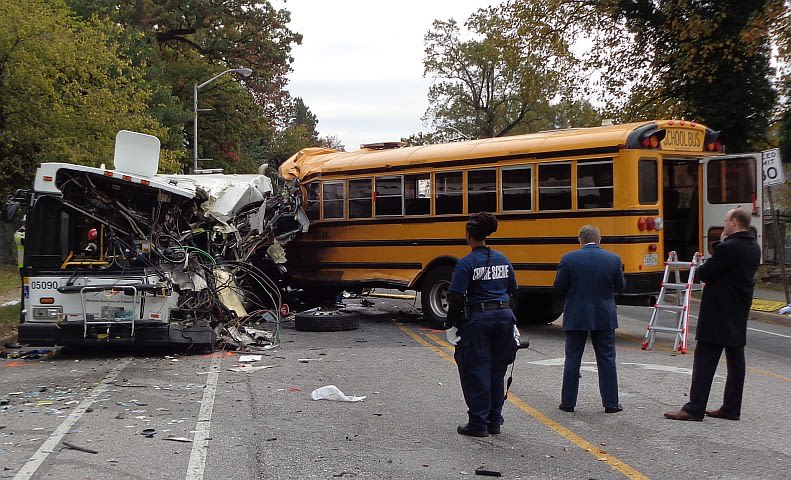
A preliminary NTSB report on the Nov. 1 school bus and transit bus crash in Baltimore found that school bus driver Glenn Chappell had a history of hypertension, diabetes, and seizures. Photo courtesy Maryland Transportation Authority Police
A preliminary NTSB report on the Nov. 1 school bus and transit bus crash in Baltimore found that school bus driver Glenn Chappell had a history of hypertension, diabetes, and seizures. Photo courtesy Maryland Transportation Authority Police
BALTIMORE — The National Transportation Safety Board’s (NTSB’s) preliminary report, released on Wednesday, has found that the school bus driver in the November crash of a school bus and a transit bus here had a history of seizures, diabetes, and hypertension.
The school bus driver, Glenn Chappell, was driving for AA Affordable Transportation on a contracted route for Baltimore City Public Schools. Chappell was driving east on Frederick Ave. when he struck a Ford Mustang, according to a news release from the NTSB. Chappell continued traveling east, and entered the westbound travel lane, where the school bus collided with a Maryland Transit Administration (MTA) bus. The impact continued along the left side of the transit bus and terminated near its rear axle.
The school bus was occupied only by Chappell and an aide. The MTA bus was occupied by the driver and 13 passengers. The drivers of both buses and four transit bus passengers were killed, and seven other passengers were seriously injured. The aide and two MTA bus passengers sustained minor injuries, as did the driver of the Mustang.
The preliminary report states that video from area surveillance cameras and the MTA bus’ onboard video system indicate that Chappell was traveling approximately 57 mph just before he struck the Mustang. The onboard video system captured the crash sequence. The airbag control module on the Mustang recorded that it was traveling approximately 16 mph when it was struck from behind.
After colliding with the Mustang, the school bus continued more than 800 feet and was traveling about 45 mph before impacting the MTA bus, which was traveling about 39 mph. The posted speed limit in the area was 30 mph.
Preliminary information suggests neither bus driver was using a cell phone at the time of the crash, according to the NTSB news release. Both bus drivers reported for work earlier that day and were not operating beyond hours-of-service regulations. Mechanical inspections were completed on both buses and no mechanical defects were found.
Investigators found that Chappell had a history of hypertension, diabetes, and seizures, and in the past five years, had been involved in at least 12 crashes or incidents while operating a school bus or personal vehicle. Reports from a number of these cases described seizure-like episodes. Paramedics were called to AA Affordable Transportation one week before the crash because Chappell experienced a medical emergency that witnesses described as a seizure, The Baltimore Sun reports.
As previously reported, Chappell held a current medical certificate at the time of the crash, but it was not on file with the Maryland Motor Vehicle Administration (MMVA). As a result, the MMVA notified Chappell about two months before the crash that he was no longer authorized to drive a school bus, and could lose his license unless he provided documentation that a doctor had cleared him to drive. However, the MMVA hadn’t informed the school system that Chappell had lost his driving privileges, and he continued to transport students. The state did not revoke Chappell’s CDL until the day after the crash, which is when school officials found out about the revocation.
All aspects of the crash remain under investigation by the NTSB and the Baltimore Police as the NTSB works to determine the probable cause of the crash. Analysis of the accident facts, along with conclusions and a determination of probable cause, will come at a later date when the final report on the investigation is completed.
View the NTSB's preliminary report here.
More Safety

How To Build a More Secure School Bus Yard During and After Hours
As thefts and overnight security threats continue, school transportation leaders are combining stronger operational practices with AI-enabled surveillance to better protect buses, facilities, and staff.
Read More →
FMCSA Names New Chief Safety Officer: What School Bus Operators Should Know
Steve Dowling is set to lead the federal agency's efforts to advance commercial motor vehicle safety and reduce crashes, fatalities, and injuries on the nation's roadways.
Read More →
New Study Finds School Zone Speed Safety Cameras Cut Speeding Violations 97%
A Florida university's research demonstrates that Verra Mobility's automated enforcement changes driver behavior and significantly improves school zone safety.
Read More →
What Changed in DOT’s New National Roadway Safety Strategy?
The federal agency's new plan shifts its focus to safer people, roads and vehicles, with a new three-pronged approach instead of five. One outlined action even addresses a key industry concern around illegal school bus passing.
Read More →
Are Autonomous Vehicles Ready to Safely Navigate School Bus Stops?
NHTSA is accelerating autonomous vehicle deployment through new safety standards and commercial approvals. See why school transportation leaders are watching.
Read More →
NFL Star Lomas Brown Kicks Off New Illegal School Bus Passing PSA
Just in time for the back-to-school season, the former Detroit Lions offensive tackle took time to record a video encouraging motorists to slow down around school buses.
Read More →
How Two Texas Districts Built Award-Winning Safety Programs
Learn how Prosper ISD and Rockwall ISD earned National Safety Council honors through hands-on training, safety culture, and strategies that reduced transportation incidents.
Read More →
NHTSA Releases 10-Year Review of Fatal School Bus Crashes
The latest federal analysis reinforces the safety of school buses while identifying where school-age pedestrians and other motorists remain most at risk.
Read More →
2026 NASDPTS Survey: Data Shows Further Reduction of Illegal Passing
New data is in! School bus stop-arm passings are down to 38.4 million violations per year, about a 2.3% decrease from last school year — but passings on the right side of the bus are higher than ever.
Read More →
Another School Bus Fatality Reported in Monsey, New York
A 7-year-old girl died after being struck by a school bus in Rockland County, New York while crossing the street. Here's what we know.
Read More →